

Key Takeaways
- Real estate content infrastructure long term ranking rewards firms that start now, since the pages ranking best today are typically years old, not weeks old.
- Ahrefs’ landmark study found only 5.7% of newly published pages reach Google’s top 10 within a year — the average top-10 page is over two years old.
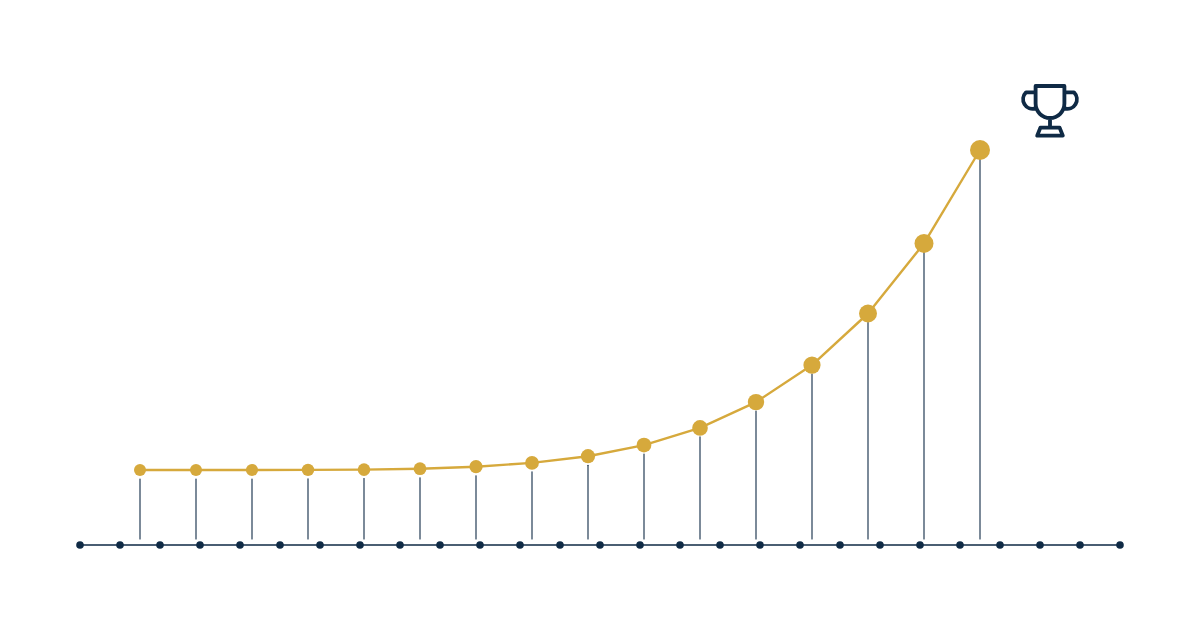
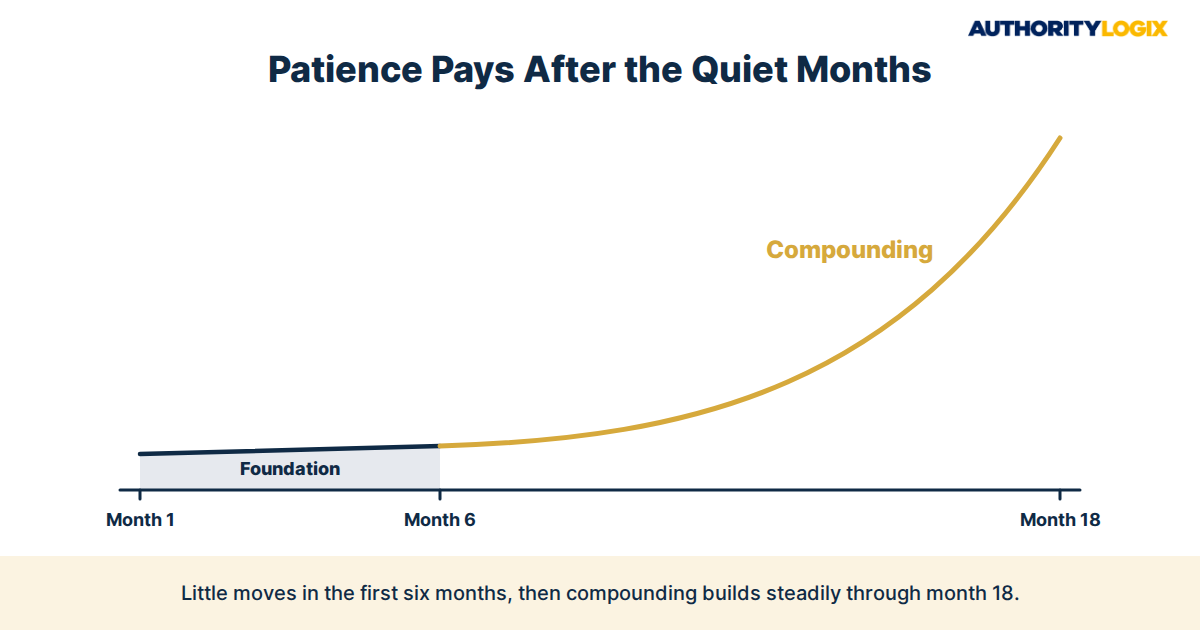
- The first six months of building content infrastructure feel like almost nothing is happening, which is exactly when most firms give up.
- Months six through eighteen is where compounding actually begins, and it happens quietly enough that firms without a plan often miss the shift entirely.
- A firm that starts today has an 18-month head start over one that waits even six more months, and that gap only widens as competitors delay further.
- Firms that treat the invisible early months as wasted time consistently quit right before the investment starts paying off.
Table of Contents
Real estate content infrastructure long term ranking rewards patience in a way that almost nothing else in real estate marketing does. Two firms could start building the exact same content today, and eighteen months from now, one of them could be dominating local search while the other quit somewhere around month five — and that patience is exactly what most firms underestimate before they start.
This is not a claim that results take eighteen months to begin. It is a claim that the real, durable advantage — the kind competitors cannot easily copy — only becomes visible around that mark, and firms that understand this timeline in advance behave very differently than firms who expect results in month two. Real estate content infrastructure long term ranking is fundamentally a patience advantage as much as it is a content advantage.
Why Real Estate Content Infrastructure Long Term Ranking Takes 18 Months, Not 18 Days
Search engines reward consistency and depth accumulated over time, not a single burst of publishing activity. A firm that publishes thirty pieces of content in one frantic month and then stops is working against the same fundamental pattern that rewards firms publishing steadily for a year and a half, even if the total volume of content ends up roughly comparable between the two approaches. Real estate content infrastructure long term ranking simply does not reward intensity concentrated into a short window the way it rewards sustained effort spread evenly across many consecutive months.
The content systems that support this kind of long-term investment need to be built for sustained output, not a sprint — real estate content infrastructure long term ranking simply does not respond to short bursts of intense effort followed by silence. A system built for the long haul survives the inevitable slow months in a way an ad hoc effort rarely does.
The same patience requirement shows up in other growth channels too, something covered directly in the referral ceiling resource — durable growth infrastructure of any kind takes time to mature, and content is no exception to that rule. Firms that expect an instant fix from any of these growth channels are working from the wrong set of assumptions entirely.
None of this means the early months are wasted. It means the value being built during those months is largely invisible until enough of it accumulates to actually move rankings in a noticeable way. Firms that understand this distinction in advance are far less likely to abandon the effort right before it starts paying off, and setting that expectation clearly at the outset is often the single most valuable thing a firm can do before publishing anything at all.
The Real Estate Growth Playbook covers the full infrastructure a long-term content strategy is built on.
Broker SEO 18 Month Compound: What Ahrefs’ Data Actually Shows
A broker SEO 18 month compound strategy is grounded in hard data, not optimism, which matters because so much of the advice circulating in real estate marketing is grounded in neither. Ahrefs’ landmark study of two million pages found that only 5.7% of newly published pages reach Google’s top 10 within a year, and the average page holding a top-10 position is over two years old. That data is sobering, but it also explains exactly why a real estate content infrastructure long term ranking strategy consistently beats a short-term one — the pages winning today simply had more time to accumulate the signals search engines reward, signals that cannot be manufactured overnight no matter the budget.
The First Six Months Feel Like Nothing Is Happening
Technical setup, initial content publishing, and search engine indexing dominate the first several months, and almost none of it produces visible ranking movement. A broker SEO 18 month compound strategy has to survive this stretch, since the temptation to abandon the effort is strongest right when the underlying foundation is actually being built. This early, invisible phase is precisely where real estate content infrastructure long term ranking either takes root or gets abandoned before it has a real chance to work, and most firms never realize how close they were to the turning point when they gave up.
Months Six Through Eighteen Is Where Real Estate Content Infrastructure Long Term Ranking Actually Compounds
Long-tail keywords typically start showing movement first, followed by broader, more competitive terms as accumulated content and internal linking reinforce each other. This is the stretch where a broker SEO 18 month compound strategy actually starts to feel like it is working, often faster than the earlier months suggested was possible. Real estate content infrastructure long term ranking tends to accelerate noticeably during this window, rewarding the firms that stayed consistent through the quieter months before it.
| Timeframe | What Typically Happens |
|---|---|
| Months 1 to 6 | Foundation building, little visible movement |
| Months 6 to 18 | Compounding accelerates, results become visible |
Agent Content Investment 18 Months: What to Build During the Wait
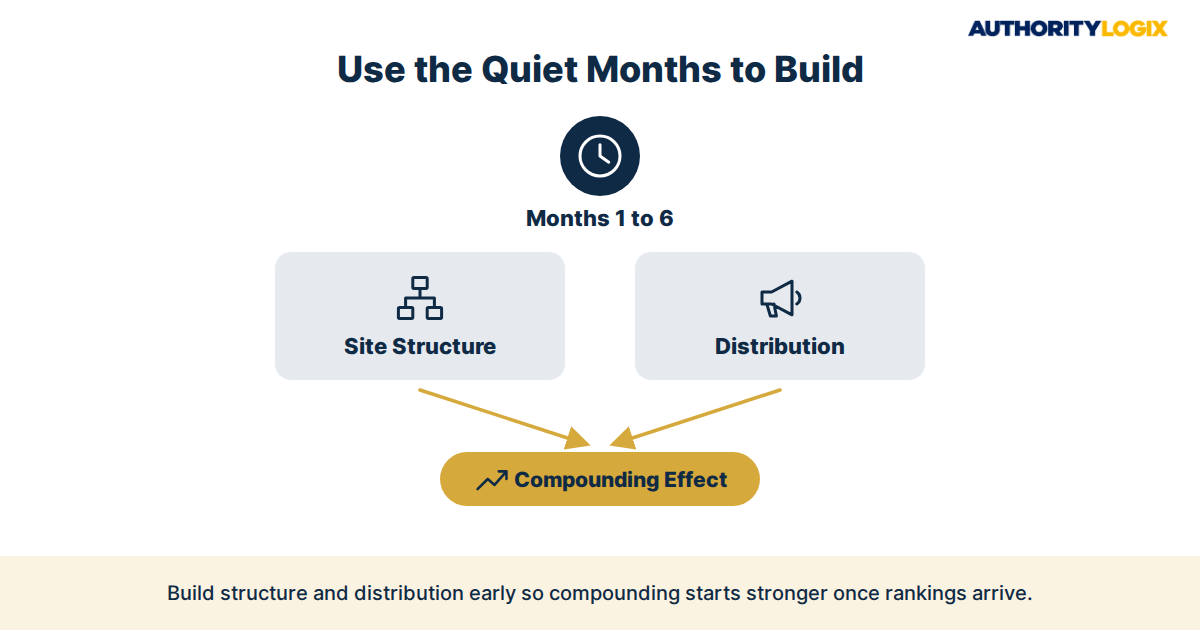
Agent content investment 18 months in the making, in practice, should not sit idle during the invisible early stretch — this is exactly the window to build the structural elements that make the eventual compounding effect stronger once it begins. Wasting this window on inaction is one of the costliest mistakes a firm can make during the entire process, since the months lost to inaction cannot be recovered later at any price.
A site organized well from the start compounds faster once content accumulates, a principle detailed in the website structure guide — agent content investment 18 months into a poorly structured site produces weaker results than the identical content published inside a well-organized one. Fixing structure after the fact costs far more than building it correctly from the very first month.
Reach beyond a firm’s own site also compounds over this same period, something covered in the authority distribution layer — content shared consistently through outside channels builds recognition well before organic rankings alone would produce equivalent visibility. That earlier recognition often bridges the gap during the months when organic traffic alone still feels slow.
Real Estate SEO Compounding Long Term: Why Early Movers Win
Real estate SEO compounding long term creates a widening gap between firms that started eighteen months ago and firms only starting today. The firm with an eighteen-month head start is not just eighteen months ahead — it has content and links that have had time to mature and reinforce one another in ways brand-new content simply cannot replicate immediately. Real estate content infrastructure long term ranking widens this gap every additional month a competitor delays, making an early start progressively more valuable over time.
Organizing accumulated content into a coherent structure amplifies this advantage further, an idea developed fully in the pillar page strategy — real estate SEO compounding long term works best when the underlying content is genuinely connected, not scattered. Scattered content still accumulates some value over time, but nowhere near as much as content organized to reinforce itself.
Building the 18-Month Plan: Where to Start
Map out a realistic publishing cadence a firm can actually sustain for the full eighteen months, not an aggressive pace that burns out by month four. Consistency over the full period matters more than intensity in any single month. Real estate content infrastructure long term ranking is far more forgiving of a modest, sustainable pace than an ambitious one that collapses under its own weight after a few months.
Organizing that plan around a genuinely useful structure, rather than a scattered list of topics, is where the educational hub system does its most important work — a firm publishing consistently but without an underlying structure still leaves significant value on the table. Consistency and structure need to be built together, not treated as separate priorities to address one at a time.
Credibility signals should be built alongside the content itself from day one, not added retroactively once the eighteen-month mark approaches. The authority guide covers exactly what those signals look like in practice.
Not sure how far along your current content timeline actually is.
What Most Firms Get Wrong About Real Estate Content Infrastructure Long Term Ranking
They quit during the invisible early months
Most firms abandon a content investment somewhere between month three and month six, precisely when the foundation is finally in place for the compounding effect to begin. Real estate content infrastructure long term ranking punishes this timing more than almost any other mistake a firm can make, since the investment already made up to that point is essentially wasted the moment publishing stops.
Earned recognition compounds this same way, a pattern documented in the backlink strategy — a firm that quits early loses the compounding benefit of both content and links at the exact same moment. That double loss is significantly more costly than either one alone, since the two effects compound together in exactly the way a firm was hoping to benefit from.
They treat 18 months as a deadline instead of a starting point
Reaching month eighteen is not the finish line — it is closer to the point where the real advantage finally becomes visible and the investment starts genuinely paying for itself, with real estate content infrastructure long term ranking continuing to strengthen for years after that point if the underlying effort continues. The lead generation infrastructure built during those eighteen months keeps producing results well beyond that mark, not just up to it.
Where This Fits Inside the Full Growth System
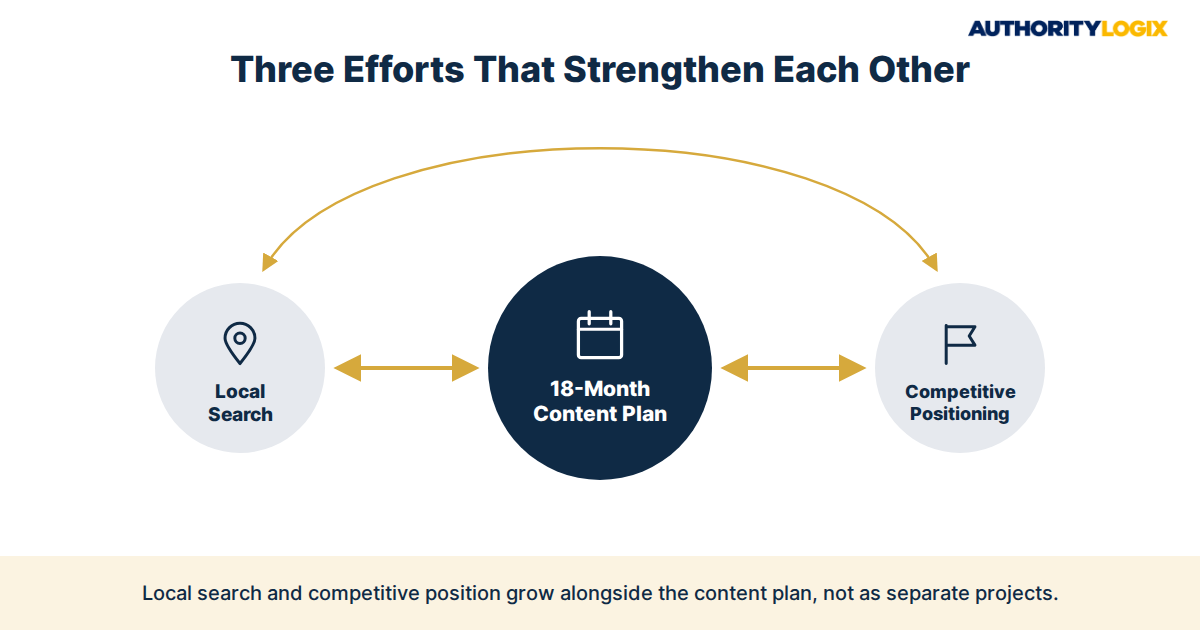
A long-term content investment does not operate in isolation — its results depend heavily on local search visibility, competitive positioning, and everything else a firm builds alongside it. Real estate content infrastructure long term ranking succeeds or fails largely on these surrounding factors, not the content in isolation.
Visibility built during this eighteen-month window shows up directly in the local search statistics — real estate content infrastructure long term ranking and local search performance reinforce each other rather than functioning as separate initiatives. Treating them as unrelated efforts leaves meaningful value unclaimed on both sides.
Competing against national portals over this same period is addressed in the local SEO comparison — those portals are making the identical long-term investment, which makes an early start even more valuable for an independent firm trying to compete. Waiting to start only hands those portals a longer uncontested runway.
Questions Firm Owners Ask About the Long Timeline
How this timeline gets tracked and measured in practice is covered on the our approach page, but most firm owners are weighing a few specific, practical questions before committing to an 18-month plan.
Will we see any results before 18 months?
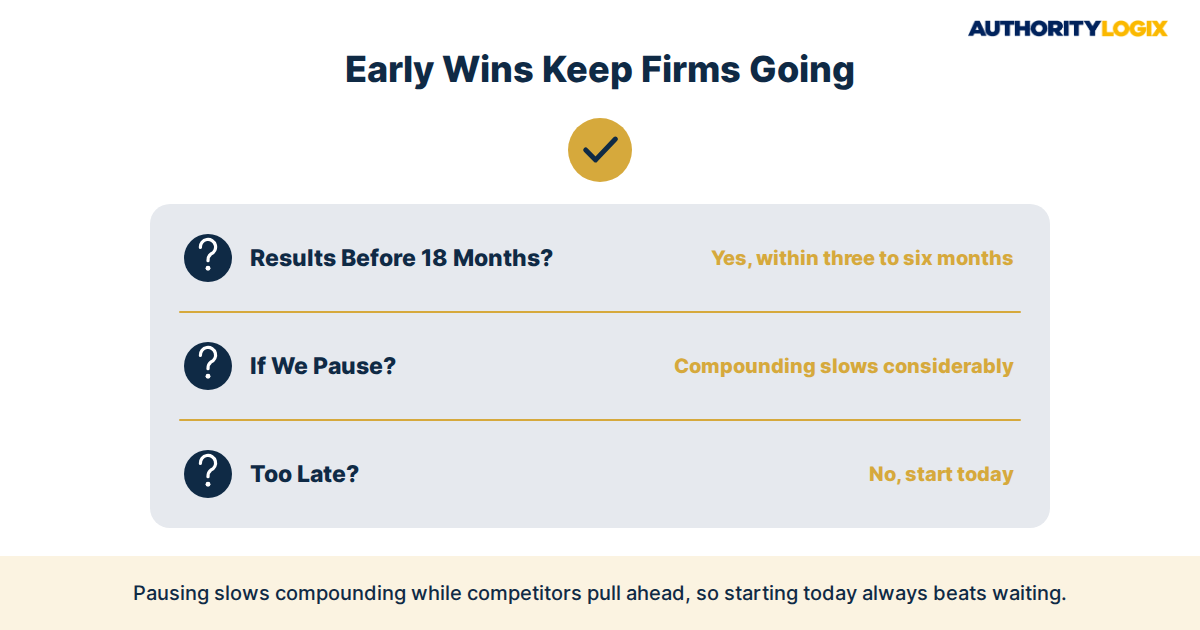
Yes — long-tail, less competitive keywords typically show movement well before then, often within three to six months. The eighteen-month mark is where broader, more competitive terms and the full compounding effect of real estate content infrastructure long term ranking become fully visible, and those early wins are usually enough to keep a firm motivated through the slower middle stretch.
What happens to real estate content infrastructure long term ranking if a firm pauses the effort partway through?
A pause does not erase existing progress, but it does slow the compounding effect considerably, and competitors who kept publishing continue pulling ahead during that gap, widening the exact advantage real estate content infrastructure long term ranking is meant to build in the first place. Resuming later is always possible, but the lost months rarely get fully recovered, since competitors used that same window to extend their own head start.
Is it too late to start building real estate content infrastructure long term ranking if competitors already have a head start?
No — every month spent waiting only widens that gap further. Starting today is always better than starting later, regardless of how far ahead competitors currently appear to be, since real estate content infrastructure long term ranking rewards the firm that started first far more than it punishes the firm that started a few months behind. The why us page covers why AuthorityLogix treats an early start as one of the highest-value decisions a firm can make, regardless of current competitive position.
Ready to start the 18-month content build that changes where your firm ranks?
Building Your 18-Month Plan: Where to Start
Commit to a publishing cadence today, however modest, and treat month six as a checkpoint rather than a deadline for results, since real estate content infrastructure long term ranking is measured in months and years, not weeks. Real estate content infrastructure long term ranking rewards firms that measure progress against the right timeline instead of an unrealistic one.
How this plan connects to the broader systems a firm needs to build is outlined on the what we do page. Most firms already have the knowledge and track record needed — the missing piece is almost always the commitment to the full eighteen-month timeline, rather than any gap in expertise, budget, or market opportunity.
Every other system covered across this resource library — structure, distribution, local search — connects directly to this same eighteen-month timeline, a relationship made explicit in the industry hub. The firms that start today will be the ones looking back at this exact point eighteen months from now, wondering why they waited as long as they did rather than starting the moment the decision first crossed their mind.