


Key Takeaways
- A real estate pillar page strategy organizes scattered blog posts into a hub-and-spoke structure that signals topical authority to search engines.
- HubSpot’s own research found that more internal links between related topic pages were associated with higher search rankings and more impressions.
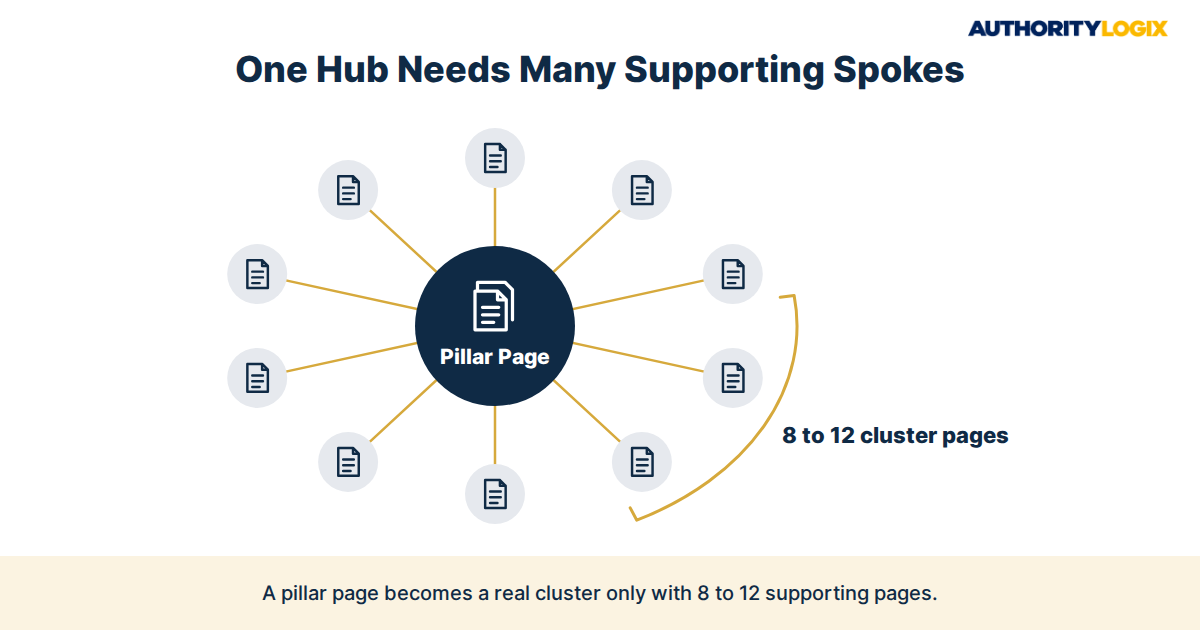
- Most pillar pages need 8 to 12 supporting cluster pages to function as a real topic cluster, not just a single long article.
- Internal linking is what actually makes the cluster work — a pillar page with no links to supporting content is just a long article, not a cluster.
- Real estate firms need separate pillar pages for distinct topics like buyer content, seller content, and investment content, rather than one pillar trying to cover everything.
- Most firms build the pillar page and stop, never adding the supporting cluster content that actually makes the structure pay off.
Table of Contents
A real estate pillar page strategy turns a scattered pile of blog posts into a structure search engines can actually understand. Most real estate sites publish content one post at a time with no organizing framework behind it — a real estate pillar page strategy fixes that by grouping related content around one comprehensive hub page, connected by deliberate internal links that signal to Google exactly how the pieces relate to each other.
This is not simply a matter of writing one longer article. A real estate pillar page strategy only works when the pillar page is genuinely supported by a network of cluster content beneath it — the pillar alone, without that supporting structure, produces almost none of the ranking benefit a genuine real estate pillar page strategy is known for.
Why a Real Estate Pillar Page Strategy Beats Scattered Blog Posts
A blog with fifty unconnected posts on related topics sends Google a much weaker authority signal than the same fifty posts organized into two or three clear pillar-and-cluster structures. Search engines increasingly evaluate topical authority across an entire subject area, not just the strength of any single page in isolation. A real estate pillar page strategy is what actually converts scattered coverage into that kind of recognized topical authority.
The content systems that produce a firm’s blog content are exactly what a real estate pillar page strategy needs to organize — the content itself does not need to change, but how it connects to a pillar page and to each other absolutely does. Reorganizing existing content is almost always faster than producing an equivalent volume of brand new material.
This reorganization does not require abandoning an existing publishing habit. Most firms already have enough scattered content to build their first pillar-and-cluster structure without writing a single new article — the work is almost entirely about grouping and linking what already exists. A real estate pillar page strategy built this way costs far less than it initially appears to, since the heaviest lift is organizational rather than creative.
The content calendar ideas a firm generates going forward should also be planned with this structure in mind — a new topic idea should always have an obvious pillar it belongs under before it ever gets written. A real estate pillar page strategy loses its organizing value the moment new content starts getting published without a defined home.
The Real Estate Content System Blueprint covers the full infrastructure a pillar page strategy is built on.
Investment Firm Topic Cluster SEO: How the Hub-and-Spoke Model Works
HubSpot’s own research found that more internal links between related topic pages were associated with higher search rankings and more impressions. Investment firm topic cluster SEO follows the same hub-and-spoke logic used across every industry — one comprehensive pillar page covers a broad topic, and a network of supporting cluster pages each address a specific subtopic, with internal links tying the entire structure together in both directions. Investment firm topic cluster SEO built this way earns authority signals no isolated article could produce on its own.
What Makes a Page a Pillar, Not Just a Long Article
A genuine pillar page is broad enough to serve as an umbrella for twenty or more supporting posts, and comprehensive enough to answer the core question a reader searching that broad topic actually has. A long article that never links out to supporting content, no matter how thorough, is not functioning as a real pillar page — it is simply a long article sitting in isolation. A real estate pillar page strategy depends entirely on this distinction between a genuine hub and an unconnected long-form post.
How Many Cluster Pages a Real Estate Pillar Page Strategy Actually Needs
Most successful implementations use somewhere between eight and twelve supporting cluster pages per pillar, though ambitious programs targeting very broad topics sometimes scale to twenty or thirty over time. A real estate pillar page strategy with only two or three cluster pages beneath a pillar has not yet reached the density needed to produce a meaningful ranking signal. Reaching that eight-to-twelve range should be treated as a milestone, not an optional stretch goal.
| Element | Typical Range |
|---|---|
| Pillar page length | 2,000 to 4,000 words |
| Cluster pages per pillar | 8 to 12 (up to 20-30 for broad topics) |
The website structure that houses this entire hub-and-spoke model matters just as much as the content itself — a pillar page buried deep in a confusing site hierarchy struggles to accumulate the authority the structure is designed to build, no matter how well the internal linking within the cluster is executed. Structure and internal linking have to work together for a real estate pillar page strategy to reach its full potential.
Broker Content Pillar Cluster Links That Actually Signal Authority
Broker content pillar cluster links need to run in both directions to work properly — every cluster page should link up to its pillar, and the pillar page should link down to every cluster page beneath it. A cluster page that links to its pillar but receives no link back from that pillar is only getting half the authority-signaling benefit the structure is supposed to provide. Checking this bidirectional requirement should be a standard step whenever a firm reviews its own real estate pillar page strategy.
Anchor text matters here too. Broker content pillar cluster links that use descriptive, topic-relevant anchor text — rather than generic phrases like “click here” — give search engines a much clearer signal about how the linked pages relate to each other within the broader topic. Small wording choices like this compound across dozens of links into a meaningfully stronger signal for the whole real estate pillar page strategy.
The lead generation infrastructure built into a pillar page should feel like a natural extension of the content, not an interruption — a well-built pillar page earns the right to ask for contact information precisely because it has already delivered real, comprehensive value on the broad topic. A pillar page that asks for an email address before delivering anything of substance rarely converts as well as one that earns the request first.
Cluster pages that link laterally to each other, not just up to the pillar, add an additional layer of connective tissue that strengthens the overall cluster. This lateral linking is optional but valuable — it gives readers additional relevant paths through the content and reinforces the topical relationships search engines are evaluating.
The neighborhood landing pages that many real estate firms already publish are a natural fit for cluster content beneath a location-focused pillar page, giving geography-specific content an obvious, organized home within the broader structure. Firms that already publish neighborhood content are often closer to a working pillar structure than they realize.

Real Estate Site Pillar Page Architecture by Category
Real estate site pillar page architecture works best when a firm builds separate pillars for genuinely distinct audiences rather than trying to force buyers, sellers, and investors under one overly broad umbrella page. A pillar page attempting to serve all three audiences at once usually ends up too shallow to satisfy any of them fully. A real estate pillar page strategy segmented by audience consistently outperforms one built around a single all-purpose hub.
A firm working with real estate investors specifically needs its own dedicated pillar structure, separate from buyer and seller content entirely, since the underlying questions and search intent are fundamentally different. Mixing investor content into a buyer-focused pillar dilutes both audiences rather than serving either one well.
The investor pipeline content that attracts real estate investors fits naturally as its own pillar topic, with cluster pages covering market intelligence, deal lessons, and investor education branching out beneath it. Each of those three content types can function as its own cluster page beneath the shared investor-focused pillar.
Building the First Cluster: Where to Start
Start by auditing existing content and grouping posts that already relate to a common broad topic. In most cases, a firm already has six or seven posts on a related theme, just scattered across the blog with no pillar page tying them together and no internal links connecting them. That audit alone is usually enough to reveal the first real estate pillar page strategy a firm should build.
The educational hub system is often the natural home for a firm’s first pillar-and-cluster structure, since educational content already tends to group logically around broad topics buyers and sellers are trying to understand. Starting there gives a firm the clearest, most obvious first pillar topic to build around.
Once the existing content is grouped, write the pillar page itself to explicitly introduce each cluster topic and link out to the corresponding cluster page. Then go back and add a link from each cluster page up to the new pillar, completing the bidirectional structure the model depends on.
The authority guide covers the credibility signals that make a pillar page worth the comprehensive treatment this structure demands — a shallow pillar page undermines the whole cluster no matter how well the internal linking around it is executed. Depth on the pillar itself is not optional; it is the foundation everything else in the cluster depends on.
Not sure if your existing content is ready to be organized into pillar clusters.
What Most Firms Get Wrong About Real Estate Pillar Page Strategy
They build the pillar page and never add cluster content
A real estate pillar page strategy that stops after publishing one comprehensive page never produces the ranking benefit the model is known for, because the supporting cluster content that generates the internal linking signal was never built. That single page, however well written, is functionally no different from any other standalone article on the site.
The backlink strategy that builds external authority works on a similar principle — one strong asset with nothing supporting it rarely produces the compounding results a genuinely connected structure can. Both internal and external authority reward the same underlying pattern of connected, supporting content.
They forget the links back to the pillar
Publishing cluster content without ever linking back up to the pillar page is one of the most common execution mistakes — the cluster pages exist, but the bidirectional linking structure that actually creates the authority signal never gets completed. A quick internal-link audit catches this gap faster than almost any other single check a firm can run.
The local SEO comparison covers how much this kind of structural gap costs a firm competing against portals that invest in complete, deliberate internal linking from the start. A missing link is a small technical detail with an outsized effect on the overall cluster’s performance.
Where Pillar Pages Fit Inside the Full Content System
A real estate pillar page strategy is not a standalone SEO tactic — it is the organizing layer that determines how every other piece of a firm’s content connects to everything else the firm publishes. Treating it as a one-time project rather than an ongoing organizing principle is where most implementations eventually stall.
The authority distribution layer extends a pillar page’s reach beyond the site itself — a comprehensive, well-linked pillar page is exactly the kind of resource other sites are willing to reference, which extends its authority even further than internal linking alone could. External references to a strong pillar page reinforce the same topical authority signal the internal structure was already building.
That extended reach compounds over time in ways that are difficult to reverse-engineer after the fact, which is exactly why the underlying pillar-and-cluster structure needs to be right from the beginning. Fixing a poorly structured cluster later is possible, but it takes considerably more effort than building it correctly the first time.
The growth playbook treats a real estate pillar page strategy as permanent infrastructure — every new cluster page added strengthens the entire structure rather than existing as an isolated, disconnected asset. That compounding growth is the primary advantage this model holds over publishing unconnected content indefinitely.

Questions Firm Owners Ask About Pillar Pages
The our approach page covers how a pillar strategy gets evaluated during a content audit, but most firm owners are weighing a few specific, practical questions before committing to build one.
Do we need to write all new content, or can we reuse what already exists?
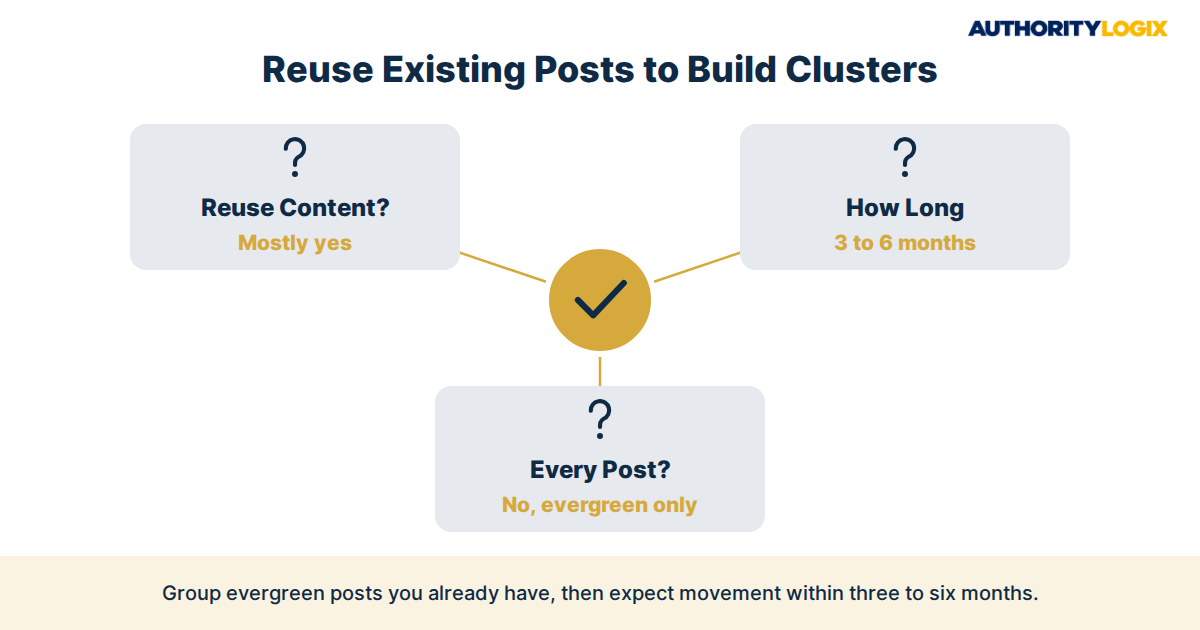
Most firms can reuse the majority of their existing content — the work is primarily about grouping related posts and adding the internal links that connect them, not rewriting everything from scratch.
How long does it take to see ranking improvements?
Most firms see measurable movement within three to six months of completing a full pillar-and-cluster structure, though the timeline depends heavily on how competitive the target topic already is. This connects directly to the topic covered in the content calendar ideas resource.
Should every blog post become part of a cluster?
No — some content genuinely stands alone, like time-sensitive market updates. The goal of a real estate pillar page strategy is organizing evergreen, topically related content, not forcing every single post into a cluster structure.
Ready to build pillar pages and topic clusters that actually rank?
Building Your First Pillar Page: Where to Start
Pick the single broadest topic a firm already has the most scattered content on, and build that into the first pillar-and-cluster structure before starting a second one. A real estate pillar page strategy that starts with the strongest existing content produces a working template faster than trying to build several clusters simultaneously from scratch.
The what we do page outlines how this first pillar structure fits into the broader content system a firm is building. That first structure becomes the template every subsequent pillar and cluster gets built from.
None of this requires specialized tools or an outside content team to begin. A spreadsheet listing existing posts, grouped by broad theme, is often enough to identify the first pillar candidate.
Most firms already have the content and the topic knowledge needed to start a real estate pillar page strategy. The why us page covers why AuthorityLogix treats this reorganization work as one of the most valuable projects a firm can undertake, precisely because so much of the raw material already exists and simply needs the right structure connecting it together.