


Key Takeaways
- A real estate firm scale single to multi agent move breaks brand authority when the market stops seeing one expert and starts seeing several unconnected names.
- Per NAR’s 2026 Member Profile, REALTOR teams typically completed 31 transaction sides in 2025; the typical REALTOR completed 9.
- Repeat clients (28%) and past-client referrals (22%) drove much of the typical REALTOR’s 2025 business, per NAR, so that base must belong to the firm.
- Google treats real estate agents as individual practitioners, so a team needs a deliberate firm and agent profile plan.
- Content standards, shared publishing, and brand-first lead routing keep new agents building the firm’s authority.
- A real estate firm scale single to multi agent plan is an infrastructure decision, and some agents should stay solo.
Table of Contents
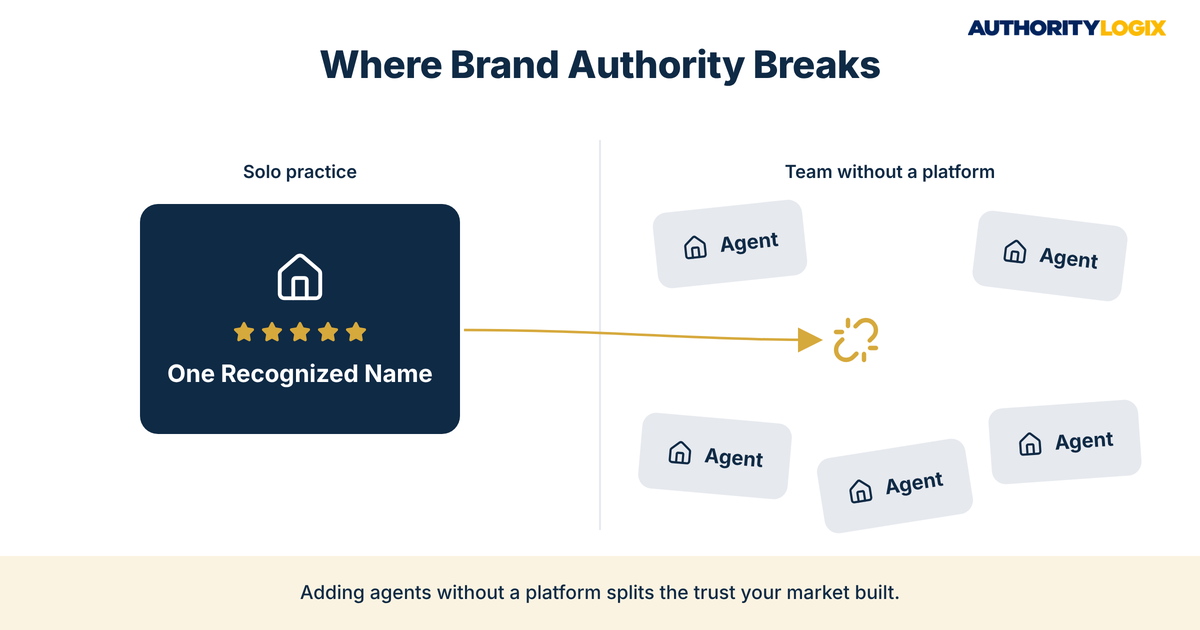
A real estate firm scale single to multi agent move is where many strong solo careers quietly lose their market position. You spent years becoming the name past clients recommend. Then you add three agents, and the market sees separate names, separate profiles, and separate messages with no clear tie to the reputation you built. Our RE industry hub starts from that problem, because it is how credible firms become invisible right when they get bigger.
Growth is not the mistake. Treating a team as a hiring decision instead of a visibility decision is, and a real estate firm scale single to multi agent transition succeeds only when the brand is built to carry more than one name.
Real Estate Firm Scale Single to Multi Agent: Where Brand Authority Usually Breaks
In a solo practice, brand authority and personal reputation are the same asset. Every review and referral points back to one person. When a second agent joins, that line of trust splits, and unless something pulls it back together, each new agent starts building a separate reputation.
NAR’s 2026 Member Profile shows how much business rides on that trust. Repeat clients and customers made up 28% of the typical REALTOR’s business in 2025, and referrals from past clients made up another 22%. In a real estate firm scale single to multi agent move without a plan, those relationships attach to agents rather than the firm — and leave when an agent does.
Most firms miss the break because production rises at first. From the outside, though, a seller searching the firm’s name finds mismatched headshots, outdated bios, and a website that still reads like a one-person practice. That gap between internal momentum and external signal is the gap behind what we build for brokers: infrastructure that makes the market see one firm.
The breaks show up in the same four places. Together they decide whether a real estate firm scale single to multi agent build keeps its market recognition:
- A website that still describes one agent
- Search profiles with different names, photos, and categories
- Agents publishing in different voices, or not at all
- Leads routed to whoever answered first, with no source tracking
Each break is fixable once the firm treats authority as something it owns rather than something each agent carries. Expertise, proof, and trust signals are the pieces laid out in our authority framework, and a real estate firm scale single to multi agent plan decides in advance how each one transfers to a team.
The Real Estate Growth Playbook shows how a real estate firm scale single to multi agent move fits the larger system of compounding visibility.
How Does Real Estate Firm Scaling Authority Show Up in Local Search?
Local search is where real estate firm scaling authority holds or fragments in public. A seller who hears your firm’s name from a neighbor will search it, and the map results decide whether that recommendation becomes a call. A solo agent manages one profile; a team can have a dozen, each one reinforcing the firm or competing with it.
Business Profile Rules for a Real Estate Firm Scale Single to Multi Agent Move
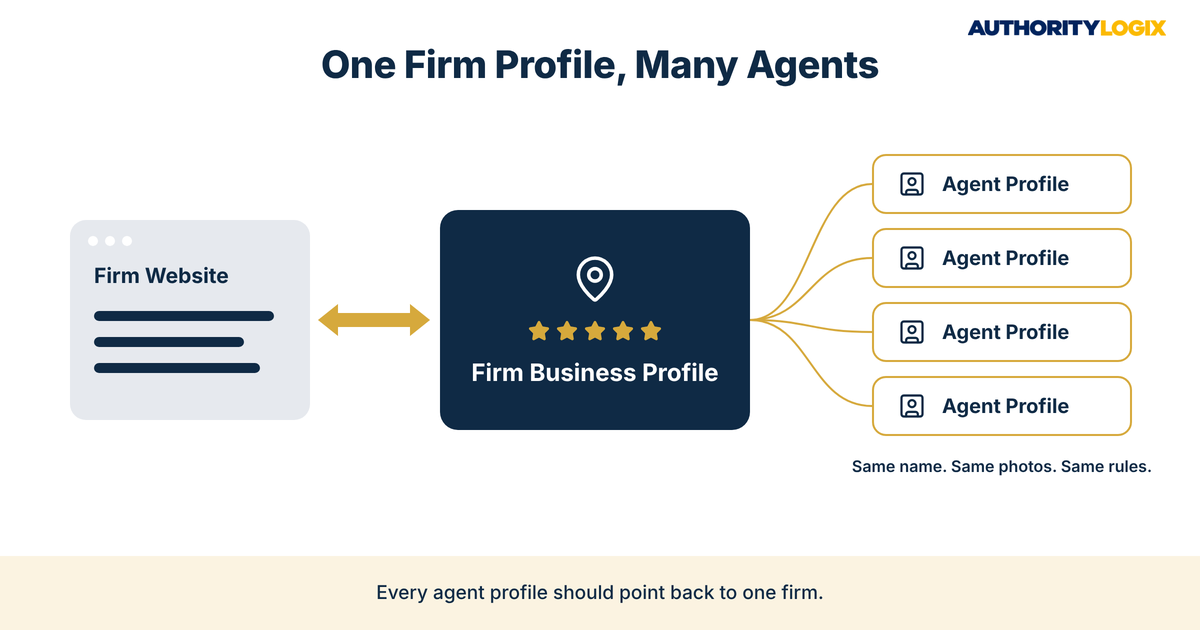
Google’s Business Profile guidelines name real estate agents as individual practitioners — public-facing professionals, typically with their own customer base. When multiple practitioners work at one location, the guidelines say the organization should create a Business Profile for that location, separate from the practitioners, and that a practitioner’s profile title should include only the practitioner’s name. The same guidelines say a practitioner shouldn’t have multiple Business Profiles to cover different specializations.
That structure works for a real estate firm scale single to multi agent plan only when it is managed on purpose. The firm’s location profile carries the brand, collects firm-level reviews, and holds the categories buyers and sellers search. Agent profiles should point back to the firm website and follow the same photo and contact rules. Google also says a business name should reflect its real-world name as consistently used, so a team that calls itself three different things works against its own rankings.
Profiles are one layer. Market pages, citations, and reviews all have to point to the same firm, which is why these profile decisions sit inside the full local visibility guide. Real estate firm scaling authority in search is the sum of those signals agreeing.
Visibility also depends on what the firm publishes. A firm that answers what buyers, sellers, and investors actually ask — closing timelines, local pricing, what a first-time investor should check — earns rankings no agent profile can win. A structured learning hub gives every agent something credible to send a prospect, and keeps that credibility on the firm’s domain during a real estate firm scale single to multi agent build.
What Content Standards Keep Every New Agent On-Brand?
Content is where a growing team drifts fastest. One agent writes market updates, another posts only listings, a third publishes nothing, and the firm’s voice becomes a mix nobody planned. A real estate firm scale single to multi agent plan needs written standards tied to a system that publishes whether or not an agent feels like writing.
The Standards Sheet Every New Agent Signs Off On
The standards do not need to be long. A one-page sheet usually covers five items:
- The firm’s market focus, stated the same way everywhere
- Voice rules: plain language, named sources, no outcome promises
- Fair Housing rules: describe areas by features and facts, never by who lives there
- One bio and headshot format for every agent page
- Which topics agents own and which the firm publishes centrally
Standards alone do not keep a team publishing. Agents follow them when a structure sits behind them — topic clusters, a review step, a schedule — which is the job of a documented content framework. Without it, a real estate firm scale single to multi agent move produces a burst of posts in month one and silence by month three.
Firms that stay on-brand separate expertise from production. Agents supply what they know — the deal that almost fell apart, the question every seller asks — and a central content engine turns it into pages in the firm’s voice. Google’s helpful content guidance strongly encourages accurate authorship information, such as bylines, so agent names stay on the work while the brand stays consistent.
Not sure your profiles and pages still read as one firm after a real estate firm scale single to multi agent move? The RE Authority Gap Assessment shows where authority has split.
Which Agent Team Growth Strategy Keeps Leads Flowing to the Brand?
An agent team growth strategy has to answer one question first: when a prospect finds the firm, where does that lead go? The routing decision determines whether the brand keeps gaining ground or each agent builds a private pipeline that leaves with them.
The production case for a team is real. Per NAR’s 2026 Member Profile, REALTOR teams typically completed 31 transaction sides and generated a median sales volume of $17.5 million in 2025, the first year the Member Profile examined team production. The same report puts the typical REALTOR at 9 transaction sides, so a real estate firm scale single to multi agent move can change the size of the business.
That production builds the brand only if the leads run through the firm. Every firm-generated inquiry — website forms, profile calls, report downloads — lands in one intake path, gets tagged by source, and is assigned by a rule the team understands. That is what a working lead capture system looks like in a real estate firm scale single to multi agent structure.
| Lead Source | Who Owns the Relationship | Why It Matters |
|---|---|---|
| Firm website and market pages | The firm, assigned to an agent | The brand created the visibility |
| Firm Business Profile | The firm, assigned by market or rotation | Calls and reviews strengthen the firm’s local ranking |
| Agent’s own sphere | The agent, logged in the firm CRM | Respects the agent’s network |
| Repeat firm clients | The firm, original agent offered first | Repeat business is the base a real estate firm scale single to multi agent plan must protect |
| Past-client referrals | The original agent, tracked by the firm | Keeps the referral personal and measurable |
Agents keep their own relationships. The firm builds a lead pipeline underneath every agent, so inbound flow from search, content, and reviews belongs to the brand that created it. An agent team growth strategy built this way gives new agents real opportunities instead of an empty calendar.
It also solves the problem that drove the growth decision. Most solo agents add a team because personal referrals stop scaling, and a team that copies the same referral model copies the same referral ceiling. Your referral network is a ceiling, not a foundation, and a team breaks through it only when the firm generates demand beyond any one person’s sphere.

How Does Broker Team Expansion Brand Authority Get Distributed Across Agents?
Broker team expansion brand authority is not divided evenly, and it should not be. The firm holds the core — website, firm profile, content library, and brand reviews. Agents hold specialized authority inside it: a market, a property type, or a service such as small multifamily sales. Distribution makes both layers visible at once.
Who Owns the Content Once the Team Grows
Ownership is the question most team agreements skip. A market guide an agent writes on the firm’s site should stay with the firm when the agent moves on, under a written byline policy. Settling that early prevents the most common dispute in a real estate firm scale single to multi agent transition.
Once ownership is clear, every agent’s expertise goes out through the same channels — the firm’s LinkedIn page, its email list, and the agent’s network, carrying both names. A shared distribution system turns one agent’s knowledge into firm-level visibility instead of a post only that agent’s contacts see.
Specialized content is where broker team expansion brand authority pays off most clearly. An agent who works with small investors can anchor a series of investor education pages — cash flow basics, what to check on a two-family listing — under the firm’s brand. The firm becomes known for that specialty, and the agent gains a body of work they could not build alone.
BKDSCR.com shows what a specialized library looks like when built on purpose: 18 pillar pages, 7 interactive investor tools, and 48 SEO-optimized blog posts in the NYC outer-borough DSCR niche, with zero paid ads. Building even part of that depth around agents’ specialties gives every new hire a credible platform on day one — the real payoff of a real estate firm scale single to multi agent plan.
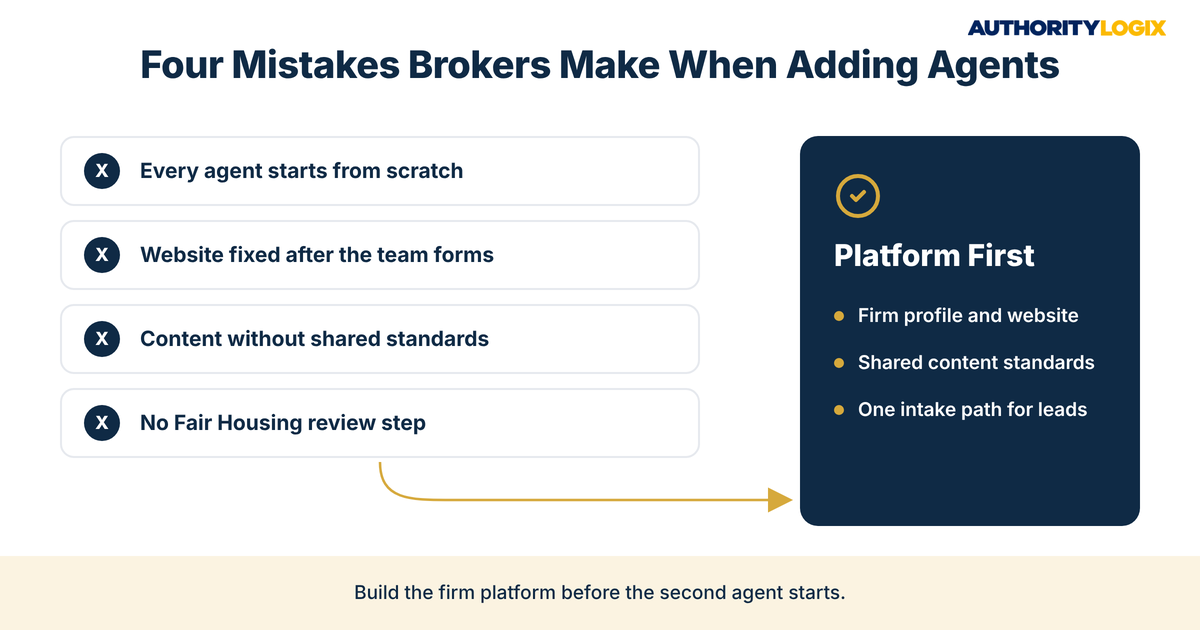
What Brokers Get Wrong in a Real Estate Firm Scale Single to Multi Agent Plan
Brokers who struggle after adding agents are rarely short on talent. They carry solo habits into a real estate firm scale single to multi agent structure that needs different rules.
Should every new agent build their own reputation from scratch?
Starting each agent from zero spreads the firm’s effort across too many small reputations. Agents should build expert positioning inside the firm’s platform — bio, specialty pages, reviews — so their visibility adds to the brand.
Can we fix the website after the team is in place?
Rebuilding after five agents join means rewriting bios, merging duplicate pages, and repairing profile links. The sequence in how we work puts the firm platform first for that reason. Agent pages added to a finished structure go in cleanly; pages bolted onto a solo site take far longer to untangle.
Is more agent content always better?
Volume without infrastructure is just noise. Ten agents posting without shared topics, standards, or a central library produce a scattered footprint that search engines and prospects struggle to read as one firm.
How long before the team’s authority catches up to the founder’s?
There is no fixed timeline, and anyone who promises one is guessing. What can be said is that a firm platform keeps gaining strength as each agent’s work is added to it, which is the logic behind long-term positioning in a local market. A real estate firm scale single to multi agent plan should be judged over years, not over its first quarter.
Do Fair Housing rules change when agents start publishing?
The rules do not change, but exposure grows with every new author. Every agent who publishes needs training on describing properties and areas by features and facts rather than by the people who live there, and a review step that catches steering language before anything goes live.
Ready to grow into a team the market still recognizes as one firm? We build the platform, standards, and lead routing that keep your brand authority intact.
When Should a Solo Agent Stay Solo?
Not every successful agent should build a team. If your business runs on a few high-trust relationships, you have no interest in managing people, or your market is narrow enough for one expert to cover, the honest answer may be to stay solo and build deeper authority. A real estate firm scale single to multi agent move adds management work, and it pays off only when the firm is ready to own the platform.
Staying solo is not standing still. A single agent can still publish market pages and earn search visibility beyond a personal network, and the topics in our research library apply at any size. A solo practice builds for depth; a team builds for coverage.
If you grow, build the platform before the second agent starts, not after the fifth. Platform first, agents second is the practical answer to why choose us over an agency that starts with ads, and it is the cheapest real estate firm scale single to multi agent order because nothing gets torn down later.
The honest assessment: most agents who build a team already have the reputation the firm needs. What breaks is the infrastructure that carries it from one person to many, and a real estate firm scale single to multi agent plan succeeds or fails on building that first.