


Key Takeaways
- Real estate investor relations content is the reporting, education and commentary that keeps capital partners informed between raises and shapes whether they reinvest.
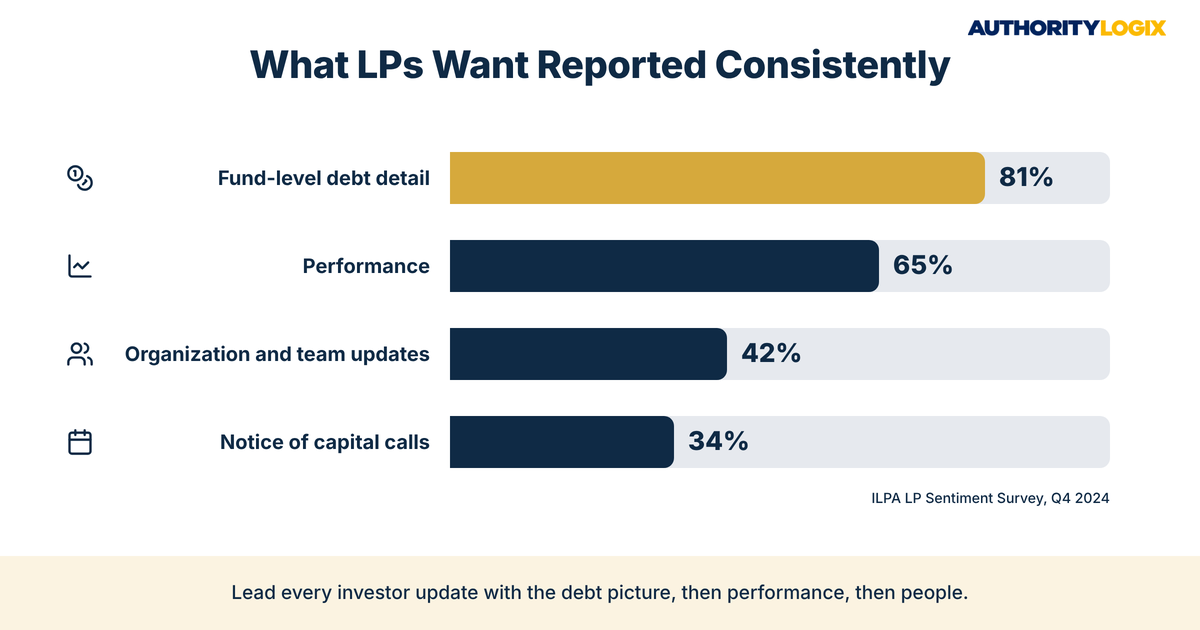
- ILPA’s inaugural LP Sentiment Survey, fielded in Q4 2024 among 101 senior investment professionals, found LPs most want consistent reporting on fund-level debt (81%), performance (65%) and organization and team updates (42%).
- Prospective investors vet a sponsor online before the first call, so the public side of your real estate investor relations content does due-diligence work you never see.
- Investment firm investor updates earn trust with a fixed cadence and the same sections every quarter.
- Syndication investor communication sits under securities rules, so educational content must stay separate from offering materials.
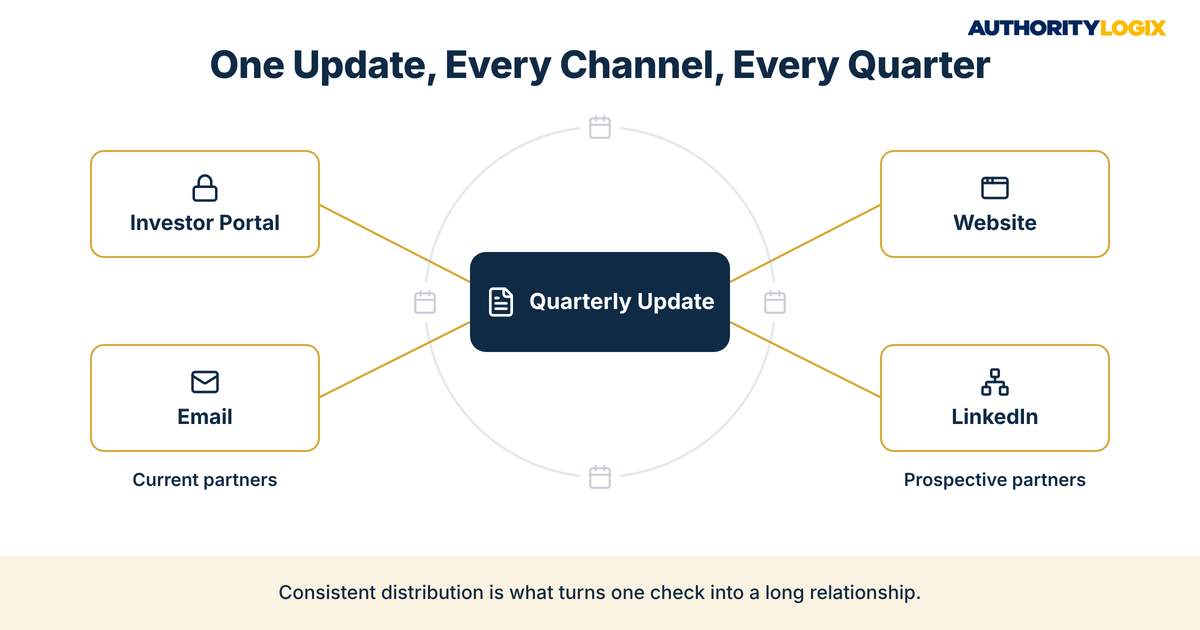
- Real estate capital partner retention depends on consistent distribution, because real estate investor relations content that arrives on schedule turns one check into a long relationship.
Table of Contents
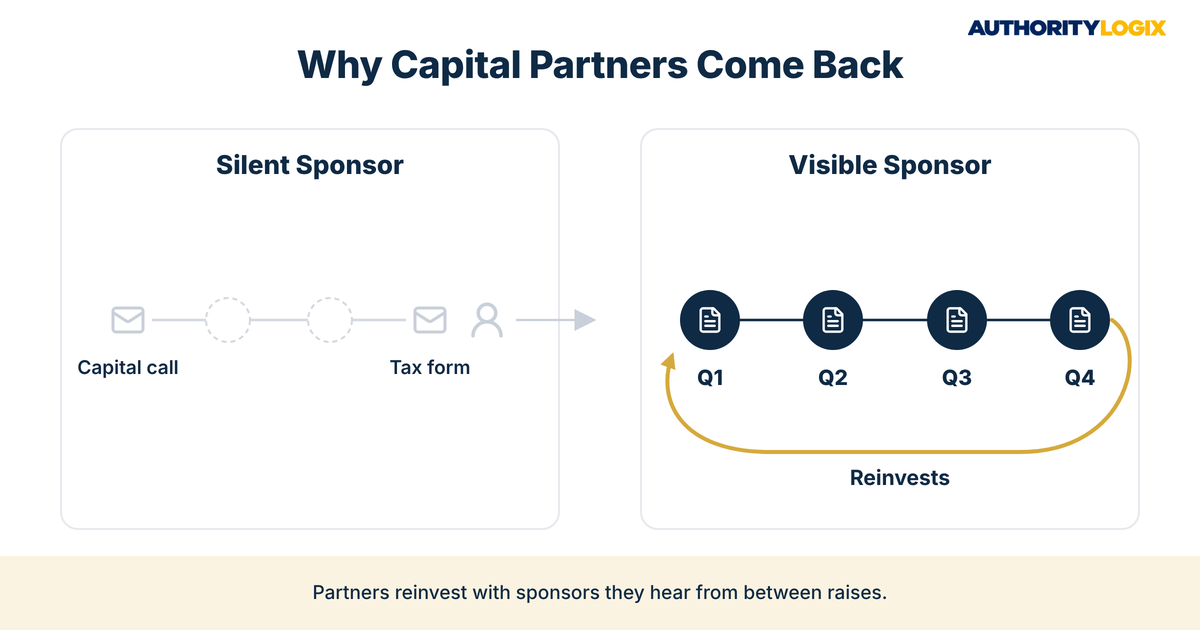
Real estate investor relations content is the part of your firm that most capital partners see more often than they see your properties. You may have a solid track record, conservative underwriting and a portfolio that has held up through more than one cycle — and still lose repeat investors because the only time they hear from you is when a tax form arrives or a new deal needs funding. The AuthorityLogix RE industry hub is built around that gap between what a firm has earned and what its market can actually see.
That is the credible but invisible problem applied to capital. The expertise is real, but partners judge it through whatever reaches their inbox, and prospects judge it through whatever they find online — which makes real estate investor relations content a system, not a mailing.
What Real Estate Investor Relations Content Do Capital Partners Actually Read?
Capital partners do not read everything you send. They read what helps them answer three questions: is my money safe, is the plan on track, and do I trust the people running it. Real estate investor relations content that answers those three questions every quarter gets opened, while content that buries them under property photos and market cheerleading gets skimmed and filed.
Most firms already produce some version of each piece below. They rarely connect them, and connecting them is what we build for real estate firms: one set of facts flowing through every format a partner touches.
- Quarterly updates on debt, performance, operations and team
- Annual letters that explain decisions, not just results
- Property notes when something material changes, such as a refinance
- Market commentary on the submarkets you own in
- Educational pieces on how your strategy works
- Team and organization notes when people or roles change
Only the first two are routine for most sponsors. The rest are optional, which is why they separate firms partners stay with from firms they quietly replace. Real estate investor relations content that goes beyond the minimum tells partners the sponsor has nothing to hide and a process for sharing news before anyone has to ask.
This is also where investor relations stops being an administrative chore and becomes part of market authority. The same commentary that keeps a current partner informed can, in a public version stripped of deal specifics, show a prospective partner how you think — the core idea behind the authority framework for real estate firms. Real estate investor relations content is the private half of that authority, and your published thinking is the public half.
The Real Estate Growth Playbook shows where real estate investor relations content fits inside the larger system that lets an investment firm grow through compounding visibility instead of starting every raise from zero.
How Do Prospective Investors Find and Vet Your Firm Online?
A new capital partner rarely commits after one conversation. They hear your name from a current investor or a broker, and then they search. What they find sets the tone of the first call before you say a word.
Research outside real estate shows how much weight published material carries. The 2024 Edelman-LinkedIn B2B Thought Leadership Study, a survey of 3,500 global B2B decision-makers, found that 73% consider thought leadership a more trustworthy basis for judging a company’s competencies than its marketing materials. Investors are not procurement teams, but the behavior is the same: they trust what you have published over what you say on a call.
Where Real Estate Investor Relations Content Shows Up in Due Diligence
Sponsor due diligence now starts with a search for the firm name, then the principals’ names, then the firm name next to words like “track record” or “reviews.” The results should show a website that explains your strategy, a body of published commentary, and principals who are visible as recognized experts in their market. Public real estate investor relations content — strategy explainers, market notes, educational articles — fills those results with your own words instead of a thin directory listing.
Local search matters more than many sponsors assume, because investors often want to back operators who know specific submarkets. A firm that owns small multifamily in two counties should be findable for those counties, and the local visibility guide covers how real estate firms appear in searches tied to the places they actually operate. That visibility is the front door, and the real estate investor relations content behind it is what earns the meeting.
The strongest version is an educational library a prospect can work through on their own time. When a prospective partner can read how you underwrite, how you report and how you handled a difficult year, the first call becomes a confirmation rather than an interrogation. A structured learning hub turns scattered articles into that library, organized around the questions new investors actually ask.

What Should Investment Firm Investor Updates Contain?
The clearest guide to what partners want comes from investors themselves. In ILPA’s inaugural LP Sentiment Survey, fielded in Q4 2024 among 101 senior investment professionals, the information LPs most wanted reported consistently was detail on the debt in use at the fund level (81%), performance (65%) and organization and team updates (42%). Those respondents lead private equity programs rather than real estate syndications specifically, but their priorities translate directly to investment firm investor updates.
Read that list as a sponsor. Partners want the debt picture first, results second and people third, and 34% of the same respondents also wanted notice of approaching capital calls. Property photos and market optimism do not appear on the list at all. Real estate investor relations content that leads with the capital stack and the numbers earns more trust than content that leads with renderings.
A Quarterly Framework for Real Estate Investor Relations Content
| Update Section | What It Covers | Why Partners Read It |
|---|---|---|
| Debt and capital | Loan balances, rate terms, maturities and reserves | Fund-level debt detail was the most requested item in the ILPA survey (81%) |
| Performance | Distributions, occupancy and results against the business plan | Performance ranked second (65%) |
| Property operations | Leasing, capital projects and material repairs | Shows the plan is being executed, not just reported |
| Team and organization | New hires, departures and role changes | Organization and team updates ranked third (42%) |
| What comes next | Upcoming capital calls, pending decisions and timelines | Notice of approaching capital calls was requested by 34% |
Each section should keep the same order and the same headings every quarter, so partners can compare one update to the last in a few minutes. That repeatability is a publishing decision more than a writing one, and it follows the same logic as the content framework for real estate firms: fixed formats, defined owners and a schedule that does not depend on anyone’s spare time.
Firms that do this well rarely write updates from scratch. They capture data, decisions and market observations as they happen, then assemble the update from existing material. A content engine built that way also produces the public commentary and educational pieces described earlier, so real estate investor relations content and authority content come from one source instead of competing for the same few hours.
Not sure where your firm stands on real estate investor relations content? The RE Authority Gap Assessment shows where your investor updates, public commentary and online visibility are weakest, and what to build first.
How Does Syndication Investor Communication Feed the Next Raise?
Every raise starts long before the offering is announced. The partners most likely to commit to your next deal are already in your last one, and syndication investor communication during the hold sets their expectations. A partner who got clear updates through a difficult year knows what investing with you feels like; a partner who got silence is guessing.
There is a regulatory line that shapes how public any of this can be. Under the SEC’s Rule 506(c), an issuer may broadly solicit and generally advertise an offering only when all purchasers are accredited investors and the issuer takes reasonable steps to verify their status. Talk to securities counsel before any content mentions a specific offering, and keep educational real estate investor relations content — strategy, market thinking, how you report — clearly separate from offering materials.
Turning a reader into a conversation requires a path. An investor who has read three of your market notes needs a clear next step, such as subscribing or booking an introductory call, and the lead capture system for real estate firms lays out how those steps connect to your website. Without that path, real estate investor relations content builds goodwill that never becomes a relationship.
Current partners belong in the same structure. A partner who forwards your quarterly commentary to a colleague is making an introduction without being asked. Treating that flow as a lead pipeline, with a simple way for forwarded readers to subscribe, turns syndication investor communication into a steady source of new capital partners.
Together, the public and private sides produce what few sponsors build: prospects who arrive already familiar with your strategy. That is the inbound investor pipeline model for real estate investment firms, and it only works when real estate investor relations content is published on a schedule rather than only while a raise is open.
How Does Real Estate Capital Partner Retention Depend on Consistent Distribution?
Real estate capital partner retention is less about any single update than about the pattern. Partners notice when the letter arrives two months late or bad news shows up only in a footnote. Consistency signals that the firm runs on process, and process is what partners underwrite when they reinvest.
Distribution is where most firms lose that consistency. The update gets written, but the public version never gets posted and the commentary never reaches the networks where prospective partners would see it. A distribution system assigns every piece a channel and a date — investor portal, email, website, LinkedIn — so real estate investor relations content reaches each audience it was written for.
Why Education Protects Real Estate Capital Partner Retention
Education plays a quieter role. Partners who understand why you hold reserves or how a refinance decision gets made are far less likely to lose confidence when a property has a rough quarter. Ongoing investor education is how sponsors build partners who stay through a hard year instead of sending their next check somewhere else.
BKDSCR.com, the AuthorityLogix proof-of-concept in the NYC outer-borough DSCR investment niche, was built on that principle: 18 pillar pages, 7 interactive investor tools and 48 SEO-optimized blog posts written to educate investors before they ever make contact. It generates inbound leads organically with zero paid ads. The lesson for sponsors is the same — investors who learned from you first arrive with trust already in place.
What Sponsors Get Wrong About Real Estate Investor Relations Content
Most sponsors who struggle with investor relations are not careless. They are working from habits formed when the partner base was a dozen people with the principal’s cell number.
Is a quarterly email enough?
For a small partner base it may cover the basic obligation, but it does not build the relationship. A quarterly email that only reports numbers leaves out the reasoning partners need to trust the next decision. Real estate investor relations content works when the email is one output of a system that also produces commentary, education and a public record of how you think.
Can our property manager or fund administrator handle this?
They can handle data and statements. What they cannot supply is the principal’s voice — the reasoning behind decisions — or the public content that brings in new partners. That split between your expertise and an outside system build is how we work with investment firms: you supply the judgment, and the infrastructure carries it to partners and prospects on schedule.
Does publishing publicly create compliance risk?
It can, which is why the line between education and offering matters. Educational real estate investor relations content discusses strategy, markets and process, and it does not describe a specific open deal, projected returns or terms. Have securities counsel review your publishing policy once, then build within it.
Where should past updates and commentary live?
In one organized place, not scattered across inboxes. An investor resource library on your own site gives prospects a searchable record of your thinking and gives current partners a single reference point. Archived commentary also keeps working in search long after it was written.
Ready to turn your track record into investor relations content that keeps capital partners informed, confident and first in line for your next deal?
What Investor Relations Content Cannot Fix
Real estate investor relations content cannot fix a weak deal, a broken business plan or a sponsor who does not tell partners the truth. If distributions stopped because the underwriting was wrong, a better-designed update will not change how partners feel about it. Content amplifies whatever sits underneath it, good or bad.
What it can do is make a good operator visible to the partners who would choose them if they knew more. That is the job of every piece in the AuthorityLogix research library: showing real estate firms how to make earned credibility visible to the people deciding where to place capital. Real estate investor relations content is one of the most direct applications of that idea, because the audience is already listening.
AuthorityLogix builds this infrastructure for real estate firms because it was built first in a live investor market, and that history is the plain answer to why choose us over a generalist agency. We already know what investors ask before they trust anyone with a deal.
The honest assessment is that most sponsors already have the track record capital partners want. What they lack is real estate investor relations content delivered with enough consistency that partners never have to wonder what is happening with their money. Build that, and the next raise starts with people who already know you.