


Key Takeaways
- A real estate keyword strategy 2026 starts with the questions buyers, sellers and investors already ask you, not with a list of high-volume terms.
- Buyers, sellers and investors search differently, so a real estate keyword strategy 2026 gives each audience its own keywords and its own pages.
- NAR’s 2025 Profile of Home Buyers and Sellers found that 52% of buyers found their home online, so the search starts long before the first call.
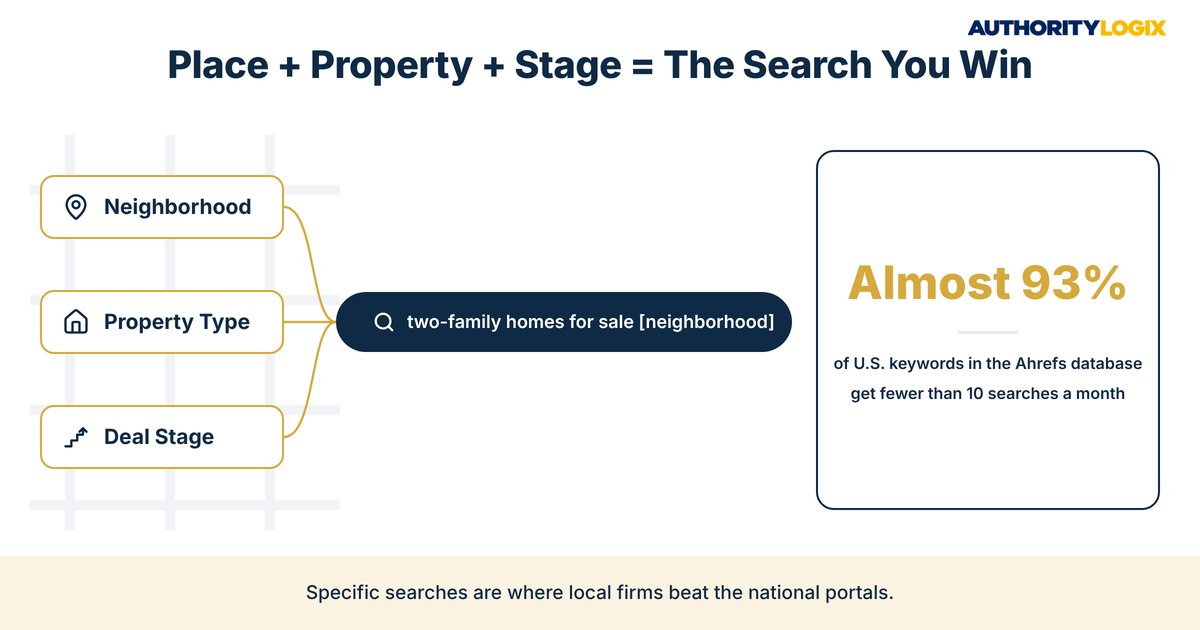
- Ahrefs reports that keywords with fewer than 10 searches per month account for almost 93% of its U.S. keyword database, which is why specific neighborhood and property-type phrases matter.
- Every keyword gets one page. When two pages chase the same term, your own site competes with itself.
- Keywords in a real estate keyword strategy 2026 only pay off when the page behind them answers the question better than the portals do.
Table of Contents

A real estate keyword strategy 2026 is not a list of words you sprinkle into listings. It is a map of what buyers, sellers and investors type into Google before they ever call anyone. You may have closed hundreds of deals and know which co-op boards are strict, and still be absent when a seller searches for what their two-family is worth. That gap is structural, which is why the AuthorityLogix real estate industry hub treats it as an infrastructure problem rather than a writing problem.
Most firms are credible but invisible in search. Their expertise lives in closings and referral relationships, while the searches the market runs lead to Zillow, Redfin and whichever competitor built pages for them. A real estate keyword strategy 2026 closes that gap by choosing the right searches, sorting them by audience, and giving each one a single page.
What Is a Real Estate Keyword Strategy 2026 Buyers, Sellers and Investors Actually Respond To?
A keyword strategy is a decision about which searches your firm wants to own and which page will answer each one. The national portals win broad terms like homes for sale plus a city name, because they aggregate listings nationally. Local firms win the searches that need judgment, and the local SEO playbook explains how map pack visibility and local pages support each other once those searches are chosen. A real estate keyword strategy 2026 firms can sustain starts there, with the questions a portal cannot answer well.
Semrush’s AI Overviews study, which tracked more than 10 million keywords from January through November 2025, found that the industries with the least percentage of AI Overviews were real estate, shopping, and arts and entertainment. The same study found that real estate and shopping have the smallest share of keywords impacted by AI Overviews and have seen relatively little growth. For a real estate keyword strategy 2026 plan, that means classic organic rankings still decide who gets the click.
The strategy also has to be produced, not just planned. A keyword list sitting in a spreadsheet changes nothing until pages, guides and market updates are built around it, and that production line is what our real estate content systems are designed to run. In a real estate keyword strategy 2026, keywords decide what gets written and the system decides whether it gets written every month.
The Real Estate Content System lays out the publishing blueprint a real estate keyword strategy 2026 depends on: which pages to build, in what order, and how they connect.
How Broker Keyword Research SEO Starts With the Questions Clients Ask You Every Week
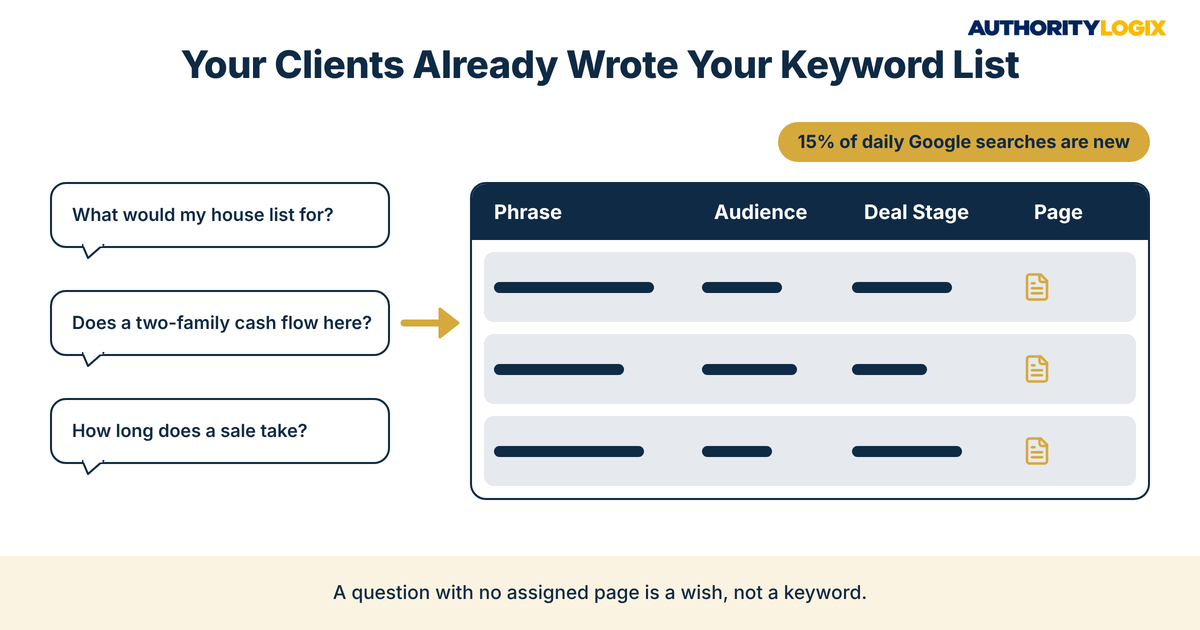
The most useful keyword research tool in your office is your own inbox. Sellers ask what their house would list for and how long a sale takes. Investors ask about rents, cap rates and which property types carry themselves. Good broker keyword research SEO begins by writing those questions down exactly as clients phrase them, because people type into Google the way they talk to you.
Search tools then show which of those questions people search at scale, but not which ones matter most to your clients. Google has said that 15 percent of the searches it sees every day are new, and Google’s John Mueller said in 2025 that the figure keeps coming back around 15%, so a real estate keyword strategy 2026 built only from tool volume misses much of what people actually ask.
Once collected, the questions need a logical home. Group them into topics such as selling, buying and investing, then let those groups become sections of the site, an approach covered in our guide to real estate website structure. A clean structure tells Google which page is the authority on which topic.
Turning Client Questions Into a Real Estate Keyword Strategy 2026 List
Each question becomes a row with four columns: the exact phrase, the audience asking it, the stage of the deal, and the page that will answer it. A question with no assigned page is a wish, not a keyword. The richest sources for a real estate keyword strategy 2026 list are already in your business:
- Seller consultation notes
- Buyer emails around showings
- Investor questions about rents and financing
- Google’s “People also ask” boxes for your market
- Questions repeated in your reviews
Answering those questions in your own voice is also what builds trust. A page that reads like it came from someone with hundreds of closings signals experience, and the authority guide explains how that recognition turns into market authority over time. Broker keyword research SEO that skips the expertise layer produces pages that read like everyone else’s.
Agent Buyer Seller Investor Keywords: Why Each Audience Searches Differently
Buyers, sellers and investors can type the same city name and want completely different things. A buyer wants listings and commute times. A seller wants a value and a timeline. An investor wants rents, taxes and financing numbers. Treating agent buyer seller investor keywords as one undifferentiated list is the quickest way to build pages that satisfy nobody.
Most of that looking happens online. NAR’s 2025 Profile of Home Buyers and Sellers found that 52% of buyers found their home online and 70% used mobile or tablet devices during their search, while 88% of buyers and 91% of sellers still used a real estate professional. Search introduces the agent and the agent closes the deal, so a real estate keyword strategy 2026 matters even for relationship-driven firms.
Investor searches need the most depth. Phrases like cash flow on a two-family, rents by borough, or how a DSCR loan works signal someone running numbers, and specialized investor content written by people who understand the math is what earns that click. A real estate keyword strategy 2026 that ignores investor phrasing leaves that audience to whoever wrote for them.
Sellers often search close to a decision. A seller typing what is my home worth plus a neighborhood name is nearer a listing conversation than a casual browser, and pages that answer that query feed directly into the lead generation system that turns visits into appointments. Each audience also needs its own next step.
Not sure which buyer, seller and investor searches your firm is missing? The RE Authority Gap Assessment shows where your keyword coverage is thin and which pages to build first.
Real Estate Search Term Targeting by Neighborhood, Property Type and Deal Stage
Broad terms are where the portals live, and specific terms are where local firms win. Ahrefs reports that keywords with fewer than 10 searches per month account for almost 93% of its U.S. keyword database. Low volume per phrase does not mean low value, because a search for two-family homes in one named neighborhood comes from someone who knows what they want, and a real estate keyword strategy 2026 should be built around exactly those searches. Real estate search term targeting works when it stacks three layers: place, property type and deal stage.
| Targeting Layer | Example Search | Page That Should Answer It |
|---|---|---|
| Neighborhood | “living in [neighborhood]” | A neighborhood page with housing stock, prices and transit |
| Property type | “two-family homes [borough]” | A property-type page on costs and what to inspect |
| Buyer deal stage | “closing costs [city]” | A buyer guide to the closing process |
| Seller deal stage | “what is my home worth [neighborhood]” | A valuation page with a clear request path |
| Investor deal stage | “two-family cash flow [borough]” | An investor analysis page with a calculator |
| All three combined | “two-family homes for sale [neighborhood]” | The most specific page in your real estate keyword strategy 2026 |
The Deal Stage Layer Most Firms Skip
Most firms target place and property but ignore deal stage. Someone searching what a neighborhood is like is early, while someone searching closing costs is close. Mapping real estate search term targeting to deal stage lets each page carry the right next step instead of the same contact form everywhere.
Place-based terms deserve their own build. Well-made neighborhood pages describe housing stock, price ranges, transit and market activity, which means the property and the place rather than who lives there. That discipline keeps the content clear of Fair Housing problems, and it makes the page more useful, because buyers want facts they cannot get from a listing photo.
Early-stage questions, such as how a 1031 exchange works, what a co-op board reviews, or how a DSCR loan qualifies a property, are educational searches. They belong in an educational hub where each guide answers one question thoroughly and links to the related ones. A real estate keyword strategy 2026 that includes this layer meets clients earlier, so your name is already familiar when they are ready to act.
How to Map Each Keyword to One Page So Your Own Pages Stop Competing
Keyword cannibalization happens when two or more pages on your site target the same search. Google has to choose between them, and your authority on that topic gets split across pages instead of concentrated in one. Real estate sites are prone to it, because blog posts, neighborhood pages and listing pages drift toward the same place names, and an unmanaged real estate keyword strategy 2026 makes the drift worse.
The One Keyword, One Page Rule
The fix is a keyword map: one primary phrase per page, with closely related phrases grouped under it instead of given their own thin pages. If a page already owns the term, improve that page instead of publishing a competitor to it. A real estate keyword strategy 2026 map might assign ownership like this:
| Keyword | Owned By | Not By |
|---|---|---|
| “sell my house [neighborhood]” | The seller page for that neighborhood | Monthly market update posts |
| “[neighborhood] market report” | The monthly market update | The neighborhood overview page |
| “two-family homes [borough]” | The property-type page | Individual listing pages |
| “how DSCR loans work” | One educational hub guide | The investor services page |
Mapping also decides where leads land. One owner page per keyword can carry the capture path built for its audience, which is how real estate lead generation connects to search instead of sitting on a separate landing page nobody finds. A seller page gets a valuation request, and an investor page gets a calculator.
BKDSCR.com, the AuthorityLogix proof-of-concept in the NYC outer-borough DSCR niche, was built this way: 18 pillar pages, 7 interactive investor tools and 48 SEO-optimized blog posts, organized around the searches outer-borough investors run. It ranks for competitive DSCR and NYC real estate keywords with zero paid ads. That map-first sequence is how we build client platforms too, and it is why the pages support each other rather than compete.

What Firms Get Wrong About Real Estate Keyword Strategy 2026 (FAQ)
Most firms that struggle with search are not short on expertise. They are working from keyword habits that made sense years ago. These are the questions firm owners ask most often about a real estate keyword strategy 2026.
Should we target “homes for sale” in our city?
You can include it, but you will be competing with portals that aggregate listings nationally. A real estate keyword strategy 2026 firms can win puts that term at the bottom of the list and puts specific neighborhood, property-type and deal-stage phrases at the top.
How many keywords should one page target?
One primary phrase and a few close variations. If a page is trying to rank for selling, buying and investing at once, split it, and browse the real estate resource library for examples of how single-topic guides are structured. Focused pages are easier for Google to understand and easier for clients to act on.
Do keywords still matter now that AI answers appear in search?
Yes, and for real estate more than most industries, as the Semrush findings above show. Pages that answer client questions clearly serve both Google and AI assistants.
Is posting on social media enough to get found for these terms?
Social posts slide out of feeds quickly and are not built to rank. Distribution works when it points back to pages that own your keywords, which is the role of authority distribution in a complete system. Volume without infrastructure is just noise.
How long until a new keyword page ranks?
No one can guarantee a ranking or a timeline, and anyone who does is selling something else. Specific phrases tend to move sooner than broad ones, especially when your real estate keyword strategy 2026 keeps pages updated and linked.
Ready to turn the questions your clients already ask into a keyword map and the pages that win those searches? We build the real estate keyword strategy 2026 your market calls for, along with the content behind it.
The Honest Truth: Keywords Only Work When the Content Behind Them Answers the Question
A keyword is a promise. When someone searches a phrase and lands on your page, the page either answers what they asked or sends them back to the results. Firms that pull ahead treat every keyword in their real estate keyword strategy 2026 as a commitment to publish the most useful local answer, and the growth playbook shows how those answers add up to visibility that keeps building year after year.
That is why keyword research is never the whole job. The research is quick, while the pages behind it take steady, expert work, and that ongoing build is what we do for brokers, agents and investment firms who already have the knowledge. The expertise stays yours, and the infrastructure is what gets added.
The proof is a live site in a competitive market, which is the short version of why AuthorityLogix approaches keywords this way. A real estate keyword strategy 2026 built on real client questions, one page per term and content that answers fully keeps working long after the research is done.
The honest answer is that most firms already know what their clients are searching for, because they hear it every week. What is missing is the infrastructure that turns those questions into pages the market can find.