


Key Takeaways
- Real estate multi-market expansion works best when local authority is built online before a lease is signed, so the new office opens into a market that already knows the firm.
- BrightLocal’s 2026 Local Consumer Review Survey found 71% of consumers use Google for local business recommendations, down from 83% in 2025, while 45% now use AI tools such as ChatGPT.
- Google’s Business Profile guidelines reject a rented mailing address and an unstaffed virtual office, so the early ground in a new market is won with pages, content and reviews.
- In real estate multi-market expansion, market-specific content — neighborhood pages, market reports and investor analysis — is what proves a firm knows a market it just entered.
- NAR’s 2025 Profile of Home Buyers and Sellers found 88% of buyers and 91% of sellers used an agent — the demand exists; the question is which firm they find.
- Real estate multi-market expansion is a system build: profile rules, market pages, lead paths, distribution and reviews working together before the office opens.
Table of Contents

Why Real Estate Multi-Market Expansion Should Start Online, Not With a Lease
Real estate multi-market expansion usually starts with a lease, a sign and a hope that the new market will notice. You may have spent fifteen years building a strong reputation at home — closed deals, repeat clients, a referral network that keeps the phone ringing — and none of it crosses the county line on its own. The AuthorityLogix real estate hub is built around that exact gap: firms that are respected in one market and unknown in the next.
Credible but invisible is the default state of every firm entering a new market. At home, buyers and sellers find you through past clients, yard signs and years of search history. In the new territory, your name is not in the results — and an office does not close that gap by itself. A storefront with no search footprint is just rent.
The smarter sequence for real estate multi-market expansion runs the other way. Build the local search footprint, the market content and the lead paths first, then open the office once the market is already sending inquiries. That order is the backbone of our services for brokerages and investment firms, because it turns the office from a bet into a confirmation.
Every new market also has incumbents with years of reviews, listings and local mentions. Competing with them means earning the trust signals described in the authority playbook — consistent expertise, visible proof and a body of work the market can check — before your agents knock on a door. Real estate multi-market expansion is an authority problem first and a real estate problem second.
The Real Estate Growth Playbook shows how firms build compounding visibility across markets — the foundation every real estate multi-market expansion plan should sit on.
How Does Real Estate Office Expansion Local SEO Work Before the Office Exists?
Real estate office expansion local SEO has one hard constraint that shapes every other decision. Google’s Business Profile guidelines say a business qualifies if it has a physical location customers can visit or travels to customers where they are, and a rented mailing address where the business does not operate is not eligible. A virtual office does not qualify unless it is staffed during business hours, and a co-working space qualifies only with clear signage, customers received there during business hours and your own staff on site then.
That rule shapes the whole pre-office plan. The map pack is largely closed to a firm with no staffed location in the market, so the work shifts to the organic results, where pages compete on relevance and depth rather than an address. The local search playbook covers both layers in full; for real estate multi-market expansion, the organic layer is where the early ground is won.
The search layer itself is also changing. BrightLocal’s 2026 consumer survey found that 71% of consumers use Google for local business recommendations, down from 83% in 2025, while 45% now use AI tools such as ChatGPT, up from 6%. For real estate multi-market expansion, the footprint has to be readable by search engines and AI assistants alike — clear, specific, well-structured pages that answer local questions directly.
| Local Signal | Available Before an Office? | What It Requires |
|---|---|---|
| Business Profile in the new market | No | A staffed location, or a co-working space with clear signage that receives customers and is staffed by your own team during business hours |
| Market and neighborhood pages | Yes | Content written from real knowledge of that market |
| Market reports and investor analysis | Yes | Local data published on a steady schedule |
| Client reviews from the new market | Yes, as deals close there | A review request built into every new-market closing |
| Local mentions and citations | Yes | Distribution of your market content to local outlets |
| Search footprint for real estate multi-market expansion | Yes | Pages that answer local questions clearly enough for search engines and AI tools to cite |
Real Estate Multi-Market Expansion and the Google Business Profile Rules
Two more details in Google’s guidelines matter for real estate multi-market expansion. Google lists real estate agents among the individual practitioners who may hold their own profile if they can be contacted at the verified location during stated hours, and it says a service-area business’s service area should not extend farther than about two hours of driving time. Neither rule replaces local pages in the new market.
The organic layer rewards depth. A single “areas we serve” page listing ten towns tells Google almost nothing, while an education hub built around one market — buying guides, process explainers, answers to local questions — gives search engines and AI tools something specific to cite. That depth is what real estate office expansion local SEO looks like before the lease.

What Content Proves You Know a Market You Just Entered?
Content is how a new firm proves local knowledge it cannot yet prove with a storefront. Buyers, sellers and investors in a new market have one question about an outside firm: does this team actually know our area, or did it just add our town name to a website? Real estate multi-market expansion succeeds when the answer is visible on the page before anyone picks up the phone.
The Market Proof Checklist
The full publishing blueprint lives in the content playbook, but real estate multi-market expansion needs a specific short list first. Each item below has to be written for the new market, not adapted from your home market with the names swapped:
- Neighborhood pages that cover inventory, property types, transit and price ranges in factual terms
- A monthly or quarterly market report built on local sales and listing data
- Investor analysis of rents, property types and holding costs where investors are active
- Process guides that explain local steps — closing customs, inspections, permits — in plain language
- Answers to the questions buyers and sellers in that market ask most often
- A clear next step on every page, such as a report download or a consultation request
The challenge is consistency. A firm can publish five strong new-market pages in a burst and then go quiet for six months, which tells search engines and readers the same thing: this firm is not really here. Sustained real estate multi-market expansion runs on content infrastructure that produces market updates on a schedule, so the new territory gets fresh material even when your agents are busy at home.
BKDSCR.com, the AuthorityLogix proof-of-concept in the NYC outer-borough DSCR niche, follows this model: 18 pillar pages, 7 interactive investor tools and 48 SEO-optimized blog posts, built in under 18 months. It ranks for competitive DSCR and NYC real estate terms with zero paid ads. The authority came from content structure, not a storefront.
Not sure how ready your firm is for real estate multi-market expansion? The RE Authority Gap Assessment shows which local signals your target market can already see and which ones you still need to build.
How Does Broker New Market Entry Generate Leads Before Agents Arrive?
Broker new market entry often stalls at one step: the content ranks, readers arrive, and nothing captures them. Visibility without a lead path just educates prospects for a competitor. The lead system guide covers the full pipeline; in real estate multi-market expansion, the job is to turn the first wave of readers into named contacts before your agents are on the ground.
What a New-Market Lead Path Needs
Real estate multi-market expansion needs a lead path that works without a local office. In practice that means three connected pieces: a reason to share an email address, a way to route the inquiry, and a follow-up sequence that keeps the firm present until a local agent can meet. A market report download, a home value request or an investor deal-analysis tool can each serve as the first piece.
Routing matters more than most brokers expect. An inquiry from a new market should reach an agent who can answer within the day, even if that agent still works from the home office. Well-built inbound lead generation handles that routing automatically, so no inquiry from the new territory sits unanswered while the team decides who owns it.
Lead paths work best when they start on pages built for a specific place. Generic city pages convert poorly because they answer no one’s question in particular, while neighborhood landing pages match the way buyers and sellers actually search. Each one becomes an entry point for broker new market entry, with its own lead offer tied to that area.
NAR’s 2025 Profile of Home Buyers and Sellers found that 88% of buyers used an agent or broker and 91% of sellers used an agent. The demand for representation in your new market already exists. Real estate multi-market expansion is about making sure the people who need an agent find your firm while they are still deciding who to call.

How Do You Build Agent New Territory Authority Through Distribution?
Agent new territory authority does not come from your website alone. A firm new to a market also has to show up where local buyers, sellers and investors already spend their attention — local news sites, association newsletters, partner blogs and LinkedIn. Deliberate content distribution puts each market report and neighborhood guide in front of those audiences, so the firm’s name starts appearing in places the new market already trusts.
Distribution also feeds search. Mentions and citations from local sources tell search engines that your firm is connected to the market, not just writing about it. For real estate multi-market expansion, every placement in a local outlet is a small signal that your firm belongs in that territory.
Investors are often the easiest audience to reach first in real estate multi-market expansion. Many of them already search across markets, compare data rather than relationships, and respond to analysis that shows local rents, property types and deal math. Publishing investor-focused content for the new territory builds agent new territory authority with an audience that is already looking beyond its home market.
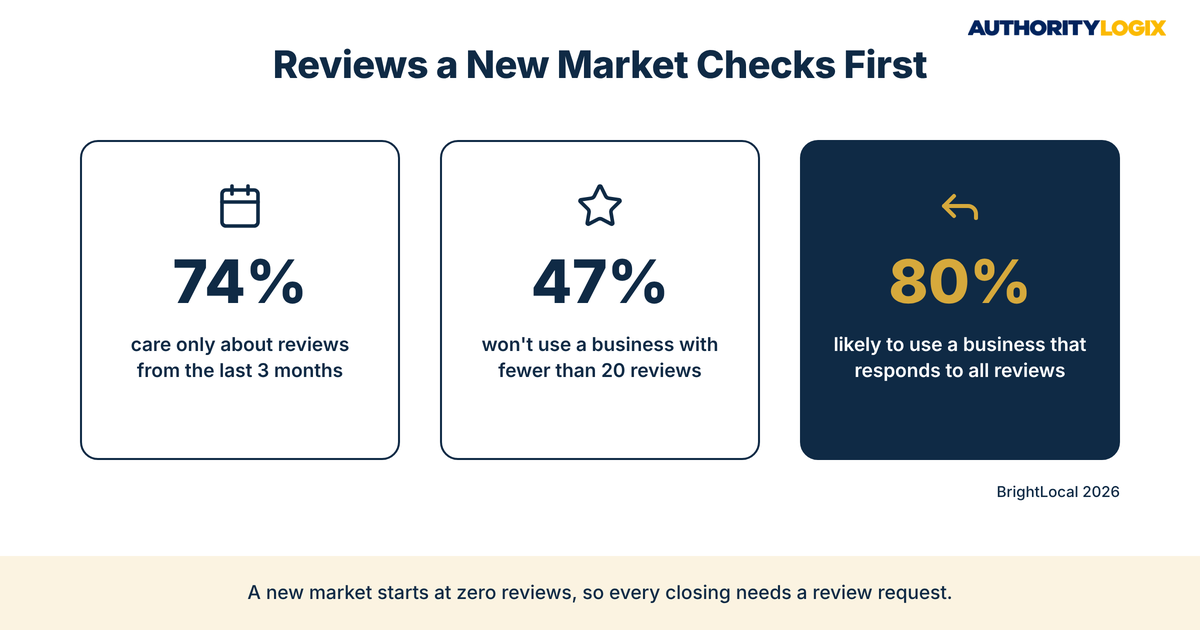
Reviews close the loop. BrightLocal’s 2026 survey found that 74% of consumers care only about reviews from the last three months, 47% will not use a business with fewer than 20 reviews, and 80% are likely to use a business that responds to all of its reviews. A firm entering a new market starts with no local reviews, so a review request at every new-market closing is part of real estate multi-market expansion.
What Brokerages Get Wrong About Real Estate Multi-Market Expansion
Most failed expansions are not short on effort or capital. They follow a sequence that worked twenty years ago, when a storefront and a few signs were enough to get noticed. These are the questions brokers ask most often.
Can we open a Business Profile at a virtual office in the new market?
Not under Google’s rules. A rented mailing address is not eligible, and a virtual office qualifies only if it is staffed during business hours. Setting up a Google Business Profile correctly at a real, staffed location is the right move when the office opens; until then, real estate multi-market expansion runs on organic pages.
Do we need local agents in place before we start marketing?
No, but you need a plan for who answers new-market inquiries from day one. The sequence in our process builds the content and lead paths first, then adds local people as inquiry volume justifies them. That way real estate multi-market expansion hands your first local agents a pipeline instead of a cold list.
How long before a new market starts producing leads?
There is no guaranteed timeline, and anyone who promises one is guessing. Organic rankings build as pages age and earn local signals, so the earlier the content starts, the sooner a new market can begin to respond. That is exactly why real estate multi-market expansion should begin months before the lease, not the week the office opens.
Ready to plan real estate multi-market expansion around local authority built before you commit to an office? Let’s map out the pages, lead paths and distribution that make your next market know your firm first.
When Is a New Market Ready for a Physical Office?
An office is a confirmation, not a launch. The right time to sign a lease in a new market is when the market is already telling you it wants your firm there. These are the readiness signals to track before real estate multi-market expansion moves from online to physical:
- New-market pages ranking on the first page of Google for the searches that matter to your firm
- Steady monthly inquiries from the new territory, not a one-time spike
- Closed deals in the new market and recent reviews from those clients
- Local mentions from news sites, associations or partners
- At least one agent with enough new-market business to justify a desk there
When those signals line up, the office opens into a market that already knows the firm, and the Business Profile at that address starts with reviews, content and local mentions behind it. The RE resource library covers each piece of that build in more depth, from local search to content systems to lead generation.
Authority compounds. Every page, report and review published before the office opens keeps working after it does, which is how real estate multi-market expansion becomes an asset rather than an expense. Firms that skip the online work pay rent while they wait to be discovered; firms that do it first arrive with a pipeline.
The honest answer is that most brokerages planning a second or third market already have the expertise to succeed there. What they lack is the infrastructure that lets the new market see it before the doors open, and that is our approach: build the authority first, then let the office confirm it. Real estate multi-market expansion done in that order is slower to start and harder for competitors to copy.