


Key Takeaways
- A real estate referral system structured around sources, touchpoints, timed asks, and tracking turns client goodwill into a steady flow of warm introductions.
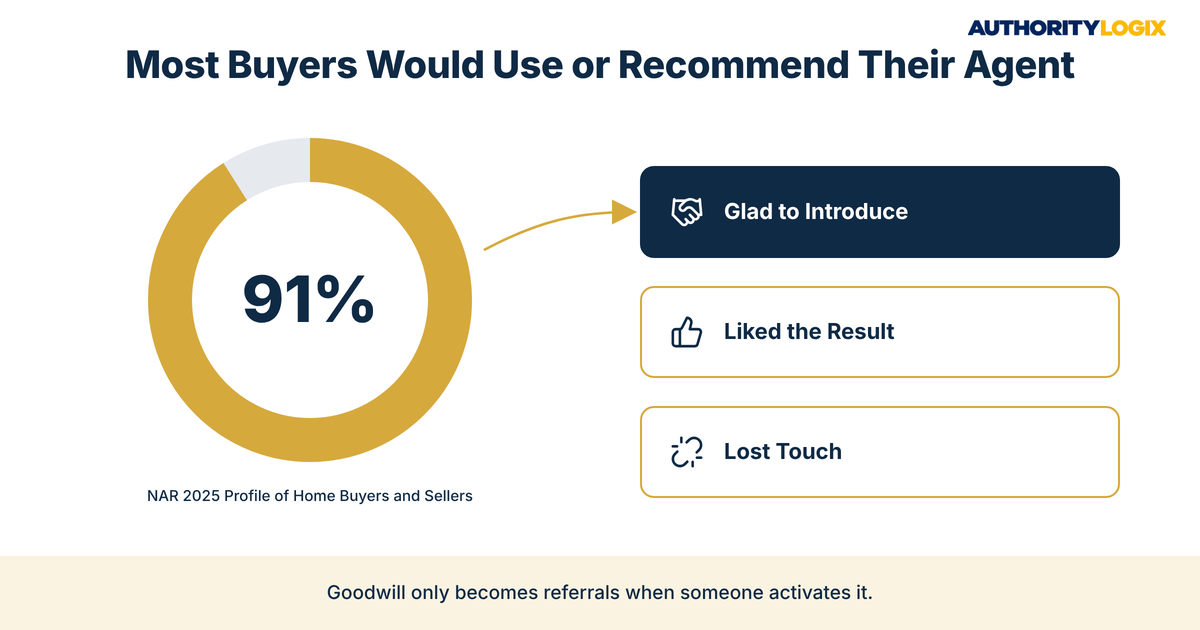
- NAR’s 2025 Profile of Home Buyers and Sellers found 91% of buyers would use their agent again or recommend them to others.
- The strongest moments to ask come right after closing, at the first home anniversary, and after a positive review, when clients already feel good about the work.
- Five simple metrics — source, introductions, appointment rate, time to close, and thank-yous — show where a real estate referral system structured by your team is stalling.
- Partner referrals have to stay inside RESPA Section 8 and state license rules, so the program should run on service and education rather than payments.
- Referrals cap growth at the size of your network, so a real estate referral system structured well works best alongside search visibility and published expertise.
Table of Contents

A real estate referral system structured around specific people, specific moments, and consistent follow-up is what separates agents who receive steady warm introductions from agents who wait and hope. Most established real estate firms already have the raw material — closed deals, satisfied clients, and contacts who would gladly send business their way. What they lack is a process that makes those introductions happen on purpose rather than by luck.
That is the credible but invisible problem in its referral form. Your past clients trust you, yet most could not tell a friend what you specialize in or how to reach you. A real estate referral system structured for warm introductions closes that gap by giving every satisfied client a clear reason, a clear moment, and a clear way to connect someone to you.
What Makes a Real Estate Referral System Structured Instead of Hopeful
Hopeful referral programs share a pattern. An agent closes a deal, sends a gift, says “I’d love any referrals,” and then goes quiet until the next transaction. The request has no timing, no follow-up, and no way to measure whether it worked. Structured programs treat referrals as one part of a wider lead generation plan, with defined stages, assigned owners, and a record of every introduction that comes in.
The Four Parts of a Real Estate Referral System Structured to Repeat
Every real estate referral system structured to produce repeat introductions rests on four parts. Each part has a job, and each one feeds the next:
- Source list: the past clients, sphere contacts, and professional partners most likely to send introductions
- Touchpoint schedule: planned contact through the year so you stay remembered between transactions
- The ask: specific, well-timed requests tied to moments when clients already feel good about the work
- Tracking: a record of who referred whom, what happened next, and how each introduction was thanked
Notice what is missing from that list: discounts, pressure, and scripts that make clients feel used. A real estate referral system structured this way runs on relationships the agent already earned. The structure simply makes sure those relationships keep producing introductions after the closing table.
Structure also exposes the limits of referrals early. Even a well-run program hits a natural referral ceiling, because one network can only produce so many introductions a year no matter how carefully it is managed. Knowing that ceiling exists lets you plan the rest of your pipeline honestly instead of waiting for a slow quarter to reveal it.
A real estate referral system structured for warm introductions is one input to a larger pipeline. The Real Estate Lead Generation System shows how referrals, search, and content work together as one inbound engine.
Building a Broker Referral Program Strategy Around Past Clients
Past clients are the strongest source in any real estate referral system structured for warm introductions, and NAR’s research shows why. The National Association of REALTORS 2025 Profile of Home Buyers and Sellers, released in November 2025, found that 91% of buyers would use their agent again or recommend them to others. Goodwill that is never activated produces nothing.
The same NAR release found that sellers had lived in their homes for 11 years before selling, an all-time high. A past client may not need you again for a decade, which is exactly why a broker referral program strategy focuses on the people that client knows rather than on the client’s own next move.
A sound broker referral program strategy starts by sorting the database. Separate past clients into those who would gladly introduce you, those who liked the result but barely remember you, and those you have lost touch with entirely. Each group needs its own cadence inside a real estate referral system structured by segment, and the growth playbook shows how that kind of segmentation fits into a long-term plan for a firm that wants steady growth rather than spikes.
For brokers running teams, the strategy has one more layer. Referral relationships often belong to individual agents and can leave when they do. A real estate referral system structured at the brokerage level keeps shared records, so the firm keeps its relationship history when the roster changes.
What you send past clients matters as much as how often you send it. A market update or a guide to preparing a home for sale gives a past client something worth forwarding, and content systems are what keep that material coming without the agent writing it alone.
Agent Referral Marketing System Touchpoints That Keep You Top of Mind
An agent referral marketing system is the schedule that keeps you remembered between transactions, and it is the backbone of any real estate referral system structured to last. Without one, contact with past clients drifts into a single holiday card and an occasional comment online, and the agent who stays in touch more consistently gets the introduction instead. Touchpoints are not about volume; they are about being useful at predictable intervals.
Email carries most of the load because it scales without becoming impersonal. A post-closing email sequence can cover the first year after a transaction — a thank-you, a homeowner checklist, an anniversary note, and a market check-in — before handing the contact to a quarterly rhythm. The real estate referral system structured on top of that rhythm then decides when to add a personal call or a handwritten note.
Milestone Moments to Ask for a Warm Introduction
The ask works best when it rides on a moment the client already feels good about. Timing turns a request that might feel awkward into one that feels natural:
- Right after closing, when relief and gratitude are highest
- The first home anniversary, paired with a short value update
- When a client thanks you for a tip, a vendor recommendation, or market insight
- After a positive review, when the client has already put their praise in writing
- When a client mentions a coworker or friend who is thinking about moving
Each milestone needs something to send, and a library of pieces built in advance keeps the touchpoints consistent. The publishing approach in the content system lays out how one market report can become an email, a social post, and a client note, so every touchpoint in a real estate referral system structured around milestones has fresh material behind it.
Not sure where your firm stands on referral structure? The Authority Gap Assessment shows where your past-client touchpoints, tracking, and visibility are weakest.
Turning Real Estate Word of Mouth Program Results Into Trackable Data
A real estate word of mouth program that cannot be measured cannot be improved. Most agents know referrals matter, yet few can say which past clients sent business last year or how many introductions became appointments. Tracking turns a vague feeling into a list of people to thank and a pattern to repeat.
| Metric | What It Tells You | Where to Record It |
|---|---|---|
| Referral source | Which clients and partners actually send introductions | CRM contact field, tagged at first contact |
| Introductions per month | Whether the real estate referral system structured by your team produces a steady flow | Monthly pipeline report |
| Introduction-to-appointment rate | Whether warm introductions are followed up quickly enough | CRM stage change |
| Time to close | How referred leads compare with other lead sources | Closed transaction record |
| Thank-you sent | Whether every referrer was acknowledged | Completed task in the CRM |
Tracking a real estate referral system structured this way also shows which reputation signals help referrals convert. A referred prospect still searches your name before calling, and what they find either confirms the recommendation or undercuts it. The credibility markers covered in the authority guide — reviews, published expertise, consistent profiles — are what keep a warm introduction warm through that search.
Data from a real estate word of mouth program often reveals that referred prospects ask the same early questions. Instead of answering each one by phone, firms with an educational hub can send a referred buyer or seller to pages that explain the process, the timeline, and the costs. The introduction arrives already informed, and the first meeting starts further along.

Scaling a Real Estate Referral System Structured for Partners and Vendors
Past clients are one source. Professional partners — lenders, attorneys, inspectors, contractors, property managers, and agents in other markets — are another, and they talk to buyers and sellers at moments when a recommendation carries weight. Scaling a real estate referral system structured for partners means choosing a small number of reliable relationships and serving them well.
Partners in a real estate referral system structured for scale refer to agents they see as knowledgeable, and visibility shapes that impression. When your market commentary appears in local publications, podcasts, and industry outlets through authority distribution, partners have something concrete to point to when they recommend you. A recommendation backed by visible expertise is easier to make and easier to accept.
Investor-focused partners need different material. Property managers and lenders working with landlords want rental market data and financing education they can pass along, and purpose-built investor content gives them exactly that. BKDSCR.com, the AuthorityLogix proof-of-concept in the NYC outer-borough DSCR niche, was built with 18 pillar pages, 7 interactive investor tools, and 48 SEO-optimized blog posts — the kind of library a partner can share with an investor without hesitation.
Partners also check whether you can be found. A lender who recommends you expects the client to locate you quickly on Google, and a thin profile reflects on the partner. The local SEO playbook covers how to make sure your firm appears when a referred client searches your name or your market.
Keeping Partner Referrals Inside RESPA and License Rules
Money changes the partner conversation. The CFPB’s Regulation X, which implements RESPA Section 8, states that no person shall give or accept any fee, kickback, or other thing of value under an agreement to refer settlement service business involving a federally related mortgage loan. The same rule exempts cooperative brokerage and referral arrangements between real estate agents and real estate brokers, which is why agent-to-agent referral fees are common while lender-to-agent payments for loan referrals are not allowed.
State license laws add their own limits on who can receive a referral fee. Review any partner arrangement that involves payment with your broker and a real estate attorney before it starts. A real estate referral system structured on mutual service, shared education, and fast follow-up does not need payments to work.

Referral Program Mistakes That Make Clients Uncomfortable
Most referral programs that stall do not fail from lack of effort. They fail because the asks feel transactional or the timing is off. These are the questions agents ask about getting a real estate referral system structured without straining relationships.
Is it pushy to ask past clients for referrals directly?
Asking is not the problem; asking badly is. A vague “send me anyone you know” in every conversation puts the burden on the client, while a specific request at a good moment feels like an offer. In a real estate referral system structured around milestones, you ask a few times a year, never in every message.
Should referral rewards be part of the program?
Tying cash or valuable rewards to referrals can raise problems under state license rules and, for settlement services, under RESPA. A handwritten note or a modest gift after the fact keeps the gesture about gratitude. Check your state rules before offering anything of value.
How do I keep the program running when business gets busy?
Busy seasons are when referral programs collapse, because the agent closing the most deals has the least time for follow-up. The fix is to automate the routine touchpoints and keep only the personal calls for the agent, which is the split behind how we build referral and visibility systems for real estate firms. That keeps a real estate referral system structured and running in the background while you handle the closings.
Can I outsource the whole program?
You can outsource the infrastructure, not the relationships. Email sequences, content, tracking, and visibility can be built and maintained by someone else, which is what we do for real estate professionals who are credible in their market but stretched thin. The calls, the thank-you notes, and the judgment about when to ask stay with you.
Ready to turn past-client goodwill into a real estate referral system structured with timing, tracking, and a steady flow of warm introductions? Let’s build the system around the relationships you already have.
Why Referrals Alone Cap Growth and What Pairs Well With Them
A real estate referral system structured well will raise the number of warm introductions you receive. It will not remove the cap. Your referral network is a ceiling, not a foundation — a single network produces a limited number of introductions each year, and growth beyond that number has to come from people who have never heard of you.
That is where search visibility, published expertise, and inbound lead capture come in. Prospects who find you through a market report or a local search arrive without a mutual friend, and the resource library covers how each of those channels is built. Referrals and inbound visibility reinforce each other: referred prospects search your name, and searchers become future referrers.
The firms that grow steadily run both at once. A real estate referral system structured around past clients and partners keeps the warmest leads coming, while content and search create a second pipeline that does not depend on who your clients happen to know. That two-track model is our approach for real estate firms.
The honest answer is that most established agents already have the relationships a strong referral program needs. What is usually missing is a real estate referral system structured around the schedule, the ask, and the tracking — plus the visibility that carries the business past the edge of the network. Build both, and referrals stop being the whole plan and become its most reliable part.