


Key Takeaways
- A real estate website retargeting strategy brings back the buyers, sellers, and investors who read a page or two on your site and left without giving you their name.
- WordStream’s 2026 benchmarks put the average real estate cost per lead at $102.51 on Google and $13.74 on Facebook, so every visitor who leaves unconverted is an expensive loss.
- NAR’s 2021 Real Estate in a Digital Age report found that 97% of 2020 homebuyers used the internet in their home search, and NAR’s 2025 Profile found 46% started by looking online for properties.
- Google’s policy bars housing advertisers in the United States and Canada from targeting by gender, age, parental status, marital status, or ZIP code, so audiences must be built on behavior.
- Retargeting works best when it brings visitors back to useful content — market reports, guides, calculators — instead of showing them the same listing again and again.
- A real estate website retargeting strategy multiplies the organic authority your site already earns; it cannot replace it.
Table of Contents
Why a Real Estate Website Retargeting Strategy Matters When Clicks Cost This Much
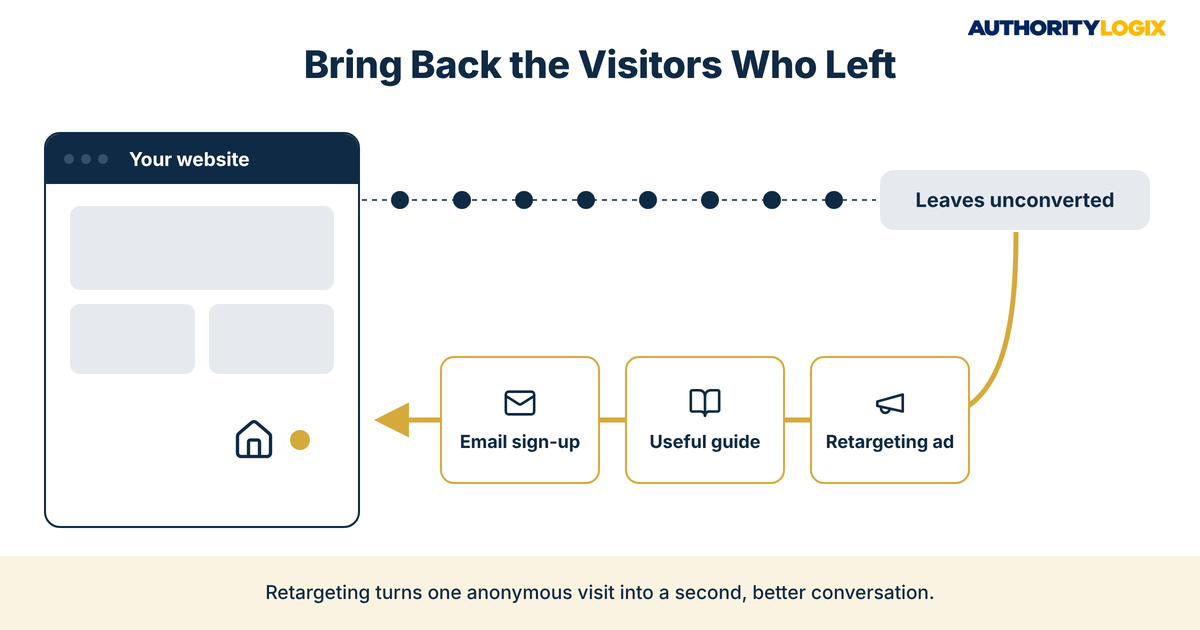
A real estate website retargeting strategy exists for one reason: most of the people who find your site leave without telling you who they are. You may have decades of closings, a sharp read on every block in your market, and a site full of listings — and still watch prospects browse a few pages and disappear. For real estate agents, brokers, and investment firms who already paid for that visit through ads, portals, or years of local search work, losing it is the most expensive leak in the pipeline.
That is the credible but invisible problem showing up at the very last step. The visitor saw you, but the visit left no trace, and without a way to reconnect you are back to hoping they remember your name. A real estate website retargeting strategy closes that loop by showing relevant, returning messages to people who have already been on your site, as one working part of the lead generation infrastructure you already run.
The economics make the case on their own. According to WordStream’s 2026 conversion benchmarks, the average real estate advertiser pays $102.51 per lead on Google, but just $13.74 on Facebook. The same report puts the real estate conversion rate on Google Ads at 3.70%, against an 8.18% average across Google Ads overall, which means the large majority of paid real estate clicks leave without converting.
None of this means more ad spend is the answer. Comparing content infrastructure against paid ads shows why rented visibility stops the moment the budget does, and retargeting inherits that weakness if it runs alone. A real estate website retargeting strategy works when it recycles visitors your content and search authority already earned, so the ad dollars go toward people who have shown real interest rather than strangers.
Think of the second visit as the one that counts. The first visit tells you a prospect exists and what they care about; the second visit, prompted by the right message, is where a name, an email address, or a booked call usually happens. A real estate website retargeting strategy is simply the system that makes the second visit likely instead of accidental.
The Real Estate Lead Generation System maps the full inbound pipeline that a real estate website retargeting strategy plugs into — from the first search to the first conversation.
Broker Retargeting Ads Lead Recovery: Who to Bring Back and Who to Let Go
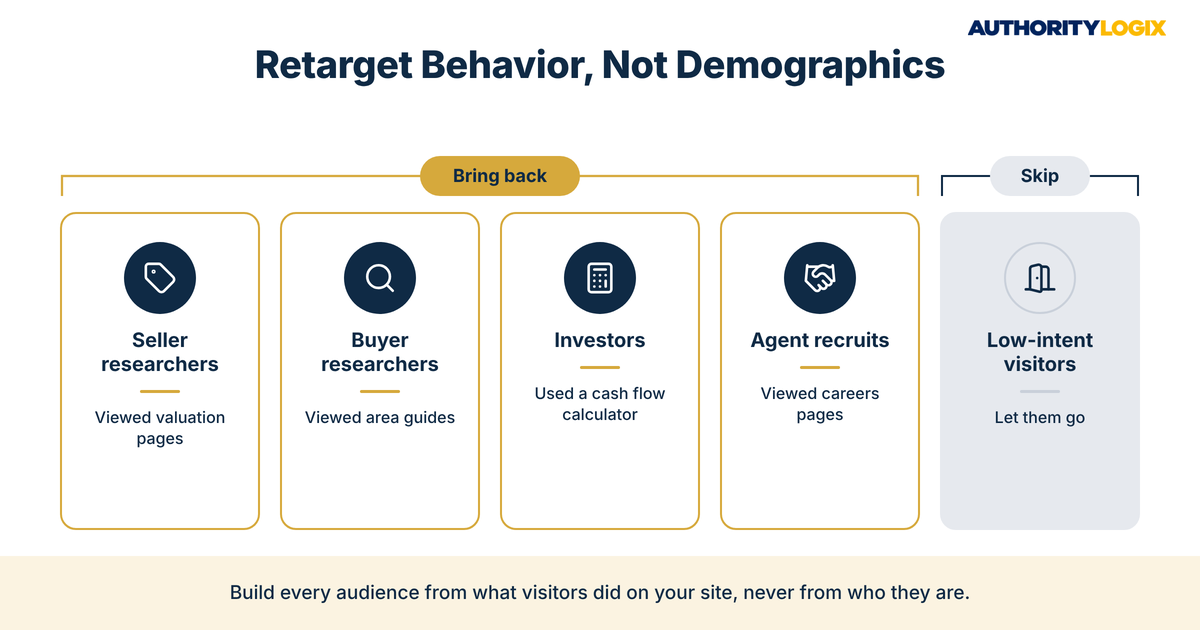
Broker retargeting ads lead recovery starts with a hard decision about who deserves a second impression. Not every visitor is a prospect. Someone who spent several minutes on your seller valuation page is worth far more than someone who bounced off a blog post in seconds, and a real estate website retargeting strategy should spend accordingly.
| Visitor Segment | Signal on Your Site | What a Real Estate Website Retargeting Strategy Shows Next |
|---|---|---|
| Seller researchers | Viewed home valuation or selling guide pages | A local market report or a pricing walkthrough |
| Buyer researchers | Viewed area guides or listing search pages | A buyer guide or a new-inventory alert sign-up |
| Investors | Used a rent, cash flow, or deal calculator | An investor market brief or a deal analysis guide |
| Agent recruits (brokerages) | Viewed careers or join-the-team pages | A training, support, and culture overview |
| Low-intent visitors | One page, a few seconds, no further action | Nothing — let them go and keep the budget for real interest |
The last row matters as much as the first four. Showing ads to everyone spreads the budget thin. Broker retargeting ads lead recovery works by concentrating spend on the visitors whose behavior already says they are evaluating a move, and by keeping the work in your local SEO playbook focused on the same high-intent pages that fill those segments.
Behavior-Based Audiences That Keep a Real Estate Website Retargeting Strategy Inside Fair Housing Rules
Real estate retargeting has a legal dimension most industries never face. Google’s personalized advertising policy says that in the United States and Canada, housing advertisers cannot target audiences using gender, age, parental status, marital status, or ZIP codes. Under the Justice Department’s settlement with Meta, entered on June 27, 2022, Meta stopped delivering housing ads through its Special Ad Audience tool and built a Variance Reduction System to narrow gaps between the audience eligible to see a housing ad and the audience that actually sees it.
The practical answer is to build every audience from what a person did on your site, never from who they are. Page views, tool use, and form starts are behavior; personal characteristics are not yours to segment on. A real estate website retargeting strategy built on behavior is both compliant and more accurate, and the same discipline should govern how authority distribution places your content across other channels and publications.
Agent Remarketing Website Visitors With Content Instead of Repeat Listings
The default approach to agent remarketing website visitors is the listing chase: someone views a home, and that same photo follows them across the internet for weeks. It rarely works, because by then the visitor has usually ruled the home out or found it on a portal.
Content gives a returning visitor a reason to come back that a listing cannot. A monthly market update for the area they browsed, a plain guide to seller closing costs in your state, or a walkthrough of how investors evaluate a two-family property each answers the question that brought them to your site. A real estate website retargeting strategy built on a content system has a steady supply of these assets, so the ads stay fresh without anyone rewriting copy every week.
Supply is the real constraint. Agents and brokers are busy closing deals, and a remarketing program that depends on the principal writing a fresh article each week tends to stall within a quarter. Dedicated content systems turn your market knowledge into a publishing schedule that keeps a real estate website retargeting strategy stocked with assets matched to each audience segment.
Not sure where your firm stands on retargeting? The RE Authority Gap Assessment shows whether your site has the content, capture points, and audiences a real estate website retargeting strategy needs before you spend on ads.
Real Estate Retargeting Lead Generation Across Search, Social, and Email
Real estate retargeting lead generation runs on three channels, and each one does a different job. Search remarketing changes how you bid when a past visitor searches again, social retargeting puts your content in front of them while they scroll, and email follows up with the people who already gave you an address. A real estate website retargeting strategy that uses only one channel leaves the other two open for a competitor.
The platforms give you a long runway. Google Analytics lets you set a remarketing audience’s membership duration anywhere from 1 to 540 days, which matters in a business where a seller may research for months before listing. Set audience windows to match how long decisions really take in your market.
Buyer behavior supports that patient approach. NAR’s 2021 Real Estate in a Digital Age report found that 97% of 2020 homebuyers used the internet in their home search. NAR’s 2025 Profile of Home Buyers and Sellers found 46% of buyers first looked online for properties for sale, and 52% found the home they purchased on the internet. Buyers are online for the whole journey, so the firm that stays visible across it is the one in position when they finally reach out.
Email is the channel most firms underuse. Once a retargeted visitor downloads a guide, the conversation moves from paid impressions to nurture emails you own outright, and each additional touch costs almost nothing. That handoff from ad to inbox is the most valuable step in real estate retargeting lead generation, because it turns a rented audience into an owned one.
Where the visitor lands decides whether the handoff happens. Sending a retargeting click to your homepage wastes it, while sending it to a page inside an educational hub that answers one specific question, with one clear offer, gives the visitor a reason to stay and a reason to subscribe. Your real estate website retargeting strategy depends on those landing pages more than on the ads themselves.
Investor audiences need a different destination than homebuyers. Landlords want numbers, scenarios, and calculators, so purpose-built investor content is the right landing spot for retargeted investors. BKDSCR.com shows the model in a live market: 7 interactive investor tools and 48 SEO-optimized blog posts give every returning investor something new to use, and the platform generates inbound leads with zero paid ads.

Budgeting and Measuring a Real Estate Website Retargeting Strategy
Retargeting budgets are small compared with prospecting budgets because the audience is small. You only pay to reach people who already visited, so the size of your retargeting pool is capped by the traffic your site earns on its own. That is the quiet truth about a real estate website retargeting strategy: it scales with your organic authority, which is why the authority guide belongs in the same planning conversation as the ad budget.
What to Track Once the Ads Are Running
Clicks and impressions are the wrong scoreboard. The numbers that matter are the ones tied to real people moving toward a conversation:
- Return visits from each retargeted audience segment
- Guide downloads, calculator uses, and email sign-ups from returning visitors
- Cost per captured lead compared with your cost per lead from cold traffic
- Consultations and listing appointments booked from retargeted contacts
- How long retargeted contacts take to become conversations
Compare those results against the benchmarks you already pay. If WordStream’s $102.51 average Google cost per lead for real estate is close to what your cold search campaigns cost, a retargeting program that captures leads for less is earning its place; one that costs more is showing the wrong audience or the wrong content. A real estate website retargeting strategy should be judged on cost per conversation, not on how many times the ad appeared.
Measurement also needs the plumbing to work. Tracking tags, consent settings, and CRM connections must be in place before the first ad runs, and the sequence in how we build puts that foundation ahead of any spend. Skipping it leaves you with a real estate website retargeting strategy you cannot evaluate, which means you cannot improve it either.

Retargeting Mistakes That Annoy Prospects and Waste Spend
Retargeting programs in real estate rarely fail for lack of budget. They fail because the setup treats every visitor the same, ignores the rules, or keeps chasing people long after the moment has passed.
Why do my retargeting ads feel like they are following people around?
Without frequency caps or exclusions, the same visitor can see the same ad many times a day, and that reads as pressure rather than expertise. Set caps, rotate creative from your content library, and exclude anyone who has already converted.
Can I retarget people who looked at homes in a specific neighborhood?
You can bring people back based on the pages they viewed, but the targeting itself must not rely on personal characteristics, and Google bars ZIP code targeting for housing ads in the United States and Canada. Keep audiences behavior-based, keep ad copy free of any language about who belongs in an area, and have someone review campaigns against Fair Housing rules before launch. No retargeting campaign is worth a complaint.
Should I keep showing ads to someone who already signed up?
No, and this is one of the most common leaks in a real estate website retargeting strategy. Once a visitor becomes a lead, they belong in your email and follow-up sequence rather than an ad audience, and building that separation into the system is part of what we do for real estate firms. Paying to advertise to your own contacts is money spent twice.
Is broker retargeting ads lead recovery enough on its own?
No. Retargeting can only reach people who already found you, so a site with little traffic has little to recover. Infrastructure compounds. Ads stop.
Where should I start if I have never run retargeting?
Start with the content, not the ads. Pick the questions your best clients asked before they hired you, make sure your site answers them well, and use the resource library to plan the publishing and lead capture pieces that support those pages. Then install tracking, build one behavior-based audience, and test a single campaign before expanding your real estate website retargeting strategy.
Ready to turn the visitors your site already earns into client conversations, with a retargeting system built on content your market actually wants to come back to?
Where Retargeting Fits Next to Organic Authority
Retargeting is a multiplier, not a foundation. It multiplies whatever your site already attracts, which is why the long-term plan in the growth playbook puts organic visibility first and paid reinforcement second. A real estate website retargeting strategy layered on strong local search and a deep content library recovers more visitors each year, because the pool it draws from keeps growing.
BKDSCR.com was built in that order: 18 pillar pages and 48 SEO-optimized posts first, organic investor leads with zero paid ads, all in under 18 months. That record is the reason why AuthorityLogix treats a real estate website retargeting strategy as the last layer of the system rather than the first, built only after there is something worth coming back to.
The honest answer is that most agents, brokers, and investment firms do not have a retargeting problem. They have a visibility problem that retargeting exposes, because there are too few visitors and too little content to bring them back to. Fix the infrastructure first, and a real estate website retargeting strategy becomes what it should be: a quiet, inexpensive way to finish conversations your expertise already started.