


Key Takeaways
- A real estate website SEO audit checks what Google can crawl, index, and trust on your site — the layer clients never see.
- Google’s Page indexing report shows the indexing status of every URL Google knows about, so every real estate website SEO audit starts there.
- Sorted and filtered listing searches create duplicate URLs; canonical tags tell Google which version counts.
- Google’s web.dev guidance sets good page experience at an LCP within 2.5 seconds, an INP of 200 milliseconds or less, and a CLS of 0.1 or less.
- A 12-item agent website audit checklist, reviewed quarterly, catches problems before they cost rankings.
- A real estate website SEO audit finds the problems; fixing them in order and building the pages that earn rankings comes next.
Table of Contents

What Does a Real Estate Website SEO Audit Actually Check?
A real estate website SEO audit examines your site the way Google does — URL by URL — instead of the way a buyer scrolls through it. Your homepage can look polished, yet the search engine may still be skipping large parts of the site. That gap is why the AuthorityLogix real estate industry hub treats a website as infrastructure, not decoration. What potential clients see and what Google sees are two different websites.
Most brokers and team leaders have earned real credibility in their markets. Then someone searches for the exact service they provide and finds a portal or a newer competitor instead. Credible but invisible is the pattern, and a real estate website SEO audit is the first diagnostic that shows whether the website itself is part of the reason.
An audit covers four layers. Crawling asks whether Google can reach every page that matters, indexing asks whether those pages are stored, and page experience asks whether they load fast on a phone. The fourth layer is architecture — how your pages connect — which is the subject of the guide to real estate website structure and the layer most firms never examine. A real estate website SEO audit scores all four before recommending a single change.
What a Real Estate Website SEO Audit Is Not
It is not a design review, and it is not a monthly traffic report. A real estate website SEO audit does not judge your colors, your photography, or your logo, and it does not promise rankings. It produces a prioritized list of technical and structural issues, each tied to a specific page and a specific fix.
Rankings also depend on signals outside the site — reviews, mentions, and the market reputation covered in the authority guide. An audit confirms the website is not working against those signals. It cannot replace them, and any audit that claims otherwise is overselling what a technical review can do.
The Real Estate Local SEO Playbook shows where a real estate website SEO audit fits inside the full local visibility system — site, profile, market pages, and reviews working together.
How Google Crawls a Broker Website (Broker Website Google Crawl Basics)
Every broker website Google crawl follows the same path. Googlebot finds a URL — through an internal link, an outside link, or your XML sitemap — reads it, and follows its links to the next URL. Pages nothing links to are hard to discover, and Search Console labels pages it found but has not crawled yet as “Discovered – currently not indexed.” A real estate website SEO audit maps that path before judging anything else.
Search Console Help notes that new content can take a few days to be indexed, and that indexing is never instant, even when you submit a crawl request directly. That is why content systems that feed each new market page into the site’s internal links matter. Every new page gets a path Google can follow from the day it goes live.
Real estate sites have crawl problems most small business sites never face. IDX feeds generate listing URLs that disappear when properties sell, and saved searches, map views, and sort options each create new variations of the same results. A broker website Google crawl can spend its time there while the market reports that actually win searches wait.
Google’s crawl budget guide is written for large sites — roughly 1 million or more unique pages with content that changes about weekly, or 10,000 or more with content that changes daily. Most broker sites are far smaller, and for them Google says a current sitemap and regular checks of the Page indexing report are adequate. A real estate website SEO audit is not crawl budget theory; it confirms that the pages you care about are the ones Google reaches.
This is where long-tenured brokers get caught. Decades of market knowledge buried behind broken navigation looks exactly like the experienced broker who stays invisible online while younger teams rank. The expertise is on the site. Google just cannot find the path to it.
Real Estate Site Technical SEO: Indexing, Speed, and Duplicate Listing Pages
Real estate site technical SEO comes down to three questions for every important page: is it indexed, is it fast, and is it the only version of itself. A real estate website SEO audit records each answer page by page.
Speed has published targets. Google’s web.dev guidance says that for a good user experience, Largest Contentful Paint should occur within 2.5 seconds, Interaction to Next Paint should be 200 milliseconds or less, and Cumulative Layout Shift should be 0.1 or less, measured at the 75th percentile of page loads. A real estate website SEO audit tests listing and gallery pages first, since they carry the most images.
Why Duplicate Listing Pages Split Google’s Attention
Google defines canonicalization as selecting the representative canonical URL of a piece of content, and names sorting and filtering on category pages as a source of duplicates. On a real estate site, that is every listing search sorted by price or filtered by bedrooms. Google also says some duplicate content is normal and not a violation of its spam policies — the issue is wasted attention, not a penalty.
According to Google, the canonical page is crawled most regularly and duplicates less often, and its crawl budget guide warns that duplicate or unwanted URLs waste a lot of crawling time. An audit identifies which listing variations need a canonical tag pointing to one clean version, which is also the one your educational hub pages and market reports should link to.
Fixing technical issues is sequencing work. Indexing errors come first, then duplicates, then speed, then structural gaps — the order laid out in how we build a real estate authority platform. A real estate website SEO audit that hands you every issue in alphabetical order is a list, not a plan.

Not sure what Google actually sees when it crawls your firm’s website? The RE Authority Gap Assessment shows where your site, pages, and local signals fall short — and what to fix first.
Reading Search Console Like an Auditor: What the Page Indexing Report Tells You
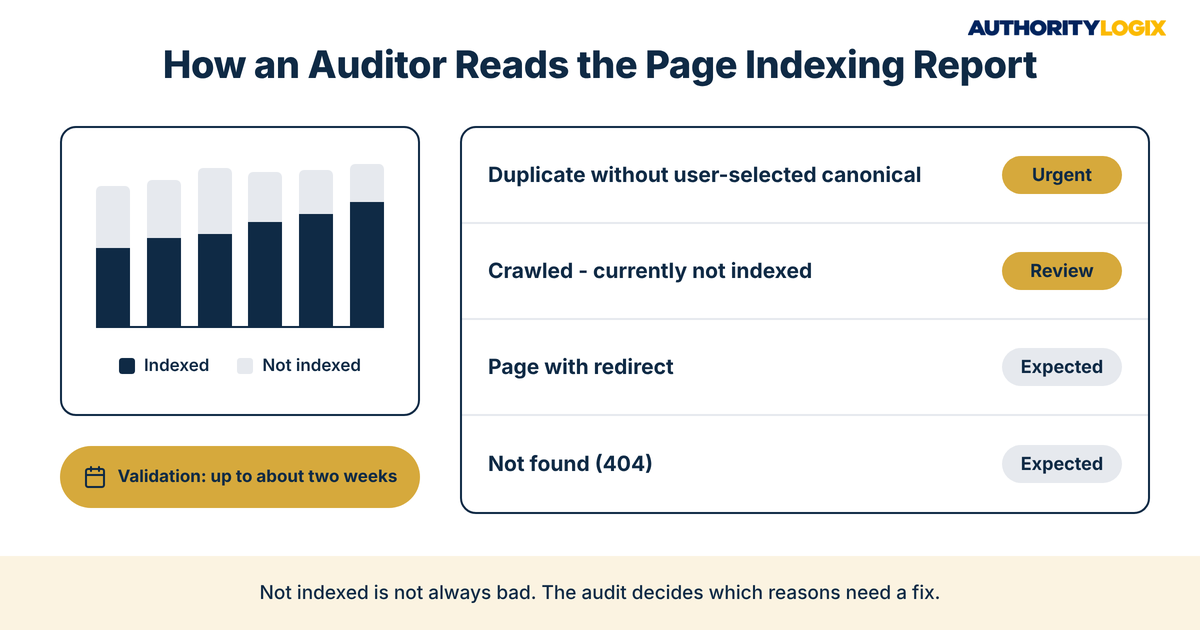
Search Console is the closest thing you have to Google’s own view of your website. According to Google, the Page indexing report shows the Google indexing status of all URLs that Google knows about in your property, and once you fix an issue and start validation, the check typically takes up to about two weeks. Every real estate website SEO audit starts here, because it replaces guesses with Google’s own records.
Which Not-Indexed Reasons Actually Matter in a Real Estate Website SEO Audit
Google’s advice is that not indexed is not necessarily bad, and that the goal is to get the canonical version of every important page indexed. A real estate website SEO audit sorts each reason as expected or urgent, so nobody chases a status that needs no fix. Here is how to read the common ones:
- Alternate page with proper canonical tag — Google says no action is needed.
- Page with redirect — expected for old listing URLs.
- Not found (404) — expected for removed listings, urgent if it hits a live market page.
- Duplicate without user-selected canonical — urgent, because Google is choosing the version for you.
- Crawled – currently not indexed — review it on market pages, since Google read the page and did not store it.
Reading the report is a habit, not a project. The same discipline applies to what you publish — every article in the real estate resource library was planned so that each one has a distinct reason to be indexed. A page with no distinct purpose gives Google no reason to keep it.
When an audit finds market pages stuck as crawled but not indexed, the fix is rarely technical. Those pages usually need more substance, better internal links, or both — the publishing work mapped in the content system blueprint. A real estate website SEO audit can show you which pages Google has read and passed over; only better content changes that verdict.
Investment firm sites face their own version of this. Deal pages and short market blurbs give Google little to keep, while specialized investor content — cash flow breakdowns, market comparisons, financing explainers — gives each page a job. BKDSCR.com, the AuthorityLogix proof-of-concept in the NYC outer-borough DSCR niche, was built that way: 18 pillar pages, 7 interactive investor tools, and 48 SEO-optimized blog posts, each answering a distinct investor question. It ranks for competitive DSCR and NYC real estate keywords with zero paid ads.
The Agent Website Audit Checklist: 12 Items to Review Every Quarter
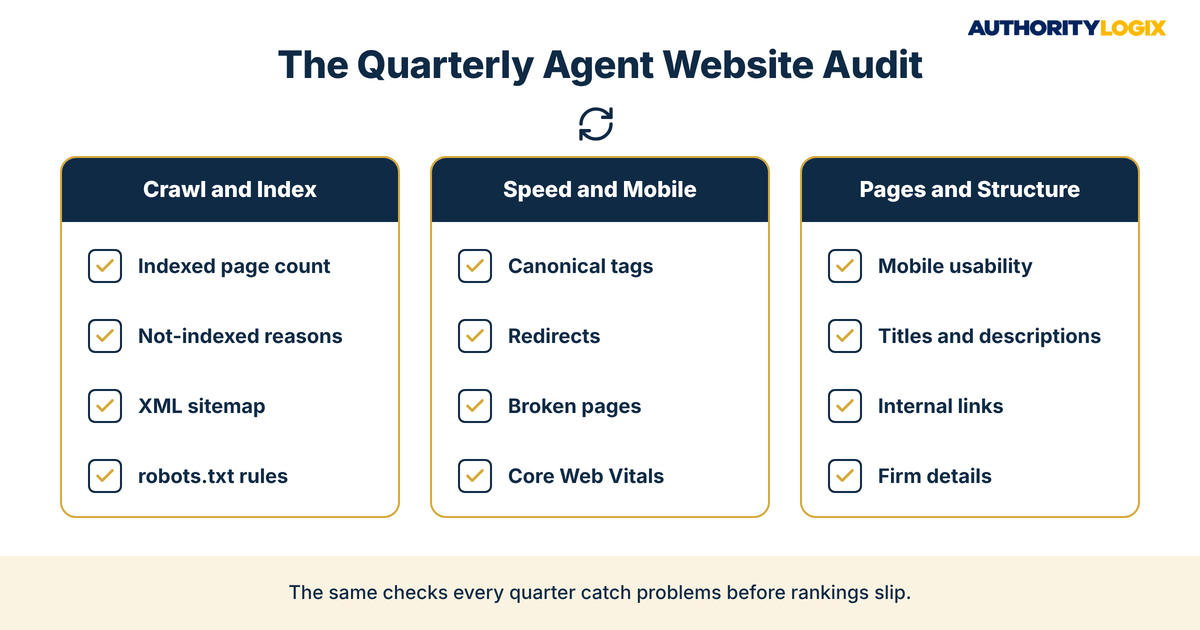
An agent website audit checklist turns a one-time diagnosis into a routine. Google’s guidance for smaller sites is to keep the sitemap current and check the Page indexing report regularly, and a quarterly real estate website SEO audit turns regularly into a date on the calendar. The 12 items below cover crawl, index, speed, and structure, and each one has a clear passing standard.
| Checklist Item | What to Check | What Passing Looks Like |
|---|---|---|
| 1. Indexed page count | Indexed totals against pages you meant to publish | Indexed count tracks your real page count |
| 2. Not-indexed reasons | Every reason listed in the report | No important page under an urgent reason |
| 3. XML sitemap | Submitted, valid, not blocked by robots.txt | Lists only live, canonical URLs |
| 4. robots.txt rules | Disallow lines and blocked folders | Nothing a client should find is blocked |
| 5. Canonical tags | Sorted and filtered listing pages | Variations point to one canonical version |
| 6. Redirects | Old listing and agent URLs | One hop to a relevant page, no chains |
| 7. Broken pages | Removed listings and departed agent bios | Redirected or removed from internal links |
| 8. Core Web Vitals | LCP, INP, and CLS on mobile and desktop | Within the good thresholds above |
| 9. Mobile usability | Forms, maps, and galleries on a phone | Every key action works with a thumb |
| 10. Titles and descriptions | Market, service, and neighborhood pages | Unique, and each names its market |
| 11. Internal links | Every market and neighborhood page | Linked from at least one other page |
| 12. Firm details | Name, address, and phone on the site | Identical to your Google Business Profile |
Two items reach beyond the website. Your firm’s details have to match everywhere they appear, and the mentions earned through authority distribution should land on pages that still exist and still load. A real estate website SEO audit checks that the site agrees with what the rest of the web says about you.
Most firm owners do not have time to run this checklist, and they should not have to. Your job is the market knowledge; keeping the infrastructure healthy is what we do for brokers, agents, and investment firms that have the expertise but not the hours. Either way, the standard holds: every item passes, every quarter.
Where Real Estate Website SEO Audit Work Goes Wrong (and Common Questions)
Most failed audits are not wrong about the problems they find. They go wrong in what happens next, or in what the firm expected. These are the questions brokers ask most.
Is an automated SEO tool score the same as an audit?
No. Automated tools produce long lists of generic warnings, many irrelevant to a real estate site. A real estate website SEO audit uses those tools as inputs, then judges which issues affect the pages that actually produce client conversations.
Why do some audits never produce leads?
Because an audit only removes obstacles. A site Google can crawl and index still needs a reason for a visitor to raise a hand — a valuation request, a market report sign-up, a consultation path — and that is the job of lead generation infrastructure built on top of a clean site. Fixing the foundation without building that layer leaves you with a healthier site and the same quiet inbox.
How often should a real estate website SEO audit happen?
A full real estate website SEO audit once a year and the agent website audit checklist every quarter suits most broker sites. Add a review after any redesign or IDX change. Google notes it can take a week or so to start crawling and indexing a new page or site, so give changes time before judging them.
Can a better website replace referral business?
It should add to referrals, not replace them. NAR’s 2025 Profile of Home Buyers and Sellers found that 88% of buyers and 91% of sellers used a real estate agent or broker, so the question is not whether clients hire agents — it is which agent they find first. A sound website is one piece of the inbound lead generation system that builds a second pipeline alongside your referral network.
Want a website Google can crawl, index, and trust — one that turns the searches it earns into client conversations? Let’s fix the technical foundation and build the market pages on top of it.
What an Audit Can and Cannot Fix for Your Firm
An audit can tell you why Google is skipping pages, which duplicates split its attention, and which templates are slow on mobile. It cannot write market reports or earn the reviews that give Google a reason to rank you above a portal. A real estate website SEO audit is the diagnosis; the system built afterward is the treatment.
That system keeps paying off when it is maintained. A clean, crawlable site makes every new page easier for Google to find, which is why the growth playbook treats technical health as the floor under every other growth investment. Authority compounds — but only on a foundation Google can read.
The honest answer is that most real estate firms do not have an expertise problem. They have a gap between what they know and what Google can see, and closing it starts with a real estate website SEO audit, fixed in the right order. That sequence is our approach on every build, because skipping the diagnosis is how firms end up paying for the same website twice.