

Key Takeaways
- Physical therapy website abandonment — visitors who land on the practice site, do not call or submit a form, and leave — is the conversion failure most practices cannot see on any report but that costs them significant patient revenue every month.
- The average healthcare website converts only about 2–3% of visitors into inquiries, per First Page Sage’s patient conversion report. Most PT practices have enough website traffic — the problem is that roughly 97–98% of visitors leave without taking action.
- 75% of patients refuse to book with a provider rated below 4.0 stars, per rater8’s 2026 Patient Choice Report. 55% have already walked away from a provider because of online reviews — up from 40% just nine months earlier.
- 53% of mobile visitors abandon a site that takes longer than 3 seconds to load. The average healthcare website takes 5.6 seconds on mobile — nearly double the threshold. Slow load speed is the single most common invisible conversion killer.
- Many patients prefer online booking when given the option. Yet Accenture found only 2.4% of patients used online self-scheduling where health systems offered it. A practice without online scheduling is asking patients who prefer not to call to do something they would rather avoid.
- Abandonment has three primary causes — trust signals, booking friction (including unclear next steps), and thin clinical content — and each has a specific, implementable fix that does not require redesigning the entire website.
Table of Contents
Physical therapy website abandonment is the revenue loss that happens in silence. A prospective patient finds the practice through a Google search or a GBP click, visits the website, and leaves without calling, without filling out a form, and without booking. From the practice’s perspective, the visit never happened. From the patient’s perspective, the practice failed to answer the question they came with — and a competitor answered it instead.
The acquisition playbook identifies website conversion as one of the five owned acquisition systems. This article covers the specific reasons PT practice websites lose visitors who arrived with intent — and the targeted fixes that recover those conversions without a full site rebuild.
The scale of the problem is significant. The average healthcare website converts only about 2–3% of visitors into inquiries, per First Page Sage. For a PT practice receiving 500 website sessions per month, that means 475 to 490 visitors leave without any contact — many of them prospective patients who found the practice for a relevant condition and had real intent to book. The lead generation systems system addresses the full conversion infrastructure, but the starting point is understanding exactly why those visitors are leaving. How the full acquisition pipeline generates the traffic that arrives at the website is mapped in the patient acquisition pipeline guide. For a deeper treatment of this topic, see the acquisition playbook.
Why Physical Therapy Patients Leave Without Booking: The Three Causes
PT website abandonment has three primary causes: missing or insufficient trust signals, booking friction (including unclear calls to action), and thin or generic clinical content. Most PT practices have at least two of these working against them simultaneously — which compounds the conversion loss significantly. Practices that address all three causes typically see stronger conversion than those that address only one or two. The content systems provides additional context on this topic, particularly for practices still building out this part of their system.
Practices tracking website abandonment can also review the educational hub for additional benchmarks. Comparing your exit-page data against those benchmarks usually reveals which of the three causes is doing the most damage.
Each of the three causes operates at a different point in the visitor’s brief decision process. Trust signal gaps cause abandonment in the first 10 seconds — before the patient reads a word. Thin clinical content causes abandonment mid-visit — after the patient reads enough to realize their specific condition question is not answered.
Friction causes abandonment at the action moment — when the patient is ready to contact and the path to doing so is harder than expected. Unclear CTAs, the last-step form of booking friction, cause abandonment at the conversion point — when the patient is willing to act but cannot identify what action to take. For the related AuthorityLogix implementation framework, see lead generation.
How Physical Therapy Website Abandonment Differs From Bounce Rate
Bounce rate measures the percentage of visitors who leave after viewing only one page. Abandonment in the conversion sense is broader — it includes visitors who view multiple pages, spend meaningful time on the site, and still leave without contacting the practice. A patient who reads the homepage, clicks to a condition page, reads the FAQ, and then closes the tab without calling is not a bounce. They are an abandonment — a visitor with high intent who encountered a barrier at the conversion moment that prevented them from acting. The acquisition playbook provides additional context on this topic.
Tracking abandonment requires mapping conversion events in Google Analytics 4 — specifically, monitoring which pages patients visit immediately before leaving the site without completing a contact form or click-to-call event. The pages with the highest pre-exit traffic are the abandonment points. Fixing those specific pages — rather than rebuilding the entire site — is the targeted approach that recovers conversion most efficiently. The education guide covers how condition page structure affects both abandonment rate and the clinical credibility signals that keep high-intent visitors engaged.

The Physical Therapy Patient Acquisition Playbook covers how practices keep website visitors moving toward a booked evaluation instead of leaving.
Cause 1: Missing Trust Signals That Make Patients Feel Safe Booking
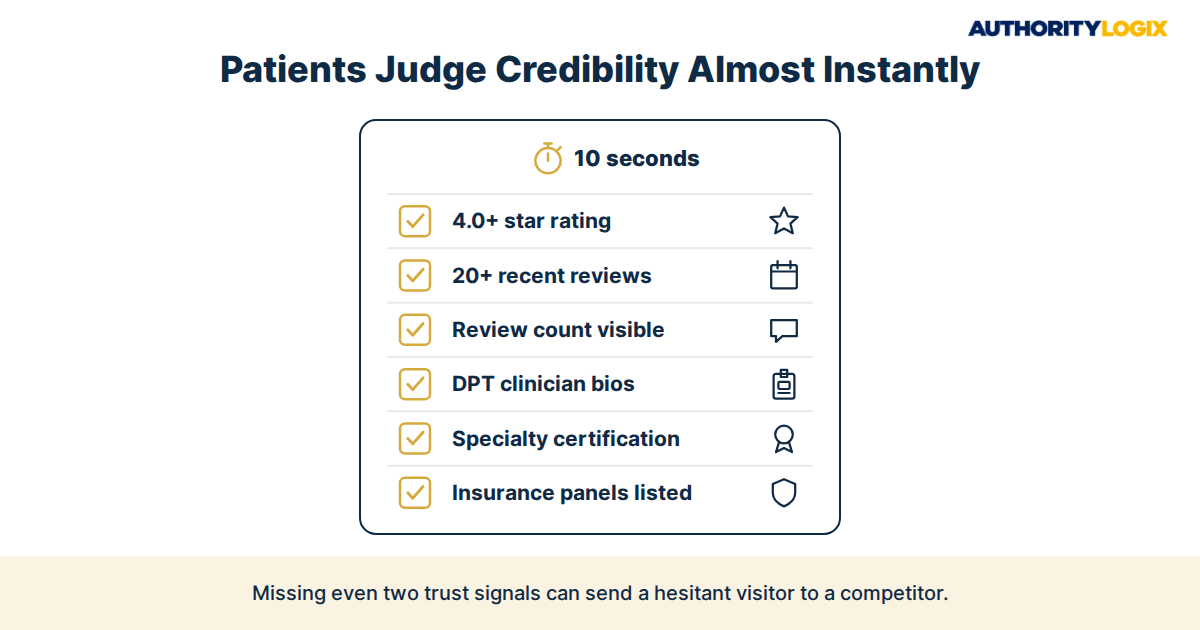
Trust signal gaps are the most common cause of early-session abandonment. A patient who lands on a PT practice website and does not immediately see evidence of credibility — a strong star rating, recent reviews, named clinicians with credentials, and recognizable professional affiliations — experiences uncertainty within the first 10 seconds. That uncertainty does not always produce immediate departure. Sometimes it produces a brief scan of the site followed by a decision not to book, which looks like a long session with no conversion rather than a quick bounce. For a deeper treatment of this topic, see the patient acquisition pipeline.
Per rater8’s 2026 Patient Choice Report, 75% of patients refuse to book with a provider rated below 4.0 stars, and 55% have already walked away from a provider because of online reviews. These are not marginal effects — they represent the majority of prospective patients making an active decision not to book based on what they see before the first appointment. A practice with a 3.8-star average or fewer than 15 reviews is losing the majority of the motivated visitors it attracts.
The Trust Signals That Matter Most
The trust signals that most directly prevent abandonment are: a Google star rating above 4.0 with at least 20 recent reviews, a Google review widget or review count displayed on the homepage, named clinician bio pages with DPT credentials and specialty training documented, a recognizable professional affiliation (APTA membership or specialty certification), and clear insurance information that tells patients whether their coverage is accepted before they have to call to find out. Missing even two of these is usually enough to send a hesitant visitor looking elsewhere.
Insurance information specifically is a consistent abandonment driver. Patients who cannot confirm their insurance is accepted within the first visit assume the practice is out of network — and leave to find one that displays insurance information clearly. Displaying the accepted insurance panels on the homepage and every condition page eliminates this specific uncertainty without requiring any interaction from the patient. The PT Authority Gap Assessment → assessment audits all visible trust signals against local competitor standards to identify which gaps are producing the most abandonment. For a deeper treatment of this topic, see the education guide.
Not sure which trust signals your practice’s website is missing?
Cause 2: Booking Friction That Stops Motivated Patients at the Action Moment
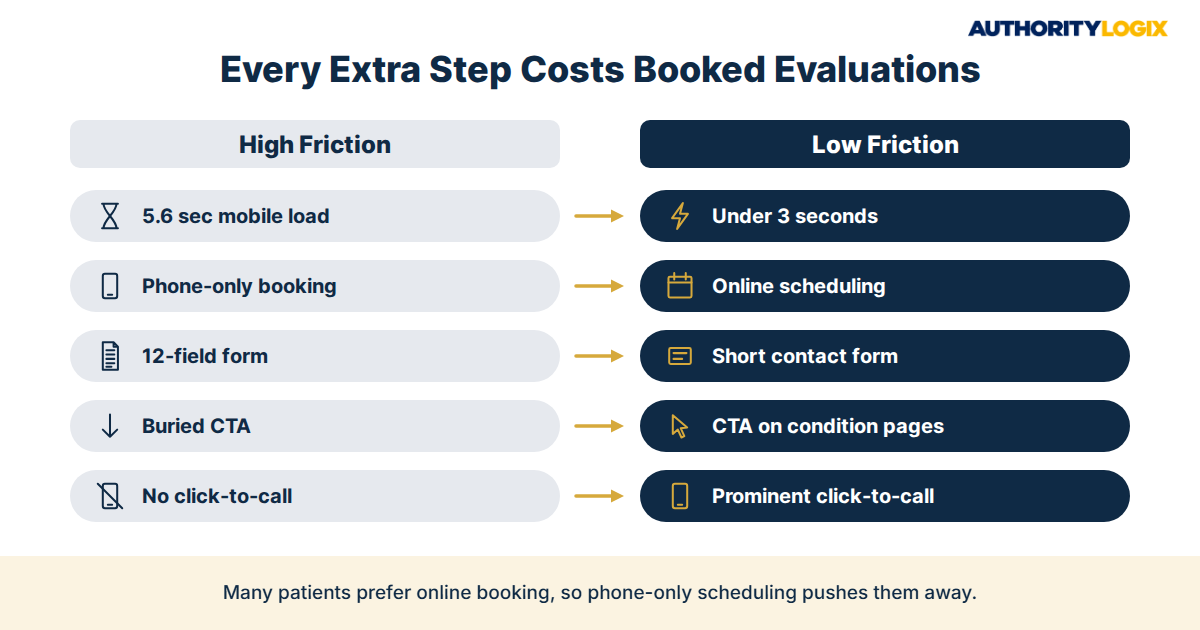
Booking friction abandonment happens at the precise moment when a patient has made a positive evaluation decision and attempts to initiate contact — and finds the path more difficult than their motivation to overcome it. This type of abandonment is the most costly because it occurs only among patients who were actually ready to book. A patient who closes a tab because the contact form requires 12 fields of information before confirming availability was not lost to a trust gap — they were lost to a friction barrier at the moment of highest intent.
Mobile Load Speed as the Primary Friction Factor
53% of mobile visitors abandon a site loading over 3 seconds. Google research with SOASTA found that 53% of mobile visits are abandoned when a page takes longer than three seconds to load — a threshold many healthcare websites still miss. For a PT practice where most searches occur on mobile, a slow-loading website is the most consistently active conversion killer — operating invisibly on every visit, eliminating the patients who would have booked before they ever reach the trust signal or content evaluation stage.
Mobile load speed is measured and improved through Google PageSpeed Insights — a free tool that identifies which specific elements are causing load delays. The most common contributors to slow healthcare site load times are uncompressed images, unused JavaScript, and third-party plugin overhead. Each can be addressed without a full site redesign. The content playbook covers how mobile page speed intersects with SEO ranking — making load time improvement both a conversion and a visibility investment.
The Online Scheduling Gap
Many patients prefer to book appointments online when given the option. Yet Accenture found only 2.4% of patients used online self-scheduling where health systems offered it — representing a massive gap between patient preference and practice infrastructure. 61% of patients have skipped doctor appointments altogether due to scheduling challenges, including being directed to book over the phone, per Notable’s patient survey. To diagnose this issue in your own practice, use the authority gap assessment.
For a PT practice, every patient who prefers online scheduling but finds only a phone number is at elevated abandonment risk — particularly if the call requires navigating a hold queue or leaving a message. Adding online scheduling does not replace phone booking — it adds a parallel path that captures the patients who prefer it. The local visibility guide covers how an online booking link integrated into the GBP profile captures high-intent map pack visitors before they ever visit the website.
Cause 3: Thin Clinical Content That Fails to Answer the Patient’s Core Question
Thin clinical content abandonment occurs when a patient visits the site with a specific condition question — “Does this practice treat my rotator cuff injury?” — and the website’s answer is a generic services page listing “shoulder pain” without any clinical depth. The patient cannot confirm the practice has specific expertise with their condition, cannot find any content that answers their questions about the treatment process, and cannot identify a clinician whose documented training matches their needs. They leave to find a practice that can answer what they came to learn.
The content fix is condition-specific pages with genuine clinical depth — not keyword-stuffed landing pages, but real educational content attributed to named DPTs that explains what the practice’s approach to the condition involves, what the evaluation covers, and what a patient with this specific condition can expect from treatment. This content serves both the abandonment prevention function and the SEO ranking function. The education guide covers the E-E-A-T content standards that satisfy both patient evaluation needs and Google’s healthcare content quality requirements simultaneously. For a deeper treatment of this topic, see the lead generation funnel.
FAQ Content as Abandonment Prevention
A patient FAQ page that answers the five most common pre-booking questions — What does a first PT evaluation involve? Do I need a referral? Does my insurance cover PT? How many sessions will I need? What should I bring? — removes the uncertainty that drives significant abandonment volume. Patients who cannot find answers to these questions on the practice website do not call to ask. They leave and find a practice whose website answers them proactively. How the full lead generation funnel works is covered in the lead generation funnel guide.
FAQ content also improves organic search performance — FAQ pages rank for the question-format queries patients search when researching PT before their first contact. A practice whose FAQ page appears in Google for “do I need a referral for physical therapy near me” is capturing a patient at the exact moment of pre-booking uncertainty — and answering that uncertainty before the patient has a reason to leave. The lead generation system includes the FAQ page framework mapped to the specific questions most associated with pre-booking abandonment in PT practices.
FAQ: Fixing Physical Therapy Website Abandonment
How do I find out where patients are abandoning my PT website?
Google Analytics 4 tracks exit pages — the last page viewed before a session ends without a conversion event. Set up conversion tracking for form submissions and click-to-call events, then examine the exit pages with the highest traffic and zero conversions. Those are the abandonment points. Pages with high time-on-page but no conversion are mid-funnel abandonment — patients who engaged but left without acting. The authority gap assessment includes a website conversion audit that identifies the specific pages and elements producing the most abandonment. For the related AuthorityLogix implementation framework, see local search service.
Is a website redesign necessary to fix abandonment?
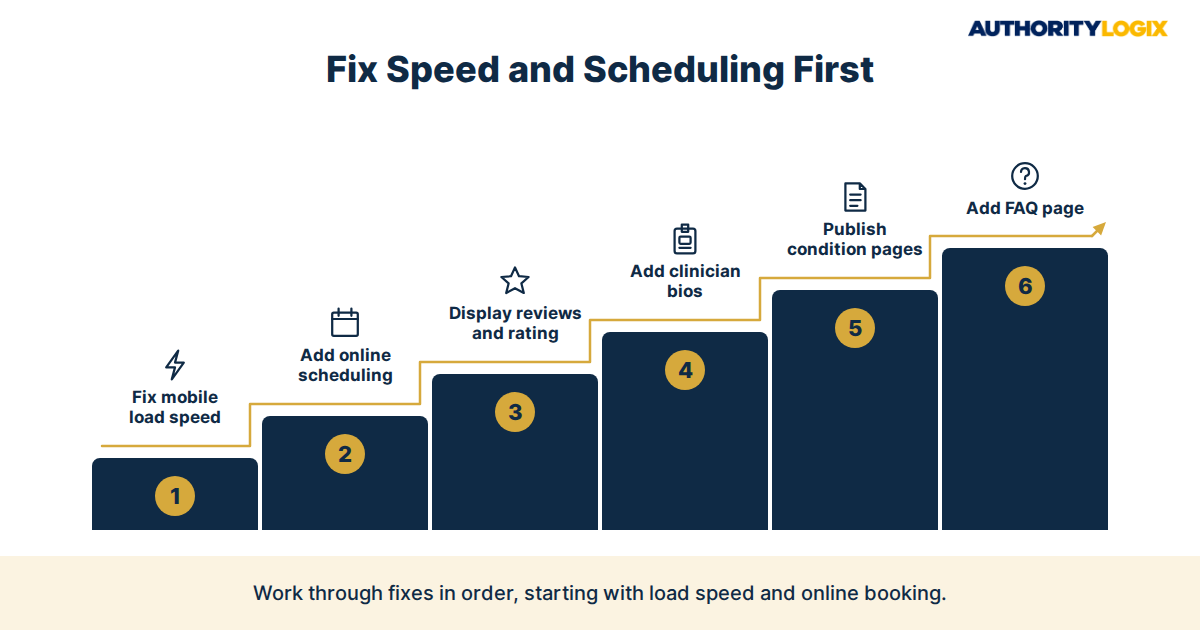
Rarely. Most abandonment is caused by specific, targeted gaps — a slow mobile load, a missing contact form on the condition page, a thin reviews section, a buried phone number — that can be fixed without redesigning the entire site. A full redesign addresses everything simultaneously but costs significantly more time and money than targeted fixes applied to the specific pages where abandonment is occurring. The faster and more efficient path is auditing exit pages, identifying the specific barrier at each, and fixing those elements individually. The acquisition playbook maps the prioritized conversion fix sequence for PT practices.
How many reviews does a PT practice need to prevent trust-signal abandonment?
47% of consumers will not consider a business with fewer than 20 reviews, per BrightLocal — making 20 the minimum threshold below which trust-signal abandonment is categorical. In competitive markets, practices ranking in the local map pack typically have 80–150 reviews. Beyond volume, recency is a separate trust factor: 32% of consumers want reviews from the last two weeks, per BrightLocal. A practice with 20 reviews published in the last 90 days converts better than one with 60 reviews where the most recent is four months old. The local visibility guide covers the review generation system that produces consistent volume and recency simultaneously.
Does improving website speed actually increase booked evaluations?
Yes — directly and measurably. Conversion drops 4.42% for every additional second of load delay. A practice that reduces mobile load time from 5.6 seconds to 2.8 seconds is removing the abandonment trigger for more than half of mobile visitors who currently leave before the page finishes loading. For a practice receiving 300 mobile visits per month, that is over 150 visitors who previously abandoned before seeing any content at all. Digital infrastructure investment — including website performance — is among the highest-ROI improvement areas for independent PT practices focused on patient acquisition efficiency.
For the full specialty framework, visit the PT resources hub. It covers every abandonment-prevention system in one place.
Recovering From Physical Therapy Website Abandonment: Patients Who Came Ready to Book
Physical therapy website abandonment is not a traffic problem — it is a conversion infrastructure problem. The patients are arriving. The intent is there. The abandonment is happening because specific, fixable barriers between a patient’s intent and the booking action are not yet resolved. Each of the three causes has a targeted fix that does not require rebuilding the entire practice website from scratch. The local search service builds the visibility infrastructure that drives qualified traffic to the practice website.
The Insight Articles in the Patient Acquisition library go deeper on every conversion element — from trust signal building and mobile optimization to online scheduling implementation and FAQ content strategy. The PT resources hub organizes the full library so practice owners can move directly to the specific abandonment cause they are fixing today. The referral dependence offers additional context on this area. The PT industry hub demonstrates how the five-system framework — content, local search, patient education, lead generation, and authority distribution — keeps website visitors moving toward a booked evaluation.
Ready to fix the website gaps that send patients away without booking?