Key Takeaways
- Physical therapy patient education is the primary mechanism through which practices build clinician trust before a patient ever walks through the door.
- Google classifies PT websites as YMYL — Your Money or Your Life — content, subjecting them to its most rigorous E-E-A-T scrutiny. Practices without visible clinical authority lose search visibility to those that have built it.
- Medical websites with strong E-E-A-T signals tend to earn substantially more organic traffic than those with weak signals.
- Roughly 70% of PT patients do not attend all of their authorized visits — patient education that begins before the first visit reduces anxiety, improves adherence, and drives better clinical and business outcomes.
- Clinician bio pages, condition-specific content, FAQ pages, and treatment explanation pages are not marketing add-ons — they are the trust infrastructure that determines whether a patient chooses your practice.
- The four E-E-A-T dimensions — Experience, Expertise, Authoritativeness, and Trustworthiness — each require specific content signals that PT practices can build systematically.
- Patient education content doubles as SEO infrastructure: condition and treatment pages that answer patient questions rank for the searches that bring direct-access patients to the practice.
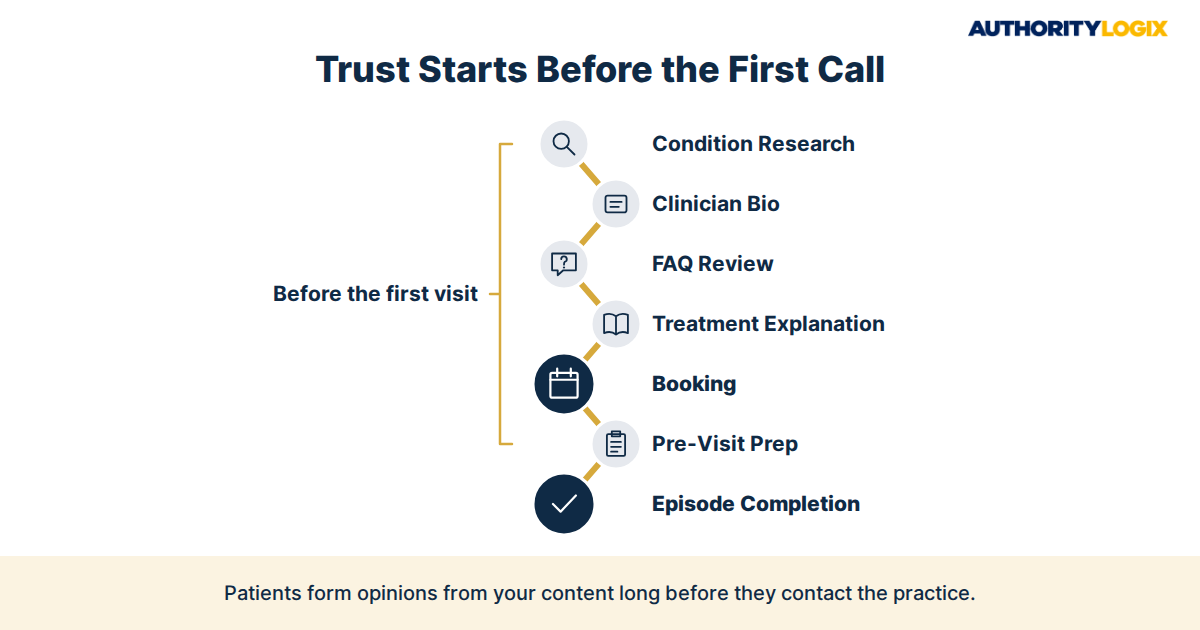
Physical therapy patient education is the mechanism through which PT practices build clinical authority — and clinical authority is what determines whether a prospective patient trusts a practice before the first visit. In 2026, patients do not wait until they arrive to form opinions about their physical therapist. They research conditions, read clinician bios, evaluate treatment explanations, and compare FAQ pages before they ever make a call. The practices that have built a visible patient education infrastructure — connected to a working lead generation system — are the ones that win that research process.
The competitive stakes are higher than most PT practice owners realize. Google classifies physical therapy websites as Your Money or Your Life content — YMYL — meaning the search algorithm applies its most rigorous quality evaluation to every page on the practice’s site. That evaluation is governed by the E-E-A-T framework: Experience, Expertise, Authoritativeness, and Trustworthiness.
Practices without visible clinical authority signals — credentialed author bios, cited educational content, structured condition pages — are systematically disadvantaged in search rankings compared to those that have built them. Local search visibility, covered in the local visibility guide, compounds directly on top of these E-E-A-T signals.
This guide maps the complete patient education and clinical authority system for PT practices: what E-E-A-T requires, how to build the content infrastructure that satisfies both Google and patients, and how to turn educational content into a direct-access patient acquisition asset that compounds over time. It connects directly to the educational hub system built for physical therapy practices. For the related AuthorityLogix implementation framework, see
lead generation.
Why Physical Therapy Patient Education Determines Clinical Authority
A patient researching physical therapy for lower back pain is not yet a patient. They are a prospective patient making a trust decision — and most of that decision happens online, before any human interaction with the practice. They are reading about their condition, evaluating which clinicians appear qualified to treat it, and comparing the depth and clarity of educational content across the practices they find. The practice whose website answers their questions most clearly and credibly is the one that earns the call.
This is the patient education opportunity that most PT practices leave unrealized. The practice has clinical expertise — deep knowledge of how to treat the conditions it sees every day. But that expertise is invisible to prospective patients unless it is translated into accessible, credible educational content and attributed to qualified clinicians. Patient education is not an add-on to clinical care. It is the mechanism by which clinical authority becomes visible and persuasive before the first appointment.
The pre-visit content touchpoint has become critical, per TopDoctor Magazine’s 2026 healthcare content analysis: patients now research conditions, compare providers, and form opinions long before contacting a healthcare organization. Educational content is the primary trust-building mechanism at that pre-visit stage — and practices without it are absent from the most important part of the patient decision process.
The Physical Therapy Patient Education Completion Problem
Patient education’s value does not end at acquisition. Roughly 70% of PT patients do not attend all of their authorized visits, per WebPT’s analysis of Strive Labs claims data. Incomplete episodes of care reduce outcomes, reduce revenue per patient, and reduce the likelihood of positive reviews and referrals. Patient education that begins before the first visit — setting clear expectations about the treatment process, the timeline for improvement, and the role of home exercise adherence — reduces anxiety, improves engagement, and drives episode completion rates that directly affect practice revenue.
A 2025 meta-analysis of 69 randomized controlled trials found that education combined with rehabilitation reduces short-term pain, disability, and fear of movement in adults with subacute and chronic musculoskeletal conditions. A JBI systematic review found that teach-back interventions improved adherence and self-efficacy in adults with chronic conditions, an approach that translates directly to physical therapy home programs. For a deeper treatment of this topic, see the
local visibility guide.
Clinical authority grows fastest when patients can find it. The Physical Therapy Content SEO Playbook covers how practices structure educational content so it ranks for the questions patients search.
Content SEO Playbook →
Physical Therapy E-E-A-T: What Google Requires and Why It Matters
Google’s E-E-A-T framework — Experience, Expertise, Authoritativeness, and Trustworthiness — is the quality evaluation standard applied by Google’s human quality raters to every page on a PT practice’s website. It is not a direct ranking factor, but it strongly influences how Google’s algorithms assess and rank healthcare content. Practices that fail to demonstrate E-E-A-T consistently lose search visibility after core algorithm updates — and healthcare sites, as YMYL content, experience this effect more severely than general-interest websites.
The consequence is measurable. Medical websites with strong E-E-A-T signals tend to earn substantially more organic traffic than those with weak signals. Practices without structured E-E-A-T content lost visibility following Google’s 2024–2025 Helpful Content updates.
Experience: Demonstrating Real Clinical Practice
The Experience dimension of E-E-A-T refers to firsthand, real-world knowledge gained through actual practice. For a PT clinic, this means content that reflects genuine clinical experience: case patterns the clinicians have treated, observations about how patients respond to specific interventions, insights that could only come from someone who has worked with real patients in real clinical settings. In 2025, Google’s quality framework updated to value firsthand knowledge on par with formal credentials for this dimension.
A blog post written by a licensed DPT who has treated hundreds of patients with rotator cuff dysfunction demonstrates Experience in a way that generic overviews do not — and
Google’s guidelines explicitly reward this firsthand clinical authorship on YMYL content. Content should be written or reviewed by the clinicians who actually treat the conditions described — not outsourced to generic health writers. For the related AuthorityLogix implementation framework, see educational hub.
Expertise: Credentials That Are Visible and Specific
Expertise is demonstrated through formal qualifications, specialty certifications, and documented clinical training. For PT practices, this means clinician bio pages that go beyond a name and a degree: the specific DPT program completed, specialty certifications (OCS, SCS, CSCS, FAAOMPT, and similar), post-graduate residency or fellowship training, years of experience in specific condition areas, and any published research or professional presentations.
Google’s guidelines explicitly require visible author credentials on YMYL content. Every condition page, treatment explanation, and educational article should carry a byline linked to the treating clinician’s full bio — not a generic “staff writer” attribution. The PT industry hub outlines the full credentialing and content infrastructure framework.
Authoritativeness: Being Recognized as the Source
Authoritativeness is built through external recognition — citations, backlinks from reputable sources, professional reputation that extends beyond the practice’s own website. For a PT practice, authoritative signals include: being listed in professional directories maintained by APTA or state associations, having educational content cited or linked by other health websites, being quoted in local media as a clinical expert, and maintaining an active profile on platforms like Healthgrades and Zocdoc that patients use to evaluate providers.
The content architecture that builds authoritativeness over time is a pillar-cluster structure — mapped in detail in the content playbook — with comprehensive cornerstone guides on the conditions the practice specializes in, supported by more specific articles that address particular patient questions and link back to the cornerstone. This structure signals to Google that the practice is a depth-of-knowledge resource on specific condition areas — not a surface-level site that covers everything shallowly.
Trustworthiness: Signals That Reassure Both Google and Patients
Trustworthiness encompasses the operational and technical signals that Google uses to evaluate whether a practice’s website is honest, transparent, and safe: HTTPS security on every page, accurate and consistent NAP data matching the Google Business Profile, a clear About page that identifies the practice and its clinicians, visible privacy policy and HIPAA compliance statements, and accurate contact information. Trustworthiness also includes review signals — a steady volume of authentic, detailed patient reviews on Google is one of the clearest trust signals available to a PT practice, as documented in the BrightLocal 2026 Local Consumer Review Survey. For the full specialty framework, visit the
PT industry hub.

Building the Physical Therapy Patient Education Content System
Patient education for a PT practice is not a collection of blog posts. It is a structured content system with four distinct content types, each serving a specific role in the patient decision process and in search visibility. The practices that build all four types create a compounding educational asset — one that captures patient searches at every stage of the research process and builds clinical authority with every page. This is the foundation of the educational hub development system.
Content Type 1: Condition Pages
Condition pages are the highest-value patient education assets a PT practice can build. A condition page answers the questions a patient with that condition is asking before they see a provider: what is this condition, what causes it, what are the symptoms, how does physical therapy help, what does treatment involve, and how long does recovery take. These pages target the high-volume condition searches that direct-access patients conduct — “physical therapy for lower back pain,” “PT for rotator cuff injury,” “physical therapist for knee osteoarthritis” — and they convert that search traffic into booked evaluations.
The content architecture of a high-performing condition page: a clear H1 targeting the primary condition keyword, an opening that frames the patient’s problem, sections covering the condition itself, PT’s role in treatment, what sessions look like, and what outcomes to expect. The page should be attributed to a licensed DPT with the credentials to address the condition, and every factual claim should be supported by a cited source from APTA, peer-reviewed research, or a recognized clinical guidelines organization. The content playbook covers the full condition page SEO architecture.
Content Type 2: Clinician Bio Pages
Clinician bio pages are the most underinvested E-E-A-T asset in physical therapy marketing. A one-paragraph bio with a headshot does not satisfy Google’s quality rater guidelines for YMYL content, and it does not satisfy patients who are evaluating whether a specific therapist has the right background to treat their specific condition.
A complete clinician bio page for a PT should document: the DPT program and graduation year, specialty certifications with their issuing organizations, any post-graduate residency or fellowship training, clinical focus areas with specific conditions treated, years of experience in each focus area, and any publications or presentations. Visible clinician credentials help build patient confidence before the first appointment. This level of documented expertise is what Google’s framework requires for YMYL content and what patients need to make an informed provider choice. For a deeper treatment of this topic, see the content playbook.
Content Type 3: Treatment Explanation Pages
Treatment explanation pages answer the questions patients ask about specific interventions: what is manual therapy, what does dry needling involve, how does aquatic therapy work, what is neuromuscular re-education. These pages serve two functions simultaneously: they build patient confidence by demystifying clinical procedures before the first visit, and they capture search traffic from patients researching specific treatment approaches.
Treatment pages should be written at the patient literacy level — clear, practical, and free of unexplained clinical jargon. Every treatment page should reference the conditions for which the treatment is most applicable, link to the relevant condition pages, and include a clear call to action toward scheduling an evaluation. Treatment pages attributed to the specific clinicians who perform those treatments carry significantly stronger E-E-A-T signals than generic content — and, when distributed through the authority distribution system, reach referral sources and patient communities beyond organic search.
Content Type 4: Patient FAQ Pages
FAQ pages capture the exact questions patients type into Google before they contact a practice: “Do I need a referral for physical therapy?” “How many sessions will I need?” “What should I bring to my first PT appointment?” “Does insurance cover physical therapy?” These are high-intent, high-conversion search queries that practices with FAQ content consistently capture and practices without it consistently miss. The local visibility guide covers how FAQ content also improves Google Business Profile performance through the Q&A feature.
FAQ content also serves AI search answer eligibility. Google’s AI Overviews and conversational AI tools preferentially pull from structured, question-and-answer formatted content when generating responses to patient queries. A PT practice with a well-structured FAQ section is significantly more likely to be cited in AI-generated search answers than one that addresses the same topics in paragraph form. For the related AuthorityLogix implementation framework, see
authority distribution.

Clinical Authority and Physical Therapy Patient Acquisition
Patient education content is not separate from patient acquisition — it is a primary patient acquisition channel. A prospective patient researching rotator cuff rehabilitation who finds a comprehensive, credentialed condition page from a local PT practice is substantially more likely to book with that practice than one they find through a generic directory listing. The educational content answers their questions, demonstrates clinical expertise, and removes the uncertainty that prevents many prospective patients from booking a first appointment.
This is the direct-access opportunity that clinical authority content unlocks. With all 50 states now allowing some form of direct access to physical therapy services, patients can self-refer to PT before seeing a physician. The practices positioned to capture that demand are the ones whose educational content appears when direct-access patients search for answers to their specific condition questions. The acquisition playbook covers the full patient acquisition system, of which patient education is one critical component.
Clinician Authority and Referral Source Confidence
Patient education content also influences physician referral behavior. Referring physicians increasingly research PT practices online before deciding where to send their patients. A practice with deep, credentialed condition content, clear clinician bios that document specialty training, and visible professional affiliations gives referring physicians the evidence they need to feel confident in the referral. A practice with a thin website and no educational depth does not — even if the clinical outcomes are identical.
Building educational content around the specific conditions that align with the practice’s primary referral sources — orthopedic surgeons, sports medicine physicians, neurologists, OB-GYNs — creates a compounding competitive advantage: the content attracts direct-access patients from search while simultaneously reinforcing referral relationships with the physicians who search for it. The growth blueprint covers the broader competitive positioning context for this strategy.
Patient Education and Practice Differentiation
In a market where multiple PT practices offer overlapping services, similar insurance panels, and comparable clinical outcomes, patient education content is one of the clearest differentiators available to an independent practice. A clinic with comprehensive condition pages, treatment explanation pages, credentialed clinician bios, and a full FAQ section occupies a fundamentally different position in patient perception than a clinic with a homepage, a services list, and a contact form. For a deeper treatment of this topic, see the
acquisition playbook.
That educational depth communicates clinical seriousness and patient-centeredness in a way that nothing else on a PT website can — and it feeds directly into the acquisition pipeline by converting informed visitors into confident first-time callers. It is also the kind of content that generates the patient reviews that reinforce it: patients who arrive at their first visit informed and prepared — because they read the practice’s educational content — are more likely to leave reviews that specifically mention the quality of communication and the thoroughness of explanation.

Practice-Owner FAQ: Physical Therapy Patient Education and Clinical Authority
How much patient education content does a PT practice need to see results?
The minimum viable foundation — outlined in the educational hub system — is: one comprehensive condition page for each of the top three conditions the practice treats, a complete bio page for each treating clinician, and a patient FAQ page covering the 10 most common pre-appointment questions. This foundation can be built in 60 to 90 days and begins generating search traffic and trust signals immediately. The compounding content library — additional condition pages, treatment explanation pages, and expanded FAQ content — builds over the following 12 to 24 months.
Does patient education content need to be written by the clinicians themselves?
It needs to be attributed to, reviewed by, and accurate to the clinical knowledge of the treating clinicians — not necessarily written word-for-word by them. A marketing writer working from clinician-provided clinical insights, reviewed and approved by the DPT whose byline will appear, satisfies Google’s E-E-A-T requirements. What does not satisfy those requirements is generic, unattributed health content with no visible clinical expertise behind it — a standard Google’s guidelines apply with particular rigor to healthcare content.
What is the difference between patient education content and marketing copy?
Marketing copy persuades. Patient education informs. Both have a role — and the content playbook maps exactly where each belongs in the site architecture. Both have a role on a PT practice’s website, but the educational content — condition pages, treatment explanations, clinician bios, FAQ pages — should prioritize clarity and accuracy over promotional language. Patients researching a condition are looking for answers, not sales pitches. Educational content that answers questions clearly and attributes those answers to qualified clinicians is inherently persuasive, precisely because it is not trying to be. For a deeper treatment of this topic, see the
growth blueprint.
How does patient education content affect Google rankings?
Patient education content affects rankings through multiple mechanisms simultaneously. Condition and FAQ pages rank directly for the search queries patients use during their pre-visit research. Clinician bio pages with documented credentials improve the E-E-A-T signals that influence how Google evaluates every page on the site. External citations of the practice’s educational content build the authoritativeness signals that contribute to domain authority. And the patient reviews generated by patients who had a positive educational experience contribute to the local search ranking signals that affect map pack visibility — a dynamic covered in depth in the local visibility guide.
How do we handle condition pages without making clinical outcome guarantees?
Frame condition pages around what physical therapy addresses, not what it guarantees. Describe the assessment process, the types of interventions used for the condition, the typical treatment timeline, and what patients can expect from the process — without promising specific outcomes for specific patients. Phrases like “physical therapy is commonly used to address” and “many patients with this condition experience improvement in” are accurate and appropriate — consistent with the evidence-based language standards APTA recommends for patient-facing content.
Phrases like “physical therapy will cure” or “patients recover in X weeks” make guarantees the practice cannot support and that Google’s quality framework flags as problematic for YMYL content.
What is the relationship between patient education content and patient reviews?
Patient education content that sets accurate expectations before the first visit produces better patient reviews. Patients who arrive knowing what to expect from the assessment process, the treatment timeline, and the home exercise requirements are less likely to be disappointed by the reality of the PT experience — and more likely to leave reviews that reflect a positive, well-managed experience.
Pre-visit educational content helps set accurate patient expectations, which supports patient satisfaction and review volume. An authority gap assessment benchmarks exactly where a practice stands on this dimension versus its local competitors. For the full specialty framework, visit the PT resources hub.
Building Physical Therapy Patient Education and Clinical Authority That Lasts
Physical therapy patient education is not a marketing project with a completion date. It is a permanent infrastructure investment that builds compounding value with every piece of content added, every clinician bio updated, and every patient review generated. The practices that build this infrastructure systematically — condition pages, clinician bios, treatment explanations, FAQ content, all attributed to qualified clinicians and supported by cited sources — build a clinical authority position that competitors cannot replicate quickly and that Google rewards with sustained search visibility.
The Insight Articles in the Clinical Authority and Patient Education library go deeper on every dimension of this guide — from writing condition pages that rank and educate simultaneously, to building clinician bio pages that satisfy Google’s quality rater guidelines, to structuring FAQ content for AI search answer eligibility. The PT resources hub organizes the full library by category so practice owners can move directly to the specific patient education challenge they are solving now.
The patient trust decision happens before the first appointment. Practices that invest in the educational content infrastructure that earns that trust — clearly, credibly, and consistently — convert prospective patients at a higher rate and feed a stronger acquisition pipeline, retain them through full episodes of care, and generate the reviews and referrals that compound into sustained practice growth.
Ready to turn your clinicians’ expertise into the patient education content that earns trust before the first visit?
Work With Us →