


Key Takeaways
- Physical therapy patient acquisition is no longer driven by physician referrals alone — all 50 states now allow some form of direct access, opening the door to direct-to-patient marketing.
- APTA’s 2025 Consumer Perceptions report found that 90% of current PT patients were referred by a physician, but 74% of Americans have received or considered PT — representing a massive direct-access opportunity most practices are not capturing.
- Practices that diversify beyond physician referrals build a pipeline they own and control, insulated from referral relationship changes.
- The five patient acquisition systems — local visibility, direct-access marketing, lead conversion, referral relationship management, and patient reactivation — work together as a compounding pipeline.
- Google Business Profile optimization is the single highest-ROI first step for most PT practices with limited marketing time and budget.
- Reactivation campaigns targeting past patients generate bookings at near-zero incremental cost — and are the most underused acquisition channel in physical therapy.
- A practice that cannot answer “where do our patients come from?” cannot scale patient volume predictably.
Table of Contents
Physical therapy patient acquisition is the operational challenge every practice owner faces — and the one most practices approach without a system. Millions of Americans receive physical therapy services each year, and IBISWorld puts the U.S. physical, occupational and speech therapists industry at $55.7 billion in 2026. Demand is not the problem. The problem is that most PT practices depend on a single acquisition channel — physician referrals — that they do not own, cannot scale, and cannot protect against disruption. Building a lead generation system that runs alongside referrals is the path to a practice the practice actually controls.
A referring orthopedic surgeon retires. A primary care group joins a hospital system with an affiliated PT department. An insurance panel change shifts referral patterns overnight. Practices built entirely on physician referrals discover that years of relationship-building can disappear faster than it was built. This playbook maps the five patient acquisition systems that give PT practices a pipeline they control — one that generates new patients through multiple channels simultaneously and compounds over time. Each system, from clinical authority to reactivation, feeds the others.
The opportunity is larger than most practice owners realize. As of July 2025, all 50 states, the District of Columbia, and the U.S. Virgin Islands allow some form of direct access to physical therapy services, per APTA’s State of Direct Access report. Patients can now legally choose a physical therapist without a physician referral in every jurisdiction. The practices capturing that demand are the ones that have built the visibility and conversion systems to meet patients where they are searching. The lead conversion gaps covers this topic in depth.
Why Physical Therapy Patient Acquisition Must Go Beyond Physician Referrals
The physician referral model worked well when patients had limited ability to find and choose their own providers. That model has eroded on multiple fronts simultaneously. Hospital employment of physicians — which typically channels referrals to affiliated PT departments — has accelerated. Private equity consolidation has placed well-resourced competitors in local markets that previously had little institutional competition. And patients themselves have changed: according to Google, 77% of patients research providers online before booking, and the majority compare at least two options before making a decision.
APTA’s 2025 Consumer Perceptions report documented a critical gap: while 90% of current PT patients arrived via physician referral, 74% of all Americans have received or seriously considered physical therapy. The gap between those numbers represents patients who need PT but are not finding it through the referral pipeline — patients who are searching online, asking friends, and making their own decisions. The practices that build direct-access marketing infrastructure are the ones capturing that demand. For the related AuthorityLogix implementation framework, see lead generation system.
The Referral Dependency Risk
Physician referral dependence creates a specific category of business risk that most PT practices do not quantify — one the growth blueprint addresses directly in its competitive resilience framework. A practice that receives 80% of its new patients from five referring physicians is one retirement, one hospital employment contract, or one interpersonal conflict away from losing most of its new patient volume. Practices that have diversified to 40% physician referrals, 35% direct-access organic search, 15% reactivation, and 10% community and partnership channels have built a fundamentally more resilient business — one where no single channel failure is catastrophic.
The goal is not to eliminate physician referral relationships. They remain valuable, efficient, and worth investing in. The goal is to make them optional rather than existential — to build owned acquisition channels alongside the referral pipeline so the practice controls its own patient volume.
The math of referral concentration makes the risk concrete. A practice generating 80 new evaluations per month with 70% from physician referrals is producing 56 referral-sourced patients. If one key referring physician retires or redirects referrals to a hospital-affiliated clinic, that practice can lose 15–25 new patients per month overnight — a revenue impact that no amount of clinical quality absorbs. For a deeper treatment of this topic, see the clinical authority.
Practices that have diversified to where no single referral source represents more than 15% of new patient volume have built structural protection that compounding owned channels provide. Each direct-access patient acquired through local search or patient education content is a patient the practice earned without a referral relationship at all.

Patient acquisition starts with being found. The Physical Therapy Local Visibility Guide covers how practices earn the local search and map visibility that puts them in front of patients first.
The 5 Physical Therapy Patient Acquisition Systems
Patient acquisition in physical therapy is not a single tactic. It is a system of five interconnected channels that each serve a different segment of the patient population at a different stage of their decision process. Practices that run all five simultaneously build the most resilient and scalable new-patient pipelines.
System 1: Local Search Visibility
Local search is the highest-intent patient acquisition channel available to a PT practice. A patient searching “physical therapy near me” or “physical therapist for knee pain in [city]” has already identified a need and is actively looking for a provider. Capturing that patient costs nothing per click when the practice ranks organically — and Google Business Profile optimization is the foundational infrastructure that determines whether the practice appears at all.
Google Business Profile local search accounted for 29.4% of non-paid healthcare leads in 2026, per Direction’s study of over 102,000 healthcare leads — second only to organic search as a patient acquisition channel. Yet many PT clinics still have incomplete GBP profiles. For a deeper treatment of this topic, see the lead conversion gaps.
A fully optimized profile — correct primary category, complete service listings, active photo library, consistent NAP data, and a review request process in place — can improve map pack visibility within 60 to 90 days. The local visibility guide covers GBP optimization, map pack ranking factors, and citation management in detail.
The Whitespark 2026 Local Search Ranking Factors report identified review signals and behavioral signals as the two fastest-growing ranking factors in the local pack algorithm. Practices with a higher volume of recent, keyword-rich reviews consistently outrank competitors with comparable profile completeness. Google’s AI now reads review content — not just star ratings — meaning the specific words patients use in their reviews affect which condition and location queries the practice ranks for.
System 2: Direct-Access Patient Marketing
Direct access changes the acquisition equation for PT practices in every state. When patients can self-refer, the practice can market directly to the populations most likely to need physical therapy — active adults with musculoskeletal pain, post-surgical patients in recovery windows, athletes managing overuse injuries, and older adults managing mobility and fall risk. These patients are searching online, and the practices that produce condition-specific content, run targeted community outreach, and maintain a visible Google presence capture them before they ever see a physician.
Research published in the Physical Therapy journal found that direct-access episodes have significantly lower total costs than physician-referred episodes — approximately $1,004 versus $2,236 in one study — with fewer visits and fewer imaging orders. That cost and speed advantage is a patient benefit that practices can communicate directly in their marketing content, educational hub, and community outreach. The Proactive Chart 2025 direct access guide documents the full scope of state-by-state access rules and their marketing implications. For a deeper treatment of this topic, see the growth blueprint.
The practical direct-access marketing infrastructure includes: condition-specific landing pages targeting high-volume search terms, a Google Business Profile optimized for direct-access queries, educational content that answers the questions patients ask before they see any provider, and a streamlined online booking path that removes friction between intent and appointment. The education guide covers the patient education content architecture that supports direct-access conversion.
System 3: Lead Conversion Infrastructure
Generating patient inquiries is only half the acquisition problem. The other half is converting those inquiries into booked evaluations. Higher online visibility does not automatically produce more bookings — more people can be finding PT practices online while fewer are booking. The conversion failure typically happens in the gap between inquiry and appointment: slow response times, friction-heavy contact forms, unclear insurance information, and missing online scheduling options all kill conversions that traffic has already paid for.
Google research indicates that 77% of patients use search before booking an appointment — and many expect a prompt response to an inquiry. The authority gap assessment identifies exactly where a practice’s conversion infrastructure is leaking inquiries. Practices that implement same-day automated inquiry response, clear call-to-action placement on every high-intent page, HIPAA-compliant short-form contact forms, and online scheduling options systematically convert a higher percentage of the traffic their other acquisition systems generate. For a deeper treatment of this topic, see the local visibility guide.
The front desk is a conversion system too. Training staff to handle incoming calls with a consistent intake script, to ask the right qualifying questions, and to offer the next available appointment rather than a callback significantly improves the ratio of inquiries to booked evaluations.

System 4: Physician Referral Relationship Management
Physician referrals remain valuable — the goal is to manage them systematically rather than passively. Practices that track their referral sources by physician, by volume, and by month know which relationships are producing, which are declining, and which represent untapped opportunity. That data drives targeted outreach: a lunch meeting with a declining referrer, a clinical update letter to a primary care group that has never sent a patient, a case study that demonstrates outcomes to a specialist who is skeptical of PT.
The referral relationships worth the most systematic investment are with orthopedic surgeons, primary care physicians, sports medicine specialists, neurologists, and OB-GYNs — depending on the practice’s specialty focus. Practices building referral-network SEO alongside traditional relationship management capture a newer opportunity: physicians increasingly research PT practices online before referring. A practice with strong online presence — detailed clinician profiles, condition-specific content, and a visible review profile — wins referrals from physicians who search before they call. The content playbook covers the content architecture that supports both patient-facing and physician-facing visibility.
System 5: Patient Reactivation
Reactivation is the most underused patient acquisition channel in physical therapy — and among the highest-ROI. Past patients already know the practice, trust the clinicians, and have experienced the value of PT. A reactivation campaign requires no brand awareness investment, no trust-building from scratch, and no referral relationship management. It requires only a reason to return and a frictionless path back to booking. To diagnose this issue in your own practice, use the PT Authority Gap Assessment →.
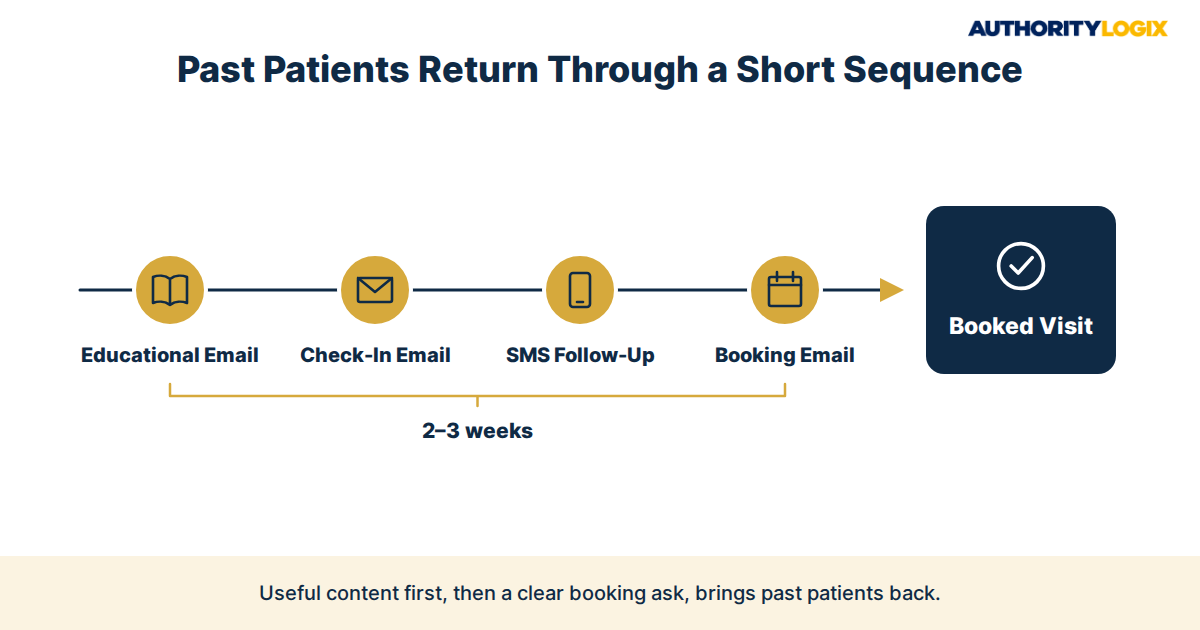
Reactivation campaigns aimed at past patients can generate new bookings quickly at very low incremental cost. The mechanism is a sequence of three to five emails over two to three weeks — useful clinical content first, a check-in second, a clear booking call to action third — combined with SMS for patients who have opted in.
Email marketing can return up to $36 for every $1 spent, per Litmus research — among the highest ROI of any digital marketing channel. For PT practices with a patient database of former clients, reactivation is the fastest path to additional scheduled visits. When reactivation is combined with educational content — covered in the content playbook — the practice becomes a trusted ongoing resource patients return to proactively.
Not sure where your practice stands on patient acquisition?
Building a Physical Therapy Patient Acquisition Pipeline That Compounds
The five acquisition systems described above do not operate independently — and the PT industry hub illustrates exactly how they interconnect. Each one feeds and strengthens the others. A practice with strong local search visibility generates more direct-access patients. More direct-access patients generate more Google reviews. More reviews improve local search rankings. A stronger online presence makes physician referrers more confident in the practice they are recommending. More completed episodes of care expand the reactivation database. The compound effect builds over 12 to 24 months into a patient acquisition engine that consistently outperforms practices running any single channel in isolation.
The practices growing fastest in 2026 treat patient acquisition as a managed system with measurable inputs and outputs — not as a passive result of clinical quality. They track new patients by source every month. They know their conversion rate from inquiry to booked evaluation. They know which referring physicians are sending more or fewer patients than six months ago. They have a reactivation campaign that runs on a defined schedule. They have a GBP review request process that runs automatically after each discharge. For a deeper treatment of this topic, see the content playbook.
Measuring Physical Therapy Patient Acquisition Performance
Four metrics give a complete picture of acquisition health for a PT practice. New patient volume by channel — how many patients arrived through each acquisition system this month versus last month and versus the same month last year. Inquiry-to-booking conversion rate — what percentage of inbound inquiries result in a booked evaluation. Cost per new patient by channel — what each acquisition system costs in time and money per new patient generated. Referral source concentration — what percentage of new patients come from the top three referral sources, and whether that concentration is increasing or decreasing.
Practices that track these four metrics quarterly — reviewed against the benchmarks available through the PT industry hub — can identify acquisition problems before they become revenue problems. A declining conversion rate signals a booking friction issue. A rising referral concentration signals growing dependency risk. A stagnating GBP action rate signals a review volume or recency problem. The growth blueprint covers the broader measurement framework for PT practice growth.
The 90-Day Patient Acquisition Foundation
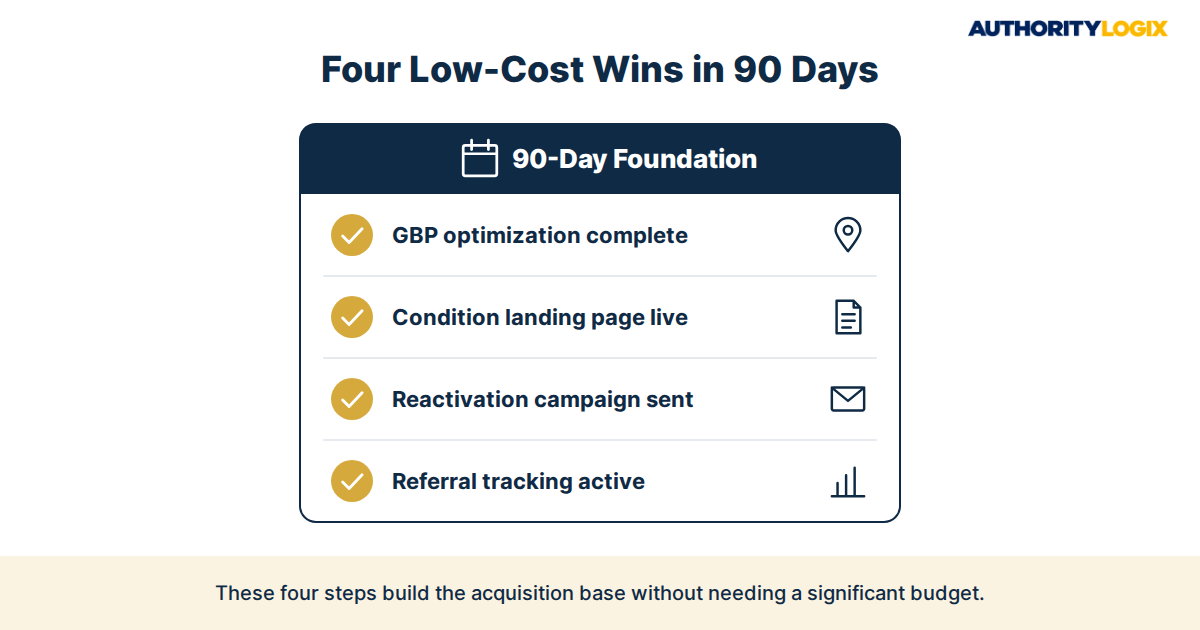
For practices starting from a limited acquisition infrastructure, the first 90 days should accomplish four things: complete GBP optimization with all profile fields filled, primary category confirmed, and a review request process activated; one condition-specific landing page built and indexed for the practice’s highest-volume condition; a past-patient list pulled from the practice management system and a first reactivation email sent; and a referral source tracking system in place so new patient channel attribution begins immediately. For the full specialty framework, visit the PT industry hub.
None of these require significant budget. GBP optimization is free. The lead generation infrastructure that converts that visibility into booked evaluations is what gets built in the months that follow. A condition-specific landing page requires copywriting time but no paid distribution. A reactivation email to past patients costs only the email platform subscription. Referral source tracking requires only a consistent intake question. The investment is time and discipline — not advertising spend. The compounding returns begin the day the foundation is in place.
Practice-Owner FAQ: Physical Therapy Patient Acquisition
How long does it take to see results from a diversified acquisition strategy?
GBP improvements — more profile views, calls, and direction requests — can appear within 60 to 90 days of completing a full optimization, covered step by step in the local visibility guide. Reactivation campaigns produce bookings within days of sending. Organic search rankings for condition and location keywords typically improve meaningfully in the 6 to 12 month window with consistent content production. The full compounding effect of running all five systems simultaneously becomes visible at 12 to 18 months.
What is the most important first step for a practice that has done no direct-access marketing?
Google Business Profile optimization. It is free, it directly affects map pack visibility for high-intent “near me” searches, and a fully optimized profile can produce measurable results within weeks. After GBP is complete, the next priority is a past-patient reactivation campaign — because it generates bookings from people who already trust the practice, at near-zero cost. Content and landing page development for direct-access organic search comes third, with results compounding over the following 6 to 12 months.
How much of new patient volume should come from physician referrals?
There is no universal target, but the growth blueprint frames it clearly: practices with strong acquisition resilience typically have physician referrals representing 40% to 60% of new patient volume — meaningful, but not so dominant that a referral disruption is catastrophic. The goal is not to reduce physician referral volume; it is to grow other channels until referrals represent a healthy share of a larger total, rather than nearly all of a fragile one. For the full specialty framework, visit the PT resources hub.
Is direct-access marketing appropriate for all PT specialties?
Yes, though the channels and messaging differ by specialty focus. Sports injury, back and neck pain, shoulder and knee conditions, and pelvic health are the condition areas with the highest direct-access search volume. Post-surgical rehabilitation and neurological conditions involve more physician referral coordination, but direct-access marketing still applies for educational content — covered in the education guide — community visibility, and building the brand awareness that influences which practice a physician recommends.
How do we build a patient reactivation campaign if we have never done email marketing?
Start with the patient database in your practice management system. This is one of the core functions of the lead generation infrastructure — converting past patients back into active ones. Export a list of patients who completed an episode of care in the past 12 to 36 months and have not returned.
Use a basic email platform — platforms like E-Rehab are built specifically for PT practices — to send a three-email sequence: a useful clinical tip relevant to their past condition, a personal check-in from the treating therapist, and a clear invitation to schedule a follow-up visit with a direct booking link. Measure open rates and bookings generated. Most practices are surprised by how many former patients respond positively to a well-timed, useful outreach.
What role does patient education content play in acquisition?
Patient education content is a direct-access acquisition asset. A prospective patient researching “why does my knee hurt when I walk downstairs” who finds clear, useful content from a local PT practice is substantially more likely to book with that practice than one they find through a generic directory listing. For a deeper treatment of this topic, see the patient acquisition pipeline.
Educational content answers the questions patients ask before they ever call — and practices that answer those questions become the trusted authority the patient turns to when they are ready to book. Patients who are informed before their first visit tend to arrive with clearer expectations and a better first experience. The education guide covers the full content architecture for building a patient education hub that converts.
Building Physical Therapy Patient Acquisition Systems That Last
Physical therapy patient acquisition is not a marketing campaign. It is a set of systems that operate continuously, compound over time, and collectively determine whether a practice grows, plateaus, or declines. The practices that grow consistently in 2026 and beyond are not the ones with the largest advertising budgets — they are the ones that have built the local visibility, direct-access infrastructure, lead conversion systems, referral management processes, and reactivation campaigns that generate new patients through multiple channels simultaneously.
The Insight Articles in the Patient Acquisition library go deeper on each dimension of this playbook — from direct-access patient generation and lead conversion gap analysis to referral diversification, reactivation sequences, and acquisition cost measurement. Each article connects directly to the systems described here. The PT resources hub organizes the full library by category so practice owners can move directly to the specific acquisition challenge they are solving. For a deeper treatment of this topic, see the direct-access patient generation.
The competitive environment for PT practices is getting more demanding, not less. Practices that have not yet run an authority gap assessment are building acquisition systems without knowing where their biggest gaps are. Physician referral pipelines are under structural pressure.
The compound effect of running all five acquisition systems simultaneously becomes visible in the 18 to 24 month window. A practice that starts with a GBP optimization and a reactivation campaign in month one, adds condition-specific landing pages in months two through four, and maintains consistent review generation throughout will look fundamentally different by month 18 than the practice that started the same way but stopped at month three. The patient acquisition pipeline goes deeper on this topic. The direct-access patient generation goes deeper on this topic.
The difference is not the quality of the effort in any single month — it is the accumulation of permanent assets, review volume, and search visibility that makes the practice’s patient acquisition engine progressively harder for any competitor to match. Each new patient acquired through an owned channel is proof that the system is working and a reason to invest further in it. PE-backed competitors are raising the marketing bar in local markets.
Patients are researching online before they make any provider decision. The practices that invest now in building diversified, owned acquisition systems are the ones that will grow through that pressure — because they will not be waiting for a referral to arrive.
Ready to build the five-system patient acquisition pipeline that fills your schedule without waiting on physician referrals?