


Key Takeaways
- Real estate content infrastructure vs paid ads is fundamentally a math problem, not a preference between two equally valid marketing styles.
- First Page Sage’s own data shows real estate delivers a 1,389% SEO ROI over three years, the highest of any industry they track — well ahead of financial services at 1,031%.
- Paid traffic stops the instant ad spend stops, while organic rankings persist and continue producing leads long after the initial investment.
- Organic leads cost a fraction of what paid leads cost industry-wide, a gap that widens further as a firm’s content library grows.
- Content infrastructure and paid ads are not actually competing strategies — the strongest firms run both, using paid spend for immediate volume while content compounds underneath it.
- Most firms treat this as an either-or decision when the actual math favors a deliberate combination weighted increasingly toward content over time.
Table of Contents
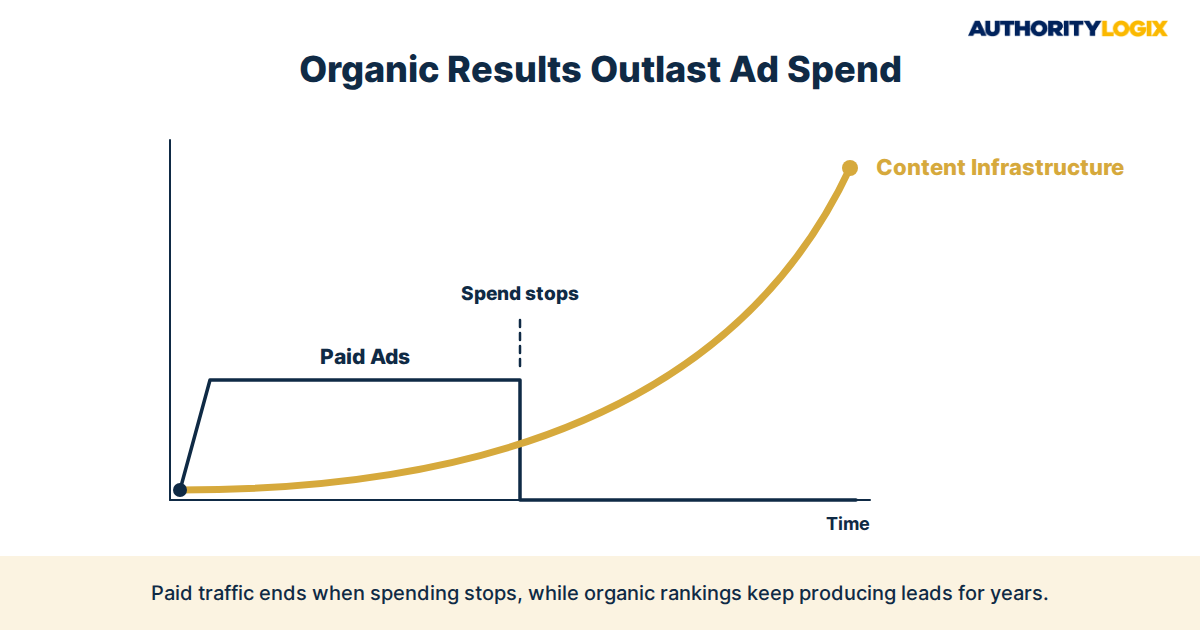
Real estate content infrastructure vs paid ads is not really a debate about marketing philosophy or personal preference. It is a math problem with a knowable answer, and the numbers behind that answer are more lopsided than most firm owners realize until they actually see them side by side. One channel compounds. The other stops the moment the spending does. Once a firm sees the actual numbers laid out, the decision usually stops feeling like a debate at all.
This does not mean paid ads have no place in a real estate firm’s marketing. It means the two channels behave completely differently over time, and a firm that understands that difference makes very different budget decisions than one treating both as interchangeable line items. Real estate content infrastructure vs paid ads is worth understanding precisely because the wrong assumption here compounds into a real, measurable cost over several years of otherwise avoidable underperformance.
Why Real Estate Content Infrastructure vs Paid Ads Is Really a Math Problem
A dollar spent on paid ads produces traffic for exactly as long as that dollar keeps being spent, and not one day longer. A dollar spent building content infrastructure keeps producing traffic for years afterward, with no additional spend required to sustain it. Real estate content infrastructure vs paid ads is, at its core, a comparison between a rented asset and an owned one, and ownership compounds in ways renting simply cannot.
The content systems that produce this owned asset take longer to show results than a paid campaign does, which is exactly why so many firms default to advertising instead. Patience is the actual price of the better long-term math, not a lack of resources or expertise, and firms that grasp this distinction early save themselves years of unnecessary indecision.
This same tradeoff connects directly to the kind of durable market position a firm builds over years, something explored fully in the competitive moat resource, since a firm’s answer to real estate content infrastructure vs paid ads shapes what kind of long-term protection it eventually builds. Real estate content infrastructure vs paid ads is really the same underlying choice as building a moat versus renting temporary visibility, just viewed through a budgeting lens instead of a strategic one.
The Real Estate Growth Playbook covers the full infrastructure this growth math is built on.
Broker Organic Growth vs Paid Ads: What First Page Sage’s Data Shows
Broker organic growth vs paid ads is not a close contest once real numbers enter the picture, and the gap only widens the longer the comparison window extends. First Page Sage’s own data shows real estate delivers a 1,389% SEO ROI over three years — the highest of any industry they track, ahead of financial services at 1,031% and medical devices at 1,183%. That figure alone should reframe how most real estate firms think about where marketing dollars actually belong.
Real Estate Content Infrastructure vs Paid Ads Favors Content Most in This Industry
No other industry First Page Sage tracks comes close to real estate’s long-term SEO return, which makes broker organic growth vs paid ads an especially lopsided comparison in this specific field. Firms in less favorable industries still choose content over ads; real estate firms have an even stronger case to make that same choice, given how dramatically the numbers favor organic investment in this particular market.
Paid Ads Stop the Instant Spending Stops
Organic rankings built through content persist and keep generating traffic long after the work that built them is finished, while paid traffic disappears the moment a campaign is paused. This single structural difference is the entire reason broker organic growth vs paid ads produces such different outcomes over a multi-year horizon, even when the upfront spending looks comparable. A firm evaluating only the first month of results is looking at the exact window where this difference is least visible.
| Metric | Content / SEO | Paid Ads |
|---|---|---|
| Real estate ROI (3-year) | 1,389% | Returns end when spend stops |
| Cost per lead | Falls as content compounds | Rises with competition |
| When spend stops | Rankings persist, decay slowly | Traffic stops immediately |
Agent Content Compound Growth Math: How the Numbers Actually Work
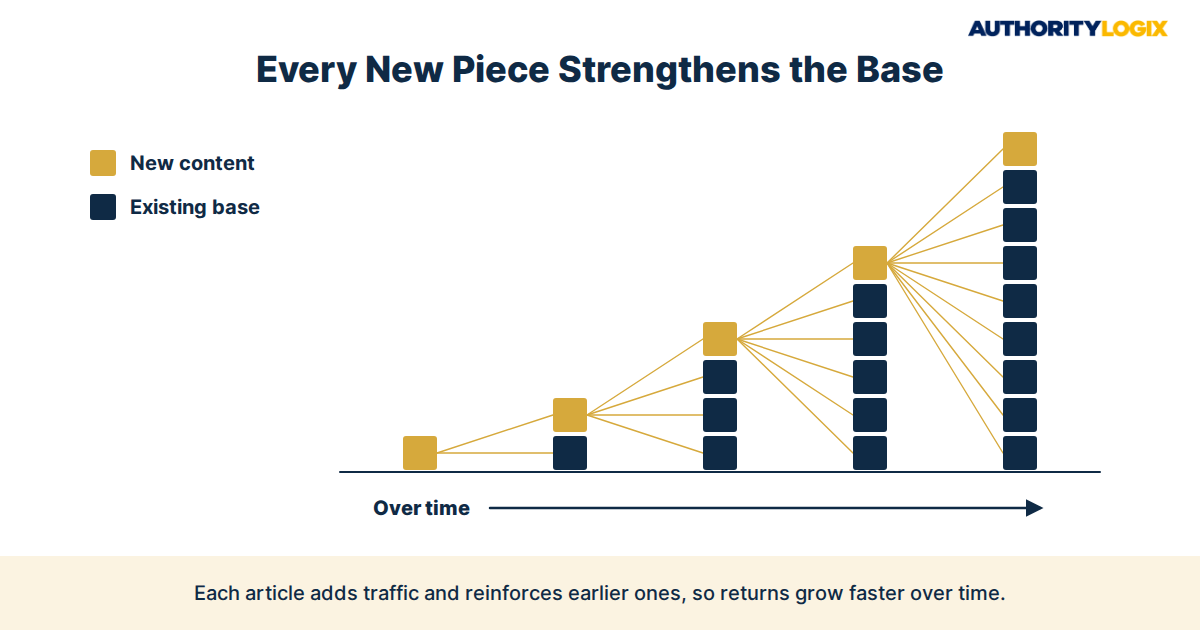
Agent content compound growth math works the way interest compounds in a savings account — each new piece of content adds to a growing base, and that base keeps producing returns on its own, independent of whatever gets published next. A firm’s tenth published article does not just add its own traffic; it also reinforces the nine that came before it through internal linking and accumulated topical authority. Real estate content infrastructure vs paid ads is fundamentally a comparison between this kind of compounding growth and a channel that never accumulates anything at all, no matter how consistently it gets funded month after month.
Automated systems make this compounding easier to sustain at scale, an idea covered in the lead generation infrastructure that captures and nurtures the leads this compounding content eventually produces. This is exactly where real estate content infrastructure vs paid ads produces its clearest practical advantage. Agent content compound growth math only pays off fully when the capture and nurture systems downstream are actually built to receive the traffic once it arrives.
The specific mechanics of automating that capture are covered directly in the automated funnel resource. A firm generating compounding organic traffic with no automated system to capture it is leaving a meaningful share of the return from that compounding growth uncollected.
Real Estate SEO vs Advertising Long Term: Which Wins and When
Real estate SEO vs advertising long term is not actually a question of which one wins outright — it is a question of time horizon. Over a single month, paid advertising almost always wins, since content takes time to rank and ads produce traffic immediately. Over eighteen months or longer, that relationship inverts decisively in content’s favor, and the longer the horizon extends beyond that point, the more lopsided the comparison becomes.
A firm’s specific position along that timeline should shape its budget allocation, a dynamic covered in the market positioning resource, since a firm early in its content journey needs a different budget split than one with years of accumulated content already in place. Real estate SEO vs advertising long term is not a decision made once and forgotten — it shifts gradually as a firm’s content library matures and takes on more of the load ads previously carried.
Building the Math Into a Real Plan: Where to Start
Start by tracking actual cost per lead separately for paid and organic channels over the next quarter, rather than relying on industry averages that may not reflect a specific firm’s real numbers. Most firms have never actually run this comparison for their own business, despite having easy access to the data needed to do it. Real estate content infrastructure vs paid ads becomes a far easier decision once a firm has its own real numbers in front of it, rather than relying on industry benchmarks alone.
Extending organic reach beyond a firm’s own website accelerates this math further, something covered in the authority distribution layer, since real estate content infrastructure vs paid ads improves further once the content itself reaches audiences beyond a single website. A firm distributing its content across multiple channels compounds faster than one relying on its website alone to generate all of its organic reach.
Credibility built alongside this content matters just as much as the raw traffic numbers, a distinction covered in the authority guide, since real estate content infrastructure vs paid ads only pays off fully when the traffic it produces actually converts. Traffic without trust converts poorly regardless of which channel produced it, which is why the underlying content quality matters as much as the channel comparison itself.
Not sure how your current budget splits between paid and organic channels.
What Most Firms Get Wrong About Real Estate Content Infrastructure vs Paid Ads
They treat it as an either-or decision
Most firms pick one channel and abandon the other entirely, when the actual math favors running both simultaneously, with the mix shifting toward content as the library matures, rather than treating either channel as a permanent, unchanging commitment. Real estate content infrastructure vs paid ads is best understood as a ratio that changes over time, not a permanent either-or choice made once at the outset.
Earned recognition from other sources accelerates the organic side of this ratio further, a pattern documented in the backlink strategy. A firm building both channels together sees each one reinforce the other in ways a single-channel approach never produces.
They quit content too early because ads produce faster results
The fast, visible results from paid ads make content investment feel slow and unrewarding by comparison, especially in the first few months when content genuinely produces very little, which is exactly when the temptation to abandon it and redirect the entire budget back to ads is strongest. Real estate content infrastructure vs paid ads only reveals its true math advantage after enough time has passed for the compounding effect to actually show up in the numbers.
Organizing content into a genuinely useful structure during this early period is where the educational hub system earns its keep, turning early, slow-growing content into something that will compound meaningfully once enough of it accumulates. Structure invested early pays off disproportionately once the content library reaches the size where compounding actually becomes visible.
Where This Fits Inside the Full Growth System
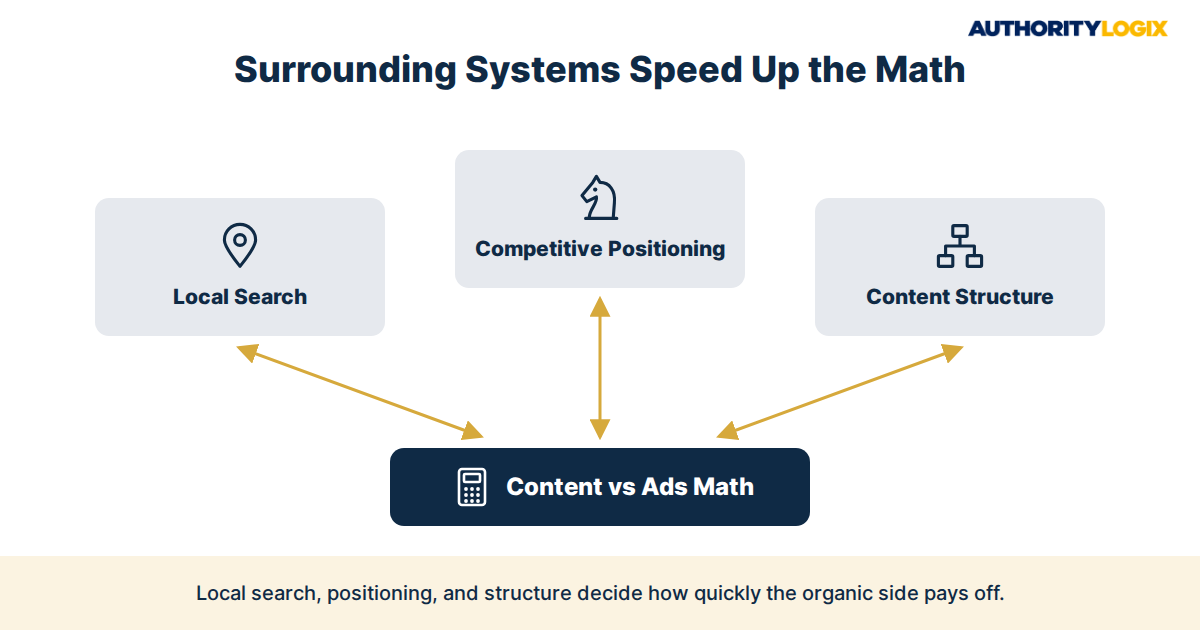
This channel comparison does not exist in isolation from everything else a firm builds — local search visibility, competitive positioning, and content structure all shape how quickly the organic side of this math actually plays out. Real estate content infrastructure vs paid ads succeeds or fails largely on how well these surrounding systems reinforce the underlying content investment.
Search performance built through consistent content investment shows up directly in the local search statistics, and real estate content infrastructure vs paid ads reinforces that same visibility continuously rather than functioning as two entirely separate concerns. Treating them separately leaves meaningful compounding value unclaimed on both sides of that relationship.
Competing against national portals that run this exact calculation at enormous scale is addressed in the local SEO comparison. Those portals have already made their bet on content infrastructure, which makes an independent firm’s own investment in the same math even more urgent, not less, since waiting only widens the gap between an independent firm and competitors already running the same calculation at scale.
Questions Firm Owners Ask About the Ad Spend Tradeoff
How real estate content infrastructure vs paid ads gets measured and tracked over time is covered on the our approach page, but most firm owners are weighing a few specific, practical questions before shifting their existing budget allocation.
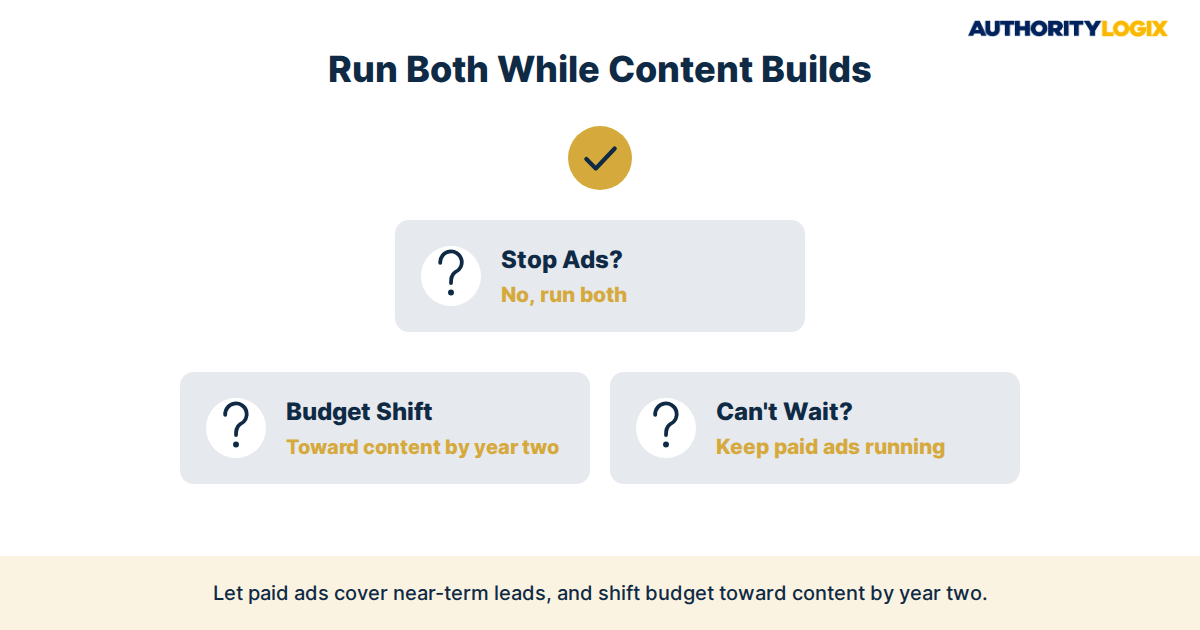
Should we stop paid ads entirely and go all-in on content, given how strongly real estate content infrastructure vs paid ads favors the content side of this comparison?
No — most firms should run both, using paid ads to cover the gap while content is still building toward its full compounding potential in the real estate content infrastructure vs paid ads comparison over the first year or two, since abandoning paid ads too early can leave a real gap in near-term lead volume.
How much of our budget should shift toward content over time?
There is no universal number, but many firms find the ratio shifts meaningfully toward content by year two, as the compounding organic traffic starts covering a larger and larger share of overall lead volume. Real estate content infrastructure vs paid ads is best treated as an evolving ratio tracked quarterly, not a single decision made once and left unexamined.
What if we can’t wait 18 months for the real estate content infrastructure vs paid ads math to actually pay off?
Keep paid ads running to cover near-term lead volume while content builds in parallel — the two channels are meant to complement each other during exactly this kind of transition period, not replace one another abruptly. The why us page covers why AuthorityLogix treats this transition as a managed process rather than an abrupt switch from one channel to the other.
Ready to replace ad spend with content infrastructure that keeps producing leads after you stop paying?
Building Your Plan: Where to Start
Pull the actual numbers on current paid ad spend and cost per lead, then compare them honestly against what a content investment of similar size could realistically produce over eighteen months. That comparison alone usually makes the right next step obvious, without requiring a firm to abandon what is currently working while the transition happens. Real estate content infrastructure vs paid ads is, in the end, a decision best made with real numbers in hand rather than instinct or industry hearsay.
How this transition connects to the broader systems a firm needs to build is outlined on the what we do page. Most firms already have the expertise and track record content infrastructure requires — the missing piece is almost always the initial commitment to start building it alongside whatever paid advertising already exists today.
Every system covered across this resource library — content, search visibility, positioning, authority — feeds directly into this same growth math, a connection made explicit in the industry hub. Infrastructure compounds. Ads stop. The firms that understand that difference early are the ones building the advantage everyone else will eventually be competing against, long after this comparison has been forgotten by everyone who didn’t act on it.