

Key Takeaways
- A real estate lead generation funnel automated correctly keeps capturing, segmenting, and nurturing leads while an agent is physically showing properties and unavailable to respond.
- Gartner research shows companies using automation tools to manage leads see a 10%+ increase in revenue within 6 to 9 months.
- One documented case saw a meaningful increase in qualified leads within three months after implementing a unified, automated funnel.
- A real estate lead generation funnel automated properly has three stages: capture, nurture, and conversion tracking — each one able to run without a human at the keyboard.
- Most agents automate the capture stage and stop there, leaving the nurture and conversion stages manual and inconsistent.
- A self-running system does not replace an agent’s judgment — it protects lead quality during the hours an agent is physically unavailable.
Table of Contents

A real estate lead generation funnel automated correctly solves a problem every busy agent has: leads do not stop arriving just because the agent is standing in a showing with their phone in their pocket. A real estate lead generation funnel automated to capture, segment, and begin nurturing new contacts keeps working during exactly the hours an agent is least available to do it manually — showings, closings, and open houses that eat up entire afternoons.
This is not about replacing an agent’s judgment or personal touch. It is about making sure a lead who arrives at 2pm on a Saturday, while the agent is three states away from their inbox, still gets a timely first response and lands in the right nurture track before the agent ever sees the notification. The agent still makes every meaningful decision — the automation simply makes sure a lead is not sitting untouched for six hours waiting for one.
Why a Real Estate Lead Generation Funnel Automated Setup Matters for Busy Agents
Every hour an agent spends showing a property is an hour they cannot personally respond to a new inquiry, and inquiries do not schedule themselves around an agent’s calendar. A real estate lead generation funnel automated to handle that gap means a new lead gets an immediate acknowledgment and starts moving through a nurture sequence, regardless of whether the agent is available to type a response in that exact moment. The alternative — a lead sitting unanswered until the agent resurfaces hours later — is exactly the gap that costs deals to competitors who responded first.
The lead generation infrastructure that captures a visitor in the first place is only half the system — a real estate lead generation funnel automated end to end is what determines whether that captured contact is still warm by the time the agent actually gets back to their phone. Capture alone accomplishes nothing if nothing happens after it.
The lead magnet strategy that first attracted the contact should feed directly into that same automated system rather than dead-ending once the download completes. A lead magnet that hands off to nothing is only half a funnel.
The local search statistics show how much effort goes into generating that initial visitor in the first place — all of that effort is wasted if the funnel behind the visibility has no automation to catch the resulting lead during the agent’s busiest hours. A real estate lead generation funnel automated properly protects that upstream investment instead of letting it leak away.
The Real Estate Lead Generation System covers the full infrastructure a self-running funnel is built on.
Broker Automated Lead Funnel: The Three Stages
A broker automated lead funnel breaks into three distinct stages, and each one can run without a human actively managing it in real time — though each requires deliberate setup before it can be trusted to run unattended. Skipping the setup work and expecting the automation to configure itself is the most common reason a broker automated lead funnel underperforms. Each stage also needs periodic review once it is live, since lead behavior and content both shift over time in ways the original setup could not have anticipated.
Top of a Real Estate Lead Generation Funnel Automated for Capture
The top of a broker automated lead funnel captures a new contact from a website form, a listing inquiry, or a lead magnet download, and immediately segments that contact by intent — buyer, seller, or investor — before an agent ever sees the notification. This segmentation is what determines which nurture track the lead enters next, and getting it wrong at capture means every later stage of the funnel is working from bad information. A simple set of intake questions at the point of capture is usually enough to make this segmentation reliable without requiring complex logic. This connects directly to the topic covered in the growth playbook resource.
Middle and Bottom: Where the Funnel Does the Heavy Lifting
The middle stage delivers segmented nurture content automatically, and the bottom stage tracks lead behavior — saved listings, email opens, page revisits — to flag which contacts are ready for a real conversation. A broker automated lead funnel that only automates the top stage is still requiring a human to manually manage the two stages where most leads are actually lost. Those two stages, not the initial capture, are where the bulk of the actual automation value gets realized.
| Funnel Stage | What Runs Automatically |
|---|---|
| Top (Capture) | Form capture, intent segmentation |
| Middle (Nurture) | Segmented email sequences |
| Bottom (Conversion) | Behavior tracking, hot-lead flagging |
Agent Marketing Automation Lead Capture Tools Worth Setting Up
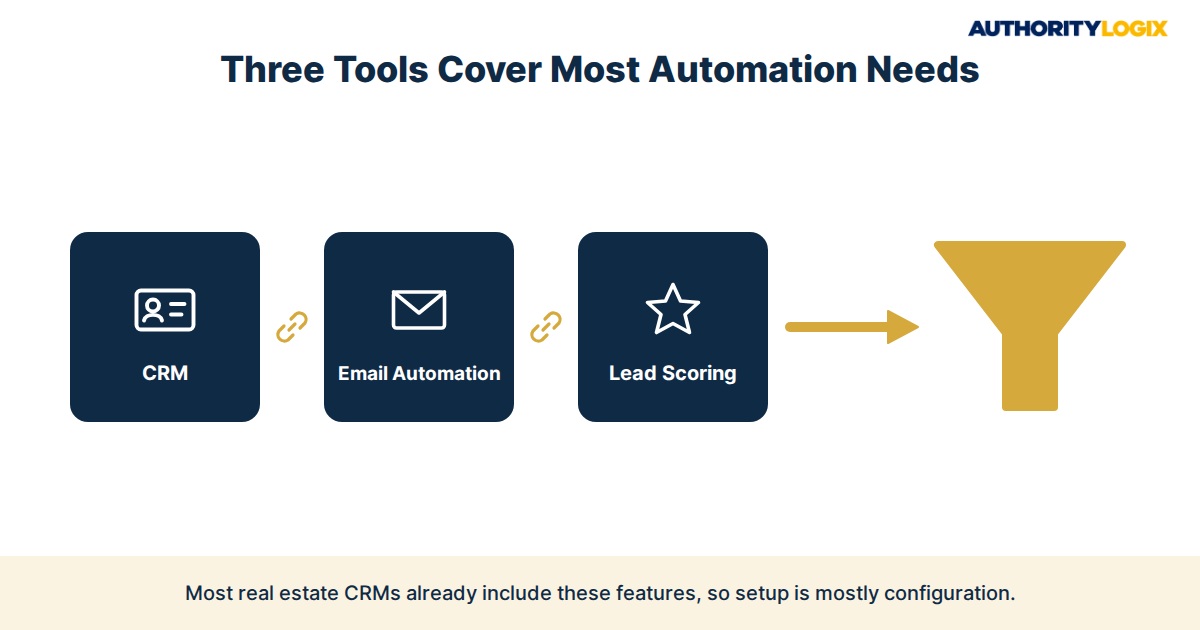
Agent marketing automation lead capture does not require a complicated tech stack to work well. A CRM that captures leads from multiple sources automatically, an email platform that triggers sequences based on lead behavior, and a simple lead-scoring rule that flags high-intent activity cover most of what a real estate lead generation funnel automated setup actually needs. Most real estate CRMs already include these three capabilities natively, which means the setup work is mostly configuration rather than new purchases.
The content systems that feed the nurture stage of agent marketing automation lead capture are usually already producing usable material — repurposing existing blog content into automated email sequences means the automation has something worth sending from day one. Building new material from scratch is rarely necessary when existing content already exists.
The email nurture sequence built on that repurposed content is what actually carries a lead through the middle stage of the funnel. Without it, the middle stage has no substance to run on at all.
Gartner research found that companies that automate lead management see a 10%+ increase in revenue within 6 to 9 months. Agent marketing automation lead capture built on the same principle produces the same kind of compounding return, without requiring an agent to work more hours to get it.
The content system that supplies this automation should be built once and reused indefinitely — a real estate lead generation funnel automated with a shallow content library will eventually run out of substance to send, no matter how well the technical automation is configured. Depth of content matters more than the sophistication of the automation platform sending it.
Real Estate Lead System Self-Running: What That Actually Means
A real estate lead system self-running does not mean an agent walks away and never checks it. It means the routine, repetitive parts — the acknowledgment email, the segmentation, the first three nurture touches — happen without requiring the agent to sit at a keyboard for every single lead that comes in. The agent’s time gets reserved for the parts of the process that genuinely need a human: the actual conversation once a lead is ready. Confusing this with full automation is where agents get uneasy about handing over any part of the process at all.
The organic vs purchased comparison covers how lead quality varies by source — a real estate lead system self-running should route organic and purchased leads differently from the very first automated touch, since the two arrive with very different levels of existing trust. Treating both sources identically wastes the context an organic lead already carries, undermining the entire purpose of building a segmented system in the first place.
Building the Automated Funnel: What Runs Without You
Building a real estate lead generation funnel automated from the ground up starts with mapping exactly which tasks genuinely require an agent’s judgment and which are purely repetitive. Acknowledgment emails, initial segmentation, and the first few nurture touches almost never need a human decision. Scheduling a showing, negotiating terms, and answering a nuanced question absolutely do. Mapping this distinction clearly before building anything prevents the common mistake of either over-automating judgment calls or under-automating routine tasks.
The educational hub system supplies the content that keeps an automated nurture sequence useful rather than repetitive — a real estate lead generation funnel automated with only three pieces of content to rotate through quickly starts to feel stale to leads on a longer nurture timeline. A deeper library is what keeps a long nurture sequence feeling fresh rather than repetitive.
The why us page covers why AuthorityLogix treats authority-building as inseparable from the automation itself, not a separate project. Treating the two separately usually means one of them gets neglected.
The authority guide covers the credibility signals that make an automated message worth opening in the first place — automation without established authority behind it just produces well-timed emails that still get ignored. Perfect timing cannot compensate for a sender the lead has no reason to trust.
Not sure how much of your current funnel is actually running without you.
Where This Fits Inside the Full Lead Generation System
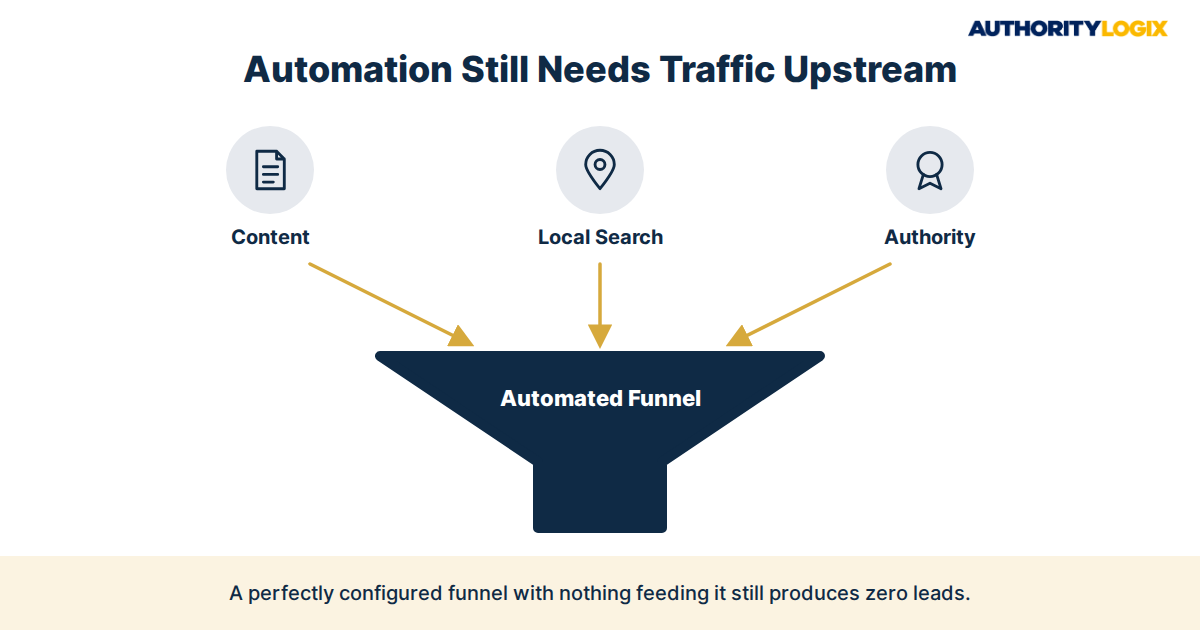
A real estate lead generation funnel automated in isolation still depends on everything upstream of it — content that attracts visitors, local search visibility that gets a firm found, and authority that makes a lead trust the automated messages once they start arriving. None of those upstream systems can be skipped just because the funnel downstream of them is now running automatically. A perfectly configured funnel with no traffic feeding it still produces zero leads, regardless of how well the automation itself performs.
The authority distribution layer extends that trust beyond the funnel itself — a lead who has already encountered a firm’s content elsewhere responds differently to an automated email than one meeting the firm for the first time inside the sequence. That prior familiarity is often the deciding factor in whether an automated email gets opened at all, rather than deleted unread.
The growth playbook treats a real estate lead generation funnel automated well as permanent infrastructure — configured once, refined periodically, and left running rather than rebuilt every time lead volume changes. That stability is what makes the upfront setup time worth the investment.
What Most Agents Get Wrong About a Real Estate Lead Generation Funnel Automated Setup
They automate capture but leave nurture manual
A real estate lead generation funnel automated only at the top stage still requires an agent to manually manage every nurture email and every follow-up decision — exactly the workload the automation was supposed to eliminate. The backlink strategy that builds organic authority works because it runs consistently over time without requiring constant manual attention — a nurture sequence should be built the same way.
They set it up once and never revisit it
A real estate lead generation funnel automated a year ago, with content and timing that has never been reviewed since, gradually drifts out of sync with what leads actually respond to. The neighborhood landing pages that feed the top of the funnel change as markets shift, and a funnel that never gets revisited eventually stops matching the traffic actually arriving at those pages.
Questions Agents Ask About Automated Funnels
The our approach page covers how a real estate lead generation funnel automated setup gets measured once it is running, but most agents are weighing a few specific, practical questions before building their first one.
Will leads notice they’re in an automated sequence?
Only if the content is generic or poorly timed — a well-segmented, relevant sequence reads as attentive follow-up, not obvious automation. A real estate lead generation funnel automated with genuinely useful content rarely feels robotic to the person receiving it.
How much technical setup does this actually require?
Most real estate CRMs include the automation features needed out of the box — the harder part is usually deciding on segmentation logic and content, not the technical configuration itself. A real estate lead generation funnel automated with an existing CRM rarely requires new software purchases, just better configuration of what is already in place. A related breakdown of this is covered in the email nurture sequence guide.
Should solo agents bother with this, or is it just for teams?
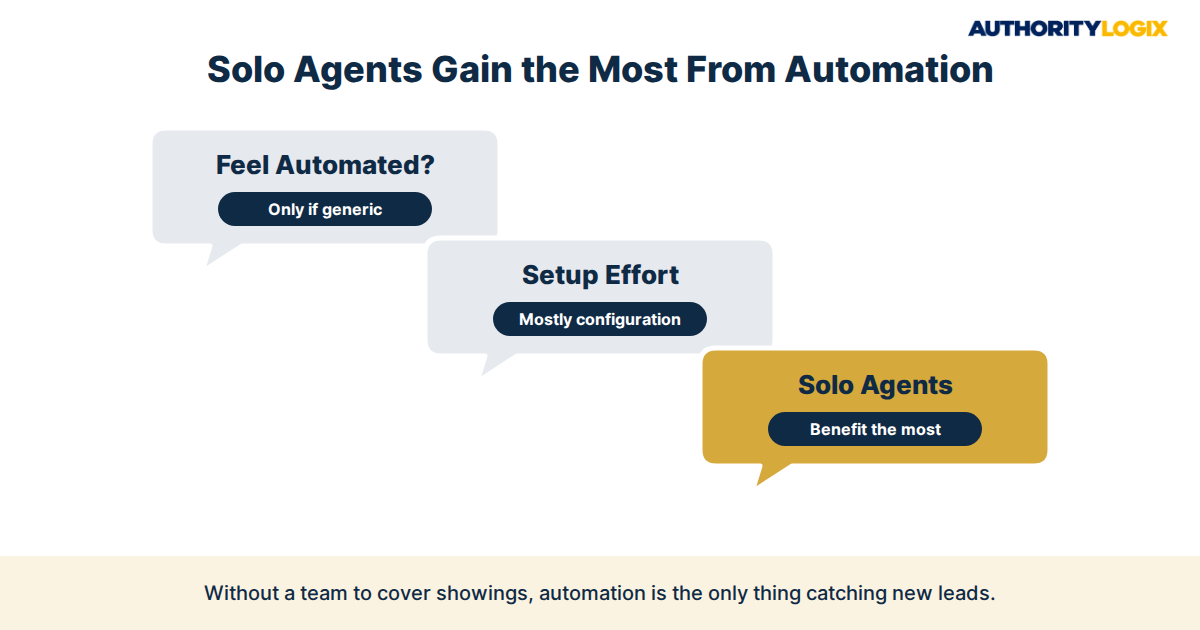
Solo agents benefit the most — a team can split coverage during busy hours, while a solo agent has no one else to catch a lead while they are out in a showing. This is precisely the gap a real estate lead generation funnel automated well is designed to close permanently.
Want an automated lead funnel that keeps working while you’re out showing properties?
Building Your First Automated Funnel: Where to Start
Start by mapping the current, manual version of the process — every step from form fill to booked consultation — and identify which steps are purely repetitive. Automate those first, and leave anything requiring real judgment in the agent’s hands. A real estate lead generation funnel automated in stages like this produces reliable results faster than trying to automate everything simultaneously in one large project. Each stage that gets automated successfully makes the next stage easier to plan and build, since the CRM and content infrastructure built for the first stage typically carries over directly into the next.
The what we do page outlines how this staged approach fits into the broader lead generation system a firm is building. Most agents already have the CRM and email tools needed to start — what is usually missing is the mapped-out logic connecting them into an actual automated sequence.
The industry hub covers how a real estate lead generation funnel automated well connects to every other system a firm depends on — content, local search, and authority distribution all feed the same funnel this article describes. None of those systems produce results working in isolation from the others.