

Key Takeaways
- Real estate competitive moat authority protects a firm’s market position without requiring constant ad spend to defend it.
- Bain & Company research led by former Bain strategy head Chris Zook found fewer than 1 in 10 companies achieve even modest sustained, profitable growth over a 10-year period.
- A genuine moat is built on infrastructure a competitor cannot simply buy their way past, unlike a paid campaign that stops working the moment the budget runs out.
- Content, authority, and search visibility accumulated over years function the same way an economic moat protects a business from competitors.
- Most firms confuse a temporary marketing advantage with a genuine moat, and the difference only becomes clear once a competitor tries and fails to copy it quickly.
- A real estate competitive moat authority strategy takes years to build but, once established, requires far less ongoing spend to defend than a firm relying entirely on paid advertising.
Table of Contents

Real estate competitive moat authority is built on the same idea Warren Buffett popularized as an economic moat — a sustainable advantage that protects a business from competitors the way a real moat protects a castle. This version is built from content, reputation, and search visibility instead of stone walls and water. A firm with a genuine moat does not need to outspend every competitor on advertising every single quarter just to hold its position, because the position itself is not rented — it is owned, in the sense that no competitor can simply buy their way into it.
Most real estate firms have never built anything like this. They compete instead on ad spend, chasing the same paid placements as everyone else, which means their position evaporates the moment the budget stops. Real estate competitive moat authority works completely differently, because it does not depend on continuous spending to remain intact, and the firms that have already built one enjoy a structural advantage no amount of catch-up advertising can quickly close.
Why Real Estate Competitive Moat Authority Protects Market Position Without Constant Ad Spend
A firm that only competes on paid advertising is in a race that never ends and never gets easier, since every competitor is bidding on the exact same keywords and audiences at the same time. The moment that firm’s budget shrinks, even temporarily, its visibility disappears just as quickly as it appeared. Real estate competitive moat authority avoids this entirely by building assets that keep working whether or not new money is being spent that month, which is precisely why it functions as genuine protection rather than a temporary rental of visibility.
The content systems that produce this kind of durable asset are the actual mechanism behind the moat — published content, once it accumulates enough depth and earns enough authority, keeps generating visibility for years without requiring the same ongoing investment a paid campaign demands. That reduced ongoing cost is exactly what makes real estate competitive moat authority so valuable compared to advertising that stops the instant spending stops, since the underlying asset keeps producing results long after the initial building effort concludes.
This same principle connects directly to how a firm establishes itself as a genuine market leader, a relationship explored fully in the market positioning resource. Real estate competitive moat authority and long-term positioning reinforce each other, since a firm cannot really hold a leadership position without the underlying moat protecting it from being displaced.
The Real Estate Growth Playbook covers the full infrastructure a competitive moat is built on.
Broker Sustainable Competitive Advantage: What Harvard Business Review Confirms
A broker sustainable competitive advantage, the kind that actually underpins real estate competitive moat authority, is rarer than most firm owners assume. Bain & Company research led by Chris Zook, then head of Bain’s global strategy practice, found that fewer than one in ten companies achieve even a modest level of sustained, profitable growth over a ten-year period. That scarcity is precisely why real estate competitive moat authority is worth the years of deliberate effort it takes to build one.
Most Competitive Advantages Are Not Actually Sustainable
A clever marketing campaign or a temporary pricing advantage can produce real short-term results, but neither one survives long once a competitor notices and copies it. A broker sustainable competitive advantage has to be built on something a competitor genuinely cannot replicate within a few weeks of trying, which rules out most of the tactics firms typically reach for first. Real estate competitive moat authority is deliberately built to fail this replication test in the other direction — genuinely difficult to copy, not merely inconvenient.
What Makes Real Estate Competitive Moat Authority Genuinely Hard to Copy
Years of accumulated content, earned backlinks, and established search rankings cannot be purchased or replicated on a competitor’s timeline, no matter how much they are willing to spend trying. That structural difficulty is exactly what separates a genuine moat from a marketing tactic that merely looks impressive for a season before fading. Time, not money or team size, is the resource a competitor cannot simply acquire more of to catch up faster.
| Type of Advantage | How Easily a Competitor Copies It |
|---|---|
| Paid ad campaign | Immediately, with equal or higher spend |
| Content and authority moat | Years, if ever |
Agent Authority Moat Real Estate Firms Can Actually Build
An agent authority moat real estate firms can genuinely sustain is built from reputation earned over years, not asserted through a single well-written bio page. Recognition from other sites, consistent search visibility, and a track record visible to anyone who looks closely all contribute to this kind of durable authority. None of these elements can be manufactured quickly or bought outright, which is exactly why they function as genuine protection rather than a claim that could be made by anyone.
Extending this authority beyond a firm’s own website strengthens the moat considerably, something covered in the authority distribution layer. An agent authority moat real estate firms build through multiple reinforcing channels is significantly harder for a competitor to displace than one resting on a single website alone, since a competitor would need to match presence across every one of those channels simultaneously rather than just one.
Credibility signals matter just as much as raw visibility here, a distinction covered thoroughly in the authority guide. A firm with excellent search rankings but no genuine credibility behind them has built only half a moat, since visitors who arrive still need a reason to trust what they find, and traffic without trust rarely converts into an actual client relationship.

Real Estate Firm Competitive Protection Content: The Infrastructure Behind the Moat
Real estate firm competitive protection content needs an organized structure behind it to actually function as a moat, rather than existing as a scattered collection of unrelated posts. Without that structure, even a large volume of genuinely good content fails to add up to the kind of durable protection real estate competitive moat authority is supposed to provide. A pillar-and-cluster structure, covered in depth in the pillar page strategy, is what turns individual pieces of content into a connected, mutually reinforcing structure that is genuinely difficult to replicate piece by piece.
A competitor attempting to copy a handful of standout articles never reproduces the full underlying structure supporting them across the entire site, which is exactly what makes real estate firm competitive protection content function as a genuine moat rather than a set of easily-copied individual pages. Structure, not just individual content quality, is what makes the entire system resistant to imitation.
Building the Moat: Where to Start
Start by identifying the specific area — a neighborhood, a property type, an investor segment — where a firm already has the deepest genuine expertise, since a moat is far easier to build around real existing strength than around an area a firm wishes it were known for. Real estate competitive moat authority built on genuine strength is dramatically easier to sustain than one built around an aspiration with no real track record behind it.
Organizing that expertise into a coherent structure is where the educational hub system earns its value, turning individual pieces of knowledge into a connected library a competitor cannot easily match one article at a time. That connected library is what ultimately separates a genuine moat from a handful of impressive but isolated pages.
The content system blueprint covers exactly how to build this kind of infrastructure methodically, rather than accumulating content haphazardly and hoping it eventually adds up to something resembling a moat. Methodical construction produces a stronger real estate competitive moat authority strategy than years of unplanned, scattered publishing ever could.
Not sure how defensible your current market position actually is.
What Most Firms Get Wrong About Real Estate Competitive Moat Authority
They mistake a temporary campaign for a genuine moat
A successful marketing push that produces a great quarter feels like an advantage, but if a competitor can replicate it within a few weeks, it was never really a moat to begin with — it was simply a head start that any well-resourced competitor could close quickly. Real estate competitive moat authority only exists once a competitor has genuinely tried and failed to catch up quickly.
Earned recognition from other sources is one of the clearest signals a real moat exists, a pattern documented in the backlink strategy. A tactic that produces no earned recognition from outside sources was likely never durable enough to function as genuine protection in the first place, no matter how effective it seemed while it was actively running.
They stop investing once the moat starts working
A moat that stops being maintained gradually narrows as competitors slowly close the gap, even if that narrowing is not obvious month to month. Real estate competitive moat authority is not a one-time achievement; it requires ongoing, if lighter, investment to remain as wide as it was when it was first established. The lead generation infrastructure that a moat supports needs continued, if reduced, investment to stay wide rather than gradually eroding back toward parity with everyone else.
Where the Moat Fits Inside the Full Growth System
A competitive moat does not function as a standalone asset — it depends directly on local search visibility, content depth, and competitive positioning working together rather than operating as separate, disconnected initiatives. Real estate competitive moat authority succeeds or fails largely on how well these surrounding systems reinforce one another, not on any single piece in isolation.
Search performance built over years shows up directly in the local search statistics, and real estate competitive moat authority reinforces that same visibility continuously rather than functioning as an entirely separate concern from local search performance. Treating them as unrelated efforts leaves meaningful value unclaimed on both sides of that relationship.
Competing against national portals that are building the identical kind of moat is addressed directly in the local SEO comparison. Those portals have enormous resources, which makes an independent firm’s own moat-building even more important as one of the few advantages available that scale cannot simply overwhelm. A local firm with genuine expertise in a specific niche can still out-compete a much larger portal precisely at the level of depth and specificity that scale tends to sacrifice.

Questions Firm Owners Ask About Competitive Moats
How this kind of moat gets tracked and measured over time is covered on the our approach page, but most firm owners are weighing a few specific, practical questions before committing years of effort to building one, since the investment required is significant enough to warrant careful thought before beginning.
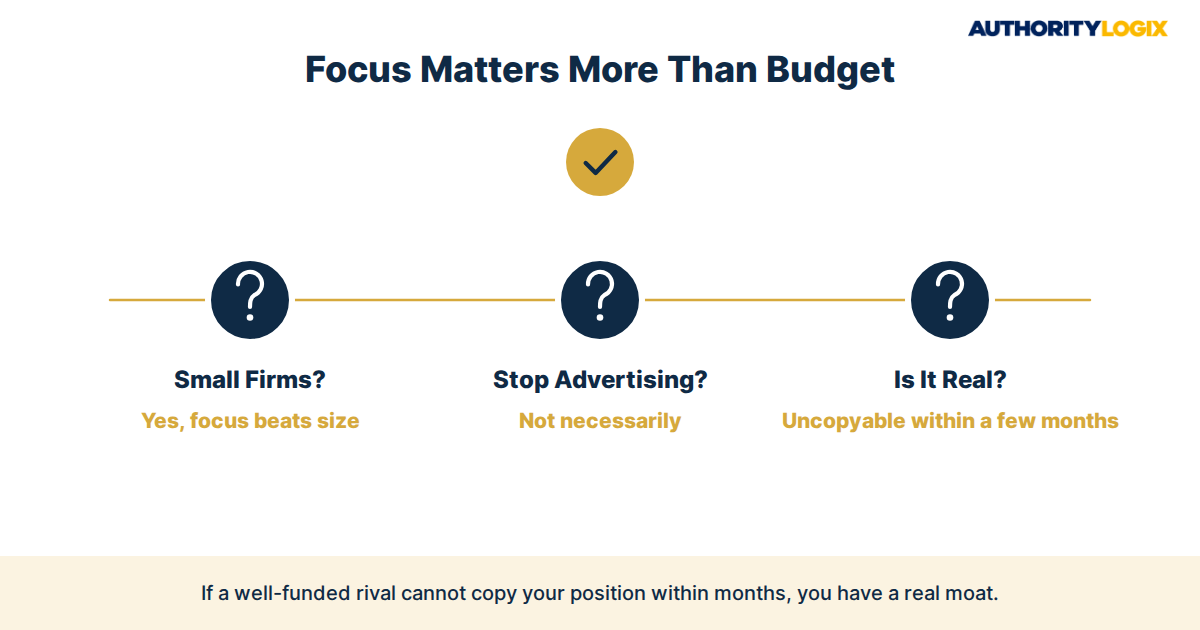
Can a small firm build real estate competitive moat authority, or is this only realistic for large firms with bigger budgets?
Small firms can absolutely build a genuine moat, often faster than a large firm, since a smaller operation can commit to a specific niche with more focus than a large competitor spread across many different markets. Focus, not size or budget alone, is usually the deciding factor in how quickly real estate competitive moat authority actually develops.
Does building a moat mean we can stop advertising entirely?
Not necessarily — most firms use both together during the transition period, but a genuine moat significantly reduces how much a firm depends on paid advertising to maintain its position, freeing up budget for other priorities. The why us page covers why AuthorityLogix treats this reduced dependence on paid spend as one of the clearest benefits of building a genuine moat.
How do we know if what we’ve built is actually a moat?
The clearest test is whether a well-funded competitor could replicate the position within a few months. If they genuinely could not, regardless of budget, that is a strong sign a real moat exists. This test is worth revisiting periodically over time, since real estate competitive moat authority can erode slowly if a firm stops reinforcing it over time.
Ready to build an authority moat that protects your market position without constant ad spend?
Building Your Moat: Where to Start
Identify the one area where a firm’s existing expertise is genuinely hardest for a competitor to match, and commit to building content and authority around that specific area for the next several years rather than spreading effort thin across many directions at once. That narrow, sustained focus is what eventually produces something a competitor cannot simply replicate on a shorter timeline, no matter how much they might want to shortcut the process.
How this moat-building work connects to the broader systems a firm needs is outlined on the what we do page. Most firms already have the deep expertise a genuine moat requires — the missing piece is almost always the sustained commitment to turning that expertise into published, organized, defensible content over a period of years rather than months.
Every other system covered across this resource library — content, search visibility, positioning — feeds directly into the same moat a firm is trying to build, a connection made explicit in the industry hub. A real estate competitive moat authority strategy, once genuinely established, becomes one of the most durable advantages a firm can hold in its market, one that continues paying off for years after the initial building work is largely finished.