


Key Takeaways
- Most real estate sales happen only after several follow-up touches — many agents quit by contact three, right before momentum actually builds. A well-built real estate email nurture sequence is what keeps a firm in the conversation long enough to reach those later, higher-converting touchpoints instead of falling silent after touch two or three.
- A real estate email nurture sequence automates that persistence so leads keep hearing from an agent without requiring a manual follow-up every time.
- Drip campaigns consistently generate more sales at lower cost than single-send emails.
- One documented three-email nurture sequence boosted buyer engagement 43% with zero unsubscribes — proof that short, well-timed sequences outperform long generic ones.
- Realistic benchmarks for a real estate email nurture sequence built for cold-to-warm leads should track open rate and reply rate over time.
- Buyers and sellers need separate sequences — a single generic drip applied to both wastes the specificity that actually drives replies.
Table of Contents
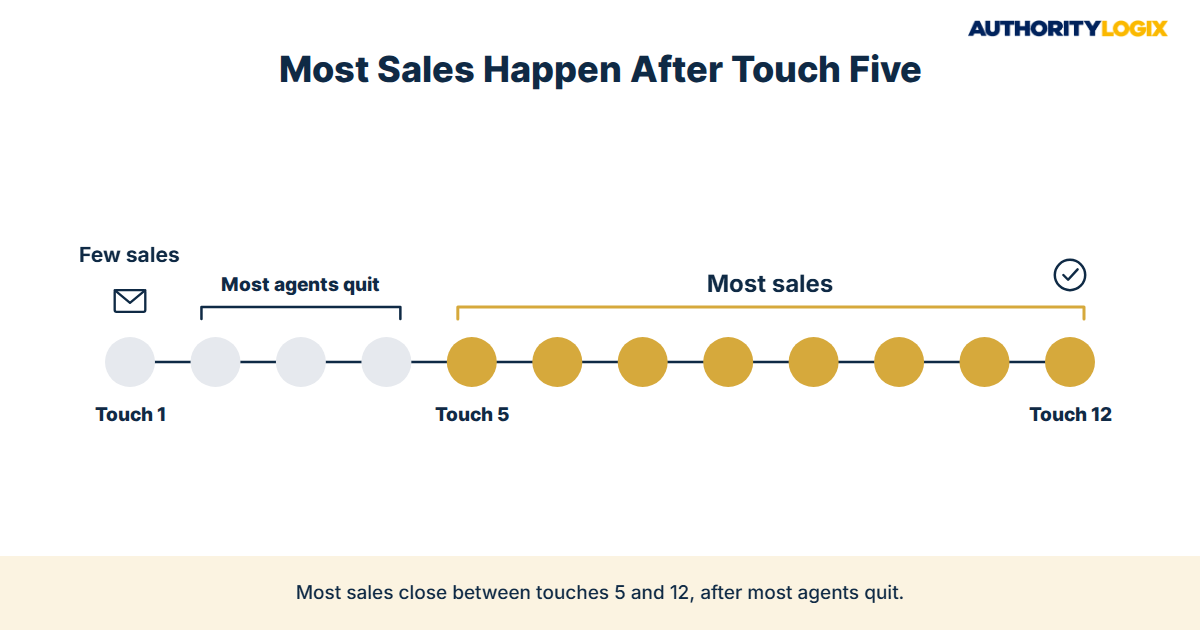
A real estate email nurture sequence exists because most agents give up on a lead long before that lead is actually ready to respond. Most real estate sales happen only after several follow-up touches, while many agents stop following up after contact three — right before the persistence would have paid off. A real estate email nurture sequence automates that persistence, so a cold website visitor keeps hearing from an agent without requiring a manual follow-up every single time.
This matters most for the leads that feel like dead ends — a name and email address from a website form, with no phone call ever answered and no obvious next step. A real estate email nurture sequence is exactly the system that turns that kind of cold, ambiguous contact into a booked consultation, over weeks rather than in a single desperate follow-up call, and it does so predictably enough to plan around. The lead was never actually dead; it was simply never followed up with enough times to reach the point where it would have responded.
Why a Real Estate Email Nurture Sequence Beats One-Off Follow-Ups
A single follow-up email, sent once and never repeated, reaches a lead at exactly one moment — and real estate decisions rarely align with that one moment. A real estate email nurture sequence reaches the same lead repeatedly, at the moments when their circumstances have actually changed enough to make them ready to respond. A lead who was simply browsing in January may be actively planning a move by April, and only a sequence still running in April is positioned to catch that shift.
The lead generation infrastructure that captures a cold website visitor in the first place is wasted if nothing happens after the form fill. A real estate email nurture sequence is the piece that actually converts that captured contact into a real conversation, rather than letting it sit untouched in a spreadsheet.
The local search statistics show the same visitors a firm works so hard to attract organically are frequently the ones lost to a missing follow-up system — the acquisition problem and the nurture problem are two separate failures, and solving only one still leaves leads on the table. A real estate email nurture sequence is what closes that second gap.
The Real Estate Lead Generation System covers the full infrastructure an email nurture sequence is built on.
Broker Email Lead Nurturing: What the Data Actually Shows
Broker email lead nurturing is not guesswork — the data on when and how leads actually respond is well established, and it consistently points away from the single-touch approach most brokerages still default to. The numbers below explain exactly why that single-touch habit is so costly, and why a properly built real estate email nurture sequence closes the gap it leaves behind.
Why Most Leads Go Cold by Contact Three
Very few real estate sales happen on the first contact, yet most agents stop reaching out well before touch five — right at the point where broker email lead nurturing data shows momentum actually starts to build. A lead that goes quiet after two attempts has not necessarily lost interest; the agent simply stopped reaching them at the moment they were finally ready. Automating the real estate email nurture sequence removes the emotional friction of feeling like a pest, since the emails go out on schedule regardless of how the agent feels about reaching out again. That removal of emotional friction is often the real reason automated sequences outperform manual follow-up, not just the scheduling convenience itself.
The Campaign Monitor Numbers Behind a Real Estate Email Nurture Sequence
Drip campaigns consistently generate more sales at lower cost than single-send emails. Broker email lead nurturing built on that same automated, sequenced approach captures the same advantage — more results, at a lower cost per outcome, than manually chasing each lead one email at a time.
| Touch Number | What Typically Happens |
|---|---|
| Touch 1 | Few sales close here |
| Touches 2 to 4 | Most agents give up here |
| Touches 5 to 12 | Most sales actually close here |
Agent Email Drip Sequence Buyers Sellers Need on Separate Tracks
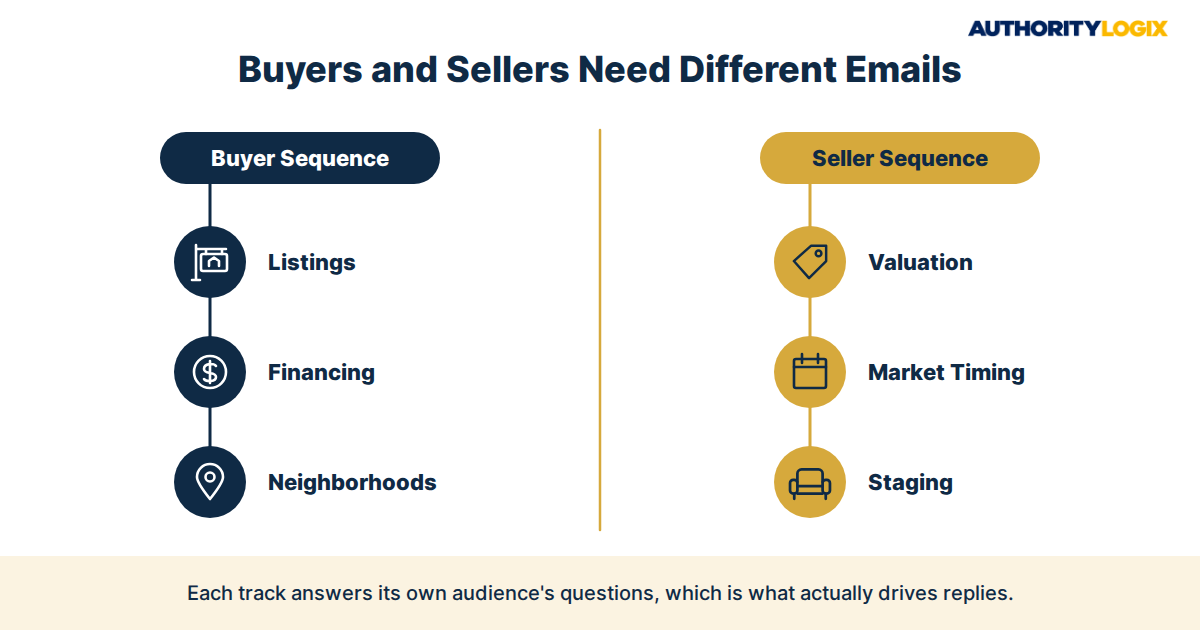
An agent email drip sequence buyers sellers both receive identically wastes the specificity that actually drives replies. A buyer wants listings, financing information, and neighborhood guidance. A seller wants valuation data, market timing, and staging advice. Sending the same generic content to both groups signals that the agent has not bothered to segment their own audience, and that impression forms before the lead has even had a chance to evaluate the agent’s actual expertise or credentials.
The organic vs purchased comparison covers why lead quality varies so much by source — an agent email drip sequence buyers sellers receive should account for that source difference too, since an organic inquiry already carries more context than a cold purchased lead does. Treating every lead identically regardless of source throws that context away.
The lead magnet strategy that captured the lead in the first place should also determine which drip track it enters — a seller who downloaded a home valuation guide belongs in the seller sequence from the very first email, not a generic welcome track that has to figure out their intent later. That routing decision alone eliminates most of the guesswork a generic sequence has to work around.
Real Estate Email Marketing Funnel Structure That Converts
A real estate email marketing funnel structure moves a cold contact through three stages: an introduction stage that establishes who the agent is and why they are worth listening to, an education stage that answers the specific questions a buyer or seller has at their point in the process, and a conversion stage that makes booking a consultation the obvious next step. Skipping straight to the conversion stage is the single most common structural mistake in a weak real estate email marketing funnel — asking a cold lead to book a call in the very first email rarely works, no matter how good the offer sounds on paper.
The investor pipeline content that works for real estate investment firms follows this same three-stage logic — introduction, education, conversion — proving the structure holds regardless of whether the audience is buyers, sellers, or investors. Only the specific content inside each stage needs to change by audience.
The educational hub system is what supplies the middle stage of a real estate email marketing funnel with actual substance — a nurture sequence with nothing but marketing copy in the education stage rarely earns the trust needed to reach the conversion stage at all. Substance is what earns the right to ask for a consultation later.
Building the Sequence: Timing and Content
A real estate email nurture sequence should open within minutes of capture, follow up again within the first three days, and then settle into a lighter cadence of roughly one email per week for the following month. Front-loading the first few touches matters because interest is highest immediately after a lead opts in, and it decays quickly if the first response is delayed. A lead who signs up for a home valuation and hears nothing for four days has usually already moved on to a competing site by the time the first email finally arrives, taking their interest and their information with them.
The content system that supplies a firm’s blog and resource library is also the easiest source of nurture content — repurposing an existing article into a nurture email costs almost nothing once the content system is already producing it for other purposes. A firm building a real estate email nurture sequence from scratch rarely needs to write new material to fill it.
The authority guide covers the credibility signals that make a nurture email worth opening in the first place — an agent with no established authority is easier to ignore than one whose name a lead already half-recognizes from prior content. Recognition is often the difference between an email that gets opened and one that gets deleted unread.
Not sure if your firm’s follow-up system is actually capturing the leads you’re already generating.
Where Nurture Fits Inside the Full Lead Generation System
A real estate email nurture sequence is never a standalone tactic — it is the connective layer between lead capture and an actual booked consultation. Without it, every other system a firm builds is producing contacts that quietly go nowhere, no matter how much time and money went into generating them in the first place.
The authority distribution layer extends the same nurture logic beyond email — a lead who also sees the firm’s content on other channels reinforces the credibility the email sequence is already building, rather than encountering the firm as a stranger every time a new email arrives. Familiarity across channels compounds faster than familiarity from email alone.
The growth playbook treats a well-built real estate email nurture sequence as permanent infrastructure — built once, refined occasionally, and left running indefinitely rather than rebuilt from scratch for every new campaign. That durability is what makes the initial setup time worth spending.

What Most Agents Get Wrong About Real Estate Email Nurture Sequence Design
They send one generic sequence to every lead
A real estate email nurture sequence that ignores whether a lead is a buyer, seller, or investor forces every recipient to sift through irrelevant content to find the parts that apply to them, and most recipients simply stop reading rather than doing that work themselves. The backlink strategy that builds organic authority works precisely because it is specific and targeted — the same specificity principle applies directly to nurture content, and ignoring it produces the same weak results in both cases.
They stop the sequence after two or three emails
Stopping a real estate email nurture sequence at touch three abandons a lead before many are ready to act, effectively paying for lead acquisition and then discarding much of its value before it has a chance to pay off. The neighborhood landing pages that first captured the lead did the hard work of generating genuine interest — cutting the nurture sequence short before touch five throws that initial investment away.
Questions Firm Owners Ask About Email Nurture
The our approach page covers how a real estate email nurture sequence gets measured once it is running, but most firm owners are weighing a few specific, practical questions before building their first one.
How many emails should the first sequence include?
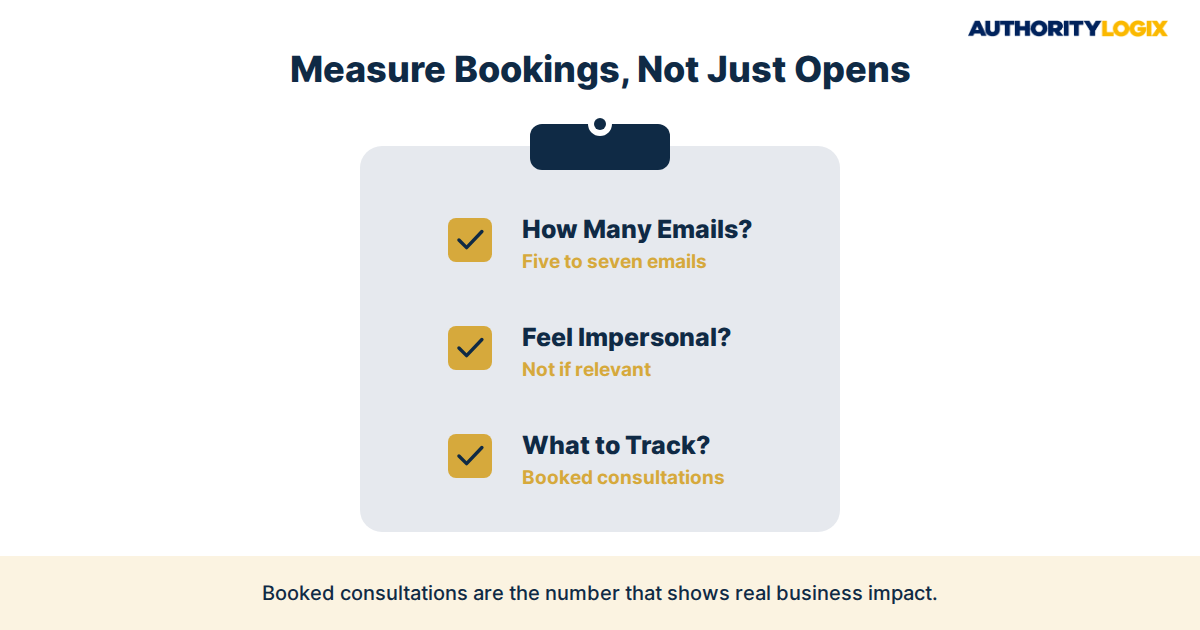
Start with five to seven emails over roughly two weeks — long enough to reach the touchpoints where momentum builds, short enough to build and refine quickly. Firms that succeed with a real estate email nurture sequence rarely started with a perfect one — they started with a working one and improved it over several months of real data.
Will automated emails feel impersonal to leads?
Not if the content is genuinely specific to the lead’s situation — segmentation and relevance matter far more to how a nurture email feels than whether it was sent manually or automatically. A generic, poorly-timed manual email feels far more impersonal to a recipient than a well-segmented automated one that actually addresses their specific situation. What feels personal has always been about relevance, not the mechanism behind delivery. This connects directly to the topic covered in the growth playbook resource.
What should we track to know if the sequence is working?
Open rate, reply rate, and — most importantly — the number of booked consultations that actually originated from the sequence, since that final number is the only one that reflects real business impact. Open rate and reply rate are useful diagnostic signals, but neither one pays the bills on its own.
Ready to build the email nurture sequence that turns cold traffic into booked consultations?
Building Your First Sequence: Where to Start
Pick one segment — buyers or sellers, whichever makes up the larger share of current leads — and build a five-to-seven-email sequence for that group before building a second track. A real estate email nurture sequence built narrow and specific for one segment converts better than one generic sequence stretched thin across every lead type at once. Once that first sequence is running and refined, the second segment’s sequence typically takes a fraction of the time to build, since the timing framework and much of the underlying structure carry over directly.
The what we do page outlines how this first sequence fits into the broader lead generation system a firm is building. Most firms already have enough existing content to populate a full nurture sequence — the missing piece is almost always the automation and timing, not the raw material. Building that missing piece is usually a matter of weeks, not months, once the content itself already exists.
The industry hub covers how this nurture sequence connects to every other system a firm needs — content, local search, lead generation, and authority distribution all feed the same pipeline that a well-timed real estate email nurture sequence ultimately converts. None of those systems produce results in isolation from the others, and a firm that builds all four while neglecting the nurture layer connecting them will still see leads quietly go cold despite all that other investment.