

Key Takeaways
- Organic vs purchased real estate leads is not a close comparison — organic leads consistently close at multiples of what purchased leads convert, industry-wide.
- The gap exists because organic traffic arrives already trusting the site that ranks for their search, while purchased leads start every relationship as strangers.
- First Page Sage’s own benchmarking shows SEO converting real estate customers at 3.5 times the rate of PPC — one of the largest SEO-to-PPC gaps of any industry they track.
- Purchased leads still have a real role — they produce volume immediately, which organic content cannot do in its first months.
- The firms winning long-term are not choosing one channel over the other — they are sequencing purchased leads for cash flow while organic infrastructure compounds underneath it.
- Organic cost per lead drops the longer a firm publishes, while purchased cost per lead stays flat or rises — the gap between the two only widens with time.
Table of Contents
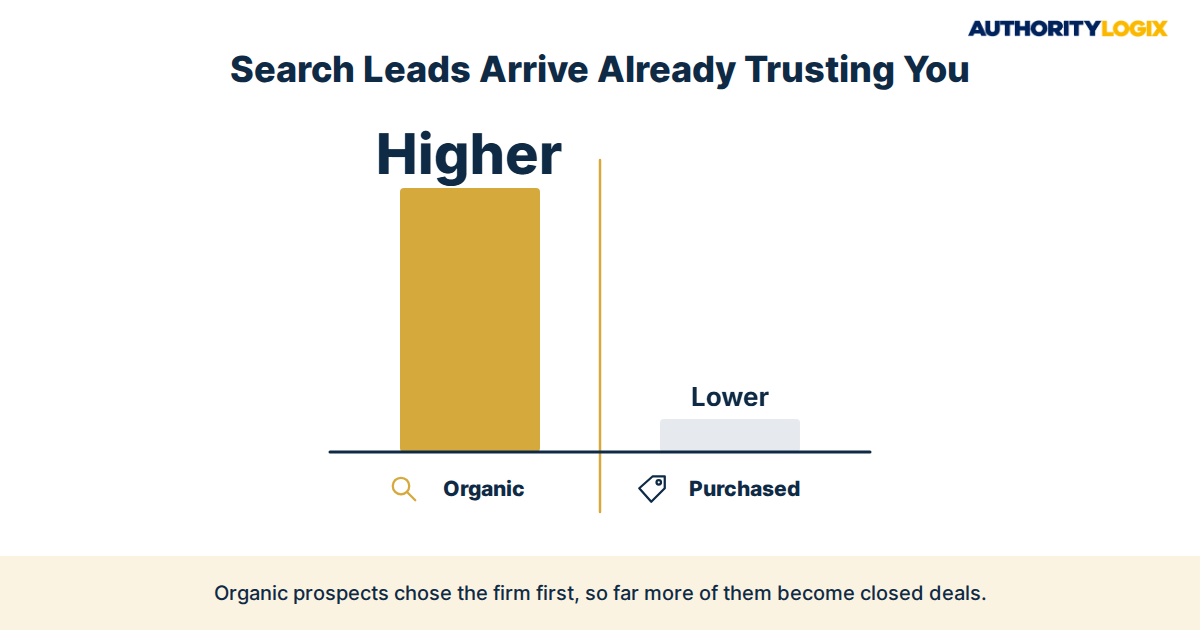
Organic vs purchased real estate leads is a comparison that industry data has already settled, even though most firms still buy leads as if the outcome were in question. Organic search leads convert at markedly higher rates industry-wide than purchased leads — from portals, pay-per-click, and third-party lead sellers — which convert at a fraction of that, depending on the source and how fast the follow-up happens. That is not a small edge. It is an order-of-magnitude difference in how many conversations turn into closed transactions.
This does not mean purchased leads are worthless, and it does not mean every firm should cancel every lead-buying contract tomorrow. It means the two channels are not interchangeable, and treating organic vs purchased real estate leads as if they were the same thing — measuring them by cost per lead instead of cost per closed deal — is why so many firms overspend on volume and underinvest in the channel that actually converts. This idea is explored further in the visibility gap resource as well.
Why Organic vs Purchased Real Estate Leads Convert So Differently
The gap between organic vs purchased real estate leads comes down to a single variable: trust, and when it gets established. A prospect who searches “best real estate agent for first-time buyers in [city]” and clicks a result that directly answers that question has already decided the site is relevant before ever speaking to a human. A prospect handed off from a lead-buying platform has made no such decision — they filled out a form, sometimes on a site with a completely different agent’s name on it, and now a stranger is calling them. That difference in starting trust is the entire explanation for why organic vs purchased real estate leads produce such different results downstream.
The lead generation infrastructure that produces organic leads does the trust-building work before the phone ever rings. A purchased lead skips that step entirely, which is exactly why organic vs purchased real estate leads diverge as sharply as they do in conversion rate.
The local search statistics confirm this pattern holds specifically in real estate, not just in marketing in general — organic real estate leads consistently outperform every purchased alternative on both cost and closing rate once a site has had time to rank. The gap shows up in market after market, regardless of price point or property type.
The Real Estate Lead Generation System covers the full infrastructure this comparison is built on.
What Real Estate Organic Lead Conversion Rate Data Actually Shows
The real estate organic lead conversion rate figures most often cited come from aggregated industry data comparing SEO-sourced leads against portal and cold-purchased alternatives, and they consistently favor organic. Purchased portal leads, by contrast, typically convert at the low end industry-wide, with pay-per-click performing somewhat better when campaigns are well-managed. Every version of the organic vs purchased real estate leads comparison, regardless of which specific benchmark a firm consults, lands on the same directional conclusion.
The Trust Gap Behind Organic vs Purchased Real Estate Leads
A visitor who arrives through organic search chose that specific result out of ten or more competing options. That choice is itself a data point — it means the page’s title, description, and reputation already matched what the visitor was looking for. A purchased lead has made no comparable choice in the organic vs purchased real estate leads comparison; they answered an ad or filled out a form on a lead-aggregator site that has no ongoing relationship with the agent who eventually calls them. This connects directly to the topic covered in the authority guide resource.
Why Purchased Leads Convert So Much Lower
Purchased leads also suffer from a distribution problem that organic leads do not: the same lead is frequently sold to three, five, or more agents simultaneously. By the time a purchased lead reaches an agent’s phone, a competitor may have already called, texted, and scheduled a showing. Organic vs purchased real estate leads is partly a conversion-rate story and partly an exclusivity story, and the two compound each other in the same direction every time, which is why the gap between them keeps widening rather than narrowing as a market gets more competitive.
| Lead Source | Typical Conversion Rate | Exclusivity |
|---|---|---|
| Organic search | Highest of the three | Fully exclusive to the firm |
| Portal leads (Zillow, Realtor.com) | Typically low | Often shared with competitors |
| Pay-per-click | Low to moderate | Exclusive, but cold |
Agent Inbound Lead Close Rate: What Changes the Math
Agent inbound lead close rate is not fixed once a lead arrives — response speed changes it dramatically, for both organic and purchased leads alike. A lead contacted within five minutes is dramatically more likely to convert than one contacted an hour later, regardless of source. But speed helps a genuinely interested organic lead far more than it helps a cold purchased one, because there is more genuine intent underneath the contact information to begin with — one more way the organic vs purchased real estate leads gap shows up in practice, not just in aggregate statistics.
The neighborhood landing pages that generate organic leads also tend to pre-qualify them before the first call — a visitor who read three paragraphs about a specific neighborhood’s market conditions is a fundamentally warmer conversation starter than a name and phone number with no context attached. That pre-qualification is doing work no purchased lead arrives with.
The visibility gap that keeps experienced brokers invisible online is the same gap that keeps their agent inbound lead close rate lower than it should be — a broker with real expertise but no organic presence is competing entirely on purchased leads, at purchased-lead conversion rates. Fixing that visibility gap is often the single most consequential change available to an experienced broker, precisely because it converts existing expertise into the kind of organic presence that changes conversion math permanently rather than for one campaign cycle.
Broker SEO Leads vs Paid Leads ROI: The Long Game
Broker SEO leads vs paid leads ROI looks unfavorable to organic in month one and increasingly favorable every month after that. First Page Sage’s benchmarking across industries found that real estate SEO converts customers at 3.5 times the rate of paid search — one of the largest SEO-to-PPC performance gaps of any industry the firm tracks, and a gap that only widens as an organic site accumulates more ranking pages.
The content system behind that 3.5x figure is not a one-time project — it is a compounding asset. Every published page keeps generating organic traffic indefinitely, while every dollar spent on purchased leads stops producing the moment the spending stops. That single difference is the entire reason organic vs purchased real estate leads produce such different long-term returns.
Not sure where your firm’s organic vs purchased lead mix actually stands.
Building the Organic Pipeline That Produces These Numbers
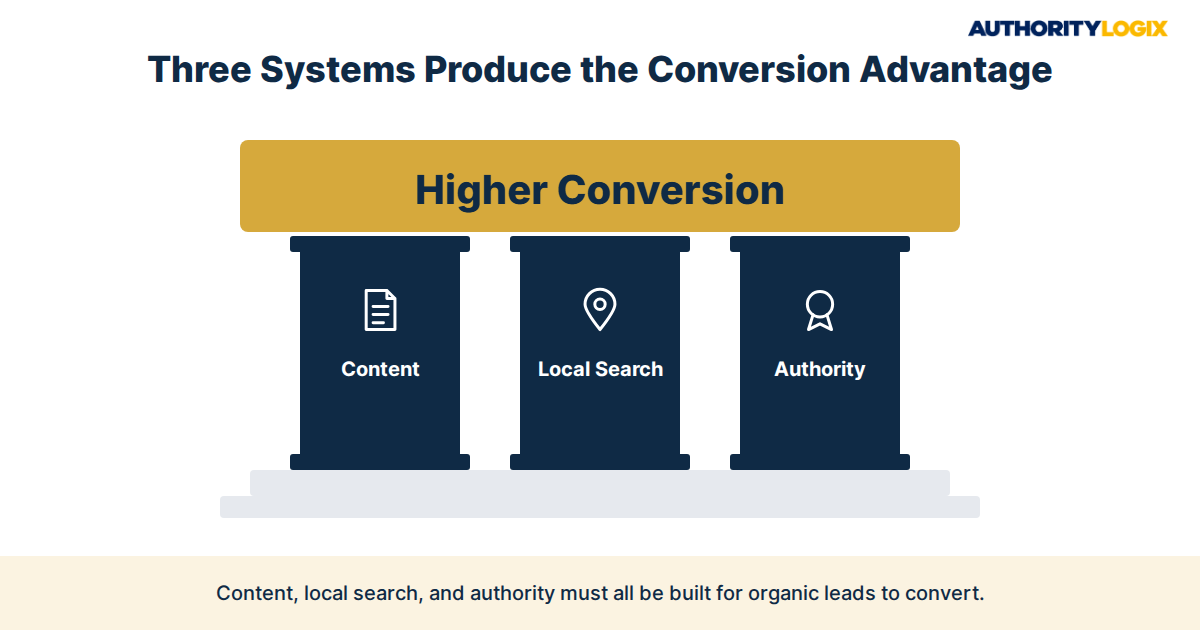
The organic side of the organic vs purchased real estate leads comparison does not happen by accident. It requires published content that ranks for the specific searches buyers, sellers, and investors actually run, a local search presence that beats out the portals for map pack visibility, and an authority foundation that convinces both Google and prospects the firm is a credible source. Building all three at once is what separates the firms converting organic leads at high rates from the ones still buying low-converting leads.
The local SEO playbook covers the specific mechanics of ranking locally against Zillow and Redfin, which is usually the first barrier a firm has to clear before organic leads start arriving in any meaningful volume. Clearing that barrier is what makes every later step in the pipeline worth building.
The authority guide covers the credibility layer that determines whether a visitor who does find the site actually trusts it enough to convert — ranking and converting are two different problems, and both need solving. Organic vs purchased real estate leads succeed or fail on exactly this distinction.
The educational hub system is what organizes that credibility content into something a prospect can actually navigate rather than a scattered collection of pages. A visitor who has to search the site to find relevant information has already started losing confidence in the firm behind it — another small factor that widens the gap in organic vs purchased real estate leads performance.
Once content, local search, and authority are in place, the authority distribution layer extends that same infrastructure beyond the website itself — sharing it through channels where prospective buyers, sellers, and investors also spend time before they ever search directly for a firm by name. That extended reach is what turns a well-built website into a firm people already recognize before they land on it.
This is not a theoretical framework for organic vs purchased real estate leads. BKDSCR.com, AuthorityLogix’s own proof-of-concept build in the NYC DSCR investment niche, was built entirely on organic infrastructure — 18 pillar pages, 7 interactive investor tools, and 48 SEO-optimized blog posts, with zero paid ad spend, generating inbound leads organically within its first 18 months. It is the same tradeoff this article describes, proven with the firm’s own money rather than someone else’s research.
Where Purchased Leads Still Fit
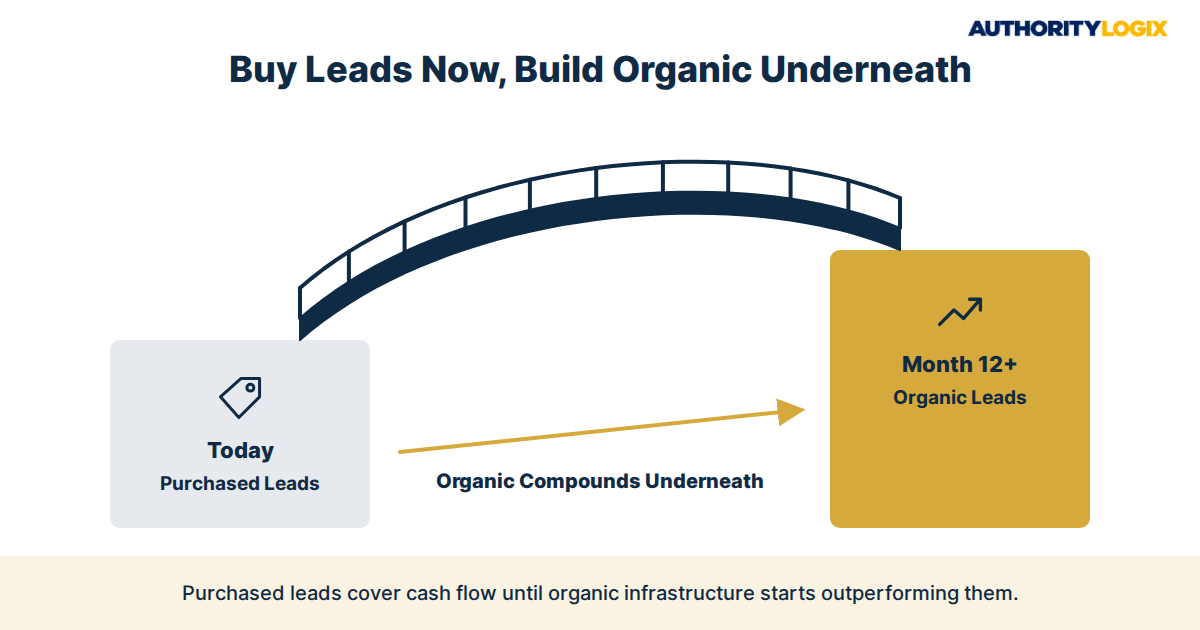
None of this means purchased leads have no place in a real estate firm’s strategy. Organic content takes months to start ranking, and a firm with no pipeline today cannot wait that long for revenue. Purchased leads produce volume immediately, which is genuinely useful while organic infrastructure is still being built underneath it. The growth playbook treats this sequencing as deliberate strategy rather than a compromise — purchased leads fund the bridge, organic infrastructure becomes the destination.
The backlink strategy that accelerates organic rankings takes time to compound, which is exactly the gap purchased leads are good at filling — not permanently, but as a bridge while the higher-converting channel matures. Most firms that succeed at this transition budget for both channels simultaneously rather than switching abruptly from one to the other, treating organic vs purchased real estate leads as a portfolio decision rather than an either-or choice.
What Most Firms Get Wrong About Organic vs Purchased Real Estate Leads
They measure cost per lead instead of cost per closed deal
A purchased lead can look cheaper on a spreadsheet while actually costing more per closing once the conversion-rate gap is factored in. A firm that only tracks cost per lead never sees this, because the metric stops exactly where the real difference between organic vs purchased real estate leads starts to show up. Cost per closed deal is the only number that tells the full story.
They quit organic before it has time to compound
Organic content genuinely does convert worse in its first few months than a firm’s existing purchased-lead baseline — that early period is exactly where most firms abandon the investment. The local SEO comparison covers how long that ramp genuinely takes and what to expect at each stage. Firms that push through that early period are the ones who eventually see those organic conversion rates for themselves.
The industry hub covers how every other system — content, local search, lead generation, authority distribution — connects to this same core tradeoff between immediate volume and compounding conversion quality. Understanding that connection is what keeps a firm from optimizing one system while accidentally undermining another.
Questions Firm Owners Ask About Organic vs Purchased Real Estate Leads
The our approach page covers how the organic vs purchased real estate leads tradeoff gets measured in practice, but most firm owners are really asking a handful of specific, practical questions before they commit budget either way.
Should we cancel our lead-buying contracts entirely?
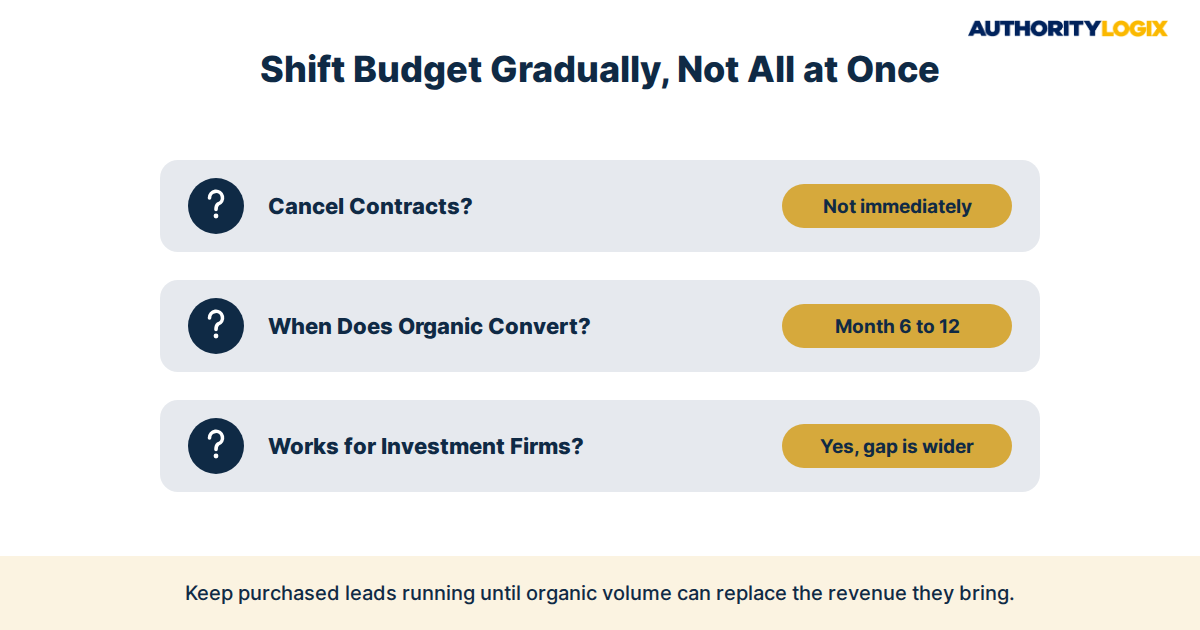
Not immediately — cutting purchased leads before organic infrastructure is generating comparable volume usually creates a revenue gap the firm cannot afford to absorb, no matter how favorable the organic vs purchased real estate leads math eventually looks.
How long until organic leads outperform what we’re currently buying?
Most firms see organic traffic start converting meaningfully between month six and month twelve, with the conversion-rate advantage becoming clearly visible by month eighteen. A related breakdown of this is covered in the authority distribution guide.
Does this comparison hold for investment firms, not just individual agents?
Yes — if anything the gap is wider for investment firms, since investors researching a firm before committing capital rely even more heavily on what they find organically before ever picking up the phone.
Ready to swap purchased leads for the organic leads that close at far higher rates?
Building the Case for Organic Investment: Where to Start
Pull the firm’s actual numbers before making any budget decision: cost per lead by source, close rate by source, and cost per closed deal by source — the last number is the only one that actually matters, and most firms have never calculated it. That single exercise usually makes the case for organic investment on its own, without needing to cite anyone else’s industry benchmark. It also settles the organic vs purchased real estate leads question for that specific firm far more convincingly than any published statistic ever could.
The what we do page outlines how to start building the organic side of this comparison without abandoning the purchased-lead volume a firm currently depends on. The honest answer is that most firms already have everything they need to make this shift except the infrastructure — the expertise, the market knowledge, and the track record are already there. What is missing is almost never talent or effort. It is the system that turns existing expertise into pages buyers, sellers, and investors can actually find.