Key Takeaways
- Google Business Profile physical therapy optimization is the single highest-leverage local visibility investment available to any PT practice — GBP signals account for approximately 32% of local map pack ranking weight, per Whitespark’s 2026 Local Search Ranking Factors study.
- Most PT clinics have incomplete Google Business Profiles. A fully optimized profile consistently outranks a partially completed one for the same practice, in the same market, at zero incremental cost.
- Primary category selection is one of the most impactful ranking signals in GBP. “Physical Therapist” as the primary category, with condition-relevant secondary categories, tells Google exactly what the practice does and which patient searches to match it against.
- Profiles with photos receive 35% more website clicks than those without photos, per Google. Businesses with photos earn 42% more direction requests than those without, per Google.
- User engagement signals — Google Posts activity, Q&A responses, review response rate — are gaining weight in local ranking algorithms, per Whitespark’s 2026 Local Search Ranking Factors survey. An active profile outranks an inactive one with the same static content.
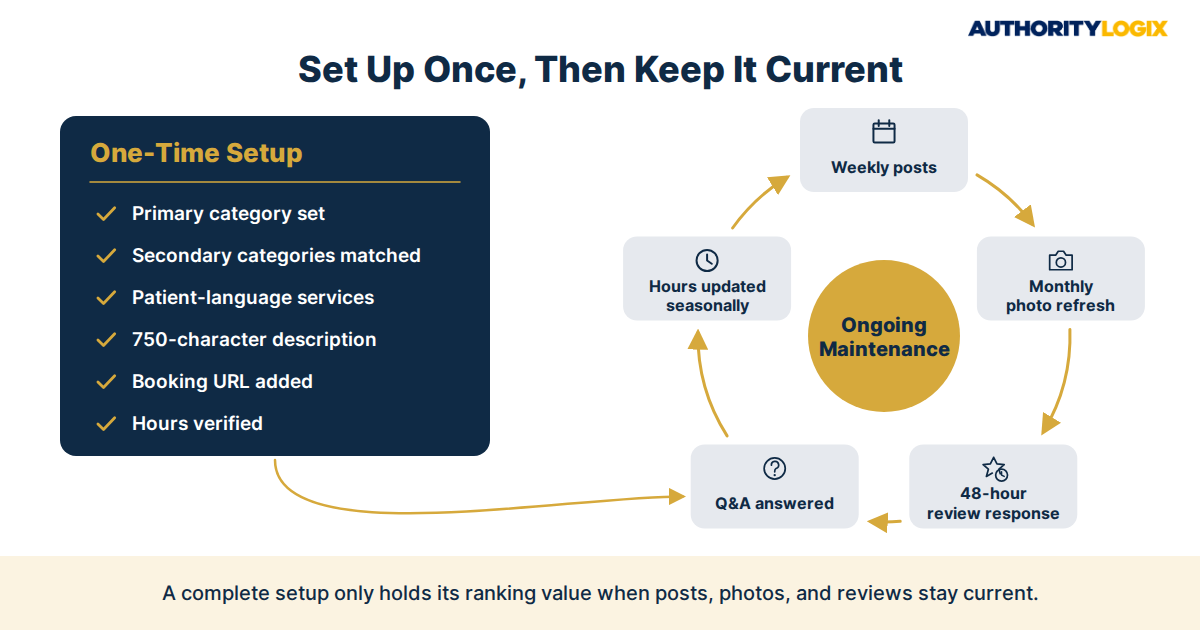
- GBP optimization is not a one-time task. The practices dominating local PT search maintain consistent weekly posting, respond to every review within 48 hours, and update their profiles immediately when any business information changes.
Google Business Profile physical therapy optimization is where most independent PT practices have the largest gap between current performance and available improvement — and where the return on a few hours of focused effort is higher than almost any other marketing investment. The GBP is the first thing a prospective patient sees when searching for a PT practice in their area. It determines whether the practice appears in the map pack at all, where it ranks within the pack, and how compelling the listing looks when compared to competitors side by side.
The local visibility guide covers all four local search signals. This article goes deep on GBP specifically — every field, every feature, and every ongoing maintenance action that determines how a PT practice’s profile ranks and converts. Most PT clinics have incomplete profiles. That incompleteness is an opportunity: a practice that completes what most of its competitors have not will rank above most of them for the same local searches. The full local visibility strategy that GBP sits within is covered in the local visibility strategy guide.
97% of consumers used the internet to find a local business, per BrightLocal’s 2017 Local Consumer Review Survey — and for healthcare specifically, that search often begins on Google Maps. The local search system manages GBP optimization as part of a comprehensive local visibility program. This guide covers what full optimization means and how to execute it. For a deeper treatment of this topic, see the local visibility guide.
Google Business Profile Physical Therapy Categories: The Foundation of Local Ranking
Category selection is one of the heaviest ranking signals in GBP — and one of the most commonly misconfigured elements in PT practice profiles. The primary category tells Google what the business fundamentally is and determines which patient searches to match it against. For a physical therapy practice, the correct primary category is “Physical Therapist” — not “Physical Therapy Clinic,” “Rehabilitation Center,” or any other variation. “Physical Therapist” is the category Google maps directly to “physical therapy near me” searches. The PT industry hub tracks which categories produce the strongest local ranking outcomes for independent PT practices by market type. The
content playbook provides additional context on this topic, particularly for practices still building out this part of their system.
Practices tracking this metric can also review the
content systems for additional benchmarks. The two together clarify whether a profile gap is the bigger constraint right now.
Secondary Categories in Google Business Profile Physical Therapy Setup for Specialty Visibility
Secondary categories extend the profile’s relevance to additional patient searches beyond the primary category. The right secondary categories for a PT practice depend on its actual specialty mix. A sports rehabilitation practice might add “Sports Medicine Clinic” and “Rehabilitation Center.” A pelvic health specialist might add “Women’s Health Clinic.” A pediatric PT practice might add “Children’s Hospital” or “Pediatric Clinic.” Google cross-references secondary categories against the website content and service descriptions — adding categories that do not match actual services creates a consistency signal problem rather than a ranking benefit.
The practical rule: add every secondary category that accurately describes a service the practice actively delivers, and none that do not. Two to four well-matched secondary categories consistently outperform a longer list of loosely relevant ones. The PT Authority Gap Assessment → assessment reviews GBP category configuration against local competitor profiles to identify whether the practice is missing high-value secondary categories its competitors are using.

The Physical Therapy Local Visibility Guide covers how an optimized Google Business Profile fits into the full local search system that brings patients to your door.
Local Visibility Guide →
75% of top-ranking businesses have complete profile descriptions, per Localo’s analysis of 2 million Google Business Profiles. The Services section and Business Description are the two elements most likely to be incomplete in PT practice profiles — and the two that contribute most directly to condition-specific search relevance beyond the primary category. A practice whose Services section lists “back pain treatment,” “sports injury rehabilitation,” and “post-surgical recovery” in patient-facing language ranks for those specific condition searches in a way that one listing only “physical therapy” does not.
For a deeper treatment of this topic, see the
local visibility strategy. It covers the other three ranking signals a complete profile depends on.
The
patient reviews guide provides additional context on how review signals connect to profile completeness. A complete profile with a thin review base still underperforms a modest profile backed by strong, recent reviews.
Writing the Services Section for Patient Search Language
The Services section should list every condition and treatment the practice actively addresses — in the language patients use to search, not the clinical terminology therapists use internally. “Lower back pain” rather than “lumbar rehabilitation.” “Knee injury recovery” rather than “knee arthroplasty rehabilitation.” “Neck pain and stiffness” rather than “cervical dysfunction management.” Each service entry is a relevance signal for the searches patients conduct using that language. The more precisely the service language matches patient search queries, the stronger the relevance connection Google draws.
Services should also include the practice’s direct access statement as a service-level note — “Evaluation available without physician referral” — since Google can surface this language in response to “physical therapy without referral” searches. The local search system includes a full PT-specific service list template in patient-facing language that covers the most common musculoskeletal, neurological, and specialty PT conditions.
Business Description: 750 Characters of Ranking and Trust Signal
The Business Description allows 750 characters — enough to include the primary location, the top three conditions treated, the practice’s direct access availability, accepted insurance panels, and a brief credibility statement. The first 250 characters are the most important — they appear in the truncated view before the patient clicks “more.” This visible segment should include the primary keyword (“physical therapy in [city]”), one to two specialty conditions, and the direct access statement. For the related AuthorityLogix implementation framework, see local search.
The description should not be a marketing tagline. It should be the clearest possible answer to the question every prospective patient is asking: “Is this the right practice for my specific problem?”
A description that answers that question — “We specialize in sports rehabilitation, post-surgical recovery, and lower back pain treatment in [neighborhood], [city]. No physician referral required.” — converts profile views into actions at a higher rate than a generic mission statement. The education guide covers how GBP description language should mirror condition page language for maximum consistency.

Photos and Google Posts: The Activity Signals That Separate Active Profiles From Static Ones
User engagement signals are gaining weight in local ranking algorithms, per Whitespark’s 2026 Local Search Ranking Factors survey. Profiles with photos receive 35% more website clicks than those without photos, per Google. Businesses with photos earn 42% more direction requests than those without, per Google. For PT practices specifically, practice photos serve a pre-visit anxiety reduction function that is unique to healthcare: a patient who has seen the waiting room, the treatment area, and the clinicians before their first appointment arrives with significantly less uncertainty. To diagnose this issue in your own practice, use the authority gap assessment.
Photo Strategy for PT Practice GBPs
A complete PT practice photo library covers six categories: exterior (helping patients find the entrance), reception and waiting area (reducing first-visit anxiety), treatment rooms and equipment (demonstrating clinical capability), clinician headshots with name and credential overlay (building personal credibility before the appointment), team group photos (conveying practice culture), and action shots of treatment in progress — without identifiable patient information visible. All photos should be professionally lit and edited, sized to Google’s recommended 1200×900 minimum, and uploaded with descriptive file names and alt text where the platform allows.
Photo freshness matters as an engagement signal. Adding two to four new photos per month — rotating through the six categories — maintains the active signal that static profiles with a one-time photo upload do not produce. The local visibility guide covers how photo strategy integrates with the full GBP activity cadence that keeps engagement signals strong month over month.
Google Posts: Weekly Content That Signals Active Practice
Google Posts are short content updates — up to 1,500 characters with an optional image and call to action — published directly to the GBP profile. They stay live for seven days (offer posts stay live through the offer end date) and signal consistent practice activity to Google’s local ranking algorithm. A profile with no Google Posts is a static listing. A profile with consistent weekly posts is an active one — and activity is now a ranking signal that affects map pack position independently of other factors.
Effective PT practice Google Posts rotate through three content types: condition-specific patient education posts that address the most common conditions treated (“Managing knee pain after a running injury? Our sports rehabilitation team offers direct evaluations — no referral required”), direct access awareness posts that communicate the no-referral message to patients who may not know they can self-refer, and practice update posts that communicate seasonal changes in hours, new services, or clinician additions. The content playbook covers how Google Post topics should mirror the condition page keyword strategy to create cross-channel relevance reinforcement. For a deeper treatment of this topic, see the
local SEO guide.

Reviews and Q&A: Managing the Trust Signals Patients Evaluate Most
Reviews are both a ranking signal (20% of map pack weight, per Whitespark’s 2026 study) and the primary trust evaluation mechanism patients use when comparing PT practices side by side. 41% of consumers now always read reviews when selecting a local business, up 12 percentage points year-over-year per
BrightLocal’s Local Consumer Review Survey 2026. The review standard has hardened: 75% of patients refuse to book with a provider below 4.0 stars, per rater8, and 32% of consumers want reviews from the last two weeks, per BrightLocal — making recency as important as volume for conversion.
Review Generation and Response for PT Practices
The most effective PT review generation system combines a discharge verbal prompt (“If your experience was positive, a Google review helps other patients find us — here’s the link”) with a follow-up SMS or email sent within two hours of the final visit. The discharge moment is the natural trigger because the treatment episode is complete. Sending the request within this two-hour window — when the patient’s experience is still fresh and their satisfaction is highest — produces the best response rates.
Responding to every review — positive and negative — within 48 hours signals engagement and accountability to both Google and prospective patients. HIPAA compliance governs response language: do not confirm the patient-provider relationship, do not discuss clinical details, and do not include identifying information about the reviewer. For a deeper treatment of this topic, see the
acquisition playbook.
A HIPAA-compliant positive response: “Thank you for sharing your experience — it means a great deal to our team.” The authority gap assessment audits review volume, recency, rating, response rate, and condition specificity against local map pack competitors.
Q&A: Proactively Answering Patient Questions in the Profile
The Q&A section of the GBP allows anyone to post questions — and anyone to answer them. Most PT practices have never visited their Q&A section, meaning patient questions may sit unanswered or be answered by third parties with potentially inaccurate information. Proactively posting and answering the five most common pre-booking questions — using a practice-owned Google account to ask and answer — takes control of this section and fills it with accurate, patient-relevant information that reinforces the practice’s credibility signal. The local search system includes the Q&A management framework and the HIPAA-compliant question-and-answer templates for PT practice profiles.
FAQ: Google Business Profile Optimization for Physical Therapy Practices
How long does GBP optimization take to improve local rankings?
Profile completeness improvements — categories, services, description, photos — typically produce measurable changes in profile views and action rates within 30 to 60 days as Google recrawls and re-evaluates the updated profile. Ongoing activity signals — Google Posts and review generation — begin contributing within the first 30-day posting cycle. Full map pack position improvement from a comprehensive optimization typically develops over 60 to 90 days. The authority gap assessment establishes the baseline GBP score and tracks position movement monthly against local competitor profiles. For the full specialty framework, visit the PT resources hub.
Can a PT practice get penalized for adding too many GBP categories?
Google does not penalize for having multiple secondary categories — but it cross-references categories against website content and service descriptions. Adding categories for services not reflected on the website creates a consistency signal gap that can suppress rather than improve ranking. The practical approach: add categories only for services genuinely offered and documented on the practice website. The local visibility guide covers how GBP category consistency with website content creates the strongest combined local visibility signal.
What should a PT practice do when it receives a negative review?
Respond within 48 hours using HIPAA-compliant language — acknowledge the concern, express genuine willingness to address the issue, and invite direct contact. Do not be defensive and do not include clinical details. 89% of consumers expect businesses to respond to reviews, per BrightLocal’s 2026 survey, and 66% of patients say a provider’s response to reviews influences whether they trust the provider, per rater8’s 2026 Patient Choice Report.
A well-handled negative review response can convert a potential deterrent into a trust signal for prospective patients reading the profile. The local search system includes HIPAA-compliant review response templates for PT practices. The local SEO guide covers the full on-page SEO system.
Does adding a booking link to GBP increase patient inquiries?
Yes. A booking URL field in the GBP profile allows Google to display a “Book” button directly on the profile — enabling patients to initiate scheduling from the map pack result without visiting the website first. This eliminates one click and one potential friction point from the conversion path for patients who are ready to act. The booking URL should link to the practice’s online scheduling page if available, or the contact page if not. Practices that offer direct online booking remove a step between a digital inquiry and a booked appointment, which phone-only scheduling cannot do. For the related AuthorityLogix implementation framework, see
lead generation systems.
A Fully Optimized Google Business Profile Physical Therapy Practices Need Is the Highest-ROI Investment
Google Business Profile optimization for physical therapy practices is not complicated — it is systematic. Every field completed, every photo uploaded, every post published, every review responded to, and every Q&A answered contributes to a profile that ranks higher and converts more prospective patients than one left partially complete. The many PT clinics with incomplete profiles are the competitive landscape — a practice that completes what they have not will consistently outrank them for the same local searches. How a fully optimized GBP contributes to the broader acquisition playbook is covered in the Cornerstone guide.
The Insight Articles in the Local Search and Visibility library go deeper on every element of the local visibility system — from review generation strategy and NAP citation management to multi-location GBP optimization and AI search visibility. The PT resources hub organizes the full library so practice owners can navigate directly to the specific local visibility challenge they are solving today. The lead generation systems service manages GBP optimization as part of a full local visibility program. The
PT industry hub demonstrates how the five-system framework — content, local search, patient education, lead generation, and authority distribution — connects Google Business Profile optimization to the rest of the practice’s growth system.
Want a fully optimized Google Business Profile that wins the local searches in your area?
Work With Us →


