


Key Takeaways
- Physical therapy local visibility is the single most controllable patient acquisition lever available to an independent PT practice — and Google Business Profile is the foundation it is built on.
- Google Business Profile local search accounted for 29.4% of non-paid healthcare leads in 2026, second only to organic search as a source of new patient inquiries.
- BrightLocal’s 2026 Local Consumer Review Survey found that 97% of consumers read reviews before choosing a local business, and 47% will not consider a business with fewer than 20 reviews.
- The top map results receive a disproportionate share of clicks in local searches — map pack position one is a measurable revenue driver, not a vanity metric.
- NAP consistency — identical name, address, and phone number across every online directory — is the entry-level requirement for local pack eligibility. Businesses with consistent NAP data across major citation sources are 40% more likely to appear in the local pack, per BrightLocal.
- Google’s AI now reads the content of patient reviews, not just star ratings — the specific words patients use affect which condition and location queries the practice ranks for.
- Healthcare websites without E-E-A-T signals lost visibility following Google’s 2024–2025 Helpful Content updates, making local search and clinical authority inseparable.
Table of Contents
Physical therapy local visibility determines whether a patient who is ready to book finds your practice or your competitor’s — and it is the foundational layer on which the local search system is built. In 2026, patients begin their search for a physical therapist on Google — typing “physical therapy near me,” “back pain PT [city],” or “physical therapist for knee pain” — and the practices that appear in the Google Map Pack capture the appointment. The practices that are invisible to local search capture nothing, regardless of clinical quality. The local visibility strategy covers this in depth.
A large share of Google searches carry local intent. Nearly all consumers use search engines to find local businesses, and most patients prefer healthcare services close to home. For a PT practice, local search is not a marketing channel alongside others — it is the primary mechanism by which high-intent patients in the practice’s geographic market discover and choose a provider. It feeds directly into the acquisition playbook that fills schedules predictably.
Practices that have optimized their local search presence systematically generate more new patient inquiries at lower cost than most paid alternatives. That gap widens every month a competing practice keeps its profile more current.
This guide covers the complete physical therapy local visibility system: Google Business Profile optimization, map pack ranking factors, review generation and management, citation and NAP management, and the website signals that amplify GBP performance. It is the local search companion to the education guide and the acquisition playbook. Each section maps directly to a measurable outcome — more profile views, more calls, more direction requests, more booked evaluations.
Why Physical Therapy Local Visibility Starts With Google Business Profile
Google Business Profile is the single most important digital asset a PT practice controls for local patient acquisition. When a patient searches for physical therapy in their area, the Google Map Pack — the block of three local business listings that appears above organic results — is the first thing they see. Eight of the top ten ranking factors in the Local Pack and Maps category come directly from the Google Business Profile. No other single channel concentrates this much ranking influence in one place. For the related AuthorityLogix implementation framework, see local search system.
Google Business Profile local search accounted for 29.4% of non-paid healthcare leads in 2026, per Direction’s study of over 102,000 healthcare leads. For most PT practices, GBP is already the largest single source of new patient inquiries feeding the acquisition pipeline — and the majority are running it at a fraction of its potential because their profiles are incomplete, inactive, or missing key optimization signals.
The top map results receive a disproportionate share of clicks in local searches. Moving from position three to position one in the map pack is not an incremental improvement — it can represent a doubling of profile action rates. Yet many PT clinics still have incomplete GBP profiles. The competitive opportunity for practices that complete a full optimization is significant and immediate.
The 3 Factors Google Uses to Rank Physical Therapy Local Visibility
Google publicly identifies three factors it uses to determine local pack rankings: Relevance, Distance, and Prominence. Relevance is how well the practice’s profile matches what the patient searched for — determined by primary GBP category, services listed, business description, and website content. Whitespark’s annual Local Search Ranking Factors report consistently identifies primary Google Business Profile category selection as one of the highest-impact relevance signals. Distance is the geographic gap between the searcher’s location and the practice’s verified address. For a deeper treatment of this topic, see the local visibility strategy.
Prominence reflects how well-known and authoritative the practice is online — measured through review volume and quality, backlinks, consistent citations, website domain authority, and behavioral signals like click rates, calls, and direction requests. Every one of these signals accumulates gradually, which is why prominence favors practices that started building it earliest.
Prominence is the most actionable of the three factors for most PT practices — and reviews are the fastest-moving lever within it. A practice cannot optimize its way around distance, but it can build strong enough Relevance and Prominence signals to rank well for searches conducted beyond its immediate proximity.
Understanding how the three factors interact in practice changes where a clinic invests its optimization effort. A practice that completes a full GBP profile (Relevance), maintains a verified address (Distance), and builds review volume and citation consistency (Prominence) is working all three levers simultaneously — which is the only approach that produces durable map pack position. Practices that optimize Relevance alone by filling out their profile but never request reviews plateau quickly.
Practices that generate reviews but have an incomplete or miscategorized profile waste the engagement they worked to earn. The Map Pack rewards practices that treat all three factors as a unified system rather than individual checkboxes. That systems perspective is what separates PT clinics that rank consistently from those that rank occasionally and lose position the moment a competitor becomes more active. For a deeper treatment of this topic, see the acquisition playbook.

Visibility only pays off when it turns into booked evaluations. The Physical Therapy Patient Acquisition Playbook covers how practices convert local searchers into scheduled patients.
Google Business Profile Optimization for Physical Therapy Practices
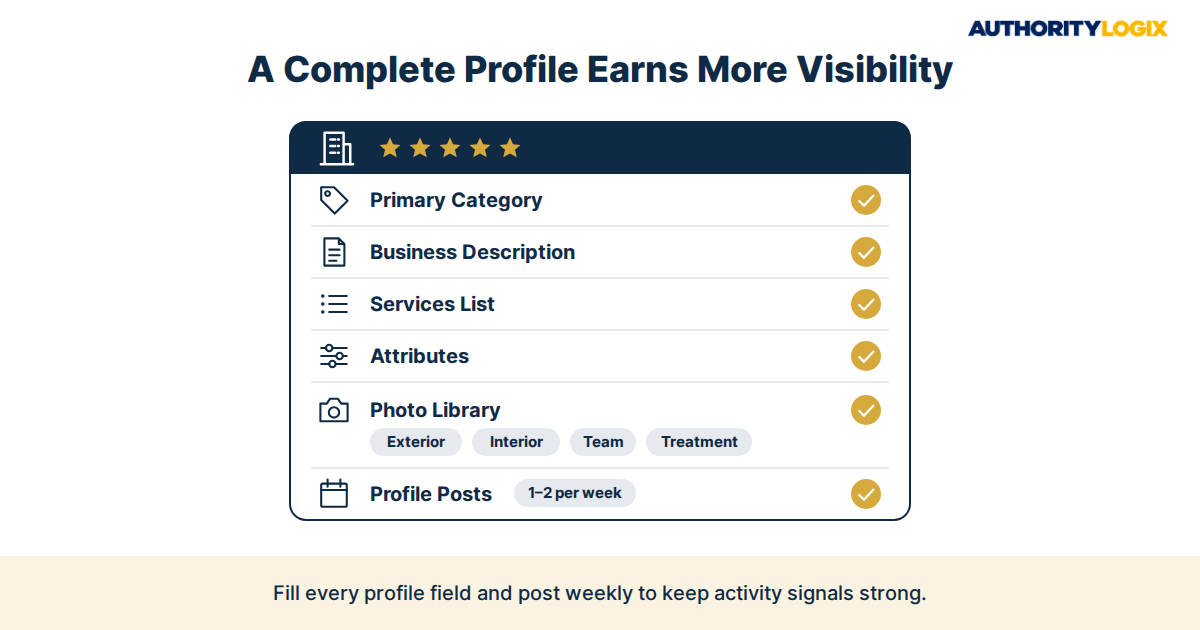
A complete, actively maintained Google Business Profile is the foundation of physical therapy local visibility — and the starting point that every section of the growth blueprint builds on top of. Completeness is not a single action — it is a structured set of profile elements that each contribute to Relevance and Prominence signals. The practices that systematically complete every profile element outrank those that treat GBP as a one-time setup task.
Category Selection
“Physical Therapist” is the correct primary category for most PT practices, as documented in the PT industry hub guidelines. Choosing a broader category like “Health” or a less specific one like “Rehabilitation Center” significantly reduces relevance for the specific queries direct-access patients use. Secondary categories — “Sports Medicine Clinic,” “Occupational Therapist,” or others — can be added to capture additional relevance signals for practices that offer those services alongside PT.
Business Description
The GBP business description is 750 characters. Use the first 250 to establish the practice’s primary category, geographic service area, and clinical specializations. Include the primary condition areas and treatment approaches the practice is known for — this text contributes to relevance matching for condition-specific searches. Avoid generic language that does not communicate specific clinical relevance.
Services, Attributes, and Photos
Every service the practice offers — manual therapy, dry needling, aquatic therapy, sports rehabilitation, vestibular rehabilitation, pelvic floor therapy, post-surgical recovery — should be listed in the Services section using the patient-facing language covered in the acquisition playbook’s direct-access marketing section. Attributes including “online scheduling,” “accepts new patients,” and “wheelchair accessible” contribute to relevance for filtered searches. For a deeper treatment of this topic, see the education guide.
Practices with active photo libraries receive substantially more profile views and engagement than those with minimal photos. The priority photo categories: exterior photos showing the building and signage, interior photos of treatment areas, team photos by clinician name and credential, and treatment photos showing clinicians working with patients. Profiles that are regularly updated with new photos signal activity to Google’s local ranking algorithm — a profile that has not received new photos in six months is a negative signal.
Google Posts
Google Posts appear on the GBP and contribute to profile activity signals. For PT practices, effective post topics include condition education tips, direct access awareness updates, seasonal injury prevention content, and new clinician announcements. A posting cadence of one to two posts per week is sufficient to maintain active profile signals without requiring significant content production time.
The most effective GBP posts for PT practices follow a simple structure: one sentence identifying a condition or patient concern, one sentence explaining what the practice does to address it, and a clear call to action with a direct booking link or phone number. Posts that skip the call to action get read but rarely convert.
Posts that mention specific conditions — aligning with the keyword strategy outlined in the content playbook — such as “If you’re managing rotator cuff pain, our sports rehabilitation specialists offer same-week evaluations” — build condition-specific relevance signals that align with how Google reads the profile for query matching. Posts expire after seven days, which means active publishing is the only way to maintain their visibility contribution. A practice that published consistently six months ago and stopped is leaving profile activity signals on the table that a posting competitor is capturing. For a deeper treatment of this topic, see the growth blueprint.
Physical Therapy Map Pack Rankings: Reviews and NAP Consistency
Reviews: Volume, Recency, and Content
BrightLocal’s 2026 Local Consumer Review Survey — conducted with 1,002 U.S. adult consumers — found that 97% of consumers read reviews before choosing a local business, 47% will not consider a business with fewer than 20 reviews, and the share of consumers who only use businesses rated 4.5 stars or higher nearly doubled from 17% to 31% year-over-year. Northwestern University’s Spiegel Research Center found that purchase likelihood typically peaks at ratings in the 4.0 to 4.7 range. The goal is volume, recency, and credibility.
Review recency matters independently from overall rating. BrightLocal’s 2026 data found that 32% of consumers want reviews from the last two weeks — up from 20% in 2025. A practice with 200 reviews and a 4.6 average, but whose most recent review is four months old, is disadvantaged against a competitor with 60 reviews but consistent weekly review activity. The review request process needs to be systematic and ongoing — not a one-time effort. Practices uncertain where their review profile stands relative to local competitors can identify gaps through an authority gap assessment.
Google’s AI now reads the content of reviews, not just the star rating. The specific words patients use in their reviews affect which condition and location queries the practice ranks for. A practice where patients consistently mention “shoulder pain,” “sports injury,” and “fast recovery” builds relevance for those specific queries. Training front desk staff to guide departing patients toward specific, condition-referenced review language — without scripting or incentivizing — produces meaningfully better review content. For the full specialty framework, visit the PT industry hub.
NAP Consistency
Businesses with consistent NAP data across major citation sources are 40% more likely to appear in the local pack, per BrightLocal. Inconsistency — a different suite number format in one directory, an old phone number in another, a shortened practice name in a third — sends conflicting signals to Google that reduce confidence in the practice’s location data and suppress local pack visibility.
The NAP audit process: search the practice name across Google, Yelp, Healthgrades, Zocdoc, WebMD, Facebook, Bing Places, and Apple Maps. Document every variation. Correct each listing to match the GBP exactly — same abbreviations, same address format, same phone number. Repeat this audit every six months, as directory data drifts over time.
Citation Building
Beyond NAP correction, structured citation building — creating new listings on authoritative directories where the practice is not yet present — expands the citation footprint that contributes to Prominence. Priority directories for PT practices: Google Business Profile, Yelp, Healthgrades, Zocdoc, WebMD, Facebook, Bing Places, Apple Maps, and any state or specialty-specific PT directories maintained by APTA chapters. Each new authoritative citation is a verification signal that strengthens local pack eligibility.
The practical citation audit runs in four steps: search the practice name across every major platform and document every listing found; note any NAP variation against the GBP master record; correct each discrepancy directly on the platform; and set a calendar reminder to repeat the audit in six months. The six-month cycle matters because directory data drifts — aggregators update their databases from multiple sources, and a corrected listing can revert without the practice’s knowledge. For a deeper treatment of this topic, see the content playbook.
Practices that treat citation management as a one-time task rather than a recurring process find that their local pack performance degrades gradually as inconsistencies accumulate. A single dedicated hour per quarter is sufficient to maintain citation accuracy across the directories that matter most for PT local search performance.

Not sure where your practice stands on local visibility?
Website Signals That Amplify Physical Therapy Local Visibility
The Google Business Profile does not operate in isolation. The website it links to sends signals that either amplify or suppress the GBP’s local search performance. Practices with strong website signals rank higher in the map pack than competitors with comparable GBP profiles but weaker websites. The website is not separate from local SEO — it is the second half of it.
Location-Specific Content
The website pages most directly connected to local search performance are location-specific service pages: “Physical Therapy in [City],” “Back Pain Treatment in [Neighborhood],” “Sports Rehabilitation [City].” These pages combine the practice’s primary condition keywords with the specific geographic terms patients use in local searches. A practice serving multiple locations should have a dedicated location page for each one — a strategy the growth blueprint covers in its multi-location authority section — each optimized for the specific neighborhood and condition searches relevant to that location.
On-Page Local SEO Signals
Beyond dedicated location pages, the website signals that most directly support local map pack rankings are: the practice’s NAP in the site footer matching the GBP exactly, the city and neighborhood name in title tags, H1 headings, and body content on the homepage and key service pages, an embedded Google Map on the contact page, and LocalBusiness structured data (JSON-LD schema) that explicitly tells Google the practice’s name, address, phone number, service area, and hours. To diagnose this issue in your own practice, use the authority gap assessment.
These signals take less than a day to implement and have measurable effects on local pack visibility within 30 to 60 days — and they work in tandem with the education guide content infrastructure that feeds them. Practices that skip this step often wonder why their content investment isn’t showing up in rankings.
Website Speed and Mobile Performance
A large share of healthcare searches now occur on mobile devices. A PT practice website that loads slowly on mobile — more than three seconds — loses a significant percentage of the patients who find it. Google uses Core Web Vitals as a ranking signal, and slow mobile performance suppresses both organic and local pack rankings. The content playbook covers the technical website factors that affect PT search visibility in greater depth.
LocalBusiness schema markup deserves specific attention because most PT practice websites either skip it entirely or implement it incorrectly. Correct schema tells Google the practice’s legal name, physical address, phone number, geographic service area, business hours, and accepted insurance types in a structured format that search engines read independently of page content.
When the schema data matches the GBP data exactly — same name format, same address format, same phone number — it creates a consistent signal across two authoritative sources that reinforces local search eligibility. Practices that add complete LocalBusiness schema to their homepage and location pages give search engines clearer signals for surfacing the practice in local results. It is one of the few technical SEO changes that produces measurable local search impact with minimal ongoing maintenance. For a deeper treatment of this topic, see the patient acquisition pipeline.
E-E-A-T and Local Authority
Healthcare websites without E-E-A-T signals lost visibility following Google’s 2024–2025 Helpful Content updates. For a PT practice, local visibility and clinical authority are not separate concerns — they are interconnected. A GBP that links to a website with credentialed clinician bios, condition-specific educational content, and cited sources performs better in local search than one that links to a thin site without those signals. The education guide covers the E-E-A-T content infrastructure that amplifies local search performance.

Practice-Owner FAQ: Physical Therapy Local Visibility
How long does it take to improve map pack rankings?
Profile completeness changes take effect within two to four weeks. Practices that want a precise picture of where they stand relative to local competitors can start with an authority gap assessment before committing to a timeline. A systematic review request process producing two to four new reviews per week generates measurable ranking improvement within 60 to 90 days. Citation cleanup — correcting NAP inconsistencies across directories — takes 30 to 60 days to propagate. The compounding effect of consistent review volume over six to twelve months produces the most significant and durable ranking improvements.
How many Google reviews does a PT practice need?
BrightLocal’s 2026 data establishes 20 reviews as the minimum below which 47% of consumers will not use a local business at all. In competitive urban markets, the practices ranking in the top three map pack positions typically have 80 to 150 reviews or more. The more meaningful number is not total volume but recency: consistent new review activity — two to four reviews per week minimum — signals ongoing patient engagement that Google’s local algorithm weights heavily.
What is the most effective way to generate patient reviews?
The most effective method is a systematic request at the point of discharge — when the patient has just completed a successful episode of care and their satisfaction is highest. Train front desk staff to deliver a brief, specific request and follow up with an automated text or email that includes a direct link to the GBP review form — a direct link removes friction and makes follow-through far more likely. Never offer incentives for reviews — Google’s policies prohibit incentivized reviews and the FTC’s 2024 rule applies civil penalties for violations. For a deeper treatment of this topic, see the direct-access patient generation.
How does local visibility differ for multi-location PT practices?
Each location needs its own Google Business Profile, optimized independently for its specific geographic market. The growth blueprint covers the brand consistency framework that holds multi-location positioning together. Each profile needs its own distinct NAP, its own photo library reflecting that specific location, and its own review stream. Brand consistency applies across all profiles, but the local signals are location-specific. A single GBP covering multiple locations is not permitted under Google’s guidelines and suppresses visibility for all locations it attempts to cover.
What should a PT practice do if it receives a negative review?
Respond within 24 hours. Review response strategy is one of the core components of the local search system — handled consistently, it converts a liability into a trust signal. Acknowledge the patient’s experience without confirming specific clinical details that could raise HIPAA concerns, express genuine regret that the experience did not meet expectations, and invite the patient to contact the practice directly to discuss the concern. BrightLocal’s 2018 Local Consumer Review Survey found that 89% of consumers read businesses’ responses to reviews, and Podium’s State of Reviews report found that 56% say a business’s responses to reviews changed their perspective on it.
Is paid local search advertising necessary if organic local SEO is strong?
No. The acquisition playbook ranks organic local SEO as the highest-ROI foundational investment before any paid channel is considered. Strong organic local visibility through GBP optimization and map pack rankings generates high-intent patient inquiries at zero incremental cost per click. Paid local search advertising is additive for practices that have already maximized their organic local presence and have budget available to capture additional search volume. For practices with incomplete GBP profiles and low review volume, the investment in organic local SEO produces higher returns than paid advertising. For the full specialty framework, visit the PT resources hub.
Building Physical Therapy Local Visibility That Compounds
Physical therapy local visibility is not a one-time optimization. It is an operational system that requires consistent attention to review generation, profile activity, citation accuracy, and website signals to maintain and improve map pack rankings over time.
The practices that treat local SEO as a managed system — with a defined review request process, a regular photo and post update cadence, a semi-annual NAP audit, and an ongoing content production schedule — consistently outperform those that treat it as a project with a completion date. The patient acquisition pipeline goes deeper on this topic. The direct-access patient generation goes deeper on this topic.
The Insight Articles in the Local Search and Visibility library go deeper on every dimension of this guide — from Google Business Profile optimization and map pack ranking tactics to review generation strategy, citation management, location page development, and multi-location local SEO. The PT resources hub organizes the full library so practice owners can navigate directly to the specific local visibility challenge they are solving.
Local search visibility is where the patient acquisition system begins. A practice that appears at the top of the map pack for the condition and location searches its prospective patients use is generating a continuous stream of high-intent inquiries at no incremental cost. Combined with the patient acquisition strategies covered in the acquisition playbook and the authority building systems in the growth blueprint, a fully optimized local visibility system is the highest-return foundational investment available to an independent PT practice.
Ready to make your practice the one patients find first when they search for physical therapy nearby?