Key Takeaways
- The physical therapy content SEO playbook that consistently produces new patients is built on keyword strategy, pillar-cluster architecture, and on-page execution — not on publishing volume alone.
- 96.55% of all web pages receive zero organic traffic from Google, per Ahrefs — making content strategy the difference between a website that earns patients and one that simply exists.
- Organic search drives a large share of new patient website sessions for health and wellness practices.
- Long-tail keywords tend to earn higher click-through rates than broad search terms — and they represent the queries where PT practices can realistically compete against large health system websites.
- Sites implementing content clusters correctly tend to see meaningful gains in organic traffic compared to non-clustered strategies.
- Healthcare queries trigger Google AI Overviews 88% of the time, per BrightEdge — meaning PT content must now be structured for AI citation eligibility, not just traditional keyword ranking.
- Content marketing generates about 3 times more leads at 62% less cost than traditional marketing, per Demand Metric.
Physical therapy content SEO playbook is the system that determines whether a practice’s website generates a continuous stream of patient inquiries or sits invisible to the patients who need it. In 2026, that distinction is not subtle.
Ahrefs’ analysis of billions of web pages found that 96.55% receive zero organic search traffic from Google.
The PT practices on the right side of that statistic built something specific — a content architecture designed for how patients search, how Google evaluates healthcare content, and how AI systems decide which sources to cite.
The foundational insight is simple: patients search with specific questions, not broad ones. “Physical therapy near me” is a local search handled by the Google Map Pack. The content SEO opportunity lives in the condition-specific, treatment-specific, and question-specific searches that occur before a patient ever considers which practice to contact. A PT practice that answers those questions with credible, attributed content builds a patient acquisition asset that compounds with every new page published. The patient acquisition pipeline covers this in detail.
This playbook covers the complete content and SEO system for PT practices: keyword strategy, pillar-cluster architecture, on-page execution, technical SEO, and AI search eligibility. It is the content infrastructure component of the PT Content Systems framework — the engine that makes every other patient acquisition system work harder.
Organic search drives a large share of new patient website sessions for health and wellness practices. For a PT practice, that means the majority of prospective patients who arrive at the website found it through search — not through referrals, paid ads, or social media. The content system is where patient acquisition is won or lost. For a deeper treatment of this topic, see the
patient acquisition pipeline.
Why the Physical Therapy Content SEO Playbook Is the Highest-Return Investment
Most PT practices know they need a website. Fewer understand that a website without a content SEO system is not a patient acquisition asset — it is a digital business card. The difference is whether the site’s pages rank for the searches patients actually conduct when they are looking for help with a specific condition. A business card exists to be found when someone already knows to look for you. A content asset surfaces your practice at the exact moment a patient is searching for what you do.
The economics of this difference are significant. SEO typically delivers a lower cost per lead and a higher close rate than paid search for healthcare practices. Organic leads close at nearly twice the rate of paid leads because they are self-qualified: the patient was searching for exactly what the practice offers. The acquisition playbook covers how content SEO fits within the broader patient acquisition system.
The compounding nature of organic content is what separates it from paid channels structurally. A condition page published today and optimized correctly will continue generating patient inquiries in three, five, and ten years — at zero incremental cost per visitor. A paid ad stops the moment the budget stops. Healthcare content with strong E-E-A-T signals compounds as it ages: it accumulates backlinks, patient reviews reference it, referring physicians find it, and Google’s authority signals grow with each passing month of consistent engagement.
The AI Search Dimension
The content SEO landscape for healthcare has shifted structurally in 2025–2026 with the dominance of Google AI Overviews. Healthcare queries trigger AI Overviews 88% of the time, per BrightEdge’s January 2026 analysis of AI Overview coverage. When an AI Overview is present, the organic click-through rate for the top-ranked result drops by 58%, per Ahrefs.
This is not a reason to abandon SEO. It is a reason to build content that earns AI citation eligibility. Brands cited in AI Overviews earn 35% more organic clicks and 91% more paid clicks than non-cited brands, per Seer Interactive. The practices that structure content to answer specific patient questions — with clear headings, cited data, and credentialed authorship — are the ones AI systems select for citation. The local visibility guide covers how AI search intersects with local map pack performance. For the related AuthorityLogix implementation framework, see PT Content Systems.

Content ranks when it carries real clinical expertise. The Physical Therapy Patient Education & Clinical Authority Guide covers how practices show that expertise in every page they publish.
Clinical Authority Guide →
Physical Therapy Keyword Strategy: Finding the Searches That Convert
Keyword strategy for a PT practice is not about targeting the highest-volume search terms. It is about finding the searches where the practice can realistically rank and where the intent behind the query maps directly to a patient who is ready to book an evaluation. High-volume head terms like “physical therapy” are dominated by large health system websites with decade-long domain authority. The PT industry hub tracks the keyword categories that independent practices can realistically compete in.
Long-Tail Keywords: Where PT Practices Win
Long-tail keywords are the specific, multi-word phrases patients use when they have a defined condition and are actively seeking a provider. “Physical therapy for rotator cuff tear after surgery” is a long-tail keyword. So is “how long does PT take for knee replacement recovery” and “physical therapist for pelvic floor dysfunction near me.” These queries have lower monthly search volume than broad terms — but they convert at dramatically higher rates because the patient has already self-identified the problem and is in decision mode.
Long-tail keywords tend to earn higher click-through rates than broader search terms. Together they also make up a large share of all search traffic. For a PT practice, this means that a library of 30 to 50 well-optimized condition and treatment pages — each targeting a specific long-tail query — generates more total qualified patient traffic than a single high-volume page ever could.
The competitive reality reinforces this. Only 5.7% of newly published pages rank in Google’s top 10 within their first year, per Ahrefs. For head terms, that timeline extends further because competition is higher. For well-researched long-tail condition pages with strong E-E-A-T signals, the timeline shortens — and the traffic that arrives is more likely to convert into a booked evaluation. For a deeper treatment of this topic, see the
acquisition playbook.
Keyword Research Process for PT Practices
Effective keyword research for a PT practice starts with the conditions the practice actually treats most frequently — content matched to actual caseload composition tends to drive the most relevant, highest-converting organic traffic. The keyword map flows from clinical reality, not from generic search volume data. If 40% of the practice’s caseload is lower back pain, lower back pain deserves the most developed content cluster — the highest-authority pillar page, the most supporting articles, and the deepest condition-specific FAQ coverage.
From each primary condition, the research expands outward through three question types. Informational queries answer what the condition is and how PT addresses it (“what is piriformis syndrome” or “can physical therapy help with herniated disc”). Navigational queries surface the practice in local searches (“physical therapist for sciatica in [city]”). Commercial intent queries capture patients ready to book (“PT evaluation for knee pain near me”). Each type requires different content and different page structures.
Question-format queries deserve specific attention. 99.9% of keywords that trigger a Google AI Overview are informational, per Ahrefs’ analysis of 146 million SERPs — which means question-format condition pages are the most likely to earn AI citation. Structuring condition pages to directly answer the top five patient questions about each condition positions the practice for both traditional ranking and AI search visibility simultaneously.
Search Intent Mapping
Every keyword the practice targets should be mapped to a search intent category before content is written — a framework built into the content systems planning process. Informational intent (the patient is learning) calls for educational condition pages. Commercial intent (the patient is comparing providers) calls for service pages that demonstrate the practice’s specific expertise. Transactional intent (the patient is ready to book) calls for pages with prominent booking calls to action and minimal friction between the search result and the appointment form.
Mismatching intent to content type is one of the most common reasons well-written PT content fails to convert. A patient searching “how long does PT take for ACL recovery” wants an educational answer — not a service page selling physical therapy. A patient searching “sports rehabilitation PT near me” wants a service page with a clear booking path — not a 2,000-word educational article. Getting intent right is what separates high-converting content from high-traffic content that produces no appointments. For a deeper treatment of this topic, see the
local visibility guide.
Pillar-Cluster Architecture for Physical Therapy Websites
The pillar-cluster content architecture is the structural framework that transforms a PT website from a collection of isolated pages into a topical authority system. Google evaluates the depth and breadth of coverage across a topic — and a site with a cluster of interconnected articles on lower back pain rehabilitation can build more topical authority than a site with one comprehensive guide. Sites implementing content clusters correctly tend to see meaningful gains in organic traffic.
The Pillar Page
A pillar page is a comprehensive guide that covers a broad condition or treatment category at a high level — typically 3,000–5,000 words. It is the authoritative parent resource for every more-specific article in its cluster. For a PT practice specializing in sports rehabilitation, the pillar page might be “The Complete Guide to Sports Rehabilitation Physical Therapy” — covering what sports rehabilitation involves, who it helps, what the assessment and treatment process looks like, and what outcomes patients can expect.
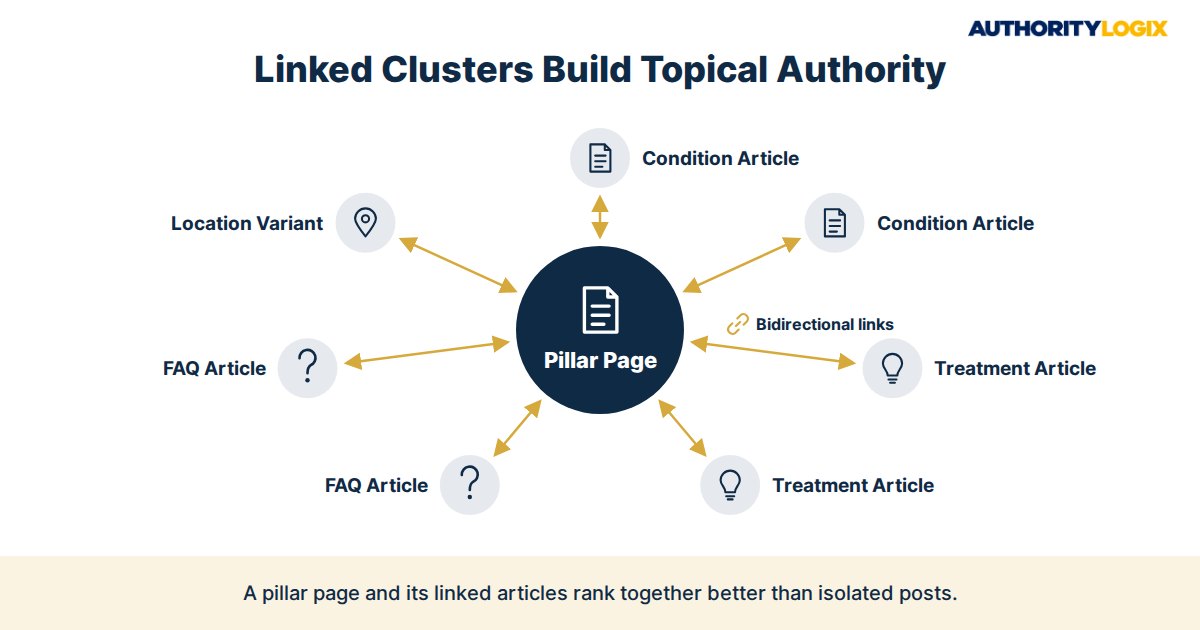
The pillar page targets the broadest keyword in the cluster — the head term that most patients would use when starting their research. It links to every cluster article beneath it and receives links back from all of them. This bidirectional internal linking structure distributes PageRank throughout the cluster and sends Google a consistent signal that the practice has deep, authoritative coverage of the topic — not just surface-level keyword presence. The education guide covers how condition pages and pillar pages work together to build E-E-A-T authority.
Cluster Articles
Cluster articles are the supporting content that surrounds each pillar page. They address the specific subtopics, conditions, and patient questions that the pillar page introduces but does not cover in depth. For the sports rehabilitation pillar, cluster articles might include “Physical Therapy for ACL Reconstruction Recovery,” “How PT Addresses Rotator Cuff Injuries,” “Return-to-Sport Protocols After Knee Surgery,” and “What to Expect in Your First Sports PT Evaluation.” For the full specialty framework, visit the
PT industry hub.
Each cluster article targets a specific long-tail keyword with defined patient intent. It links back to the pillar page using anchor text that includes the pillar’s target keyword, and the pillar page links forward to it. This internal linking architecture is what gives the cluster its collective authority — isolated articles do not produce the same ranking signals that a properly interconnected cluster does. The growth blueprint maps how content clusters feed into the broader competitive authority position.
PT Practice Cluster Structure
Most PT practices should build content clusters around their top three to five condition specialties. A musculoskeletal-focused practice might build clusters around lower back pain, shoulder injuries, knee rehabilitation, and post-surgical recovery. A pelvic health specialist might build clusters around pelvic floor dysfunction, prenatal and postpartum physical therapy, and urinary incontinence management.
Each cluster should include at minimum: one pillar page, four to six condition or treatment-specific articles, two to three patient FAQ articles, and one or two location-specific variants targeting the practice’s primary service areas. This cluster structure — roughly 10 to 12 pages per condition specialty — creates the topical depth that Google’s Helpful Content system rewards with sustained organic visibility. The content systems service builds and manages this architecture for PT practices.
On-Page SEO Execution for Physical Therapy Content
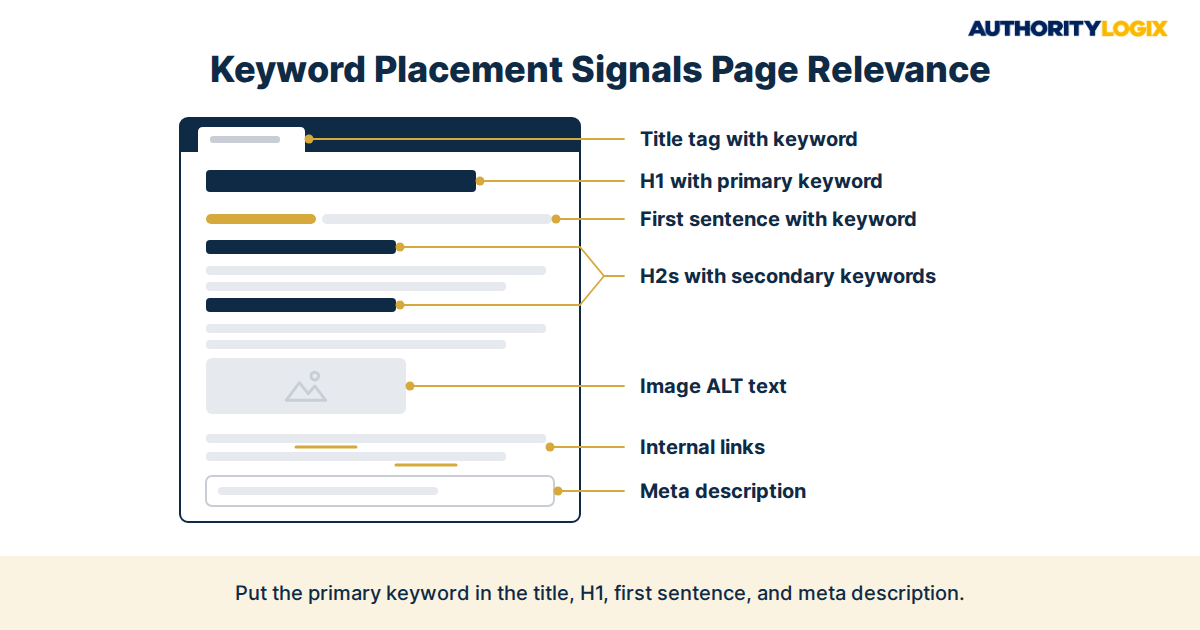
On-page SEO is where keyword strategy and content architecture become visible to Google at the page level. The authority gap assessment audits every existing page against these on-page standards as its first diagnostic step. A correctly structured condition page — with the primary keyword in the title, H1, meta description, first sentence, at least two H2 subheadings, and the image ALT text — sends a consistent relevance signal that search engines can read clearly. A page without that structure may contain excellent clinical content that Google never surfaces to the patients who need it. For a deeper treatment of this topic, see the education guide.
The title tag is the single most important on-page SEO element for a condition or service page. It should place the primary keyword in the first half of the title, stay under 60 characters, and include a sentiment or power word that differentiates the result from competing listings. “Physical Therapy for Lower Back Pain — Brooklyn, NY” outperforms “Lower Back Pain Treatment” because it combines the primary keyword with a geographic signal and implied specificity.
Meta descriptions do not directly affect ranking — but they determine click-through rate from the search results page. A meta description that includes the primary keyword in the first 120 characters, addresses the specific patient concern, and ends with a clear reason to click produces meaningfully higher CTR than a generic practice description. The authority gap assessment audits title tag and meta description quality across the entire practice website as part of its content coverage analysis.
Heading Structure and Keyword Placement
Every condition page should follow a consistent heading hierarchy: one H1 that includes the primary keyword, H2 headings that address the major patient questions about the condition, and H3 subheadings that break each H2 into the specific sub-topics patients search for. This heading structure serves two simultaneous functions — it signals the page’s topical relevance to Google, and it creates the scannable, question-answering format that AI Overviews preferentially cite.
Primary keywords belong in the first sentence of the page. Secondary keywords belong in at least one H2 subheading and throughout the body. The target keyword density for healthcare content is 1.0–1.5% on the editorial word count — enough to signal relevance without triggering the keyword stuffing penalties that Google’s Helpful Content updates specifically target in healthcare YMYL content. The local visibility guide covers how location keywords integrate with on-page optimization for condition pages targeting local search.
Technical SEO Foundations for the Physical Therapy Content SEO Playbook
Page speed is a direct ranking factor — and a patient experience factor that affects conversion independently of ranking. As mobile page load time goes from one second to three seconds, the probability of a bounce increases 32%, per Google research. A large share of healthcare searches now occur on mobile devices, making mobile page speed the primary performance metric for PT websites. A slow-loading condition page that ranks well still loses the patient when they bounce before reading a word. For a deeper treatment of this topic, see the
growth blueprint.
LocalBusiness schema markup — the JSON-LD structured data that tells Google the practice’s name, address, phone number, service area, and hours — is one of the highest-impact technical SEO changes available to a PT practice at low implementation cost. Relatively few US medical practice websites currently deploy proper medical schema markup. The practices that implement it correctly gain a technical signal advantage that most local competitors have not captured. The lead generation systems framework covers how technical SEO integrates with the full patient inquiry pipeline.
Building Physical Therapy Content for AI Search Visibility
AI search is no longer an emerging channel for healthcare — it is the dominant format for how patients encounter healthcare information in 2026. Understanding how the authority distribution system amplifies PT content into AI citation networks is now a core component of the content strategy.
Healthcare queries trigger Google AI Overviews 88% of the time, per BrightEdge. ChatGPT, Perplexity, and Google’s AI Mode are pulling from the same indexed web content that traditional SEO targets. The practices with strong organic content rankings are significantly more likely to earn AI citation — but citation eligibility requires specific structural signals beyond traditional keyword optimization.
What AI Systems Look For
AI citation systems select content that directly answers specific questions — with clear structure, primary source citations, and visible clinician authorship. The authority distribution system is designed specifically to amplify PT content into the external citation networks that AI models use to evaluate source credibility. Only 17% of AI Overview citations come from pages ranking in the organic top 10, per BrightEdge — meaning AI citation and traditional ranking are partially independent, and content structure matters as much as domain authority. For the related AuthorityLogix implementation framework, see
lead generation.
Content organized to directly answer specific questions — with clear headers, structured answers in 100 words or fewer per paragraph, and cited primary data — is what AI systems select for summarization. Per Ahrefs’ AI Overview research, 99.9% of keywords triggering AI Overviews are informational in intent, and long-tail, question-format queries trigger them significantly more often than short-tail queries. This maps directly to the condition-specific, question-answering content architecture a PT practice’s content cluster should produce.
Structured Content for AI Eligibility
FAQ sections are the highest-value AI citation format for PT content. Results with a FAQ rich snippet averaged an 87% click-through rate versus 41% for results without rich features, per a Milestone study reported by Search Engine Journal. A condition page that includes a well-structured FAQ section — with explicit question-and-answer formatting, clinician attribution, and cited statistics — captures both the traditional FAQ rich snippet and positions the content for AI Overview inclusion. The education guide covers how FAQ content architecture integrates with E-E-A-T and AI citation eligibility.
Clinician authorship is a structural eligibility signal for AI systems as much as it is an E-E-A-T requirement. AI systems that evaluate source credibility look for named experts with verifiable credentials — exactly what a properly built clinician bio page provides. A condition page attributed to a named DPT with documented specialty training, linked to a full bio page, is structurally superior for AI citation to the same page attributed to “the [Practice Name] team.”

Practice-Owner FAQ: Physical Therapy Content Strategy and SEO
How many content pages does a PT practice need to see SEO results?
The minimum viable SEO foundation is one fully optimized condition page for each of the top three conditions the practice treats, one location page targeting the primary service area, and a properly structured homepage with clear service and location signals. This foundation — five to six pages — begins generating organic traffic signals within 60 to 90 days.
Meaningful search visibility for competitive condition terms typically develops over 6 to 12 months of consistent content production. The acquisition playbook maps how to stage content investment to generate patient inquiries while the longer-horizon organic authority compounds. For the related AuthorityLogix implementation framework, see
authority distribution.
Should PT practices blog, and how often?
A blog is valuable when every post targets a specific keyword with defined patient intent — and counterproductive when posts are written for general interest without search strategy. A practice that publishes one well-optimized condition article per month consistently outperforms a practice that publishes four generic wellness posts per week with no keyword structure.
The ideal publishing cadence for most independent PT practices is two to four SEO-optimized articles per month — each targeting a specific long-tail condition query, attributed to a credentialed clinician, and internally linked to the relevant pillar page. The growth blueprint covers how content cadence integrates with the broader authority building timeline.
How does content SEO interact with local search rankings?
Content SEO and local search are not separate systems — they amplify each other. Condition and location pages that rank organically increase the behavioral signals (time on site, pages visited, low bounce rate) that contribute to local pack ranking. Patient reviews that mention specific condition terms reinforce the condition relevance signals that condition pages build. And a GBP that links to a website with deep condition-specific content performs better in local search than one linking to a thin site.
Practices that combine local SEO with condition-specific content are better positioned than those relying on either channel alone. The interconnected nature of these systems is why the PT resources hub organizes content, local, and authority resources as a unified system rather than separate disciplines. For the full specialty framework, visit the PT resources hub.
How do you measure whether content SEO is working?
The primary metric for content SEO is new patient inquiries attributable to organic search — not impressions or rankings in isolation. The PT industry hub benchmarks what healthy organic growth looks like at each stage of the content build. Google Search Console tracks which queries drive clicks to which pages. Google Analytics tracks which pages generate the form submissions, calls, and direction requests that indicate patient acquisition intent.
Secondary metrics to track monthly: organic search session growth by page, keyword ranking movement for the top 20 target keywords, and the share of new patient inquiries arriving through organic search versus other channels. A content system that is working should show organic’s share of total inquiries growing over the 12 to 18 month window — even if individual keyword ranking movements are slow in early months.
Does AI-generated content hurt a PT practice’s SEO?
Google’s 2026 Medical Core update explicitly demoted unattributed, generic, and AI-generated filler content in healthcare categories. The standard is not whether AI was involved in production — it is whether the content demonstrates genuine clinical expertise, accurate clinical information, and visible author credentials. AI-assisted content reviewed and attributed to a licensed DPT satisfies those requirements. Generic, unreviewed AI content published at volume does not.
TopDoctor Magazine’s 2026 healthcare content analysis states that clinical review is the primary differentiator between trusted and risky AI-generated patient education. Every piece of patient-facing content should be reviewed by a practicing clinician before publication — not as a legal formality, but as a genuine quality signal that both Google and patients evaluate before trusting a source.
How much does content marketing cost compared to paid advertising?
Content marketing generates about 3 times more leads at 62% less cost than traditional marketing, per Demand Metric. The cost comparison depends on how the practice is producing content — in-house with clinician time, outsourced to a specialist, or through an managed content system. The relevant metric is cost per acquired patient, not cost per article. For a deeper treatment of this topic, see the
direct-access patient generation.
A condition page that generates two new patient inquiries per month for 36 months has produced 72 patient contacts at the cost of one page’s production. The same patient volume from Google Ads at $150 cost per lead would cost $10,800. Content’s ROI advantage widens over time because the cost is front-loaded and the returns compound. The authority gap assessment benchmarks the practice’s current content coverage against the local competitive landscape and identifies the highest-ROI content gaps to close first.
Building a Physical Therapy Content SEO Playbook That Compounds
Physical therapy content SEO is not a launch project — it is a permanent infrastructure investment that produces compounding returns with every new page published, every cluster article added, and every FAQ section that earns an AI citation. The practices that commit to this system consistently and build it with the structural rigor Google’s healthcare content standards require are the ones that dominate their local organic search landscape within 18 to 24 months. The direct-access patient generation goes deeper on this topic.
The Insight Articles in the Content and SEO library go deeper on every dimension covered here — from keyword research methodology and condition page writing standards to pillar page architecture, AI citation optimization, and technical SEO execution for healthcare websites. The PT resources hub organizes the full library so practice owners can navigate directly to the specific content or SEO challenge they are solving now.
The practices that invest in content SEO infrastructure now are building something that paid advertising cannot replicate: a patient acquisition system that runs permanently, compounds over time, and positions the practice as the credible, authoritative answer to the questions patients ask before they ever pick up the phone. That gap only widens the longer a competing practice waits to start.
Ready to build the content and SEO system that turns your clinical knowledge into rankings and booked evaluations?
Work With Us →