

Key Takeaways
- The physical therapy Google local map pack — the three PT practices Google displays above organic results for location-based searches — captures a large share of all clicks for local intent searches. Practices outside the top three are largely invisible to the majority of prospective patients searching for PT in their market.
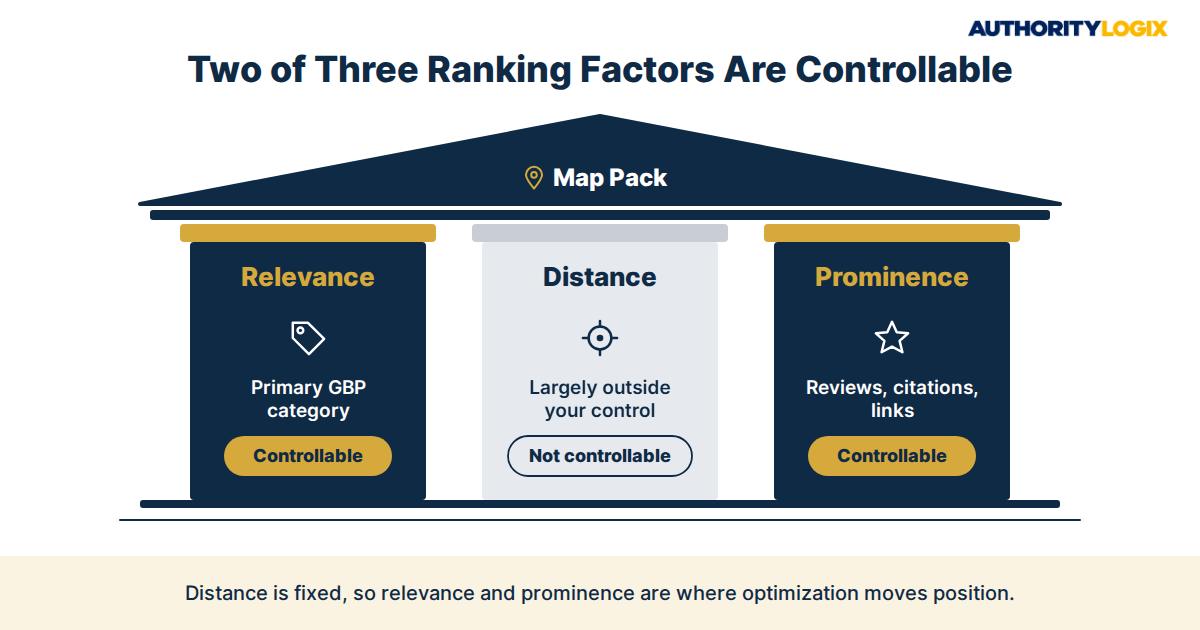
- Google selects the three-pack using three factors: Relevance (how well the GBP matches the query), Distance (proximity of the practice to the searcher), and Prominence (how trusted and authoritative the practice appears across the web). Every map pack optimization action feeds one of these three factors.
- Proximity ranks as the second most important individual Local Pack factor in Whitespark’s 2026 Local Search Ranking Factors survey — but it is largely uncontrollable. The competitive opportunity is in Relevance and Prominence, which are entirely within a practice’s control and determine which practice wins within the same proximity radius.
- Primary GBP category is the single highest-weighted individual ranking factor in the map pack. Category-swap tests consistently show ranking changes within days. A PT practice with the wrong primary category may not be in the candidate set that proximity and prominence rankings sort — regardless of how optimized the rest of the profile is.
- Businesses in the map pack receive 126% more website traffic and 93% more user actions than those ranking in positions four through ten, per SOCi’s local search analysis. The revenue difference between position three and position four is significant enough to justify sustained, systematic optimization investment.
- Map pack position is not static — it varies by searcher location, query phrasing, and device. A practice that appears in position one for a search from one neighborhood may appear in position three or not at all for the same search from across the city. Tracking position requires a grid-based rank tracking approach, not a single-point check.
Table of Contents
The physical therapy Google local map pack is the three-business listing block that appears above organic search results for local intent queries — “physical therapy near me,” “PT clinic in [city],” “physical therapy for back pain [neighborhood].” It appears in the large majority of searches with local intent and captures a large share of all clicks on local search pages. A PT practice that does not appear in the map pack at all is invisible to a large share of the patients actively searching for physical therapy in its market.
The local visibility guide introduced the map pack as the primary high-intent discovery channel for PT practices. This article covers the mechanics — how Google constructs the three-pack, what each ranking factor actually means in practice, where the optimization leverage is, and how to track position movement over time. The acquisition playbook shows how map pack visibility feeds into the full patient acquisition pipeline.
The map pack is not ranked like organic search results. It is a database competition: Google assembles the three-pack from Google Business Profile data, review signals, and the searcher’s physical location — then cross-checks that data against the wider web before trusting it. Category settings, GBP completeness, review signals, and local website content are the primary inputs. Understanding which input does what is the foundation of a map pack optimization strategy that produces actual position movement. The full local visibility system that the map pack is part of is covered in the local visibility strategy guide. For a deeper treatment of this topic, see the local visibility guide.
How Google Selects the Physical Therapy Three-Pack
Google’s own documentation names exactly three ranking factors for local results: Relevance, Distance, and Prominence. Every map pack optimization action — category selection, GBP completeness, review generation, NAP consistency, website content — feeds one of these three factors. Understanding the factor each action feeds is the difference between a systematic optimization strategy and a checklist of disconnected tasks. The PT industry hub tracks how the three-factor framework applies specifically to PT practice map pack competition across market types. The content playbook provides additional context on this topic, particularly for practices still building out this part of their system.
Practices tracking this metric can also review the content systems for additional benchmarks. Together the two paint a fuller picture of where map pack position is actually being won or lost.
Relevance in the Physical Therapy Google Local Map Pack: Matching Profile to Query
Relevance is how well the GBP matches what the patient searched. The primary GBP category is the main relevance filter — if the category does not match the query’s intent, the practice may not enter the candidate set that proximity and prominence rankings sort. This is why category selection is the single highest-weighted individual ranking factor in Whitespark’s 2026 analysis.
A misconfigured primary category removes the practice from consideration for the most common PT searches before any other factor applies. Services, business description, and Google Posts content contribute secondary relevance signals that extend the profile’s match to condition-specific and specialty searches. For a deeper treatment of this topic, see the acquisition playbook.
Distance: The Factor You Cannot Optimize
Distance is the proximity of the practice’s physical address to the searcher’s location at the moment of the query. It ranks as the second most important individual Local Pack factor in Whitespark’s 2026 survey — but it is almost entirely outside a practice’s control. The acquisition playbook provides additional context on this topic.
A practice cannot move closer to every searcher. What it can do is optimize Relevance and Prominence to a level that compensates for the proximity disadvantage against closer competitors. A practice with superior GBP optimization, stronger reviews, and more complete local content regularly outranks a closer competitor with a weaker profile.
Prominence: How Trusted the Practice Appears Across the Web
Prominence encompasses everything that makes a business look established, trusted, and authoritative across the web — reviews, links, citations, mentions in local media, and GBP activity signals. It is the factor most responsive to systematic optimization over time. A practice that generates consistent new reviews, maintains NAP consistency across 20 directory listings, earns local links from PT associations and healthcare directories, and publishes weekly Google Posts builds a prominence signal that compounds month over month. For a deeper treatment of this topic, see the local visibility strategy.
The local search system manages all three factor categories as a coordinated program rather than isolated tasks. The clinical content and E-E-A-T signals that build Prominence through the website are built to the standards in the education guide. The clinical content and E-E-A-T signals that build Prominence through the website are built to the standards in the education guide.
The Physical Therapy Local Visibility Guide covers the full local search system that earns and holds a spot in the three-pack.
Why Map Pack Position Matters More Than Most PT Practices Realize
Businesses in the map pack receive 126% more website traffic and 93% more user actions — calls, direction requests, website clicks — than those ranking in positions four through ten, per SOCi’s local search analysis. The map pack appears in the large majority of local intent searches, and the top three positions combined capture a large share of all clicks on the search page — including organic results, ads, and the pack itself. A PT practice that moves from position four (below the visible pack) to position three gains access to nearly half the patient click volume on that search page.
The CTR Difference Between Pack Positions
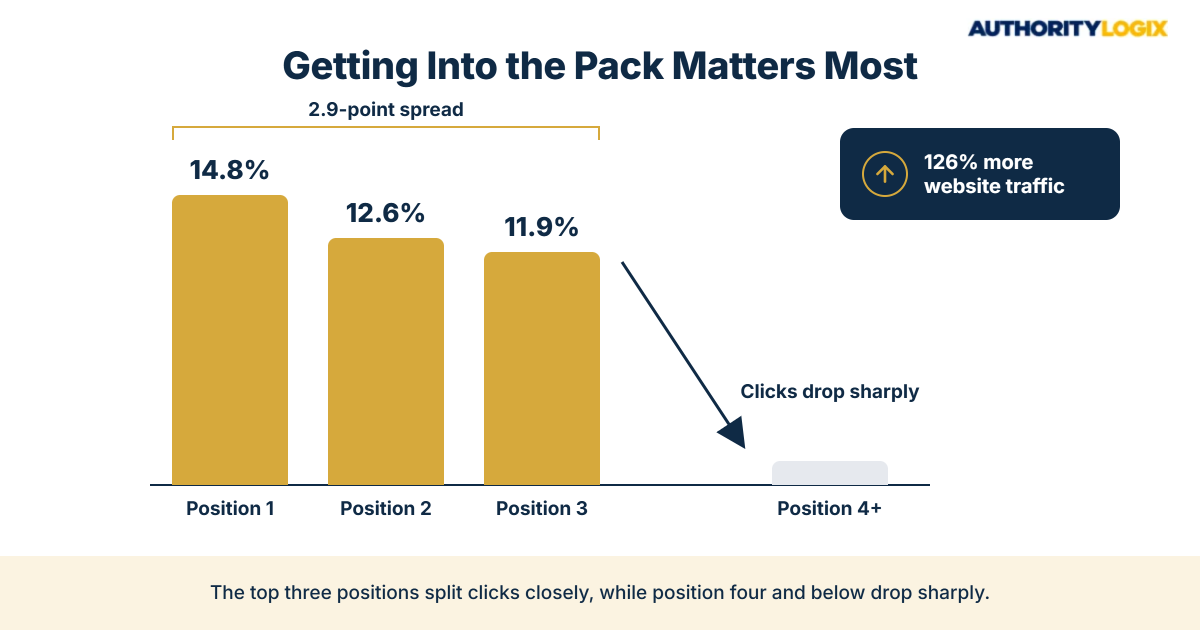
Within the three-pack, click-through rate differences are smaller than most practices expect. Position one carries approximately 14.8% CTR, position two approximately 12.6%, and position three approximately 11.9% — a spread of only 2.9 percentage points across all three visible positions, per First Page Sage’s 2026 local search data. The real cliff is between position three and position four: position four requires a searcher to click “More places” — an action most patients never take. Being in the pack at any position is dramatically more valuable than being the best-ranked practice outside it. For the related AuthorityLogix implementation framework, see local search.
These numbers also explain why the map pack is worth more than the organic results directly below it. Even a number-one organic ranking on the same page receives far less traffic than a position-three map pack listing — because the pack appears above the organic results and captures patient attention before organic listings are ever seen. For PT practices, ranking in organic results without appearing in the map pack is a second-best outcome. The acquisition playbook covers how map pack visibility and organic content rankings work together to capture the full range of patient search behavior.
This means a PT practice that consistently holds position three in the map pack for its primary keywords is not being outperformed meaningfully by the practices in positions one and two — they are all inside the visible pack. The optimization priority is first achieving pack presence, then improving position within the pack. The PT Authority Gap Assessment → assessment identifies whether the practice currently appears in the map pack for its primary PT searches and maps the gap between its current profile strength and the profiles of the practices holding the top three positions.
Not sure where your practice currently ranks in the local map pack for your priority searches?
The Controllable Ranking Signals That Move PT Practices Into the Pack
With proximity largely fixed, the entire map pack optimization strategy concentrates on the controllable signals — GBP completeness and activity (feeding Relevance and Prominence), review signals (feeding Prominence), on-page website signals (feeding Relevance and Prominence), and NAP citation consistency (feeding Prominence). These four controllable signal categories account for the ranking influence beyond proximity — and within a competitive proximity radius, they are what determines which practice ranks first, second, or third.
GBP Signals: 32% of Map Pack Ranking Weight
GBP signals account for 32% of map pack ranking weight per Whitespark’s 2026 Local Search Ranking Factors study — the single largest controllable factor category. Within GBP signals, primary category selection is the highest-weighted individual factor, followed by keyword presence in the business title, profile completeness, GBP website URL, and Google Posts activity. A practice that has completed every GBP field, selected the correct primary and secondary categories, and maintains a weekly posting cadence is extracting the maximum available GBP signal contribution to its map pack ranking. The local visibility guide covers the full GBP optimization protocol field by field. To diagnose this issue in your own practice, use the authority gap assessment.
Review Signals: 20% of Map Pack Ranking Weight
Review signals account for 20% of map pack ranking weight, up from 16% in Whitespark’s 2023 edition — the full review system is covered in the patient reviews guide. Volume, velocity, recency, and sentiment are all evaluated. A practice receiving four or more new reviews per week at 4.5 stars or above is generating a stronger review signal than one with twice the total volume but no new reviews in three months. The full review system — generation, response, and monitoring — is covered in the patient reviews guide.
The review signal compounds fastest when velocity and recency are maintained consistently — not in bursts before a campaign, then silence. The content playbook covers how review language intersects with condition-specific content strategy to maximize both ranking and patient trust signals simultaneously.
FAQ: Physical Therapy Google Local Map Pack
How long does it take to get into the map pack?
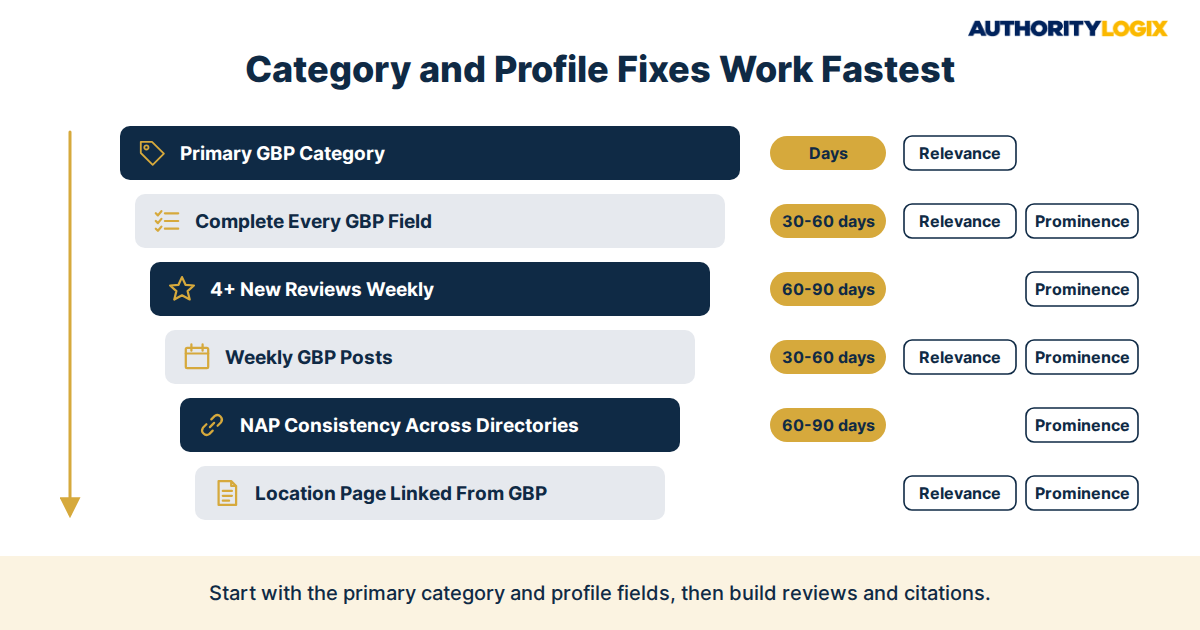
For a new or unoptimized profile in a competitive market: 3 to 6 months of consistent optimization to achieve pack entry, and a further 3 to 6 months to improve position within the pack. Category correction is the fastest-acting change — ranking shifts can appear within days. GBP completeness and posting cadence produce measurable profile view increases within 30 to 60 days. Review velocity and NAP consistency improvements compound over 60 to 90 days. The authority gap assessment benchmarks the practice against the current pack holders to identify how large the gap is and which actions will close it fastest. For a deeper treatment of this topic, see the patient reviews guide.
Why does my practice rank differently depending on where the search is done?
Map pack position is determined partly by the searcher’s physical location at the moment of the query — a practice three miles from a searcher ranks differently than it does for a searcher eight miles away. This is the proximity factor in action: position varies block by block and neighborhood by neighborhood. A practice may hold position one for searches from the immediate neighborhood and position three or below for the same search from across the city.
This is normal behavior, not an error. The correct monitoring approach is a geographic grid — a 5×5 or 7×7 grid spanning the practice’s realistic service area, checked monthly for three to five priority keywords. The local search system includes grid-based rank tracking as part of the ongoing map pack monitoring program.
Can a PT practice rank in the map pack for cities where it does not have a physical location?
Consistently appearing in the map pack for a city where the practice has no physical address is very difficult — distance is a primary ranking factor and Google heavily favors businesses within or near the searched area. A practice can extend its proximity reach somewhat through service area settings in GBP and through local content targeting nearby neighborhood names, but cannot replicate the proximity advantage of a physical presence. For the full specialty framework, visit the PT resources hub.
For multi-location PT groups, opening a second location in a target market is the most effective map pack strategy for that area. The local visibility guide covers service area business settings and their limitations for PT practices without a fixed patient-facing address.
Does the map pack affect AI search recommendations?
Yes — and increasingly so. AI tools like ChatGPT and Perplexity that generate local business recommendations pull from GBP data, reviews, and website content — the same sources that drive map pack ranking. A practice that holds a strong map pack position has built the underlying data quality that AI recommendation systems cite.
The relationship runs in both directions: strong map pack optimization improves AI citation eligibility, and strong AI-ready content improves the on-page signals that support map pack ranking. Practices that invest in map pack optimization build visibility that carries across both traditional and AI-driven search surfaces. For the related AuthorityLogix implementation framework, see lead generation systems.

The Physical Therapy Google Local Map Pack Is a Competition You Can Win
The physical therapy Google local map pack is not an algorithmic lottery — it is a structured competition with known factors, measurable gaps, and clear optimization priorities. The practices holding the top three positions have built stronger Relevance and Prominence signals than those outside the pack, within the same proximity radius. Building those signals requires systematic, sustained effort across GBP optimization, review generation, NAP consistency, and website content — but the framework is clear and the inputs are entirely within a practice’s control.
The Insight Articles in the Local Search and Visibility library cover every dimension of the map pack optimization system in depth — from GBP field-by-field optimization and review generation strategy to local SEO guide, citation management, and AI search visibility. The PT resources hub organizes the full library so practice owners can navigate directly to the specific map pack challenge they are solving today. The lead generation systems service manages the full map pack optimization program for PT practices. The PT industry hub demonstrates how the five-system framework — content, local search, patient education, lead generation, and authority distribution — connects map pack visibility to the rest of the practice’s growth system.
Ready to earn a place in the local map pack where most local patient clicks happen?