


Key Takeaways
- Financial advisor educational content trust is built before the first meeting — prospects who have read an advisor’s content arrive already knowing the advisor’s expertise, approach, and perspective.
- Research shows 60% of Americans say trust is the most important factor when choosing a financial advisor — and educational content is the most scalable way to build that trust before any direct interaction.
- RIAs with dedicated marketing programs open a growth channel that referral-only practices do not have — publishing is the mechanism that separates the two groups.
- Firms with a written marketing plan, ideal client persona, and value proposition acquired 67% more new clients and 68% more new client assets in 2024, per Schwab’s 2025 RIA Benchmarking Study.
- Most high-net-worth prospects research advisors online before any meeting — the advisor whose published content they find owns the trust advantage before the first conversation.
- Authority compounds. A referral validates the advisor to one prospect. Published content validates the advisor to every prospect who runs a search — indefinitely.
Table of Contents

Financial advisor educational content trust is not a theory. It is the measurable difference between a prospect who arrives at a first meeting skeptical — asking who you are, why you, and why they should trust you — and a prospect who arrives already knowing your perspective on retirement income, your stance on sequence-of-returns risk, and your thinking on tax-efficient withdrawal strategies. That prospect has read your content. They have already made a trust decision before you said a word.
Research is direct on what drives advisor selection. 60% of Americans say trust is the most important factor when choosing a financial advisor. Most high-net-worth prospects research advisors online before any meeting. The visibility infrastructure framework for financial services firms covers how search visibility works — but for advisors, the point is simpler: if a prospect searches for you and finds nothing, you lose the trust advantage before the conversation starts.
The full authority-building framework for financial services firms — including how advisors convert educational content into compounding trust — is in the authority guide.
The Trust Problem Financial Advisors Don’t See
Most financial advisors believe they are trusted. Their existing clients trust them. Their referral sources trust them. Their network trusts them. What they do not see is the trust gap that exists with everyone who does not already know them — the prospects who get a referral and then google the advisor, the business owner who sees a LinkedIn post and checks the website, the retiring executive who wants to vet the CFP before returning the call.
The FS industry hub serves advisors, mortgage companies, and financial services firms who have earned real market credibility — and remain invisible to anyone outside their existing network. That is the credibility gap this article addresses. The expertise exists. The track record is real. The problem is structural: without published content, none of that expertise is visible to the people who have not yet met you.
Why Referrals Alone Cannot Scale Trust
Referrals are the most common form of client acquisition in financial services — Kitces research found 88% of advisory practices use client referrals. But referrals have a ceiling. A referral validates the advisor to the specific person being referred. It does not scale. Published content validates the advisor to every prospect who runs a search — indefinitely — without requiring a referral source to be activated first.
RIAs allocate only about 5% of their total expenses to marketing, according to Cerulli Associates. Only 14% have a dedicated marketing resource. The result: most advisory firms are entirely dependent on referrals for new client acquisition, and referral pipelines are ceilings, not foundations. The content systems that close that gap are not expensive — they are simply unbuilt.

Why Publishing Builds the Trust That Referrals Cannot Replicate
When a prospect reads an advisor’s article before any direct contact, something specific happens. They evaluate the advisor’s thinking independently, without the advisor present to manage the impression. If the content is substantive — specific scenarios, clear reasoning, no generic platitudes — the prospect concludes that the advisor knows what they are talking about. That conclusion, reached independently, is more durable than any trust built in a sales meeting.
The search statistics on financial professional discovery confirm this: high-net-worth prospects research advisors online before meetings. The content they find — or do not find — shapes the trust context for every subsequent interaction. An advisor with a published resource library does not start from zero at the first meeting. An advisor with nothing published does.
The Specific Financial Advisor Educational Content Trust Signals
Educational content produces trust signals that credentials alone cannot. A CFP designation tells a prospect the advisor passed a test. A published article on sequence-of-returns risk in a down market tells the prospect how the advisor thinks, what they prioritize, and whether their approach matches the prospect’s situation. That second signal is more actionable and more persuasive for the same reason that showing is more convincing than telling.
75% of readers say data-backed content is more trustworthy than content without data, according to SurveyMonkey research. For financial advisors, that combination — credentialed authorship plus cited data — is exactly the trust signal Google’s quality raters evaluate under E-E-A-T standards. The same content that builds prospect trust also builds search ranking authority. For lenders specifically, a well-maintained local SEO presence reinforces that trust signal in geographic search — the layer beneath organic content that captures local prospects before they reach the advisor’s website.
The Content Types That Build Financial Advisor Educational Content Trust
Not all content produces the same credibility signal. For financial advisors building trust with qualified prospects, four content types outperform everything else. Each demonstrates expertise in a different way. Each serves a different stage of the prospect’s evaluation process.
| Content Type | What It Demonstrates | When It Builds Trust |
|---|---|---|
| Educational articles on specific scenarios | Deep knowledge of client situations and planning complexities | When prospects research their specific situation before seeking an advisor |
| Market commentary with a stated perspective | Intellectual honesty and willingness to take a position, not just report data | During volatile markets — advisors who publish calm, specific analysis stand apart from those who go silent |
| FAQ content addressing prospect objections | Transparency about fees, process, and approach before the prospect asks | When prospects are in evaluation mode — comparing multiple advisors |
| Case study frameworks (without identifying clients) | Demonstrated real-world outcomes through structural problem-solving | When referrals research the advisor before returning a call |
For advisory firms with a local client base, a fully optimized GBP setup reinforces the credibility of published content at the local search layer. Prospects who find an advisor through organic content often check the advisor’s Google Business Profile as a secondary trust validation — reviews, business hours, and profile completeness are part of the evaluation.
The finance content layer is where most advisory firms underinvest relative to the trust return it produces. The compliance concern — that publishing creates regulatory risk — is real but manageable. Marketing and visibility content focused on planning concepts, market context, and educational frameworks does not constitute regulated investment advice. Advisors who treat every article as a liability are leaving the trust-building channel to competitors who understand how to publish within compliance guardrails.
A structured educational hub organizes that content so prospects can navigate it by concern — retirement income, tax strategy, estate planning, market volatility — rather than having to scroll through a chronological blog. The organization of the content is itself a trust signal: an advisor who has published systematically on the topics their clients actually face is demonstrating depth, not just presence.
Not sure where your firm’s content and authority infrastructure stands? The FS Authority Gap Assessment maps the gaps.
How Financial Advisor Educational Content Compounds Over Time
Firms with a written marketing plan, an ideal client persona, and a client value proposition acquired 67% more new clients and 68% more new client assets in 2024, according to Schwab’s 2025 RIA Benchmarking Study. That differential does not come from having a plan — it comes from the consistent execution a plan produces. Content published in month 3 is still ranking and building trust in month 24. That compounding effect does not exist with referral-only growth strategies.
Advisors with active digital marketing programs open a growth channel that referral-only practices do not have. The mechanism is not complicated: a referral-only practice grows as fast as its referral sources activate. A practice with a published content library grows whenever a prospect runs a relevant search — which is happening around the clock, whether the advisor is in client meetings, on vacation, or asleep. Content published today generates trust for AI search citations and traditional organic rankings simultaneously — both channels reward the same underlying investment in substantive, expert-authored content.
The E-E-A-T guide covers exactly what Google evaluates in financial content — named authorship, credential display, cited data, compliance-reviewed copy. Advisors whose published content meets those standards outrank those who do not, regardless of which advisor has the larger practice. The market authority compounds. The referral network does not.
Building the Publishing Infrastructure That Produces Consistent Trust
Most financial advisors who attempt content marketing stop within six months. Not because publishing does not work — it does — but because they are producing content without infrastructure. A single article published once a quarter is not a publishing program. It is activity without compounding.
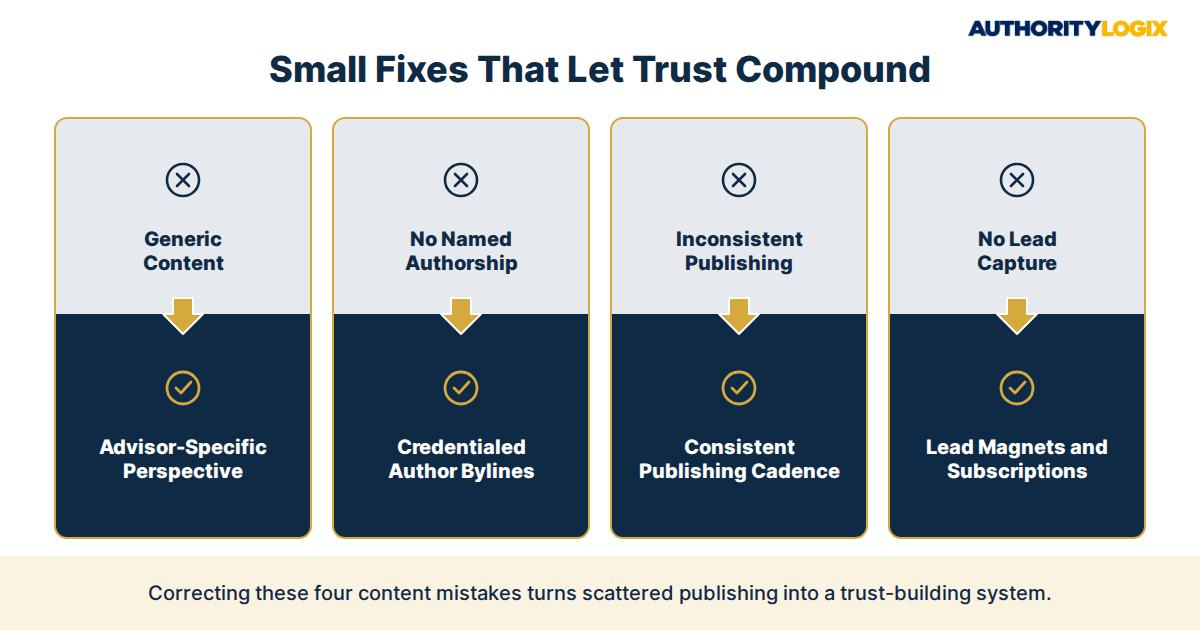
A publishing infrastructure for a financial advisory firm has four components that work together. Without all four, the trust-building effect is limited. With all four, each piece of content produces more trust signal than the last.
The first component is a structured topic architecture — content organized around the planning concerns your ideal clients actually have, not generic financial content that any advisor could publish. The lead generation layer converts that content into identifiable prospects — lead magnets, planning guides, and newsletter subscriptions that capture a prospect’s contact information at the moment they are most engaged with the advisor’s thinking.
The second component is a distribution system that gets content in front of prospects who are not yet searching the advisor’s domain. The lead generation system for financial services firms covers how that pipeline connects content to prospect — email sequences, LinkedIn publishing, and referral source newsletters that keep the advisor’s thinking in front of the right audience consistently.

Frequently Asked Questions About Financial Advisor Educational Content Trust
Does publishing content help financial advisors build trust with referrals?
Yes — and the effect is specific. A referral who looks up an advisor and finds substantive published content validates the referral and proceeds. A referral who finds nothing published hesitates, re-evaluates, or runs a comparison search. The authority distribution system ensures that when a referred prospect searches the advisor’s name, they find credibility signals — articles, resources, and expert positioning that confirm the referral source’s recommendation rather than leaving it unverified.
How much content does a financial advisor need to publish to build trust?
Depth beats volume. One well-constructed article on a specific planning scenario — with named authorship, cited data, and a clear perspective — builds more trust than ten generic posts about market performance. For advisors starting from nothing, four to six substantive articles on the planning topics most relevant to their ideal client profile, organized into a structured resource section, is a stronger foundation than a high-frequency posting schedule without depth.
What is the relationship between RIA publishing and AUM growth?
The Cerulli data is clear: RIAs with marketing programs grow faster. The Schwab benchmarking study confirms advisors with written marketing plans acquire significantly more clients and client assets. Publishing is not the only variable — execution, targeting, and distribution all matter — but the underlying mechanism is trust at scale. The credibility gap article covers why the gap between advisors who build visibility infrastructure and those who rely solely on referrals is structural and compounds over time.
How does DSCR lender content compare to financial advisor content in trust-building?
The trust mechanism is identical — educational content demonstrates expertise before the first interaction. For DSCR lenders the audience is brokers rather than individual investors, but the credibility signal is the same: a lender whose published content answers a broker’s specific scenario question is trusted before the first file. The infrastructure principles that apply to advisory firm publishing apply directly to wholesale lender broker marketing.
Can a solo advisor or small RIA build a publishing program without a content team?
Yes. The AuthorityLogix model is built for financial services firms that need infrastructure, not headcount. The advisor provides the subject matter expertise — which is the only irreplaceable component. The infrastructure build, content organization, distribution system, and authority distribution layer are what AuthorityLogix delivers. The work with us page details how that engagement is structured for advisory firms building from a referral-only baseline.
Ready to publish the educational content that earns client trust beyond referrals?
The Advisor Prospects Trust Before They Meet
There is a version of this that makes the case in the abstract — publishing builds trust, trust converts prospects, and so on. The more useful version is concrete: a prospect who gets a referral to an advisor and then spends 20 minutes reading that advisor’s published content on the planning scenario most relevant to their situation is not the same prospect as one who finds nothing. The first one shows up to the meeting ready to work. The second one shows up still deciding whether to trust you.
Advisors who publish tend to earn more trust, attract better-fit prospects, and build practices that grow without requiring a referral pipeline to be activated for every new client conversation. That is not a marketing trend. It is a structural advantage that compounds every month the infrastructure is in place.
The honest answer is that most financial advisors already have the knowledge that would make compelling educational content. The planning expertise is real. The client experience is deep. The perspective on their specific market is differentiated. What most advisors lack is the infrastructure that makes all of that visible to the prospects who are searching for it — and that is the build.