Key Takeaways
- Mortgage company E-E-A-T signals are the trust framework Google uses to evaluate financial content before ranking it — and YMYL classification means mortgage pages face the strictest E-E-A-T standard in search.
- For YMYL queries, E-E-A-T signals carry substantially more ranking influence than they do on ordinary queries, according to industry analysis of Google’s Quality Rater Guidelines.
- Sites that built E-E-A-T infrastructure before the March 2026 Core Update tended to gain organic visibility. Sites that ignored it often saw significant traffic drops.
- NMLS credential display, named author attribution, and schema markup are the three mortgage-specific E-E-A-T signals that most lenders have not implemented — and that most directly impact ranking.
- E-E-A-T signals in 2026 feed both traditional Google rankings and AI citation eligibility — the same infrastructure that ranks a mortgage page also determines whether AI systems cite the lender as an authoritative source.
- Building mortgage company E-E-A-T signals is a one-time infrastructure build that compounds — unlike paid campaigns that reset to zero when spend stops.
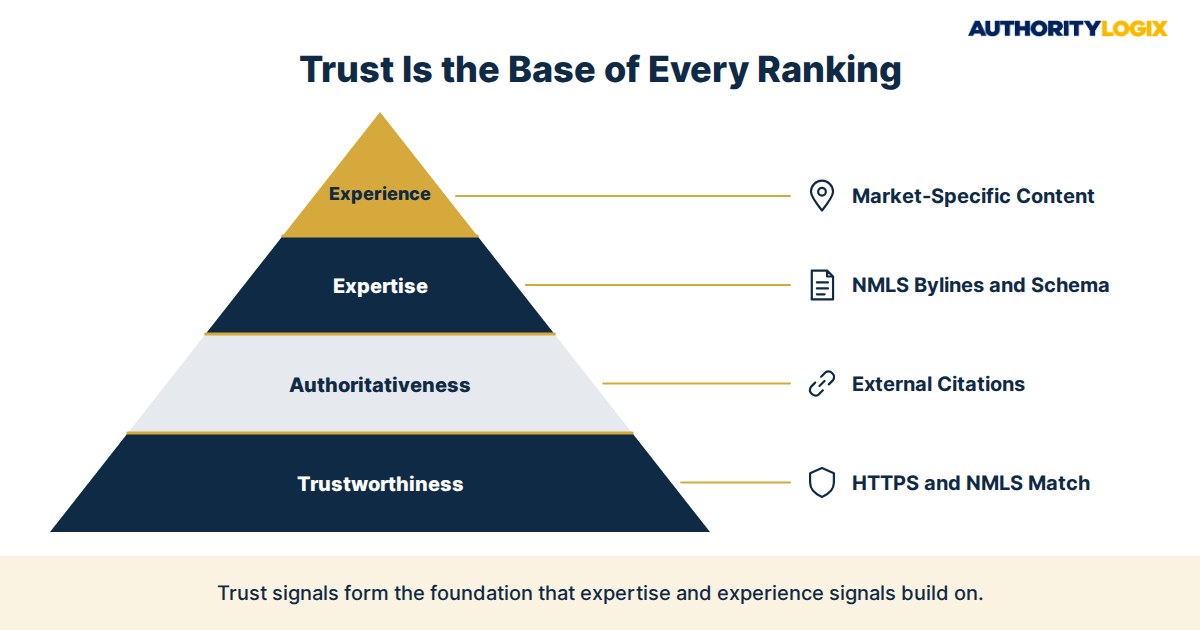
Mortgage company E-E-A-T signals are the trust infrastructure Google requires before ranking any YMYL financial content — and mortgage content is among the most YMYL-classified categories in search. Every loan program page, every rate explanation, every borrower guide a lender publishes is evaluated against Google’s E-E-A-T framework before it ranks for anything. Most mortgage companies have not built that framework. They have published content. They have not built the signals that make that content trustworthy enough to rank.
The Google
quality rater guidelines define exactly what quality raters look for when evaluating mortgage and financial content. YMYL — Your Money or Your Life — is the classification Google applies to content that materially affects a person’s financial wellbeing. Mortgage content is YMYL. That classification means a mortgage company’s content is held to the strictest version of the E-E-A-T standard in search — and failing that standard means ranking below lenders who have built the trust infrastructure, regardless of how much content a lender has published.
For YMYL queries, E-E-A-T signals carry substantially more ranking influence than they do on ordinary queries. The
FS industry hub serves mortgage companies and DSCR lenders facing this exact challenge: expertise that is real but invisible to Google because the signals that make it visible have not been built.
The full authority-building framework for financial services firms — including how mortgage companies convert E-E-A-T signals into ranking authority — is in the authority guide.
Authority Guide →
Why E-E-A-T Hits Mortgage Companies Harder Than Most Industries
Google’s YMYL classification creates a two-tier search environment. Generic content — recipes, travel guides, product reviews — is evaluated against a standard quality bar. Content that affects someone’s financial stability or safety is evaluated against a significantly higher one. Mortgage content — loan program explanations, rate guidance, qualification requirements, refinancing advice — sits at the highest tier of YMYL scrutiny.
The
search statistics on borrower search behavior confirm why this matters practically: 92% of borrowers went online before contacting a lender, according to Ellie Mae’s 2017 borrower research. They run searches. Google decides which lender’s content appears when they do. And Google’s decision is based on E-E-A-T signals — not just keyword matching. A mortgage company with strong keyword optimization but weak E-E-A-T infrastructure will be outranked by a lender whose content demonstrates the trust signals Google’s quality raters evaluate.
The March 2026 Core Update Raised the Stakes
The March 2026 Core Update was the most consequential for financial content in years. Sites that had built E-E-A-T infrastructure before the update tended to gain organic visibility. Sites that had not often lost significant traffic. The update specifically tightened evaluation of YMYL content — named authorship, credential verification, compliance-reviewed copy, and external authority signals all weighted more heavily.
The content systems that survive and improve through core updates are built on E-E-A-T fundamentals. Lenders who treated content as a keyword play and ignored the trust infrastructure lost rankings they cannot quickly recover. Lenders who built the signals first held their positions and gained from the update.

Building the Experience Layer: Mortgage-Specific Content That Demonstrates Real Market Knowledge
The Mortgage Company E-E-A-T Signals in the Experience Layer
The Experience layer of E-E-A-T asks whether the author has direct, first-hand involvement with the subject matter. For mortgage companies, this is the easiest layer to demonstrate authentically — and the most commonly wasted. A loan officer who has closed 500 DSCR loans in the NYC outer-borough market has experience that no AI-generated content and no competing lender can replicate. The problem is that most lenders publish that expertise without the signals that make it visible to Google’s quality raters.
Experience signals for mortgage content include: market-specific loan data referenced in articles (not national averages), closed loan case studies structured to avoid client identification, property-type-specific guidance based on actual underwriting experience, and local market commentary with specific, verifiable references. Generic content does not produce Experience signals. Market-specific, operationally detailed content does.
The
local SEO layer reinforces Experience signals for lenders serving specific geographic markets. A mortgage company with a fully optimized local presence — accurate NAP data, GBP posts that reference recent local market activity, and content that addresses the specific buyer demographics of their market — signals local experience to both Google’s ranking systems and the quality raters who evaluate YMYL content.
A well-maintained
GBP setup is not just a local search tool. For YMYL E-E-A-T evaluation, an active, verified GBP profile with consistent NMLS-matching business information is a Trustworthiness signal that Google cross-references when evaluating content authority. Lenders whose GBP data matches their NMLS Consumer Access record exactly signal regulatory compliance. Lenders with mismatched or abandoned profiles signal the opposite.
Building the Expertise Layer: NMLS Attribution and Credential Display
The Mortgage Company E-E-A-T Signals in the Expertise Layer
The Expertise layer is where most mortgage companies have the actual credentials and fail to display them in the format Google’s quality raters evaluate. A CFP designation not mentioned in author bios, an NMLS number not linked to the Consumer Access record, a loan officer byline with no credential attribution — these are Expertise failures that cost rankings regardless of how good the underlying content is.
For mortgage content, the Expertise implementation is specific: every piece of content published on a lender’s website needs a named, NMLS-credentialed author with a bio page that links to their NMLS Consumer Access profile. That bio page needs Person schema markup that connects the author entity to their verifiable credentials. And the content itself needs to demonstrate expertise through program-specific detail, not generic explanations that any uninformed writer could produce.
The
finance content layer is where Expertise signals are created at scale. Published articles attributed to credentialed loan officers, with cited regulatory sources and program-specific accuracy, produce the Expertise signals that anonymous or generically attributed content cannot.
Building the Authoritativeness Layer: External Validation Google Can Verify
The Authoritativeness layer is the one mortgage companies most often try to shortcut — and cannot. Authoritativeness is built through external validation: citations from recognized industry publications, links from MBA publications and regulatory sources, mentions in local news coverage, bylined content in industry-recognized platforms. This layer cannot be manufactured internally. It requires the lender’s expertise to be recognized by sources outside their own domain.
The
educational hub is the infrastructure that earns external citations by producing content worth citing. A lender whose educational resource library answers specific questions — DSCR qualification thresholds by property type, NMLS overlay requirements by state, local market cap rate data — is producing content that industry sources and other publishers reference.
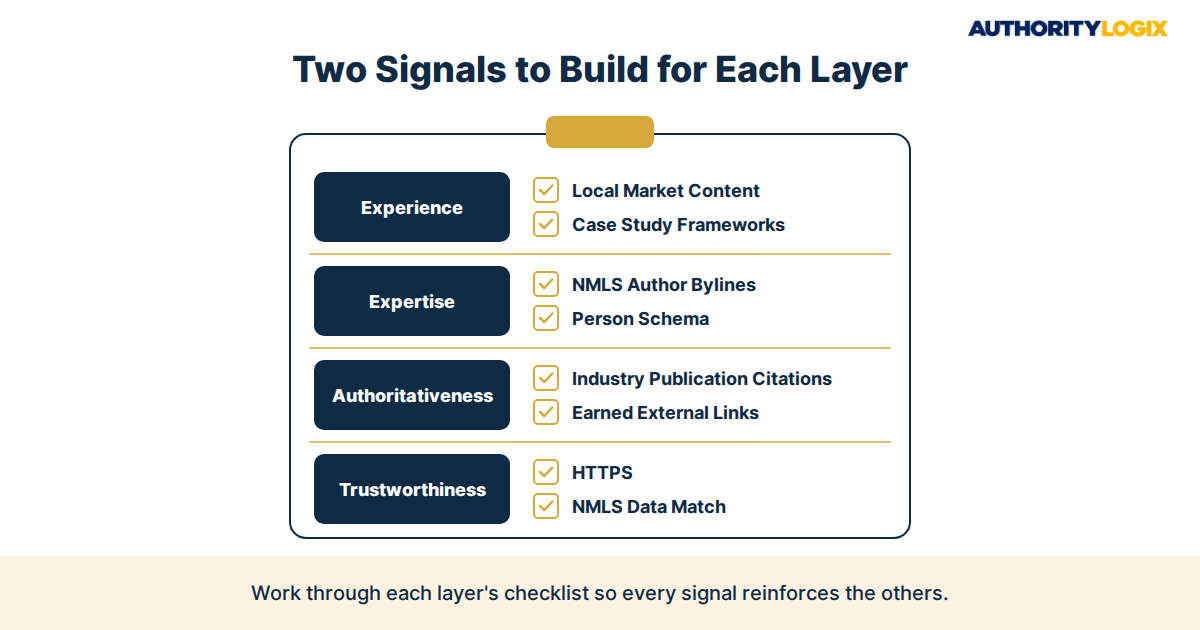
| E-E-A-T Layer |
Mortgage-Specific Signal |
Implementation |
| Experience |
Market-specific content with verifiable local detail |
Closed loan scenario articles, local market reports, property-type guides with operational specifics |
| Expertise |
NMLS-attributed authorship with schema markup |
Named loan officer bylines, bio pages with NMLS Consumer Access links, Person schema with credential properties |
| Authoritativeness |
External citations from recognized industry sources |
MBA citations, CFPB-adjacent educational content, local news coverage, industry publication bylines |
| Trustworthiness |
Technical compliance + NMLS data consistency |
HTTPS, Core Web Vitals, NMLS number matching GBP and Consumer Access, no UDAAP violations in content |
Not sure where your firm’s E-E-A-T signals stand? The FS Authority Gap Assessment maps the gaps across all four layers.
Gap Assessment →
Building the Trustworthiness Layer: Technical Compliance and Regulatory Alignment
Trustworthiness is the foundation layer — the one Google’s quality raters evaluate first, before any of the other three layers matter. For mortgage companies, Trustworthiness has both technical and regulatory dimensions that are unique to YMYL financial content.
The technical dimension: HTTPS, Core Web Vitals compliance, accurate contact information consistently displayed, no deceptive patterns in content or UI. These are baseline requirements. A mortgage company’s website that fails on any of these signals technical incompetence that overrides whatever content quality exists above it.
The regulatory dimension is specific to mortgage and financial content. The NMLS number displayed on every page must match the NMLS Consumer Access record exactly. The business name on the GBP profile must match the NMLS filing. Any rate advertising must comply with Regulation Z disclosure requirements. Content that implies investment advice, promises specific outcomes, or makes unsubstantiated performance claims creates UDAAP exposure and Trustworthiness failures simultaneously.
The
AI search visibility layer depends directly on Trustworthiness signals. AI systems that generate citations from financial content apply the same scrutiny as Google’s quality raters — content attributed to a named, credentialed, NMLS-verified author with schema markup is citation-eligible. Anonymous or generically attributed content is not.
How Mortgage Company E-E-A-T Signals Compound Over Time
E-E-A-T is not a one-time optimization. It is an infrastructure that compounds as content accumulates, as external citations grow, and as the author entity builds a verifiable track record across the web. A mortgage company that builds E-E-A-T signals consistently for 18 months has a fundamentally different authority position than one that started building 18 months later.
The
authority distribution layer is what accelerates this compounding. Distributing attributed, credentialed content through broker-facing channels, industry publications, and AI citation-eligible platforms builds the external authority record that Authoritativeness requires. Content that stays on the lender’s domain only builds internal authority. Content distributed through recognized external channels builds the external authority signal that Google’s quality raters evaluate when scoring YMYL content.
The
growth playbook for financial services firms covers how this compounding plays out over time. The lenders who built E-E-A-T infrastructure in 2024 are the lenders who gained visibility in the March 2026 update. The lenders building now are positioned for the next update — whenever it arrives, and it will arrive.
What Most Mortgage Companies Get Wrong About E-E-A-T
Publishing content without named authorship
Anonymous content — bylined “Editorial Team,” “Admin,” or not attributed at all — is an Expertise failure that no amount of content volume repairs. Google’s quality raters specifically flag anonymous YMYL content as a low-quality signal. Every article a mortgage company publishes needs a named, NMLS-credentialed author with a linked bio page. The
lead generation layer that converts content traffic into identified prospects depends on content credibility — and anonymous content produces neither the trust signals that build credibility nor the conversion rates that produce pipeline.
Treating schema markup as optional
Person schema connecting loan officer author entities to verifiable credential profiles, Organization schema with NMLS number, FAQPage schema on program pages, LocalBusiness schema with geographic coordinates — these are not optional enhancements. In 2026, schema markup is the machine-readable signal that connects a lender’s content to their verified entity in Google’s knowledge graph. Without it, the E-E-A-T signals are present in prose but invisible to the systems that evaluate them algorithmically.
Ignoring the NMLS-GBP consistency requirement
The NMLS Consumer Access record and the Google Business Profile must match on business name, address, and contact information. Google cross-references these data sources when evaluating Trustworthiness for mortgage content. A lender whose GBP address is formatted differently from their NMLS filing, or whose business name varies between the two, is signaling identity inconsistency that suppresses local ranking and weakens the Trustworthiness layer for all content on the domain.

Frequently Asked Questions About Mortgage Company E-E-A-T Signals
How do mortgage companies build E-E-A-T?
By implementing all four layers in sequence: Trustworthiness first (HTTPS, NMLS consistency, Core Web Vitals), then Expertise (named NMLS-attributed authorship with Person schema), then Experience (market-specific content with operational detail), then Authoritativeness (external citation building through educational hub content and authority distribution). The
credibility gap between lenders who have built this infrastructure and those who have not widens with every core update.
How long does it take to build mortgage E-E-A-T signals?
Trustworthiness signals — HTTPS, NMLS data consistency, schema markup — can be implemented in weeks. Expertise signals — named authorship, bio pages, Person schema — follow immediately. Experience signals — accumulated market-specific content — typically take 3 to 6 months of consistent publishing. Authoritativeness — external citations and industry recognition — takes 9 to 18 months of consistent authority distribution. The full infrastructure compounds from the first day of implementation.
Do E-E-A-T signals affect DSCR lender content differently than conventional mortgage content?
The YMYL classification applies equally.
DSCR lenders face the same E-E-A-T requirements as conventional mortgage companies — named NMLS attribution, program-specific accuracy, compliance-reviewed copy, and external citation building. The audience differs but the trust infrastructure Google evaluates is identical.
How does E-E-A-T connect to what financial advisors build?
The E-E-A-T framework applies across all YMYL financial content. The
advisor content article covers how the same named authorship, credential display, and external citation signals that mortgage companies build for YMYL compliance also produce the trust signals that convert advisory firm prospects before the first meeting.
Can a mortgage company build E-E-A-T without a large internal team?
Yes. AuthorityLogix builds the infrastructure — attributed content, schema implementation, educational hub organization, and authority distribution — for financial services firms that have the expertise but not the content team. The work with us page details how that engagement is structured for mortgage companies and DSCR lenders building from a content baseline that lacks E-E-A-T signals.
Ready to build the E-E-A-T signals Google uses to rank your mortgage content?
Work With Us →
The E-E-A-T Infrastructure That Ranks Before the Next Update
Google’s core updates are not surprises. They are algorithm refinements that reward the infrastructure lenders should have built already. Every update in the YMYL space has moved in the same direction: toward more stringent credential verification, more emphasis on named authoritative authorship, more weight on external validation from recognized sources. The direction does not change. The lenders who built for it gained. The lenders who did not lost.
The
E-E-A-T signals guide covers the full implementation for financial services websites — the technical layer, the content attribution layer, and the external authority building layer. For mortgage companies specifically, the compliance dimension adds specificity: NMLS attribution is not just an E-E-A-T best practice. It is the signal that distinguishes a credentialed lender from an anonymous content publisher in Google’s quality evaluation system.
The honest answer is that most mortgage companies already have the expertise the E-E-A-T framework requires. The NMLS license exists. The market knowledge is real. The loan history is deep. What most lenders lack is the infrastructure that makes all of that visible to Google’s quality raters at the moment a borrower runs a search — and that is the build. If your firm is ready to make that expertise rankable, that is the starting point.