


Key Takeaways
- Mortgage loan program pages SEO means building one dedicated, fully answered page for each loan product — conventional, FHA, VA, jumbo, DSCR, bank statement — instead of one “Loan Programs” list.
- Ahrefs found that 96.55% of pages get zero traffic from Google, and thin program pages with no search demand, no backlinks, and the wrong intent land squarely in that group.
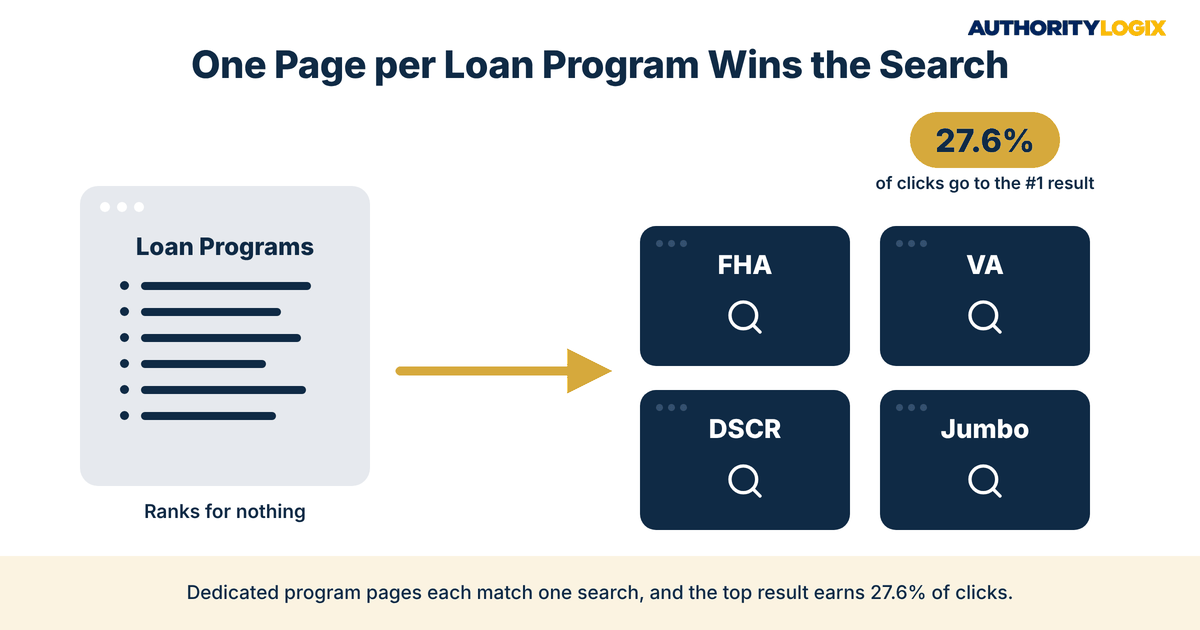
- Position decides the outcome: Backlinko’s analysis of about 4 million results found the #1 organic result earns 27.6% of clicks, while only 0.63% of searchers click to page two.
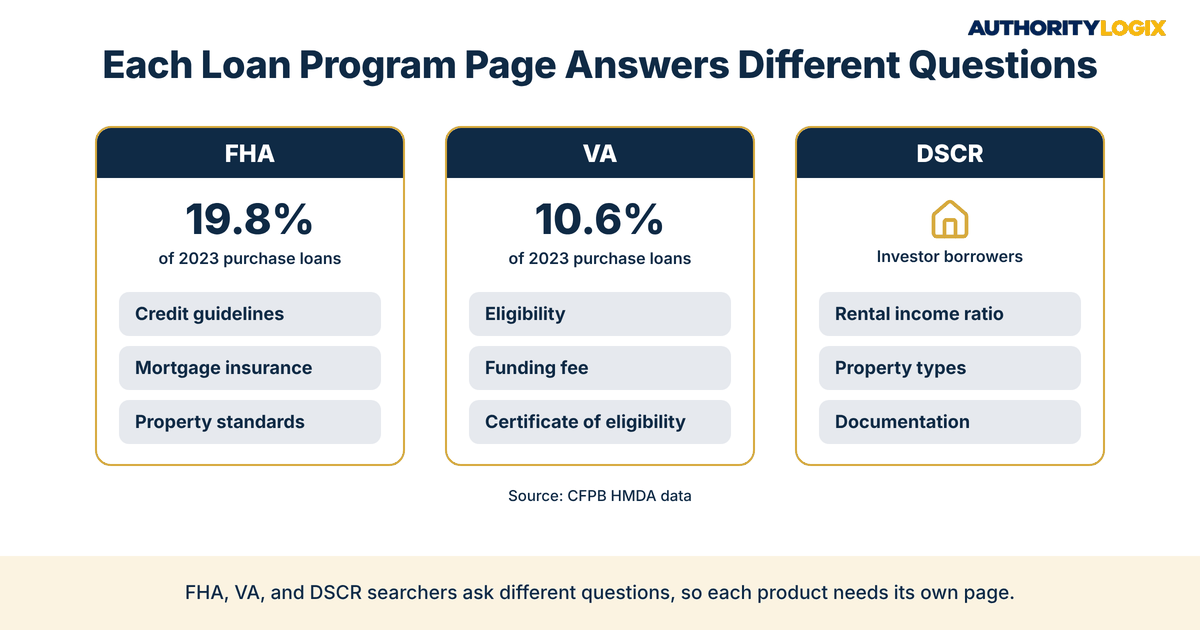
- CFPB analysis of 2023 HMDA data shows FHA loans at 19.8% and VA loans at 10.6% of first-lien home purchase loans — each product has its own searcher and needs its own page.
- Mortgage loan program pages SEO works inside Regulation Z: naming a down payment, payment amount, term, or finance charge triggers added disclosures, so compliance review is part of the build.
- Mortgage loan program pages SEO succeeds when every page is connected — linked from educational content, linked to neighboring products, supported by outside authority, and tied to a clear next step.
Table of Contents
Why Mortgage Loan Program Pages SEO Drives Funded Loans
Mortgage loan program pages SEO is the work of making each loan product you offer findable on its own — and for most mortgage companies, it is the gap between a credible operation and a visible one. You have the products, the underwriting knowledge, and the closing record. What the market sees is one “Loan Programs” page with six bullet points and a phone number.
Google ranks pages, not companies. Fixing that starts with site structure: a parent page for loan programs, one child page per product, and a URL path that tells search engines how the pieces relate. A borrower who searches “DSCR loan for a rental property” or “VA loan eligibility” is matched to the single page that answers that exact question best. When all of your products share one URL, none of them can win that match.
The cost of getting this wrong is measurable. In a study of roughly 14 billion pages published on the Ahrefs blog, Ahrefs found that 96.55% of pages get zero traffic from Google and another 1.94% get between one and ten visits a month. The three causes it named — no search demand, no backlinks, and a mismatch with search intent — describe the typical mortgage program page almost exactly.
Rankings also carry a trust signal. A borrower who finds your FHA page in the first position reads it as evidence that you know FHA lending, the same credibility effect the authority guide describes for firms that publish real expertise in public. Backlinko’s analysis of about 4 million Google results found the #1 organic result earns 27.6% of all clicks and the top three take 54.4%. Only 0.63% of searchers ever click through to page two.
Credible but invisible is the honest description for most lenders here. The expertise behind each loan product exists inside the company; it simply has no page doing the work of showing it. Our services hub for financial services firms shows how mortgage loan program pages SEO fits alongside content, distribution, and lead capture as one system rather than a list of isolated website fixes.
The Financial Services SEO Playbook covers the full search visibility system that loan program pages plug into, from site architecture to local rankings.
DSCR FHA VA Loan Page Ranking: What Each Page Needs
DSCR FHA VA loan page ranking does not follow one template, because each product attracts a different searcher with different questions. CFPB analysis of 2023 HMDA data shows that FHA-insured loans made up 19.8% of first-lien home purchase loans and VA-guaranteed loans made up 10.6%, across 5,113 reporting institutions. Those are large, distinct borrower groups. An FHA buyer asks about credit minimums and mortgage insurance, a VA buyer asks about eligibility and the funding fee, and a DSCR investor asks how rental income gets measured. Mortgage loan program pages SEO treats each of those groups as a separate audience with its own page.
| Loan Program | Who Is Searching | What the Page Must Answer | Mortgage Loan Program Pages SEO Focus |
|---|---|---|---|
| FHA | First-time and moderate-credit buyers | Credit guidelines, mortgage insurance, property standards | Local modifiers such as “FHA lender [city]” |
| VA | Veterans, service members, eligible spouses | Eligibility, certificate of eligibility, funding fee | Eligibility questions and process steps |
| DSCR | Rental property investors | How the ratio works, property types, documentation | Investor terms and calculator-style tools |
| Jumbo | Buyers above conforming loan limits | Reserve expectations, documentation, local limits | Market-specific limit questions |
| Bank statement | Self-employed borrowers | How income is reviewed without tax returns | Self-employed search phrases |
What a DSCR Page Needs That an FHA Page Does Not
Investor products behave differently in search. A DSCR searcher is usually comparing rental income against a property’s debt payments, so the page has to explain how the ratio works, which property types qualify, and what documentation is typically requested — without promising approval. Every one of those claims needs to pass review, which is why a documented compliance system belongs upstream of the page build rather than after it.
Owner-occupied products need a different kind of depth. FHA and VA pages earn rankings by answering eligibility questions plainly and pointing to the next question the borrower will have. That next question is often a page of its own: a first-time buyer guide, a credit score explainer, a closing cost breakdown. Those supporting articles belong in an educational hub, and each one links back to the program page it supports — which is how mortgage loan program pages SEO builds topical depth around every product.
Mortgage Service Page Optimization Under Compliance Rules
Mortgage service page optimization is where most lenders hesitate, and the hesitation is reasonable. Regulation Z treats certain terms in an advertisement as triggers: the amount or percentage of any down payment, the number of payments or repayment period, the amount of any payment, and the amount of any finance charge. Use one of them on a program page and additional disclosures are required. That rule shapes how mortgage loan program pages SEO gets written, not whether it gets done.
The practical approach is to build program pages around eligibility, process, and borrower questions rather than rate and payment claims. A line stating a specific down payment percentage needs disclosure review; a section explaining how VA eligibility is determined is educational and evergreen. Search demand exists for both kinds of query. The borrower search statistics show how much of that research happens before a borrower ever contacts a lender, which is exactly where educational program copy earns its place. Strong mortgage loan program pages SEO keeps evergreen sections educational and isolates any rate language in a separately reviewed block.
Optimization inside these limits still covers the full on-page stack. Each page needs a title tag that names the product and the market, a single H1, subheadings that mirror real questions, an FAQ block, and schema markup where it applies. Each page also needs an owner. Program terms, overlays, and investor guidelines change, so pages need a scheduled review built into the content systems that produce them — otherwise accurate pages drift into inaccurate ones.
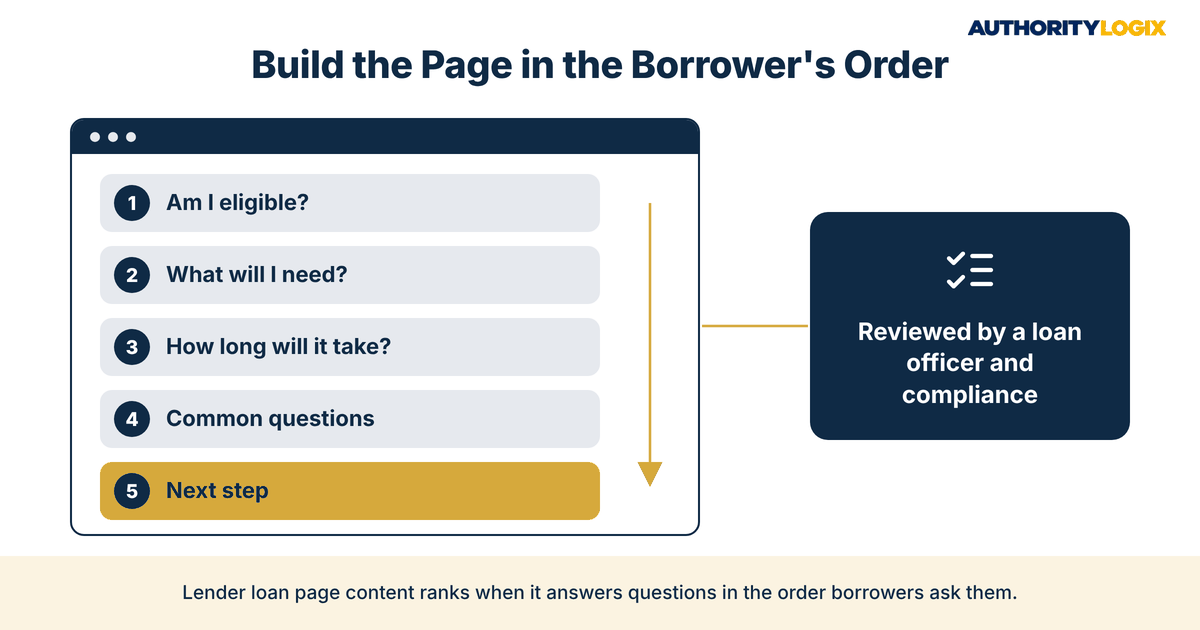
A short review path keeps mortgage loan program pages SEO manageable. The writer drafts, a loan officer checks product accuracy, and a compliance reviewer checks advertising language before anything publishes. Lenders who set up that path once can publish and update program pages on a schedule instead of avoiding them out of fear of a mistake.
Not sure whether your loan program pages are ranking, converting, or simply sitting on your site? The FS Authority Gap Assessment shows where the gaps are and what to build first.
Lender Loan Page Content That Answers Borrower Questions
Lender loan page content earns rankings by answering the questions a borrower types, in the order the borrower thinks of them. Most program pages answer the lender’s question instead: what do we want to say about this product. The borrower’s sequence is different — am I eligible, what will I need, how long will it take, and what happens next. A page built in that order matches search intent, which removes one of the three failure points in the Ahrefs research. That question order is the core of mortgage loan program pages SEO.
Writing at this depth for six or eight products is a production problem, not a talent problem. The pages need shared structure, shared review steps, and a publishing order, which is what a documented content system provides. Without one, the first two program pages get written well and the remaining four wait a year.
The Mortgage Loan Program Pages SEO Checklist
- One product per page, with the product name and the market in the title tag and H1.
- An eligibility section written in plain language and reviewed for accuracy.
- A documents section listing what borrowers typically prepare for that product.
- A process timeline from application to closing, without promised turn times.
- An FAQ block built from the real questions your loan officers hear every week.
- One clear next step: a call, an application, or a related borrower guide.
The FAQ block deserves extra attention. Your loan officers already know the dozen questions borrowers ask about each product, because they answer them every week. Turning those answers into reviewed, page-ready copy is the job of finance content development, and it is the part of mortgage loan program pages SEO that competitors cannot copy from a template.
BKDSCR.com, the AuthorityLogix proof-of-concept in the NYC outer-borough DSCR niche, was built on this principle: 18 pillar pages and 7 interactive investor tools, each answering a specific investor question. It ranks for competitive DSCR and NYC real estate keywords with zero paid ads. Every page works because each one has a single, clear job.
Connecting Program Pages to the Rest of the Site
A program page standing alone is still an orphan, even with excellent copy. Pages rank when they sit inside a network: linked from the navigation, linked from every educational article that mentions the product, and linked to the neighboring products a borrower might compare. The Ahrefs research found that pages without backlinks rarely earn meaningful search traffic, and internal links are the part of that equation a lender controls completely. In mortgage loan program pages SEO, internal linking is the cheapest lever available.
External signals matter too. Mentions on industry sites, local business directories, and syndicated articles all point authority toward the domain, and program pages inherit that authority through internal links. That outward work is called authority distribution, and for mortgage loan program pages SEO it often decides the difference between position seven and position two.
Connection also has to run toward conversion. The CFPB’s National Survey of Mortgage Borrowers found that almost half of borrowers seriously consider only one lender or broker before applying, and three out of four apply with just one. The first credible page a borrower finds often becomes the only one they consider. A reader on your FHA page needs a next step that fits their stage — a pre-qualification form, a document checklist download, or a call with a loan officer.
Those capture points are part of your lead generation infrastructure, and they turn a ranking page into a pipeline source. Without them, mortgage loan program pages SEO produces informed borrowers who apply somewhere else.
Program Page Mistakes That Cost Rankings
Most program page problems are not technical failures. They are planning decisions made once and never revisited. Here are the mistakes that show up most often, followed by the questions lenders ask most about mortgage loan program pages SEO.
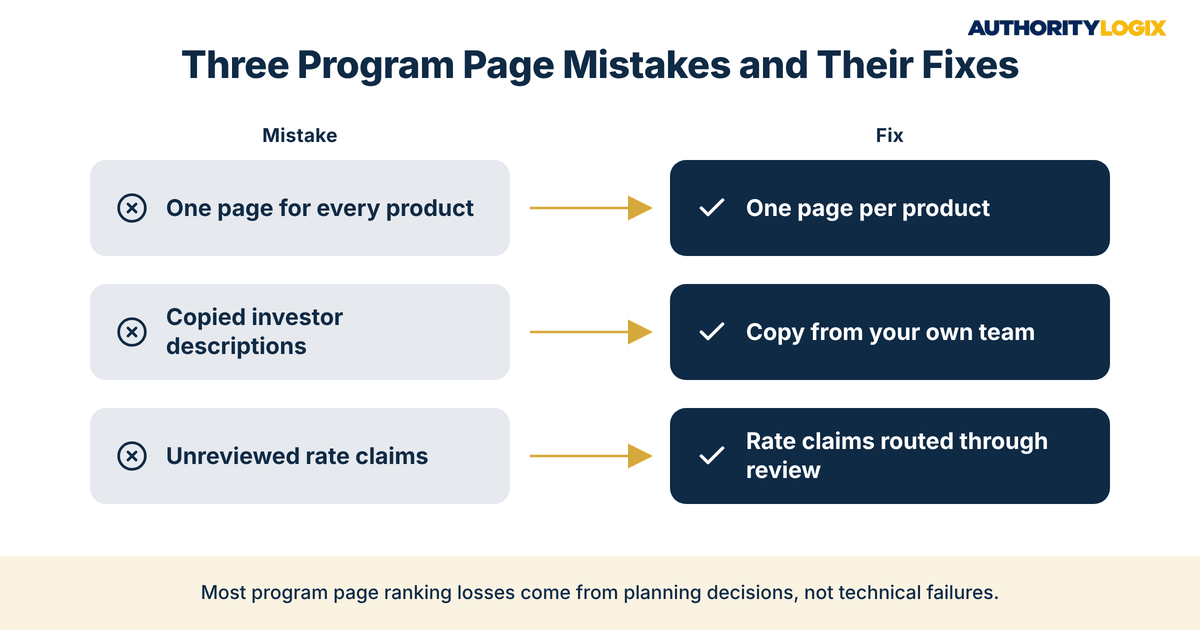
Mistake: One “Loan Programs” page covering every product
A combined page cannot match any single search intent, so it ranks for none of them. Splitting products into dedicated pages is the first fix, and connecting those pages to capture points is the second — the sequence the lead system follows from search to application.
Mistake: Copying product descriptions from investor or wholesale materials
Duplicate copy gives Google no reason to rank your page over the hundreds of others using the same text. It also misses the local, borrower-specific detail that makes a page credible. Write from what your team actually sees in files. Original copy is a basic requirement of mortgage loan program pages SEO.
Mistake: Publishing rate and payment claims without review
Trigger terms on a program page require disclosures under Regulation Z, and rates change faster than pages get updated. Keep rate claims off evergreen pages, or route every change through review.
Question: How long does mortgage loan program pages SEO take to show results?
It depends on the competition in your market and the authority your domain already carries. New program pages usually take months, not weeks, to settle into stable positions, and no one can honestly promise a specific ranking. Measuring where each product ranks today is the first step in what we do for lenders, because the timeline depends on the size of the starting gap.
Question: Should every loan product get its own page?
Every product that borrowers search for by name should, which usually covers conventional, FHA, VA, jumbo, DSCR, and bank statement loans. Niche products with little search demand can share a page until demand appears. That prioritization is the first decision in how we build a program page set for a lender.
Ready for loan program pages that rank for the programs you offer? We’ll build one strong page per program, linked as a system.
Mortgage Loan Program Pages SEO: One Page per Product, Built to Rank
The firms that win local mortgage search are rarely the largest lenders in the market. They are the ones that treated program pages as permanent assets — written once with care, reviewed on a schedule, and connected to everything around them. The growth playbook explains why that kind of asset keeps producing long after a paid campaign would have ended.
None of this replaces underwriting skill, competitive pricing, or service quality. Mortgage loan program pages SEO makes those things visible to the borrower who has not met you yet. If you want to see the reasoning behind the approach, why it works walks through the proof-of-concept and the system behind it.
The honest assessment is that most mortgage companies already have the product knowledge to build excellent program pages. What they lack is the structure, the review path, and the time to build six or eight of them properly. That gap, not product knowledge, is what mortgage loan program pages SEO closes. If you would rather have that system built than build it yourself, work with us is where that conversation starts.