

Key Takeaways
- Financial services website structure content determines whether a site ranks and converts or publishes content into a void. Topic clusters built around pillar pages tend to drive more organic traffic than unconnected content — and the same architecture that produces rankings produces the lead capture opportunities that convert traffic into pipeline.
- Most financial services websites are structured as digital brochures: service pages, an about page, a contact form, and a blog that publishes without topical organization. This structure produces almost no organic traffic because Google cannot identify topical authority across a site that presents no coherent content hierarchy.
- The three-tier content architecture for financial services websites — cornerstone pillar pages, scenario-specific cluster articles, and lead capture pages — mirrors how borrowers and financial clients actually research decisions: from broad topic to specific scenario to firm comparison to first contact.
- Internal linking is the mechanism that makes content architecture work for SEO. Cluster articles that do not link back to their pillar page are isolated pages, not a cluster. The internal link is what tells Google that these pages are topically related and that authority earned by any one page should flow through to the others.
- Clustered content tends to earn more AI citations than standalone posts. The same topic cluster architecture that builds Google ranking authority is what earns AI platform citation — because AI platforms are evaluating the same signals: topical depth, content interconnection, and named authorship on financial topics.
- Lead capture must be embedded in the content architecture, not appended to it. A contact form at the bottom of the service page captures only decided prospects. Lead magnets positioned within cluster articles — at the moment a visitor has found the firm credible enough to read this far — capture the research-phase majority who never reach the contact form.
Table of Contents

Financial services website structure content is the underlying architecture that determines whether a financial services firm’s website produces compounding organic traffic or publishes content into a void. Most financial services websites — mortgage companies, DSCR lenders, financial advisory firms — are structured as digital brochures. A home page, service pages, an about page, a contact form, and a blog that publishes articles without topical organization. This structure produces almost no organic search traffic because Google cannot identify topical authority across a site that presents no coherent content hierarchy.
Without structure, the blog posts compete against each other rather than reinforce each other, no page accumulates the authority needed to rank for competitive queries. And the site remains invisible to the borrowers and brokers actively searching for the firm’s expertise. The SEO playbook covers the organic search strategy. This article covers the website architecture that makes that strategy executable. The specific structural framework that turns a collection of content into a topical authority platform that ranks, attracts, and converts.
The performance case for organized content architecture is clear. Topic clusters built around pillar pages tend to drive more organic traffic than unconnected content. According to Ahrefs, websites with structured internal linking and topic cluster architecture consistently outperform unstructured sites across every competitive ranking metric. And in 2026, clustered content tends to earn more AI citations than standalone posts — because AI platforms evaluate topical depth and content interconnection using the same signals Google does. The financial services firm that structures its website for content authority is simultaneously building Google organic presence, AI citation eligibility, and the lead capture infrastructure that converts that traffic into pipeline.
The authority guide covers why trust is the prerequisite for financial services lead conversion. This article covers the website structure that builds that trust at scale — organizing content so that every page reinforces every other page, every visitor encounter with the site deepens their impression of the firm’s expertise, and every article creates an opportunity to capture the contact that the content has earned.
The complete content architecture framework — pillar page design, cluster strategy, and publishing cadence — is in the Financial Services Content System.
Why Website Structure Determines Content Authority — Not Just Content Volume
The most common content strategy mistake in financial services is treating website structure as a design decision rather than an SEO decision. A financial services firm that publishes 50 blog posts without topical organization has 50 isolated pages that each compete alone for their keyword, with no authority flowing between them and no topical signal telling Google that this site is an expert on any specific topic. The FS industry hub covers the economic picture of financial services digital authority; the structure of a financial services website is the foundation that either enables authority to build or prevents it from accumulating regardless of how much content is published.
Google’s evaluation of financial services content — classified as YMYL (Your Money, Your Life) — applies a higher trust standard than most industries. A financial services site must demonstrate expertise, experience, authoritativeness, and trustworthiness across its entire content footprint, not just on individual pages. A disorganized site that covers mortgage topics inconsistently, financial advisory topics sporadically, and DSCR topics in isolation signals breadth without depth — the opposite of the topical authority profile Google rewards. The credibility gap between financial services firms with structured content architecture and those without it is the gap between firms that rank for competitive queries and firms that don’t appear in the first five pages of results for any query their target borrower searches.

The Three-Tier Financial Services Website Architecture
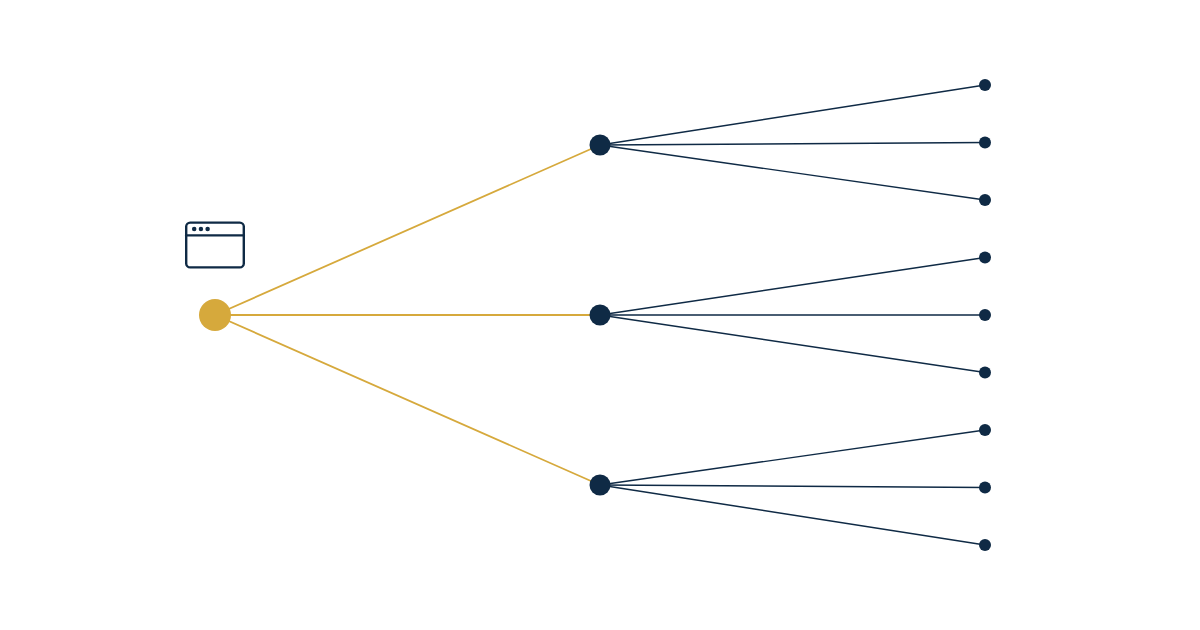
A financial services website structured for content authority and lead capture has three tiers. Each tier has a distinct function in the overall system, and the tiers work together. The pillar page establishes topical authority and passes it to cluster articles through internal links. The cluster articles target scenario-specific long-tail queries, capture traffic from active researchers, and funnel that traffic back to the pillar and forward to lead capture.
The lead capture layer converts research-phase visitors into identified contacts before they leave. The search statistics on financial services buyers suggest this three-tier architecture mirrors how financial clients actually research decisions. They start with a broad topic query, move to scenario-specific research, and arrive at a firm comparison when they have enough information to evaluate options.
The content systems that support this architecture for financial services firms are organized around topic clusters defined by audience type and service category — not by service features the firm wants to promote. A DSCR lender builds topic clusters around DSCR loan scenarios, investor types, and property categories. A financial advisory firm builds clusters around planning scenarios, life stage categories, and client wealth profiles. A mortgage company builds clusters around borrower scenarios, loan programs, and geographic markets. Each cluster is anchored by a pillar page and surrounded by 5–10 cluster articles that each address a specific sub-question within the pillar’s topic.
Tier 1: Cornerstone Pillar Pages That Anchor Topical Authority
A cornerstone pillar page is the most comprehensive resource a financial services firm publishes on a specific topic. It covers the topic broadly, addresses the primary questions a borrower or financial client would bring to it, links to every cluster article in its topic cluster. And is the page Google should associate with the firm’s expertise on that topic. A DSCR lender’s pillar page on DSCR loans covers what DSCR is, how it’s calculated, what property types qualify, what the program requirements are. And how to evaluate whether a specific deal qualifies.
Without quoting specific rates or triggering Regulation Z advertising requirements. At 3,000–4,000 words, it is comprehensive enough to earn Google’s trust signal for topical depth while linking to cluster articles for each specific sub-question it mentions. The E-E-A-T guide covers why Google’s financial content trust standards require exactly the named-authorship, credential attribution, and depth that pillar pages provide. And why a pillar page built to E-E-A-T standards is more likely to earn both organic rankings and AI citations than a shorter, less-attributed page on the same topic.
The pillar page for a financial services topic cluster is permanent infrastructure — not a blog post scheduled for next month. It is the canonical resource the firm wants Google to associate with its expertise on this topic for the next 3–5 years, updated as programs change and market conditions evolve. The educational hub architecture that BKDSCR.com demonstrates — 18 pillar pages covering every major DSCR topic — is the result of treating each pillar as permanent infrastructure, not a content marketing campaign. Each pillar page links to the cluster articles beneath it, passes accumulated authority to the cluster, and creates the topical depth signal that lifts the entire site’s authority for DSCR-related queries.
Tier 2: Scenario Cluster Articles That Rank for Long-Tail Queries
Cluster articles target the specific long-tail queries that borrowers and financial clients search when they are actively researching a specific scenario. These queries are more specific than the pillar page topic and lower in search volume — but they are dramatically higher in buyer intent. A borrower searching “DSCR loan requirements for self-employed LLC borrower New York” is not researching the concept of DSCR.
They are evaluating whether their specific deal will qualify. The cluster article that answers that specific question earns a qualified visit from a prospect who is further along the decision process than any broad-topic search could produce. The lead magnet positioned on that cluster article captures the contact at the moment of maximum relevance — when the visitor has just confirmed that their specific scenario is addressed.
Every cluster article performs two structural jobs simultaneously: it targets its own specific long-tail query and it links back to the pillar page it belongs to. That return link is not optional — it is the mechanism that makes the cluster architecture work for SEO. Without the return link, the cluster article is a standalone page.
With the return link, it is part of a topical authority network where authority earned by the cluster article flows back to the pillar and vice versa. The lead generation infrastructure that depends on cluster article traffic to fill the capture layer cannot function if cluster articles do not exist — and cluster articles that do not link back to their pillar do not contribute to the topical authority the pillar page needs to rank for competitive head terms.
| Financial Services Vertical | Example Pillar Page Topic | Example Cluster Article Topics |
|---|---|---|
| DSCR Lender | DSCR Loan Requirements: Complete Guide | DSCR for LLC-titled properties; short-term rental DSCR; self-employed DSCR qualification; multi-unit property DSCR; DSCR vs conventional for investors |
| Mortgage Company | First-Time Homebuyer Loans: Programs and Qualification | FHA vs conventional for first-time buyers; down payment assistance programs; gift fund guidelines; debt-to-income limits; co-borrower options |
| Financial Advisor | Retirement Income Planning for Business Owners | Solo 401(k) vs SEP IRA for self-employed; converting business income to retirement savings; succession planning and retirement timing; distributions from S-corp in retirement |
| Non-QM Lender | Non-QM Mortgage Programs: Borrower Eligibility Guide | Bank statement loans for self-employed; 1099 income qualification; asset depletion mortgage; foreign national non-QM; no-income-verification investment property |

Tier 3: Lead Capture Architecture Embedded in the Content
Lead capture in a financial services website architecture is not a contact form on a separate page — it is a lead magnet positioned within the cluster article at the moment the visitor has found the content credible enough to want more. A contact form captures one type of visitor: the one who has already decided they want to speak with the firm.
A lead magnet positioned inline in a cluster article captures the research-phase visitor who has read enough to trust the firm’s expertise and is willing to exchange their contact information for a scenario-specific resource that delivers immediate value. The nurture sequence that follows the lead capture converts that contact into a booked call over 10–14 days — but none of that conversion can happen if the lead capture mechanism does not exist in the content at the right moment.
The lead magnet must be scenario-matched to the cluster article it sits in. A cluster article on DSCR qualification for self-employed borrowers should offer a DSCR qualification checklist for self-employed borrowers — not a general mortgage guide. The scenario match is what produces the higher conversion rates of scenario-matched interactive tools that turn cluster article traffic into pipeline. A contact form at the bottom of the same article converts a far smaller share of the same visitors. The finance content layer that produces the lead magnets for each cluster article in a financial services website is built around this match logic — every article has an associated capture mechanism built from the same scenario content as the article itself.
Not sure where your financial services website stands relative to what content authority requires? The FS Authority Gap Assessment identifies the structural gaps.
Internal Linking: The Mechanism That Makes the Architecture Work
How Internal Linking Organizes Financial Services Website Structure Content
Internal linking in a financial services website content architecture is not optional decoration — it is the structural mechanism that makes the topic cluster model work for SEO. Without internal links connecting cluster articles to their pillar page and to each other, the cluster does not exist in Google’s model of the site. The pages are connected in the firm’s mind, but not in the site architecture Google can crawl. Every cluster article must link back to its pillar page. The pillar page must link to every cluster article in its cluster. Cluster articles that are contextually related should link to each other.
This web of internal links is what tells Google that these pages cover a coherent topic, that authority earned by one page flows to the others. And that this site is an expert on this specific topic. Not just a publisher of loosely related content. The email nurture sequence that converts cluster article visitors into clients depends on lead capture being triggered by a cluster article visit. And the cluster article receives traffic only if it ranks — and it ranks only if internal links connect it to the topical authority of the pillar.
Anchor Text Standards for Financial Services Website Structure Content
Anchor text in internal links matters for financial services websites because it provides the contextual signal that helps Google understand the topic of the linked page. Short, descriptive anchor text — “DSCR qualification checklist,” “coverage ratio guide,” “self-employed borrower requirements” — is more useful than generic anchors like “learn more” or “click here.” The finance content infrastructure that produces the cluster articles for a financial services website builds the anchor text guidelines into the writing standards — every internal link uses descriptive, keyword-relevant anchor text that reinforces the topical relationship between the linking and linked pages. This is one of the simplest and most consistently under-executed elements of financial services website architecture.
What Most Firms Get Wrong About Financial Services Website Structure Content
They organize by service, not by scenario
A financial services website organized around service pages — “Conventional Loans,” “FHA Loans,” “DSCR Loans,” “VA Loans” — is organized around what the firm offers, not around how borrowers research. A borrower does not search for “DSCR loans” when they are evaluating whether their specific deal will qualify. They search for “DSCR for LLC-titled investment property” or “DSCR minimum coverage ratio 2026.” The cluster article that answers the specific scenario question is what earns the qualified visit.
The service page organized around the loan product is what earns nothing. The compliance system that governs what content can be published without trigger term risk applies equally to service pages and cluster articles. But the cluster article architecture produces the traffic that the service page architecture cannot.
They publish cluster articles without building the pillar first
A cluster article without a pillar page to link back to is a standalone page — not a cluster member. Some financial services firms publish blog posts on scenario-specific topics without first building the cornerstone pillar page that would anchor the cluster and pass authority to those posts. The cluster article needs to link back to something authoritative and comprehensive on the same topic. Without the pillar page, the cluster article has nowhere to return to and cannot benefit from the authority accumulation that the pillar enables. The authority marketing framework for DSCR lenders is clear: build the pillar page first, then build the cluster articles around it. Reversing that sequence produces cluster articles that orphan rather than cluster.
They treat lead capture as an afterthought
A financial services website that drives cluster article traffic but has no lead capture mechanism embedded in those articles is producing anonymous readership. The visitor arrives on a high-intent cluster article, finds useful scenario-specific information, and leaves without any mechanism to follow up. The AI search dimension amplifies this problem: as AI platforms increasingly surface cluster article content in response to borrower queries, the firm gets the citation benefit only if the content architecture also captures the contact when the reader clicks through. Without lead capture embedded in the content, the AI citation produces a visit that produces nothing.
Ready to rebuild your website architecture so it builds authority and generates leads?
Building the Financial Services Website Structure Content Sequence
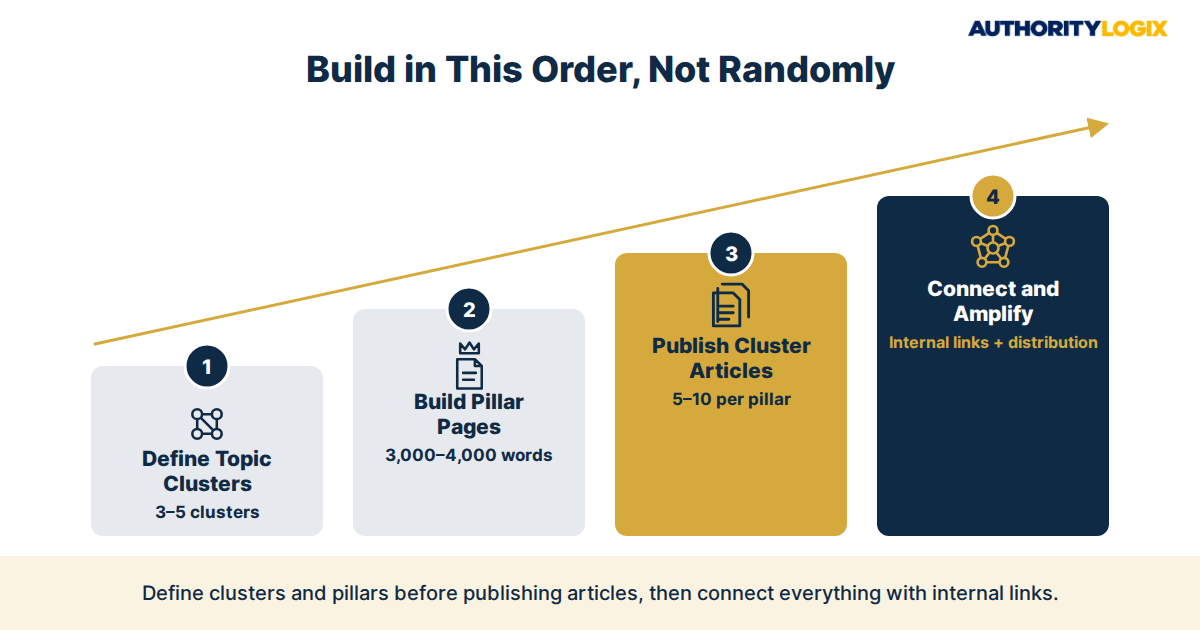
The correct build sequence for a financial services website content architecture starts with cluster definition, not content creation. Before writing a single article, the firm needs to identify which 3–5 topic clusters will anchor its content authority strategy — one cluster per primary audience type or service scenario. A DSCR lender might define clusters around DSCR qualification requirements, short-term rental investment, LLC-titled property financing, self-employed investor loans, and multi-unit property programs. Each cluster becomes a pillar page and a set of 5–10 cluster articles.
The pillar pages are built before the cluster articles — because the cluster articles need to link back to a pillar page that exists. The growth playbook for financial services firms treats this content architecture as permanent infrastructure. The clusters are defined, the pillars are built, and the cluster articles are published over 6–12 months on a cadence that the firm’s compliance and approval workflow can sustain.
BKDSCR.com demonstrates this build sequence at full scale: 18 pillar pages across 6 topic clusters, each with associated scenario cluster articles, each with embedded lead capture tools including a DSCR Calculator, Cash Flow Analyzer, and Deal Filter. The platform ranks for competitive DSCR and NYC real estate keywords because the content architecture — pillar pages anchoring topic clusters, cluster articles linking back to pillars, lead capture embedded at each cluster article — produces the topical authority and E-E-A-T signals that Google’s financial content evaluation requires. The authority distribution layer that amplifies this content — LinkedIn posts, email broadcasts, syndication — multiplies the reach of each published piece without changing the underlying architecture that produces the authority.
The honest answer on timeline: a financial services website restructured around topic cluster architecture typically sees meaningful organic traffic improvement within 6–9 months of consistent publishing. The firms that start the architectural restructuring today — defining clusters, building pillar pages, publishing scenario cluster articles — are the ones with compounding organic pipelines in 2027. The ones still publishing standalone blog posts without topical organization are the ones wondering why their content produces no traffic. When you’re ready to build, work with us is the starting point.