


Key Takeaways
- Real estate IDX SEO schema markup tells Google what your broker website pages contain: the firm, the agents, the guides, and the listings.
- An IDX feed puts the same MLS listings on many sites, and Google groups near-identical pages and selects one canonical URL.
- Google’s search gallery has no dedicated real estate listing feature, so real estate IDX SEO schema markup does its best work on firm, agent, and content pages first.
- Google states that structured data enables a search feature but does not guarantee that the feature will be present.
- Markup must be a true representation of visible page content, which means listing markup has to change when a listing’s status changes.
- Real estate IDX SEO schema markup is infrastructure, not a plugin setting: owned pages, accurate markup, and regular testing.
Table of Contents

What Real Estate IDX SEO Schema Markup Means for a Broker Website
Real estate IDX SEO schema markup is the code layer that tells search engines what each page on your broker website contains — the firm, its agents, the areas you cover, and the listings on the page. You may have two decades of closings and a market read no portal can match, yet your site can still look like every other brokerage running the same feed. The real estate industry hub shows how AuthorityLogix approaches that problem: start with the pages you own, then describe them precisely.
That is the credible but invisible problem in its technical form. An MLS feed delivers listing data to your site, but the feed is not authority. Real estate IDX SEO schema markup labels the parts of your site that are genuinely distinct, so search engines connect them to your name rather than to shared listing data.
Google’s own documentation makes the case for structured data in plain numbers. Google Search Central’s structured data guide, last updated in December 2025, reports that Rotten Tomatoes added structured data to 100,000 unique pages and measured a 25% higher click-through rate for pages enhanced with structured data. Rotten Tomatoes is not a brokerage, but the result shows what happens when a search engine can read a page with confidence.
How Real Estate IDX SEO Schema Markup Differs From the Feed Itself
The IDX feed and the markup do different jobs. The feed moves listing data from the MLS onto your pages, while real estate IDX SEO schema markup describes those pages, and the business behind them, in a format Google can parse. Google says it generally recommends JSON-LD for structured data if a site’s setup allows it, which keeps the markup in one block of code.
This is why markup belongs inside a publishing plan rather than a plugin settings screen. Every page your firm publishes needs the right type assigned when it goes live, a step built into the content system so it happens by default. Real estate IDX SEO schema markup added once and never revisited drifts out of date within a season.
For most brokers, the gap is not knowledge of their market. It is the absence of a team that turns that knowledge into structured, owned pages, which is what we do for real estate firms that are credible in their market but missing from its search results. The work starts with an inventory of which pages the firm owns and which the feed vendor owns.
The Real Estate Local SEO Playbook covers the full local search architecture that real estate IDX SEO schema markup plugs into — from site structure to profiles to neighborhood content.
Does MLS Integration Website SEO Help or Hurt Your Rankings?
MLS integration website SEO is where many broker sites lose ground without realizing it. When you sign up with an IDX provider, your site gains thousands of listing pages almost overnight, but every other brokerage on the same MLS can gain the same pages. Search engines then see one listing described in nearly identical words across many domains.
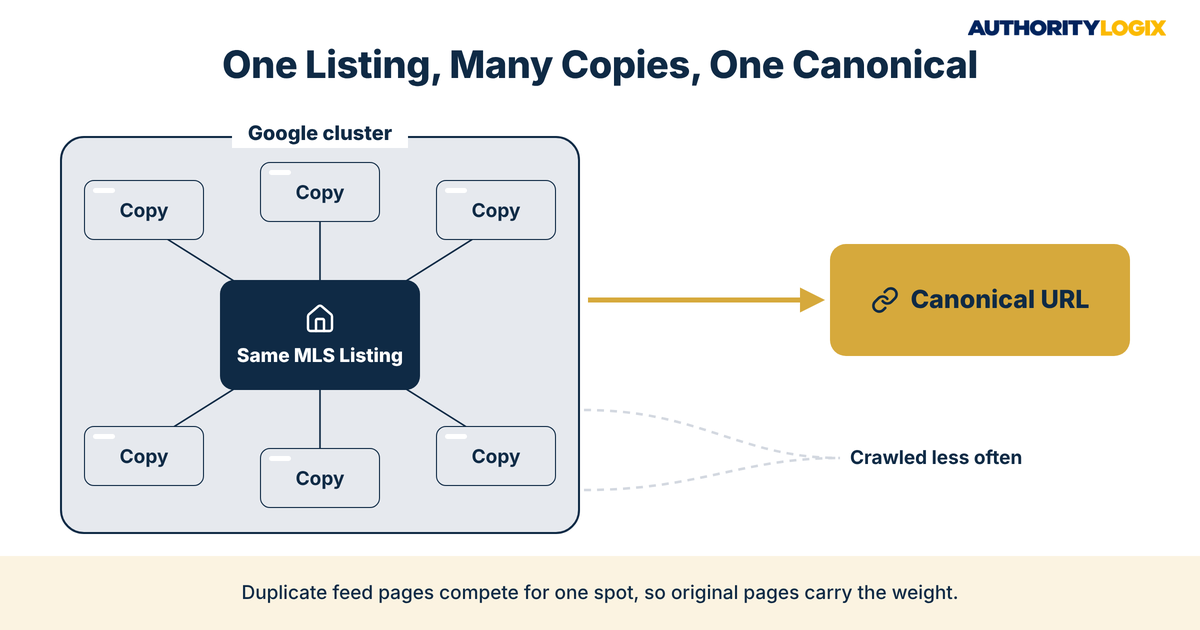
Google’s canonicalization documentation explains what happens next. Google groups near-identical pages into a cluster, selects one as the canonical URL, and crawls the duplicates less frequently. The same page says some duplicate content on a site is normal and is not a violation of Google’s spam policies — this is a selection, not a penalty, and a broker’s copy is rarely the one selected.
That selection is why real estate IDX SEO schema markup applied only to raw feed pages delivers so little. Marking up a page Google treats as a duplicate does not turn it into the canonical version. The national portals built their position on scale, and a brokerage will not beat them on the same listing.
The pages that can win are the ones no one else has. Original neighborhood pages that explain housing stock, commute options, price ranges, and what is changing on specific blocks give search engines something unique to rank. They also give your listing pages a home inside a structure you control.
Building those pages at the pace a market changes is a production problem as much as an SEO problem. Firms that keep up run content systems that turn agent knowledge into publishable pages on a schedule, so MLS integration website SEO becomes a supporting layer under original work instead of the whole plan.
How IDX Real Estate Search Rankings Are Won on Owned Pages, Not Feeds
IDX real estate search rankings follow ownership. A page a vendor’s feed generated competes with every site using that feed, while a page your firm wrote competes only with other original work. The practical question for any broker is how many pages on the site are genuinely yours.
This is the same logic behind competing for local SEO visibility against the national portals: the portals win on listing volume, and local firms win on local depth. Real estate IDX SEO schema markup strengthens that depth when it sits on the right pages — a firm page marked up as a business, agent pages tied to the firm, and market content tied to your areas.
Not every owned page carries equal weight. The pages that tend to matter most for IDX real estate search rankings are the ones only your agents could write:
- Area and neighborhood guides written by agents who work there
- Market reports with your own commentary on recent sales activity
- Agent profile pages with credentials, service areas, and track record
- Buyer, seller, and investor guides that answer real client questions
- Featured pages for exclusive listings you represent, with original descriptions and photos
Grouping those pages into an educational hub gives Google a clear map of what the firm knows. Each guide links to related area pages, and real estate IDX SEO schema markup then describes each page type consistently, so the whole library reads as one connected body of expertise.
BKDSCR.com, the AuthorityLogix proof-of-concept in the NYC outer-borough DSCR investment niche, was built on owned pages from the start: 18 pillar pages, 7 interactive investor tools, and 48 SEO-optimized blog posts. It ranks for competitive DSCR and NYC real estate keywords with zero paid ads, built in under 18 months.
Not sure where your firm stands on real estate IDX SEO schema markup? The RE Authority Gap Assessment shows which pages you own and where structured data is missing or wrong.
Broker Website Listing Schema: Which Structured Data Types Apply
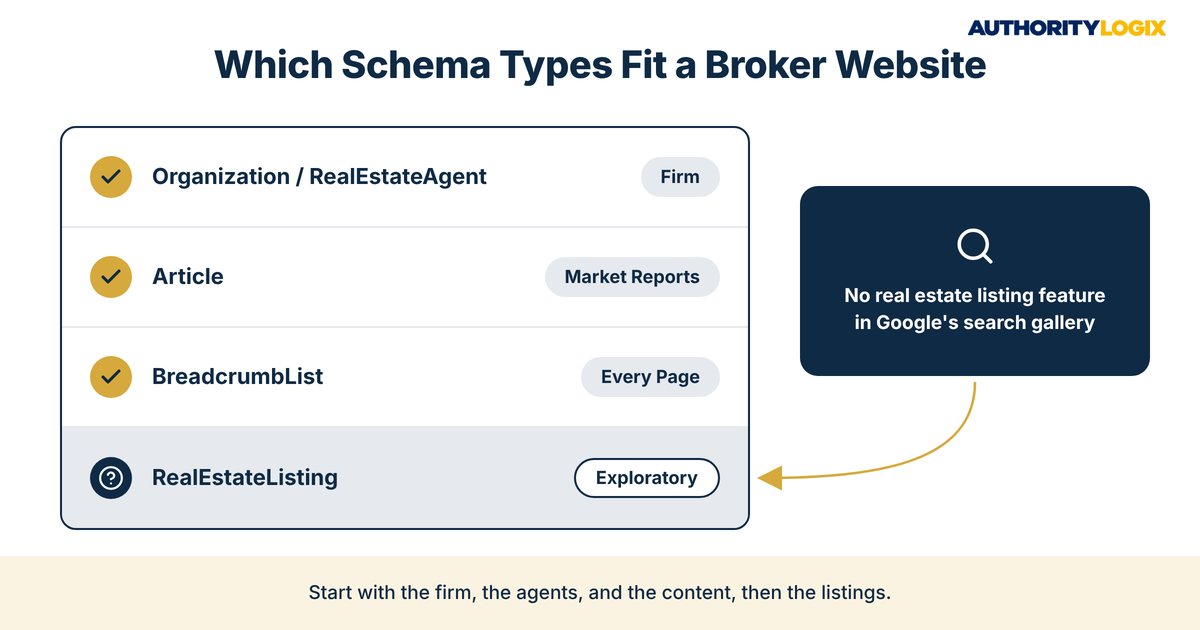
Broker website listing schema starts with a reality check. Google’s search gallery lists the structured data features Google Search supports, and none of them is a real estate listing feature. The closest is Vacation rental, which Google describes as information about a vacation property — not homes for sale.
That changes the order of work. Real estate IDX SEO schema markup should begin with the types Google does support and that describe your business accurately, a sequence that mirrors how we build visibility infrastructure for brokers: the firm first, then the people, then the content, then the listings.
The Real Estate IDX SEO Schema Markup Types Worth Adding First
| Page Type | Schema Type | What It Does |
|---|---|---|
| Firm homepage and contact page | Organization or RealEstateAgent | Ties the firm name, logo, and contact details together; RealEstateAgent is a type of LocalBusiness |
| Office location pages | LocalBusiness (RealEstateAgent) | Supports the business details Google displays in the knowledge panel |
| Market reports and area guides | Article | Identifies the headline, author, and dates of editorial pages |
| Every page | BreadcrumbList | Shows where a page sits in the site structure |
| Featured listing pages | RealEstateListing | No dedicated Google feature; the last layer of real estate IDX SEO schema markup, not the first |
The firm and agent markup carries more weight than most brokers expect, because it ties every page back to a named business with real credentials. Those trust signals are the subject of the authority guide, and broker website listing schema is one of the quieter ways to reinforce them: the same names, addresses, and agent details on every page.
Listing pages are where markup gets uncertain. Schema.org does include a RealEstateListing type, but Dan Brickley of Google, writing on the public schema.org mailing list in November 2019, called that piece of schema rather early and exploratory. Marking up featured listings is reasonable when the markup matches what the page shows, but expect no special search result.
Writing the type mapping down is part of a broader visibility plan, and the real estate resource library covers the other pieces — local search, content, and lead capture — that the markup supports. Real estate IDX SEO schema markup stays maintainable when each page category maps to one primary type and the mapping is applied by template rather than page by page.
Testing and Maintaining Markup as Listings Change Daily
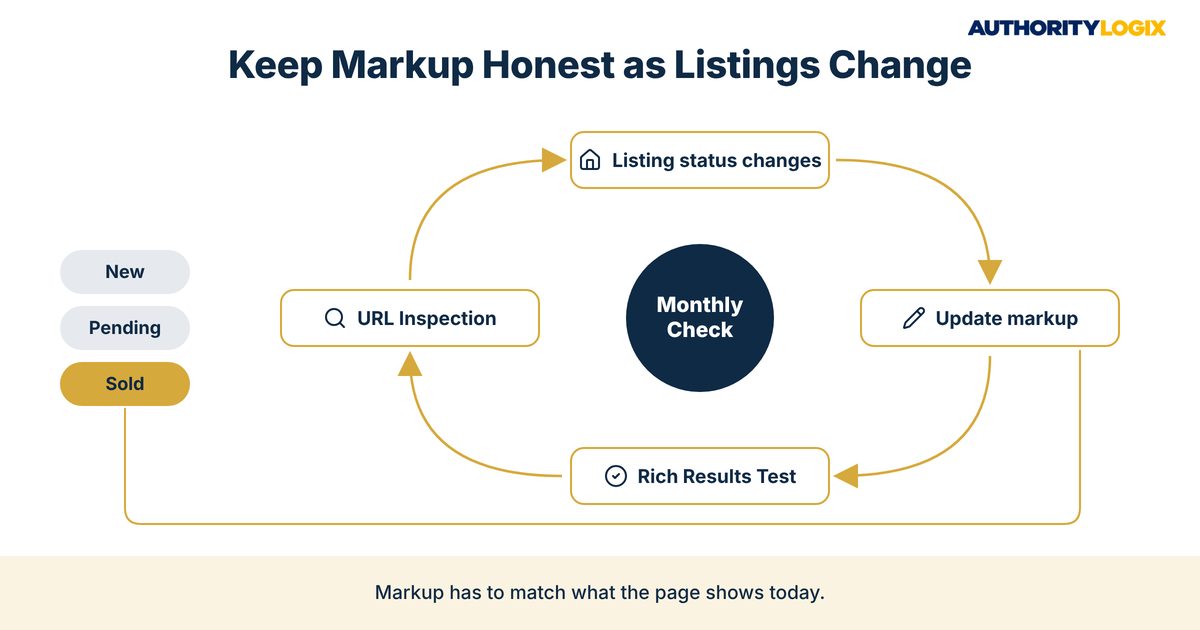
Listings change status constantly — new, pending, sold, withdrawn — and markup has to keep up. Google’s general structured data guidelines say structured data must be a true representation of the page content, and they say not to mark up content that is not visible to readers of the page. A featured listing page still marked up as available after it sells breaks that rule.
The consequence is specific. Google’s guidelines state that a structured data manual action means a page loses eligibility for appearance as a rich result, and that it does not affect how the page ranks in Google web search. That is a narrower risk than many vendors imply, but still a real cost.
A Monthly Real Estate IDX SEO Schema Markup Check
Google’s own tools make the review manageable. A monthly real estate IDX SEO schema markup check should cover these points:
- Run each page template through the Rich Results Test using the live URL, not pasted code
- Use the URL Inspection tool to confirm what Google sees on key pages
- Review the rich result status reports in Search Console for new errors
- Confirm sold and withdrawn listings no longer carry active listing markup
- Check that firm and agent details match on every page
Many IDX plugins and site builders inject markup with JavaScript. Google’s documentation says Google Search can understand and process structured data that is available in the DOM when it renders the page, and it recommends testing with the URL input instead of the code input. That confirms the rendered page carries the markup.
Investment-focused pages need the same discipline. Rental market updates and deal breakdowns produced as investor content should carry Article markup with accurate dates, because an investor judging a market report checks when it was written before trusting it.
Maintenance also extends beyond the site. When market reports are syndicated or cited elsewhere through authority distribution, the firm details in those placements should match the firm details in your real estate IDX SEO schema markup, so every mention points back to one consistent business.
Real Estate IDX SEO Schema Markup Mistakes and Common Questions
Most brokers who struggle with structured data are not careless. They are working from plugin defaults and advice written for online stores. These are the questions that come up most often.
Will my IDX plugin’s built-in schema handle this?
Plugin markup usually covers the listing pages the feed generates, which are the pages least likely to be chosen as canonical. It rarely describes the firm, the agents, or original content correctly. Treat plugin markup as a starting point and audit it against the type mapping above.
Can schema markup push my listings above Zillow?
No markup changes the fact that a shared listing has one canonical version, and it is usually not yours. Google states that structured data enables a feature to be present but does not guarantee that it will be. Real estate IDX SEO schema markup earns its value on pages the portals cannot copy.
Where does schema fit in lead capture?
Markup helps the right page get found, and what happens after the click depends on the lead generation infrastructure on that page — a valuation request or a clear contact path. Real estate IDX SEO schema markup without a capture path sends qualified visitors straight back to the results page.
How long before structured data makes a difference?
Google can read new markup once it recrawls a page, but the pages it describes take longer to earn rankings. Firms that see results treat markup as one layer of a full lead generation system, not a shortcut. No one can promise a ranking position or a rich result, and Google’s own documentation says as much.
Ready to turn a broker website that mirrors the MLS feed into owned, correctly marked-up pages that search engines can read and attribute to your firm?
What Schema Can and Cannot Do for Listing Visibility
Schema cannot make a duplicated listing page original, and it cannot overrule Google’s choice of canonical URL. It cannot guarantee a rich result or replace agent knowledge. What real estate IDX SEO schema markup can do is make every page you genuinely own easier for search engines to understand and attribute to your firm.
That attribution builds over time. Each correctly described market report, agent page, and featured listing adds to a body of work tied to one business name, which is the long-term visibility model laid out in the growth playbook. It becomes an asset the firm owns instead of a feed it rents.
AuthorityLogix built that model first on BKDSCR.com with its own time and money, which is why our approach starts with owned pages and treats markup as the finishing layer, not the foundation. The same order applies to any brokerage with real expertise in a real market.
The honest answer is that most brokers already have the market knowledge buyers, sellers, and investors are searching for. What is missing is owned infrastructure that makes that knowledge visible, and real estate IDX SEO schema markup is the layer that labels it once it exists. Build the pages first, describe them accurately, and keep the markup honest as listings change.