


Key Takeaways
- A mortgage company blog SEO strategy turns the questions borrowers already ask your loan officers into posts that rank and keep producing qualified traffic without a charge for every visit.
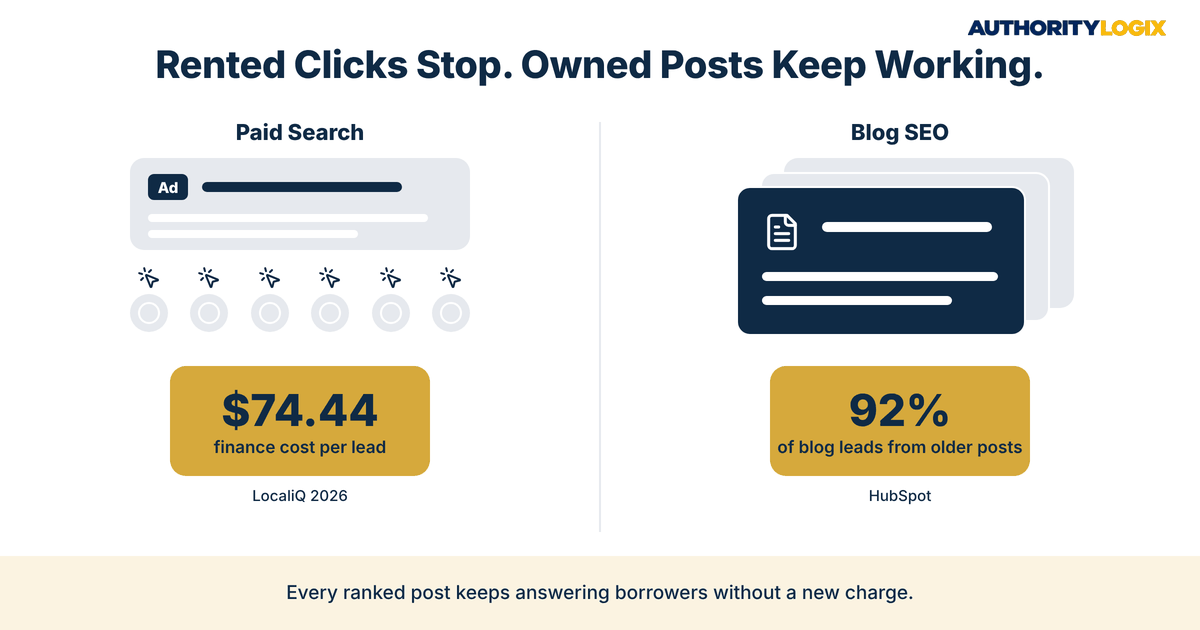
- LocaliQ’s 2026 search advertising benchmarks put the average finance and insurance cost per lead at $74.44 — a cost that returns every time the ad budget renews.
- HubSpot found that 92% of its monthly blog leads came from posts published in earlier months, the compounding effect paid clicks never produce.
- Mortgage blog keyword ranking comes from topic clusters: one pillar page per borrower subject, supported by focused posts that answer narrower questions.
- Loan officer blog leads depend on capture points inside each post — worksheets, checklists, and next-step offers matched to the reader’s stage.
- Ahrefs reports that 96.55% of pages get zero Google search traffic, so a mortgage company blog SEO strategy succeeds on structure and maintenance, not publishing volume.
Table of Contents
Why a Mortgage Company Blog SEO Strategy Beats Paying per Click
A mortgage company blog SEO strategy is a planned system of educational posts built to rank for the questions borrowers search before they ever contact a lender. Most mortgage companies already have the raw material for one. Your loan officers answer the same questions about down payments, debt-to-income ratios, and self-employed income every week.
Almost none of those answers live on a page Google can find, and that is the credible but invisible problem in practical terms. The expertise is real, but the market only sees it when someone already has your phone number. Fixing it starts with a publishing plan, and a mortgage-specific content calendar turns that question log into a schedule of posts that each fill a gap instead of repeating last month’s topic.
The economics explain why this matters. HubSpot’s State of Marketing research, summarized in its marketing statistics roundup, ranks website, blog, and SEO as the number one ROI-generating channel for marketers, while only 12% of marketers name search and display ads among their highest-ROI channels. The same data shows small businesses are 23% more likely than average to see ROI from blog posts. That finding matters for independent mortgage companies competing against national lenders with far larger ad budgets.
What a Paid Click Actually Costs a Lender
Paid search is not wrong, but it is rented. According to LocaliQ’s 2026 search advertising benchmarks, the average cost per click in finance and insurance is $3.39, the average conversion rate is 2.64%, and the average cost per lead is $74.44. Every one of those leads is paid for again next month, and the flow stops the day the budget does. Infrastructure compounds. Ads stop.
| Factor | Paid Search Clicks | Mortgage Company Blog SEO Strategy |
|---|---|---|
| How the cost works | Charged for every click, every month | Paid once to build, then maintained on a schedule |
| When spending stops | Traffic stops the same day | Published posts keep ranking and answering borrowers |
| Finance benchmark | $74.44 average cost per lead (LocaliQ, 2026) | 92% of HubSpot’s monthly blog leads came from older posts |
| What you own afterward | Nothing once the campaign ends | An indexed library of posts, internal links, and backlinks |
| Where it fits | Short-term demand in a defined window | Long-term qualified traffic from real borrower questions |
Ranking also carries a trust advantage that ads do not. Borrowers know an ad was bought, while a clear answer on page one reads as earned expertise, which is why the authority guide treats educational publishing as one of the strongest credibility signals a lender controls. Ellie Mae’s Connecting with Borrowers Online study found that 92% of borrowers went online before reaching out to a lender, so those answers are being read whether or not your firm wrote them.
None of this replaces referrals or makes paid search obsolete. A mortgage company blog SEO strategy adds a channel that keeps working after the invoice is paid, and it sits alongside the other visibility systems mapped on the financial services services hub. The goal is a lower cost per qualified conversation over time, not zero marketing spend on day one.
The Financial Services SEO Playbook lays out the full framework behind a mortgage company blog SEO strategy, from keyword mapping to site architecture.
Lender Content Marketing Traffic: What to Publish First
Lender content marketing traffic is only worth earning if it comes from people who might borrow. A post about general housing market news can attract thousands of visitors who will never apply anywhere. A post built around a specific qualification question attracts fewer readers, but most of them are borrowers in the middle of a real decision.
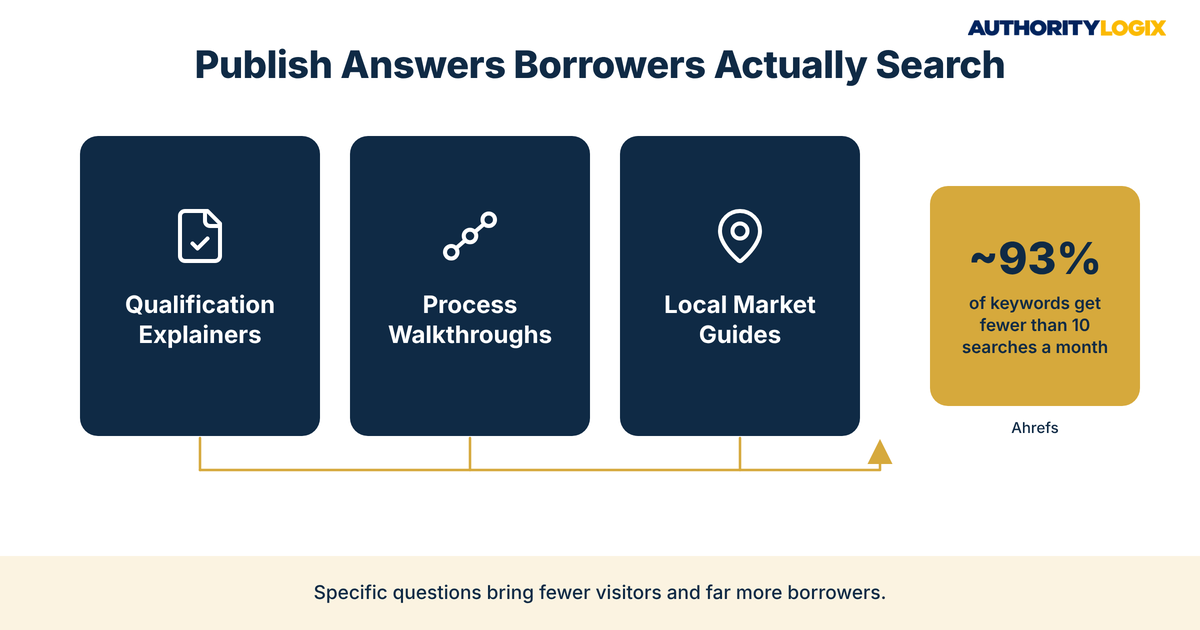
That distinction shapes what a mortgage company blog SEO strategy publishes first. Ahrefs reports that almost 93% of the keywords in its U.S. database get fewer than 10 monthly searches, which means most real demand sits in long, specific questions rather than broad head terms. Those small-volume questions are where an independent lender can outrank national brands, because few competitors bother to answer them well.
Not every post deserves the same effort. Three content types earn the most qualified lender content marketing traffic within a mortgage company blog SEO strategy.
- Qualification explainers — self-employed income, DSCR ratios, gift funds, reserves, and credit questions answered in plain language.
- Process walkthroughs — what happens between application and closing, which documents are needed, and how long each step takes.
- Local market guides — neighborhood, county, and property-type pages that tie loan programs to the places your borrowers actually buy.
Each of those posts needs a home in a larger structure. Individual posts rank more easily when they link up to pillar pages that cover a full borrower topic in depth, because that hierarchy tells Google which page carries the most authority on the subject. Without it, even strong posts compete with each other for the same searches.
Format matters as well. Orbit Media’s 2025 blogging survey put the average blog post at 1,333 words, but length is not the goal — completeness is. Posts organized inside an educational hub let a borrower move from one answer to the next question naturally, which keeps them on your site longer and closer to contacting a loan officer.
Mortgage Blog Keyword Ranking: Topic Clusters That Work
Mortgage blog keyword ranking rarely comes from a single post. Search engines reward sites that cover a subject thoroughly, so the lenders who rank are usually the ones who answered 15 related questions instead of one. That is the logic of topic clusters: a pillar page on a broad subject, surrounded by focused posts that each target a narrower search.
The demand is already there. Mortgage borrowers start online, and the search statistics on borrower behavior show how much of the decision is shaped before a lender is ever contacted. First Page Sage’s 2025 click-through-rate data showed the top three organic results receiving 68.7% of clicks, so a cluster that reaches page one captures most of the attention for its questions.
Building Clusters Into Your Mortgage Company Blog SEO Strategy
A practical cluster map starts with five or six borrower subjects and assigns each one a pillar and eight to twelve supporting posts. Every post links to its pillar, the pillar links down to every post, and related posts link sideways where a reader would naturally want the next answer. That internal linking pattern is what turns a mortgage company blog SEO strategy from a list of articles into a ranked structure.
| Borrower Subject | Pillar Page | Supporting Post Examples |
|---|---|---|
| Self-employed borrowers | Self-employed mortgage guide | Bank statement loans, 1099 income, two-year history questions |
| Investment property | DSCR loan guide | Rent estimates, reserve requirements, borrowing through an LLC |
| First-time buyers | First home financing guide | Down payment sources, gift funds, closing cost basics |
| Refinancing | Refinance decision guide | Cash-out basics, break-even timing, document checklists |
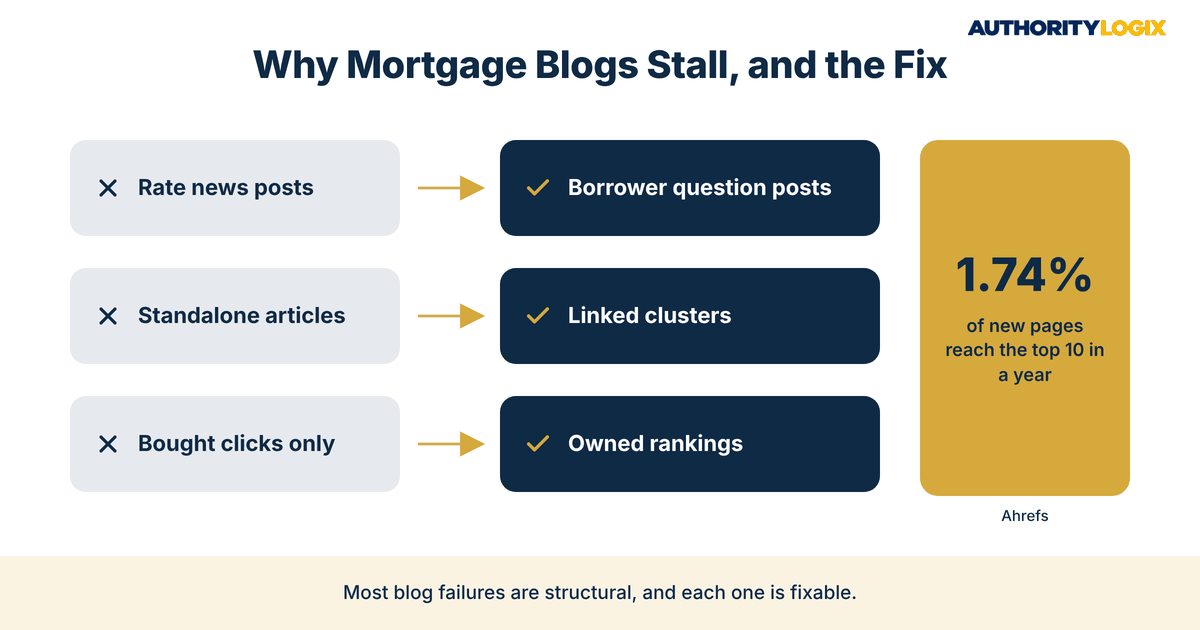
Patience is part of the plan. Ahrefs found that 72.9% of pages ranking in Google’s top 10 are more than three years old, and only 1.74% of newly published pages reach the top 10 within a year. Mortgage blog keyword ranking is slow to earn and durable once earned, which is why clusters need content systems that keep publishing and updating on a fixed rhythm instead of in bursts.
Not sure where your mortgage company blog SEO strategy stands against the lenders outranking you in your market?
Loan Officer Blog Leads: Turning Readers Into Inquiries
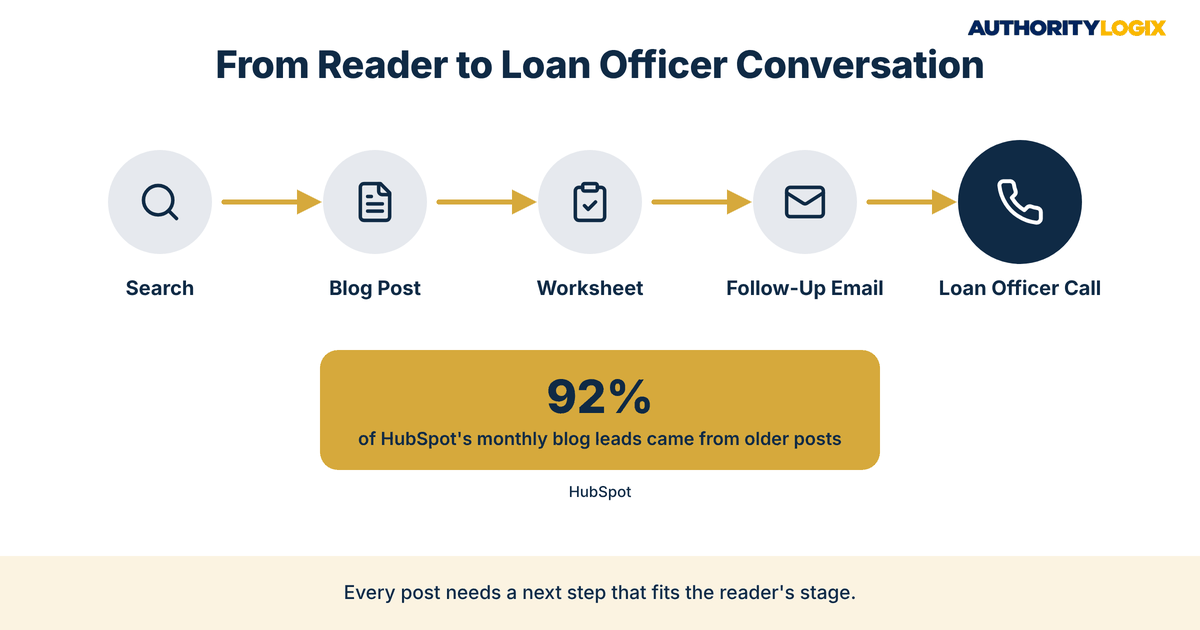
Traffic is not the finish line of a mortgage company blog SEO strategy. Loan officer blog leads come from what a reader can do once they finish a post, and most mortgage blogs offer nothing beyond a generic contact form in the footer. A borrower reading about reserve requirements is not ready to apply, but that same borrower may want a reserves worksheet or a document checklist.
HubSpot’s historical optimization analysis shows why each post deserves a capture point. HubSpot found that 76% of its monthly blog views and 92% of its monthly blog leads came from posts published in earlier months. A mortgage company blog SEO strategy that adds offers to older posts is converting traffic it already earned, not chasing new visitors.
Capture Points That Turn Posts Into Loan Officer Blog Leads
The right offer depends on where the reader is in the decision. Matching the capture point to the post is what separates a blog that collects page views from one that fills a loan officer’s calendar.
- Early-stage posts — a glossary, a program comparison, or a short checklist download.
- Comparison posts — a side-by-side guide paired with an email follow-up sequence.
- Decision-stage posts — a worksheet, a calculator, or a consultation request with a named loan officer.
Those offers only work when they connect to follow-up. A download on a refinance post should trigger refinance-specific emails rather than a generic newsletter, and the compliance-aware content system behind the blog is what keeps the post, the offer, and the follow-up in the same lane. That connection is where loan officer blog leads stop being anonymous readers and become named conversations.
Writing for conversion in a regulated industry takes a specific skill. Posts must stay educational, avoid promising rates or approvals, and pass compliance review, yet still give a borrower a clear reason to take the next step. That is why finance content for lenders is drafted differently from general business writing, and why a strong mortgage company blog SEO strategy pairs loan officer input with editors who understand the rules.
Distributing Mortgage Company Blog SEO Strategy Posts Beyond the Website
A post that lives only on your website leaves a mortgage company blog SEO strategy waiting for Google to find it. Distribution shortens that wait. Each pillar page can become a LinkedIn article, a past-client email, a short summary for realtor and CPA partners, and a syndicated version that points back to the original.
HubSpot’s 2026 data adds urgency: nearly 30% of marketers reported decreased search traffic as consumers turn to AI tools. Search remains the foundation of a mortgage company blog SEO strategy, but posts also need to be cited and shared in places beyond the results page. Structured authority distribution puts each post in front of the audiences most likely to forward it, link to it, or search your name afterward.
Referral partners are the most underused channel. A realtor who receives a clear explainer on gift funds or bank statement income has something worth sending to their own buyers, and every forward brings a borrower who arrives already warm. When those visits land on a post wired into your lead generation infrastructure, distribution produces inquiries instead of page views.
What Mortgage Companies Get Wrong About Blogging for Search
Most failed mortgage blogs did not fail for lack of expertise. They failed because of a few structural mistakes that repeat across markets, and each one is fixable once it is named.
Publishing news instead of answers
Rate updates and market commentary go stale within weeks and compete with national publishers. A mortgage company blog SEO strategy built on borrower questions keeps earning traffic long after news posts stop.
Treating every post as a standalone
In a mortgage company blog SEO strategy, posts without links to a pillar or an offer leave readers with nowhere to go. Connecting each post to the firm’s lead system turns isolated articles into a path from search to inquiry.
Why not just keep buying clicks and leads?
Purchased leads stop the moment spending stops, and the same lead is often sold to several lenders. A mortgage company blog SEO strategy builds owned posts that keep ranking for months or years after the invoice is paid.
How long does a mortgage company blog SEO strategy take to work?
Expect months, not weeks. Long-tail questions usually rank first and competitive pillar topics follow, so year one is a build phase measured by steady growth rather than a sudden spike.
Where should a lender start if nothing exists yet?
Start with the question log and one borrower subject, not a full website rebuild. Mapping that first cluster is part of what we do with mortgage companies, and it usually shows that half the content already exists in your loan officers’ heads.
Who should write the posts?
Loan officers should supply the substance of a mortgage company blog SEO strategy, while a production system handles structure, drafting, and compliance formatting. That division of labor is how we build blogs that sound like the firm without consuming the firm’s time.
Want a mortgage blog that brings in borrowers, not just readers? We’ll plan the topics and build the posts that rank and convert.
A Mortgage Company Blog SEO Strategy Builds Traffic You Own Instead of Rent
Paid clicks are a lease. A mortgage company blog SEO strategy is closer to equity, because every post that ranks keeps answering borrowers without a new charge each time someone reads it. How that asset fits a longer plan for market position and referral independence is covered in the growth playbook for financial firms.
The model is not theoretical. BKDSCR.com was built from scratch in the NYC outer-borough DSCR niche with 18 pillar pages and 48 SEO-optimized blog posts, with zero paid ads and in under 18 months. That build is the clearest example of why it works when structure comes before volume.
The honest answer is that most mortgage companies already have the expertise a mortgage company blog SEO strategy needs. What is missing is the infrastructure that turns those answers into posts the market can find, and the discipline to keep them current. If you want that system built for your firm, you can work with us on a plan for your first topic cluster.