


Key Takeaways
- A real estate self running lead system connects four parts — search visibility, expertise-driven content, automated capture and nurture, and distribution — so inbound leads arrive without daily prospecting.
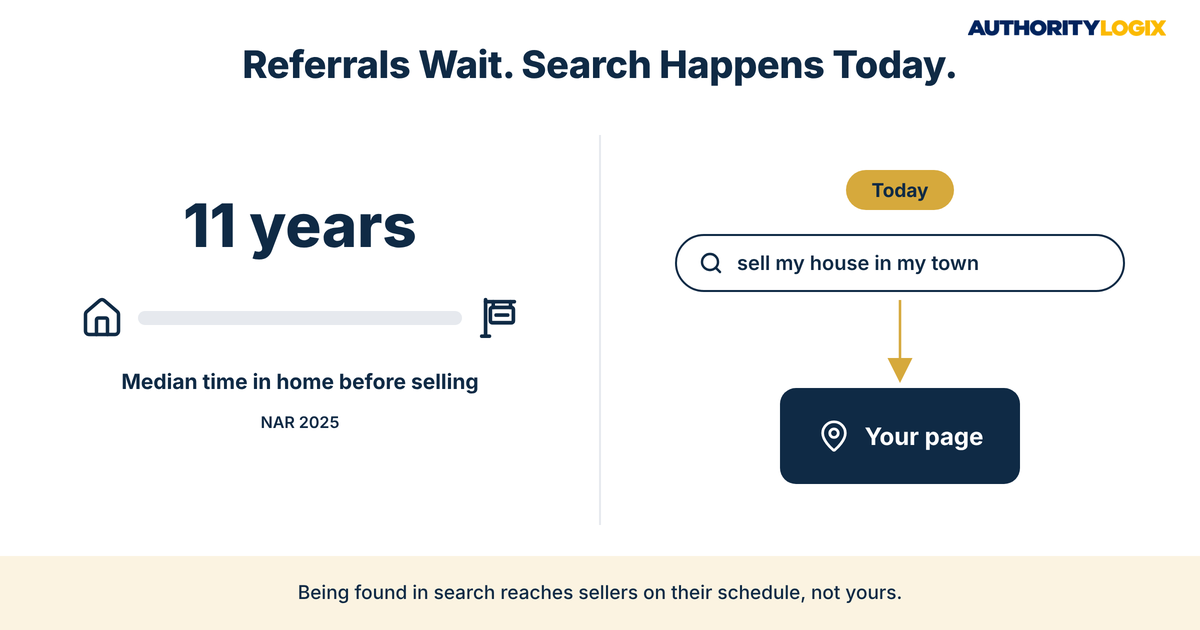
- NAR’s 2025 Profile of Home Buyers and Sellers found 91% of buyers would use their agent again or recommend them, yet sellers stayed a median of 11 years before selling.
- Referrals reward work you did years ago; a real estate self running lead system reaches the people searching for an agent right now.
- In HubSpot’s 2026 State of Marketing Report, nearly 70% of marketers said leads reach them later in the buying process.
- Automation handles follow-up timing, but your market knowledge is the fuel — without it, a real estate self running lead system has nothing worth sending.
- No lead system is fully hands-off; the honest goal is a pipeline that keeps working between your client conversations, not instead of them.
Table of Contents

A real estate self running lead system is what separates the agent whose phone rings from search and content from the agent who is still waiting on the next referral. You may have closed hundreds of transactions and know every block in your market, yet stay invisible to a seller who starts by typing a question into Google. The AuthorityLogix real estate hub is organized around that gap: the expertise exists, but the infrastructure that lets the market see it does not.
That is the credible but invisible problem, and more prospecting hours rarely fix it. What fixes it is a connected set of assets that keep finding, educating, and following up with prospects while you are at a closing or a showing. This article walks through how each part of a real estate self running lead system works, what it needs from you, and where automation honestly stops.
What Is a Real Estate Self Running Lead System, and Why Do Most Agents Lack One?
A real estate self running lead system is a set of connected assets — search visibility, educational content, capture points, automated follow-up, and distribution — that turns your market knowledge into inbound conversations on a predictable schedule. Each part hands the prospect to the next one. When one part is missing, the chain breaks and the work falls back on you.
Most agents lack one because the referral model worked well enough for years. NAR’s 2025 Profile of Home Buyers and Sellers found that 88% of buyers used an agent or broker, and 91% of buyers would use their agent again or recommend them to others. Those numbers describe loyalty, not lead flow, because a satisfied client can only refer you when someone they know is ready to move.
Building the system is a different job from selling homes, which is why the work behind our services is split into distinct pieces rather than treated as one website project. A real estate self running lead system needs search structure, content, capture, and distribution designed to work together.
The Four Parts of a Real Estate Self Running Lead System
Every working version has the same four parts, whether it belongs to a solo agent, a team, or a brokerage. The table shows what each part does, what you supply, and what keeps running once the part is built.
| Part | What It Does | What You Supply | What Runs Without You |
|---|---|---|---|
| Get Found | Puts your pages and profile in front of local searches | Market knowledge and the areas you serve | Rankings, map visibility, and profile views |
| Expertise Content | Answers the questions buyers, sellers, and investors ask before they call | Your opinions, local numbers, and experience | Pages that keep ranking and pre-qualifying prospects |
| Capture and Nurture | Turns a visit into a contact and keeps the conversation going | Your guides, tools, and email voice | Downloads, follow-up emails, and send timing |
| Distribution | Moves each asset to the places your market already looks | Approval of what goes out | Scheduled publishing across channels |
None of these parts works on visibility alone, because prospects also have to trust what they find. The credibility signals laid out in the authority playbook — reviews, credentials, consistent profiles, and published expertise — are what let a real estate self running lead system convert attention into calls. A system that ranks but looks thin sends prospects straight back to the portals.
The Real Estate Growth Playbook shows where a real estate self running lead system fits inside the larger plan for compounding visibility and growth beyond referrals.
How Does Agent Expertise to Leads Infrastructure Start With Being Found?
Agent expertise to leads infrastructure starts with search, because a prospect who never finds you never reads anything you wrote. The same NAR 2025 profile reported that sellers stayed in their homes a median of 11 years before selling, an all-time high. If past clients move roughly once a decade, your referral pipeline runs on their calendar, not yours.
Search runs on the prospect’s schedule instead. Someone thinking about selling or buying usually starts researching well before contacting anyone. A real estate self running lead system meets that person during the research phase, which is the window referral-only agents never see.
The mechanics of being found locally — Google Business Profile categories, service-area pages, reviews, and consistent listings — are covered field by field in the local search playbook. For a real estate self running lead system, the priority is matching the searches people in your market actually run, with one page per area or property type you seriously serve. A single generic about page cannot rank for all of them.
Being found also means being found for questions, not just for agent-near-me searches. Agents who build an education hub that explains closing costs in their county, what a two-family purchase involves, or how to price a home in a slow month give their system far more entry points than a listings page ever could.
Which Content Turns an Agent’s Expertise Into Lead-Ready Assets?
Content becomes a lead-ready asset when it does something a portal listing cannot: explain the market from the point of view of someone who works in it. Zillow and Redfin can show every listing, but they cannot tell a seller why two similar homes on the same street sold at very different speeds. That explanation is your expertise, and it is the raw material of a real estate self running lead system.
Marketers in HubSpot’s 2026 State of Marketing Report ranked website, blog, and SEO as the number one ROI-generating channel. For agents, that channel only produces when the content on it is specific enough to rank and useful enough to keep a prospect reading. Generic market updates copied from a national feed do neither.
Not every piece of content earns its place. The formats that carry the most weight in a real estate self running lead system share one trait — each answers a question a prospect asks before choosing an agent.
- Neighborhood and market pages that explain pricing patterns, inventory, and the questions people ask about each area you serve
- Seller guides that walk through preparation, pricing strategy, and timing in your market
- Investor content on rental math, small multifamily purchases, and financing basics
- Monthly market reports built from local sales data and written with your interpretation
Publishing these steadily takes a plan, and the content playbook lays out the publishing infrastructure that keeps a real estate self running lead system supplied without depending on spare evenings. The plan decides what gets written, in what order, and which page each new piece supports.
The other half is production. Agents rarely have time to write, so the practical model is an interview: you talk through what you know, and a writer turns it into pages, posts, and guides in your voice. That is the job of content infrastructure — capturing expertise once and turning it into many assets that keep working.
Not sure where your firm stands on building a real estate self running lead system? The RE Authority Gap Assessment shows which of the four parts is missing and what to build first.
How Does Real Estate Lead System Automation Expertise Capture and Nurture Leads?
Real estate lead system automation expertise is where the system starts running without you. A prospect who reads a seller guide or runs a rental analysis is interested but rarely ready. Capture and nurture are the parts that keep that person from disappearing.
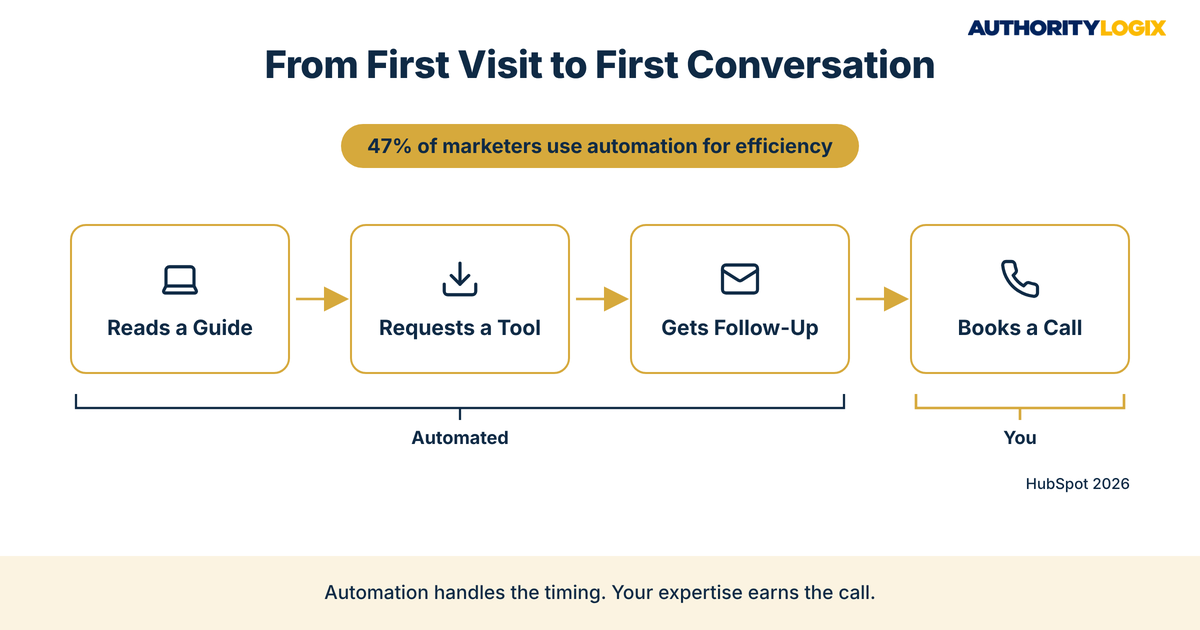
Automation is not a real estate invention. Per HubSpot’s 2026 State of Marketing Report, 47% of marketers report using automation to make marketing processes more efficient, according to HubSpot’s own marketing statistics summary. In a real estate self running lead system, that efficiency shows up as follow-up that goes out on time, whether you are at a showing or on vacation.
HubSpot’s report also found that nearly 70% of marketers say leads now come to them later in the buying process, because those leads have done more AI-assisted research first. Real estate prospects who research on their own can follow the same path. Nurture keeps educating them until they are ready to talk.
Where Agent Expertise to Leads Infrastructure Pays Off After the Click
Capture works best when the offer matches the page. A seller reading about pricing gets a pricing guide, an investor reading about rental math gets a calculator, and the full sequence of offers and handoffs is mapped in the lead system guide.
Once someone raises a hand, routing decides what happens next. Good inbound lead generation sends each contact into the right track — seller, buyer, investor, or renter weighing a first purchase — each with its own follow-up. Routing is what lets a real estate self running lead system respond right away even when you will not see the lead until evening.
The follow-up itself is a planned series rather than a burst of messages. An automated funnel paces emails, guide deliveries, and check-ins around the decision timeline of each track, with your market commentary doing the persuading. The automation handles timing, and your expertise handles trust.
How Does a Broker Authority Lead Generation Machine Stay Visible Without Daily Effort?
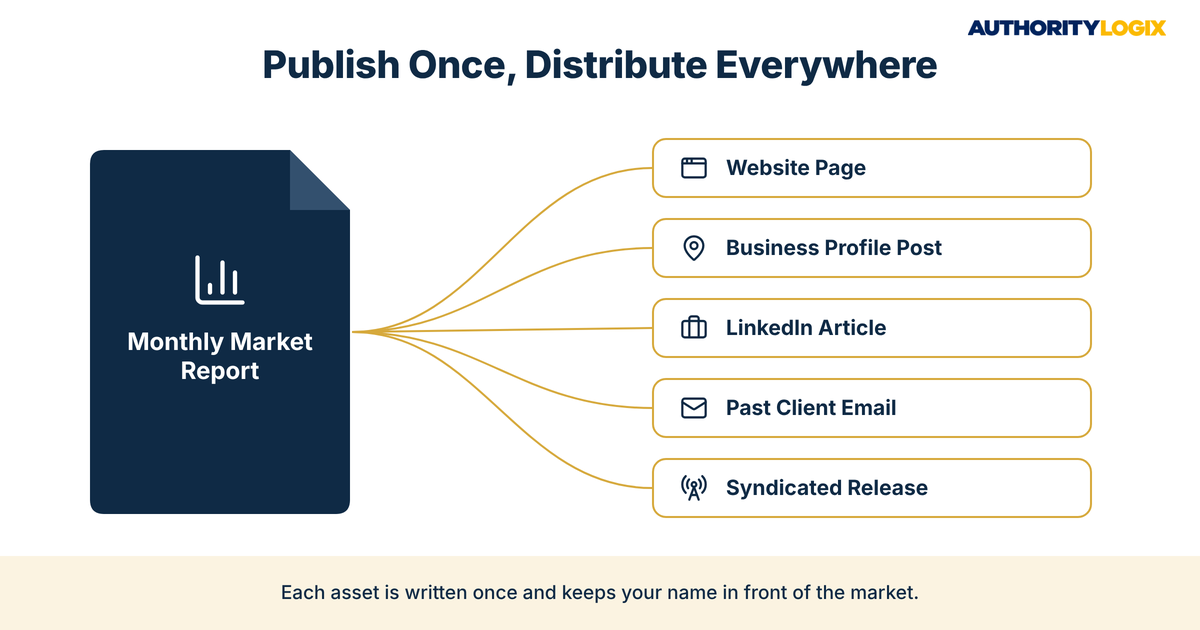
A broker authority lead generation machine stays visible because each asset is published once and then distributed many times. A market report can become a website page, a Google Business Profile post, a LinkedIn article, an email to past clients, and a syndicated release without anyone rewriting it for each channel. Distribution is what keeps a real estate self running lead system in front of the market between your own conversations.
That reach has to be scheduled, not remembered. A planned approach to content distribution decides where each piece goes, in what format, and on what timing, so a busy month at the brokerage does not leave the market hearing nothing. Volume without infrastructure is just noise, and scattered posting is exactly that.
BKDSCR.com, the AuthorityLogix proof-of-concept in the NYC outer-borough DSCR investor niche, was built on this model with 18 pillar pages, 7 interactive investor tools, and 48 SEO-optimized blog posts. It was built in under 18 months with zero paid ads, and every piece was designed to keep working after it was published.
For brokerages with investor clients, distribution matters even more, because investors read and compare before they commit. Distributing investor-focused content puts the brokerage’s name in front of buyers who may purchase several properties over time. That is how a broker authority lead generation machine turns one good article into repeat business.
What Agents Get Wrong When Building a Real Estate Self Running Lead System
Most agents who try to build one are not short on effort. They are working from assumptions that made sense for a different market or a different era of search, and each one shows up as a question.
Can I just buy leads and call that a system?
Purchased leads often go to several agents at once and stop the day the payments stop. They build nothing that keeps working afterward. A real estate self running lead system produces contacts who found you, read your work, and chose to reach out.
How much of my time does it actually take?
The heavy lift is at the start, when your knowledge is captured and the first pages, guides, and sequences are built. After that, the time commitment drops to reviewing drafts and answering leads, which is how our process is sequenced for agents who are already busy with clients. No one should promise a real estate self running lead system that needs nothing from you.
Is email follow-up still worth it in real estate?
Email remains the channel that carries a prospect from first visit to first call, because it reaches people on their own timing. A well-built email nurture sequence sends market context rather than reminders that you exist, so each message gives the reader a reason to keep opening. The sequence is where real estate lead system automation expertise matters most, since bad timing turns helpful follow-up into spam.
Will the leads be ready to list right away?
Many will not, and that is the point. A real estate self running lead system catches people early and keeps them close until they are ready, which means some conversations start months after the first visit. Agents who judge the system in its first few weeks usually quit right before it starts producing.
Ready to have a real estate self running lead system built around your market knowledge, so prospects are found, educated, and followed up with between your appointments?
How Self-Running Can a Lead System Honestly Get?
Honestly, a lead system can run most of the pipeline but never all of it. Search visibility, content, capture, follow-up timing, and distribution can all operate without daily attention once they are built. Answering the call, reading the client, and negotiating the deal still belong to you.
The parts that do run on their own get stronger with every asset you add. The guides in the AuthorityLogix RE resource library follow the same principle, each one connected to the pieces around it, and a real estate self running lead system grows the same way, page by page and sequence by sequence.
BKDSCR.com was built in a live outer-borough market with AuthorityLogix’s own time and money, which is why our approach starts with infrastructure instead of tactics that spike and fade. A real estate self running lead system follows the same order: foundation first, automation second, distribution third.
The honest answer is that most agents already have the expertise their market is searching for. What is missing is the infrastructure that captures it once and keeps putting it in front of the right people, and that infrastructure is a build, not a subscription. Build it in the right order, and the system takes on the prospecting work you rarely have time for.