


Key Takeaways
- A financial advisor referral system replaces hoping for introductions with a defined process for earning, receiving, and following up on warm referrals.
- In the 2026 Kitces Research marketing study, 88% of advisory practices used client referrals, at a revenue acquisition cost of $0.34 per marketing dollar.
- A financial advisor referral system usually starts with CPAs and estate attorneys, used by 89% and 79% of practices that work with centers of influence.
- Ficomm Partners found half of investors with $5 million or more chose an advisor without any referral, so referrals alone no longer cover the market.
- Any advisor structured referral program has to run inside the SEC Marketing Rule and your compliance team’s review process.
- A financial advisor referral system works best when every introduction lands on published expertise that confirms what the referrer said about you.
Table of Contents
A financial advisor referral system is the difference between hoping a happy client mentions your name and knowing where your next ten introductions will come from. Most advisors already have the hard part — years of client results, trusted relationships with CPAs and attorneys, and a solid reputation inside their network. What they lack is a repeatable structure that turns that goodwill into a steady flow of warm, qualified conversations.
Referrals are still the dominant growth channel for advisory firms, but most of them arrive by accident. When introductions depend on memory and luck, the firm eventually hits a referral ceiling that no amount of client service can break through. A financial advisor referral system is how firms break through it.
Why a Financial Advisor Referral System Beats Waiting for Introductions
The numbers explain why advisors rarely abandon referrals. In the 2026 Kitces Research marketing study of 506 advisory practices, client referrals were the most widely used marketing method at 88% of firms, and they produced new revenue at a cost of $0.34 for every marketing dollar. Centers-of-influence referrals were used by 64% of practices and came in at $0.72 per dollar, close to the study’s $0.70 average across all methods.
The same study shows the limit. Kitces Research found that among firms with $500,000 to $749,000 in revenue, high-growth practices got about one-third (33%) of new client revenue from referrals, while other firms relied on referrals for 83%. Referrals are efficient, but a firm that depends on them almost entirely grows at the pace its clients happen to talk about it. Your referral network is a ceiling, not a foundation.
Survey data reported by InvestmentNews points the same way. In InspereX’s 2025 Advisor Pulse Outlook Survey of 829 advisors, 76% gained clients through unsolicited referrals, while only 38% gained clients through referrals they asked existing clients for and 38% through other professionals.
The gap between unsolicited and solicited referrals is the opportunity. A financial advisor referral system closes it by giving clients and partners a clear reason, a simple path, and a credible destination when they mention you. That credibility layer — covered in depth in the authority guide — is what makes a referred prospect book the first meeting instead of filing your name away.
What a Financial Advisor Referral System Actually Includes
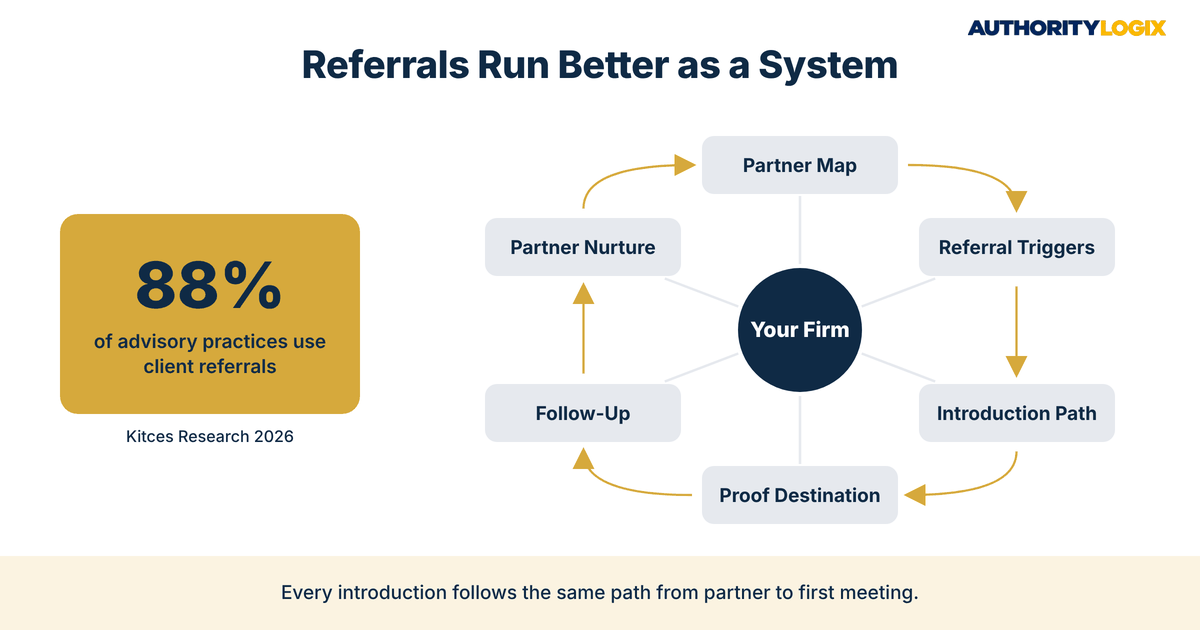
Think of a financial advisor referral system as six connected parts, not a script for asking. Each part has an owner, a trigger, and a measurable output.
| Component | What It Does | Who Owns It |
|---|---|---|
| Partner map | Lists the CPAs, attorneys, and other professionals who serve your ideal clients | Advisor and marketing lead |
| Referral triggers | Defines the moments when an introduction is natural, such as a plan review or a client life event | Advisor |
| Introduction path | Gives referrers a simple way to connect a prospect, from a shared guide to a warm email | Operations |
| Proof destination | The website pages and published expertise a referred prospect checks before the first meeting | Marketing |
| Follow-up and tracking | Records every introduction, response time, and outcome in the CRM | Operations |
| Partner nurture | Keeps referral partners informed and your expertise visible between introductions | Marketing |
None of these parts is complicated alone. Most firms run one or two informally and never connect the rest, which is why a financial advisor referral system belongs alongside the other visibility systems on the services hub rather than in one advisor’s notebook.
The Financial Services Lead Generation System shows how a financial advisor referral system fits inside a full first-party pipeline that never depends on buying leads.
RIA Referral Network Strategy With Centers of Influence
An RIA referral network strategy starts with the professionals who already sit next to your ideal clients’ biggest decisions. The Kitces study found that among practices working with centers of influence, 89% partnered with CPAs and 79% with estate planning attorneys. Those two groups see income events, business sales, inheritances, and retirement transitions before an advisor usually does.
The study also found that 37% of high-growth practices used centers of influence tied to a specific target market, compared with 21% of other firms. A generalist CPA produces occasional introductions. A CPA who serves the same dental practices or business owners you specialize in produces a pattern.
Which Centers of Influence Belong in the Network
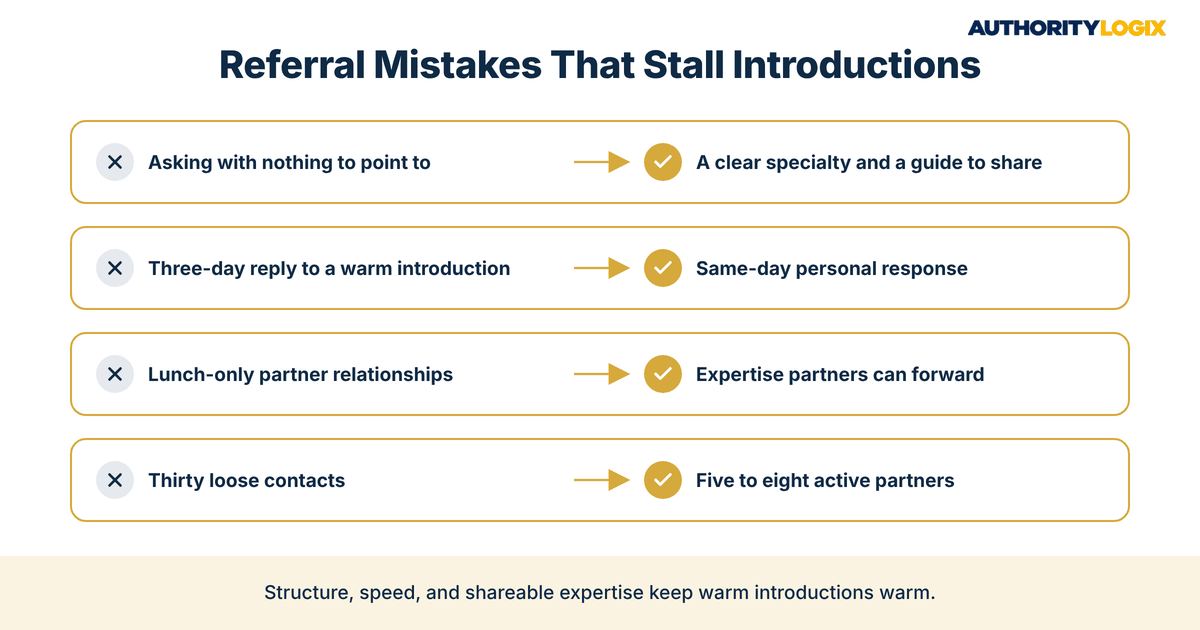
A financial advisor referral system needs a short list, not a long one. Five to eight active partners who share your client profile usually outperform thirty loose contacts.
- CPAs and tax preparers who serve your niche and see liquidity events first
- Estate planning and business attorneys handling transitions, trusts, and sales
- Mortgage and lending professionals working with the same households
- Insurance specialists who identify protection gaps but do not manage assets
Every partner on that list takes a reputational risk when they introduce you. If their client searches your name and finds a thin website with no published expertise, the partner’s own judgment looks weak — a credibility gap that quietly reduces how often they refer. Professionals protect their clients, so they refer to advisors whose expertise they can point to.
This is where an RIA referral network strategy connects to the content inside a financial advisor referral system. A partner who can send a client to a specific guide on equity compensation or business succession is far more comfortable making the introduction. An educational hub gives CPAs and attorneys something concrete to share, so the referral starts with your expertise instead of your phone number.

Building an Advisor Structured Referral Program Within Compliance Rules
An advisor structured referral program is a documented process, not an incentive scheme. It defines when you ask, how you ask, what the referrer receives, and how the prospect is followed up. Compliance shapes every one of those decisions, so it belongs at the start of the design rather than at the final review.
For SEC-registered advisers, the Marketing Rule (Rule 206(4)-1), fully in effect since November 2022, governs testimonials and endorsements, including referrals. Endorsements require clear disclosures about the relationship, any compensation, and material conflicts, and promoters paid more than $1,000 in a 12-month period require a written agreement. Broker-dealer representatives work under FINRA’s communications rules. Your compliance team decides what is allowed — the system makes sure every step is documented.
Within those rules, uncompensated client referrals and reciprocal professional relationships do most of the work. Structure comes from timing and clarity. Natural trigger points include annual reviews, plan deliveries, a client’s own life event, and the moment a client thanks you for solving a problem.
Follow-up is where most financial advisor referral system efforts break. A referred prospect who receives a prompt, personal reply and a short series of useful, compliance-reviewed messages stays warm until the first meeting. An email nurture sequence handles that consistency without the advisor writing every message by hand, and it gives compliance one approved set of messages to review instead of dozens of improvised ones.
Shared materials need the same discipline. Introduction emails, partner one-pagers, and client guides should come from one approved library. Firms that build those assets through content systems rather than one-off documents spend less time in compliance review and more time in client conversations.
Not sure whether your firm’s online authority supports the introductions your clients and referral partners are already making?
Financial Firm Referral Marketing That Prospects Can Verify Online
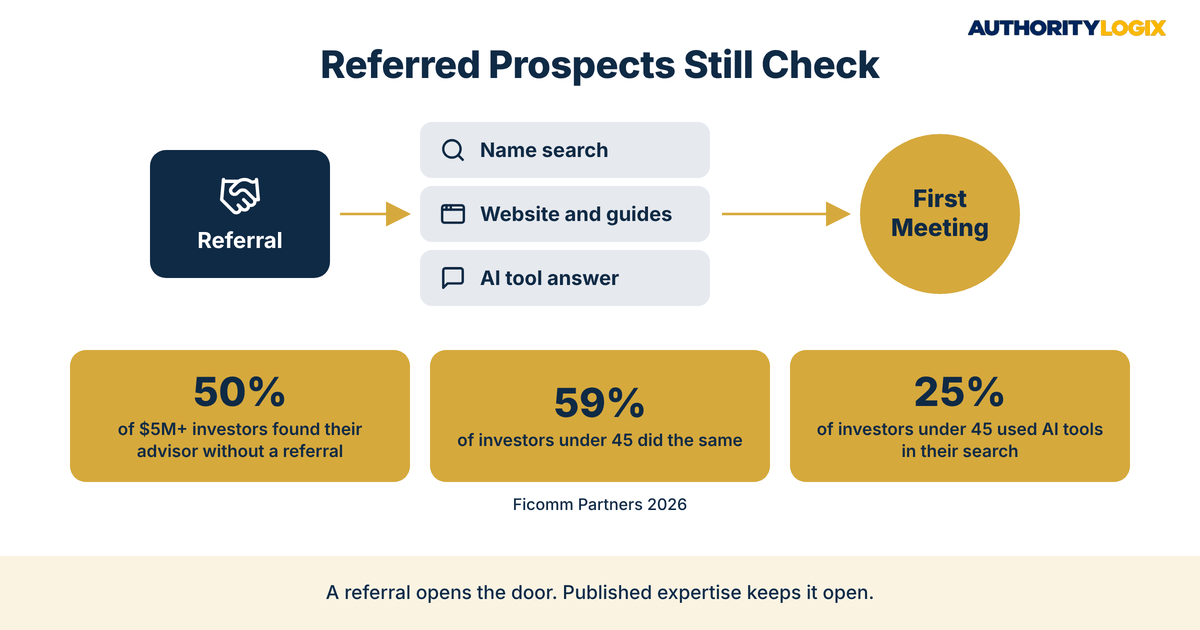
Financial firm referral marketing has changed because the referred prospect now checks before calling. In a 2026 study of 1,000 investors from Ficomm Partners and Absolute Engagement, 15% of respondents received a referral and then used at least one additional method to evaluate the advisor. Half of investors with $5 million or more in investable assets found their advisor without a referral at all, and 59% of investors under 45 did the same.
Referrals are not fading. A referral now opens a door, and a financial advisor referral system has to make sure your digital authority holds it open. The same study found nearly 74% of investors said it was very important that an advisor showed an understanding of their specific needs — something a prospect judges from your published content long before the first meeting.
What a Referred Prospect Checks Before the First Meeting
A referred prospect’s research is short and specific. Every financial advisor referral system should be built to pass this check.
- A search of your name and firm name, including public regulatory records
- Your website’s services and who-we-serve pages
- Published articles or guides on the topic the referrer mentioned
- Credentials, designations, and any media mentions
- AI tool answers when they ask who specializes in their situation
Search visibility decides whether that research confirms the referral or undermines your financial advisor referral system. If your name returns a directory listing and a thin bio, the prospect’s confidence drops right when it should be rising. The search foundation covered in the SEO playbook makes sure your name, your firm, your specialties, and your service pages show up cleanly for the people already looking for you.
Depth matters as much as findability. The Ficomm study found nearly 9% of investors used an AI tool such as ChatGPT, Gemini, or Claude in their advisor search, rising to 25% among investors under 45. Those tools draw on published expertise, which is why a library of finance content written around your clients’ real questions supports financial firm referral marketing and AI visibility at the same time.
How a Financial Advisor Referral System Nurtures Partners Between Introductions
Most referral relationships fade between introductions rather than ending badly. A CPA who sent you one client two years ago may still respect your work, but if they have not heard from you since, someone else is now top of mind. The system treats partner attention as something to maintain on a schedule, not something to hope for.
Inside a financial advisor referral system, the cadence is simple. Close the loop on every introduction within a week, with whatever detail compliance and privacy rules allow. Share one useful piece of expertise with each partner every month or quarter, and meet your most active partners in person at least twice a year.
Consistent publishing makes that cadence sustainable. A firm releasing one strong guide each month always has something to send a partner, and something the partner can forward. The content system behind that schedule turns partner nurture from an extra task into a natural result of publishing with purpose.
Outside visibility reinforces the relationship. When a CPA sees your commentary in an industry publication, it confirms they refer clients to a recognized expert. Deliberate authority distribution places that expertise where partners and their clients already read, so you stay visible without asking for attention.
A financial advisor referral system also needs measurement. Track introductions by partner, time to first response, meeting rate, and the share of new clients that came from referrals each quarter. A partner who sent three introductions last year and none this year is a signal to reconnect, not a lost cause.
Financial Advisor Referral System Mistakes That Stall Warm Introductions
Most stalled financial advisor referral system builds fail in predictable ways. The mistakes below come from treating referrals as separate from the rest of the firm’s lead generation infrastructure, when they depend on the same website, content, and follow-up. Each is easier to prevent than repair.
Mistake: Asking for referrals with nothing to point to
A request for introductions without a clear specialty or a credible destination puts all the work on the client. Give them a specific type of person to think of and a page or guide they can share.
Mistake: Slow or generic follow-up on a warm introduction
A referred prospect who waits three days for a reply cools quickly. Respond the same business day with a personal note and one relevant resource.
Mistake: Building partner relationships around lunches alone
Partners refer more often when they can share your expertise with their own clients. Giving them articles, guides, and tools to forward is a core part of what we do for advisory firms that rely on professional introductions.
How many referral partners does an advisor actually need?
Fewer than most advisors expect. In a financial advisor referral system, five to eight active partners in your niche usually beat a large, loosely managed list.
Can a financial advisor referral system work without paying for referrals?
Yes, and for many firms it works better that way. Clients and professionals refer when an advisor is easy to recommend and easy to verify, and that is exactly how we build referral support for financial firms — through published expertise and visibility rather than incentives.
How long before a referral system shows results?
Faster follow-up can help within weeks. Partner networks and published expertise build over six to twelve months, so a financial advisor referral system has to run continuously.
Want referrals arriving on a system instead of by chance? We’ll build the process and content that keeps referral sources sending clients.
Referrals as Infrastructure, Not Luck
A financial advisor referral system keeps referrals central to growth, as it should. The firms that grow fastest stop treating them as luck and start running them as one channel inside a broader growth playbook, alongside search visibility, published expertise, and direct inquiries from prospects who never needed an introduction.
BKDSCR.com, the AuthorityLogix proof-of-concept in the NYC outer-borough DSCR niche, was built on that principle. Its 18 pillar pages, 7 investor tools, and 48 posts generate inbound leads with zero paid ads, and they give anyone who mentions the platform a credible place to send people. Published expertise plus visibility is why it works in a competitive market.
The honest assessment is that most advisors already have the credibility referrals depend on. What is missing is the structure around it — the partner map, the follow-up, and the published expertise that lets a referred prospect confirm what they heard. If you would rather have that structure built than assembled piece by piece, the next step is to work with us on a financial advisor referral system designed around your niche.