

Key Takeaways
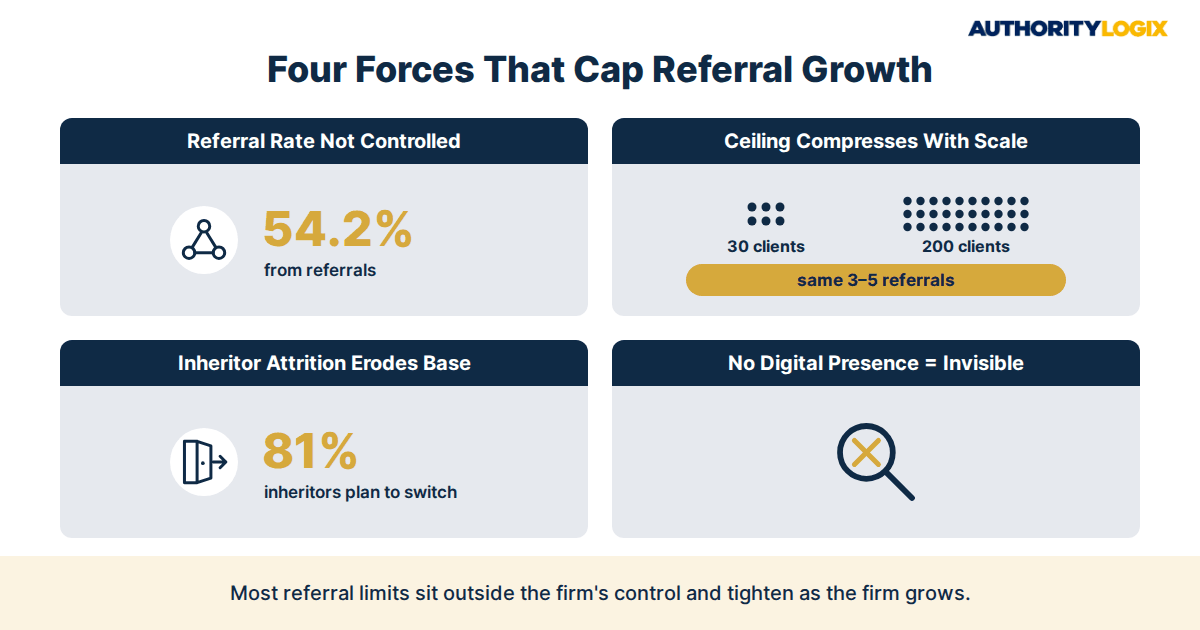
- Financial advisory firm referral ceiling growth is not a prospecting problem — it is a structural problem. Referrals from clients, friends, and family account for 54.2% of new clients for financial advisors, according to Cerulli’s U.S. Advisor Metrics 2025 report. That number also defines the ceiling: a firm whose only growth lever is the referral network of its existing clients can only grow as fast as its clients refer — which is not a rate the firm controls.
- The average RIA saw organic growth of just 5.7% in a year when market performance alone generated gains well above that, according to research by Ensemble Practice and BlackRock. When the growth rate of an advisory firm is lower than the market return of a passive index fund, the firm is not growing — it is treading water with an inflated AUM figure.
- In 2025, organic marketing narrowly edged out referrals as a source of new client growth for the first time in the survey’s history, according to Nitrogen’s 2025 Annual Growth Study. The firms leading this shift are not the largest in the industry — they are the firms that built content-driven authority infrastructure while the referral-only firms were waiting for the phone to ring.
- Authority infrastructure — a published body of scenario-specific educational content, organized in topic clusters, distributed through search and LinkedIn — creates a growth channel that operates independently of the existing client base. It reaches prospects who have never heard of the firm, earns their trust before first contact, and delivers qualified inbound inquiries that the referral network cannot generate.
- About two-thirds of those expecting a significant inheritance plan to switch advisors, according to an Equitable survey. The advisory firm that has no published content presence — no articles, no educational hub, no digital authority — is invisible to the next generation of inheritors who will research their options online before making a decision about who manages their wealth going forward.
- The referral ceiling is not eliminated by authority infrastructure — it is supplemented. The firms that break through it fastest are those that combine referral cultivation with a content-driven inbound channel: the referral validates what the prospect already knows from researching the firm online, and the online presence reinforces the referral’s credibility. Together they produce a growth rate neither channel could achieve independently.
Table of Contents
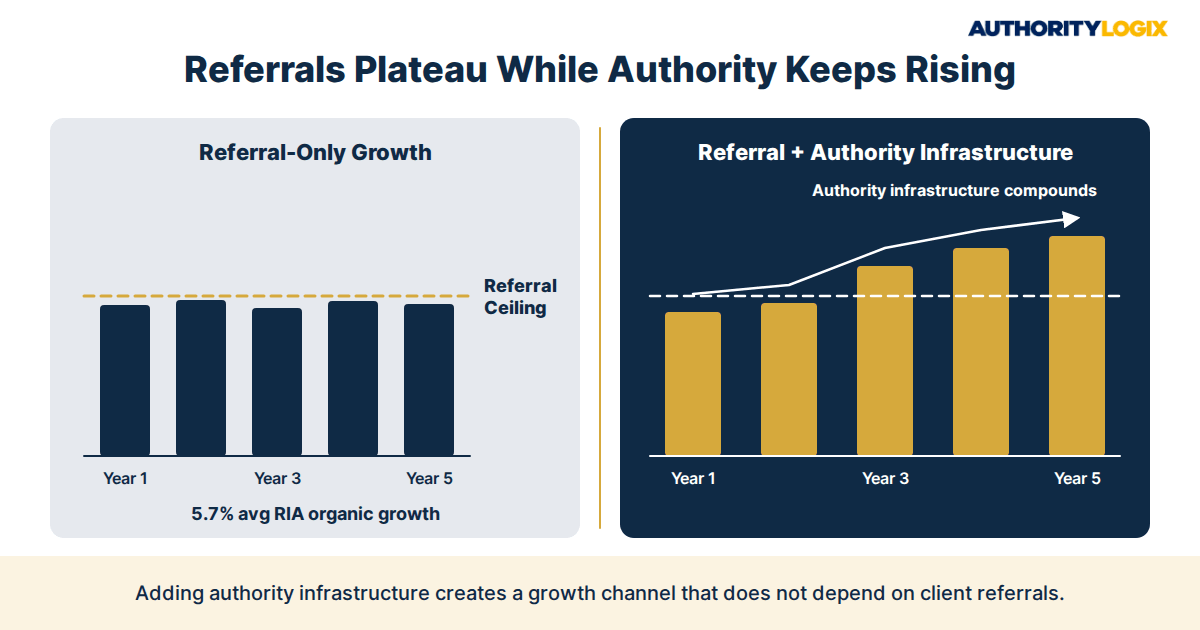
Financial advisory firm referral ceiling growth is the specific growth constraint that catches most advisory firms by surprise. Not because they didn’t know referrals had limits, but because the limits only become structurally visible at a certain scale. A firm with 30 clients generating 3–5 referrals per year is growing comfortably on referrals alone. A firm with 200 clients generating the same 1.5–2.5% referral rate is generating 3–5 new clients per year — the same absolute number. But from a much larger base, with higher operational complexity, and with a growth rate that barely covers advisor attrition.
The referral ceiling is not a crisis that arrives suddenly. It is a growth rate deceleration that accumulates over years until the firm’s organic growth falls below the market return on its own AUM. And the question becomes not “how do we grow?” but “why have we stopped growing?” The SEO playbook for financial services firms is built around the authority infrastructure that breaks this ceiling. And this article is the business case for building it.
The data on referral ceiling dynamics in advisory firms is now well-documented. According to Cerulli Associates‘ U.S. Advisor Metrics 2025 report, referrals from clients, friends, and family account for 54.2% of new clients for advisors — by far the largest source of new business. But Cerulli’s same research shows that COI (center of influence) referrals — the second-largest source — account for only 13.9% of new relationships, and traditional marketing for only 8.2%. The referral dependency is structural: most advisory firms have no meaningful growth channel that operates independently of their existing relationship network.
The authority guide covers why published expertise is the asset that creates that independent channel. It also covers what it takes to build it.
The complete framework for breaking through the referral ceiling — authority infrastructure, content strategy, and distribution — is in the Financial Services Growth Playbook.
Understanding the Referral Ceiling: Why Referrals Are Not a Scalable Growth Strategy Alone
The referral ceiling is structural, not motivational. Brent Brodeski, CEO of Savant Wealth Management — a $30 billion RIA — said it clearly at the 2024 WealthManagement.com Industry Awards Executive Forum: “Referrals are just table stakes. You have to have that institutionalization of drivers of growth.” The average RIA saw organic growth of 5.7% in a year when passive index funds returned multiples of that. When a firm’s organic growth rate is lower than the market return on its own assets, the firm is not growing relative to the market.
It is treading water with an inflated AUM number. The FS industry hub covers the competitive dynamics shaping advisory firm growth. The referral ceiling is not a minority problem — it is the median outcome for firms that have not built an independent growth channel.
The structural problem with referral-only growth is compounding at both ends. On the inflow side, the referral rate is determined by the activity level, social capital, and satisfaction of the existing client base — none of which the firm controls directly. On the outflow side, about two-thirds of those expecting a significant inheritance plan to switch advisors, according to an Equitable survey conducted by WSJ Intelligence. A firm whose only growth mechanism is referrals from current clients is building a practice on a client base that will not refer the next generation — because the next generation will switch.
The credibility gap between advisory firms with published digital presence and those without it is the gap that next-generation inheritors see when they search for a new advisor. And they will search before they pick up the phone.
What Authority Infrastructure Is — and What It Is Not
Authority Infrastructure and Financial Advisory Firm Referral Ceiling Growth: A Definition
Authority infrastructure is the published body of educational content — organized in topic clusters, optimized for organic search, distributed through LinkedIn and email. That makes a financial advisory firm visible to prospective clients who have never heard of the firm, before those prospects ever speak to anyone at the firm. It is not a social media presence. It is not a newsletter. It is not a podcast. Each of those can be components of a distribution strategy, but authority infrastructure is the underlying content that makes any distribution strategy worth deploying.
Without the pillar pages, the scenario cluster articles, and the educational depth that earns Google’s YMYL trust, there is nothing to distribute. The search statistics on financial clients suggest the discovery moment for high-net-worth prospects increasingly happens through search. They identify their planning question, search for firms that have written about it. And evaluate the firm’s expertise through the quality and depth of what they find before making any contact.
The Four Components of Financial Advisory Firm Referral Ceiling Growth Infrastructure
Authority infrastructure for a financial advisory firm has four components: a published pillar page for each client scenario the firm serves (retirement income planning for business owners, multi-generational wealth transfer, tax-efficient distribution strategies, equity compensation planning); a cluster of scenario-specific articles beneath each pillar; a lead capture mechanism embedded in the cluster articles that converts research-phase visitors into identified contacts; and a distribution layer that amplifies each published piece to the firm’s target audience through LinkedIn and email. The content systems that build this infrastructure for financial advisory firms organize it by client scenario rather than by service category — because clients search for answers to their specific planning questions, not for the categories of services an advisory firm offers.
How Authority Infrastructure Creates a Growth Channel That Referrals Cannot
The growth channel that authority infrastructure creates is fundamentally different from the referral channel in one critical respect: it is not bounded by the existing client network. A referral can only come from someone who already knows the firm. Authority infrastructure reaches people who have never heard of the firm — through Google, through LinkedIn, through AI platforms that cite the firm’s content when answering financial planning questions.
The E-E-A-T guide covers the specific trust signals — named authorship, credential attribution, scenario-specific depth, cited external data. That Google and AI platforms evaluate when determining whether a financial firm’s content should be surfaced to the prospect who is searching for expertise on their specific planning scenario. These signals are buildable. They compound over time. And they produce a discovery pathway that no referral network creates.
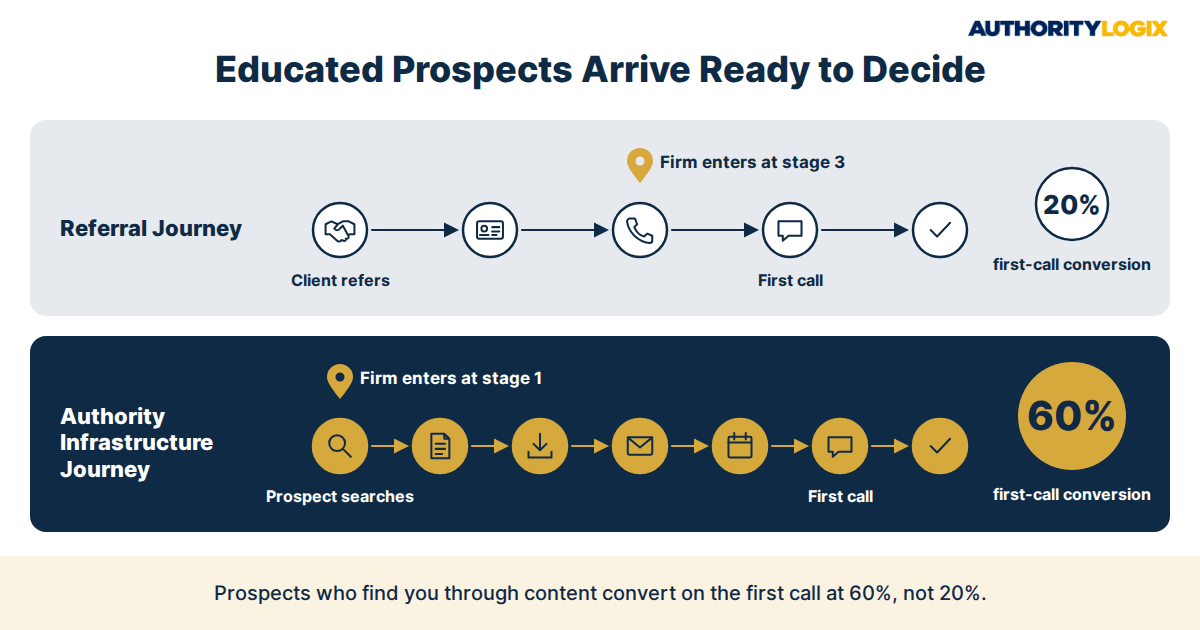
The client journey for a prospect who finds a firm through authority infrastructure is structurally different from the referral journey — and it tends to produce more qualified first conversations. A prospect who arrives through a referral knows the firm only through the referring client’s description. A prospect who arrives through authority infrastructure has already read the firm’s pillar page on their specific planning scenario, has downloaded the scenario-matched guide or calculator.
And has received five emails over two weeks that deepened their understanding of the approach. By the time they book a first call, they are not evaluating the firm — they are confirming what they already believe to be true. The educational hub architecture that produces this pre-qualified prospect journey is the structural difference between a firm that converts most first calls and one that converts few.
| Growth Channel | Who It Reaches | Firm Control | Compounds Over Time |
|---|---|---|---|
| Client Referrals | People in the existing client network | Low — determined by client behavior | No — rate is relatively stable as firm scales |
| COI / Strategic Alliances | Clients of partner CPAs, attorneys, other professionals | Medium — relationship-dependent | Partially — as alliances deepen over time |
| Authority Infrastructure | Anyone searching for the firm’s expertise — unbounded | High — the firm builds and owns the asset | Yes — each published article ranks longer and earns more AI citations over time |
| Paid Advertising | Targeted audience within ad platform reach | High — but spend-dependent | No — stops when spend stops |
The Lead Capture Layer That Converts Authority Into Pipeline
Authority infrastructure without a lead capture mechanism produces qualified readers who leave without a way to follow up. The lead capture layer is what converts the anonymous readership that educational content produces into identified contacts who enter a structured nurture sequence and eventually book a first call.
For financial advisory firms, the lead capture tool must be scenario-matched to the article it sits in: a Roth conversion analysis tool embedded in an article on tax-efficient distribution strategies for business owners, a retirement income calculator in an article on sequence-of-returns risk, an equity compensation guide in an article on managing concentrated stock positions. The website structure article covers how lead capture is embedded in the three-tier content architecture; for advisory firms specifically, the scenario-matched tool is what captures the planning-phase prospect at the moment they have found the firm credible enough to want more than the article provides.
The lead generation infrastructure that follows lead capture — the five-email nurture sequence, the booked call, the first planning conversation — converts a share of the contacts who enter the sequence into clients. That conversion rate is not lower than the referral conversion rate; it is higher, because the authority-educated prospect arrives at the first call already familiar with the firm’s approach, already convinced of the firm’s competence, and already prepared to evaluate whether they are a good fit. The referral prospect arrives knowing only what the referring client told them, which is typically a general endorsement without specific knowledge of the firm’s planning approach. The authority-educated prospect is a more informed, more prepared, and more efficiently converted prospect.
Not sure where your advisory firm’s current growth infrastructure stands? The FS Authority Gap Assessment identifies the referral ceiling constraints and maps the build sequence.
AI Search and Distribution: Amplifying Authority Infrastructure Beyond Organic
The AI search dimension of authority infrastructure adds a compounding element to the discovery channel that no referral network can replicate. When a high-net-worth prospect asks ChatGPT, Perplexity, or Google AI Overviews “how do I manage sequence-of-returns risk in early retirement with a $3M portfolio,” the answer draws on firms that have published on that exact scenario. And the answer cites an advisory firm’s pillar article on retirement income planning. That citation reaches a prospect who is actively planning and actively evaluating options, at the exact moment of research.
The AI search article covers what makes financial services content AI-citation-eligible: the same named authorship, credential attribution, scenario specificity, and topical depth that Google’s E-E-A-T evaluation rewards. An advisory firm that publishes 20 scenario-specific, credentialed articles on a defined set of client planning topics is a significantly more likely AI citation source than one with a generic brochure site. And the probability compounds as the content library grows.
Distribution amplifies authority infrastructure without changing its underlying compounding logic. A LinkedIn post linking to the firm’s new article on retirement income planning for business owners reaches the firm’s LinkedIn network — potentially hundreds of CPAs, attorneys, and business owners who are not current clients and who would never appear in a referral chain from existing clients.
An email broadcast to the firm’s subscriber list promoting the new article reaches a warmer audience with a direct link to a piece of content that demonstrates exactly the expertise they are looking for. The authority distribution layer is what accelerates the authority infrastructure from the baseline — turning the slow organic ranking build into a multi-channel reach event from the moment each new piece of content is published.
What Most Firms Get Wrong About Financial Advisory Firm Referral Ceiling Growth
They try to solve a structural problem with tactical fixes
A referral incentive program, a client appreciation event, or a COI dinner is a tactical enhancement to the existing referral channel — not a structural solution to a structural problem. If the ceiling is structural (the referral rate of the existing client base is the limit), then tactical enhancements that improve the referral rate by 10–20% raise the ceiling slightly without breaking through it.
Authority infrastructure is the structural solution: a growth channel that operates independently of the existing client base and is not bounded by any referral rate. The compliance guide for financial advisory content is what makes that authority infrastructure publishable within the regulatory framework. Because the most common structural reason advisory firms don’t publish is compliance uncertainty, not lack of things to write about.
They confuse brand awareness with authority infrastructure
A firm that sponsors a local event, buys billboard advertising, or runs digital display ads is building brand awareness. Which tells people the firm exists but does not demonstrate why the firm is worth trusting with a multi-million-dollar wealth management engagement. Authority infrastructure builds demonstrated expertise: the prospect who reads the firm’s pillar article on tax-efficient retirement distribution does not just know the firm exists.
They know the firm understands their specific planning scenario at a level of depth that warrants a first conversation. The authority marketing framework — originally built for DSCR lenders — applies equally to financial advisory firms: demonstrated expertise in the specific scenario a prospect is researching is what earns the qualified inquiry, not brand presence in general circulation.
They underestimate how long it takes — and quit before the compounding begins
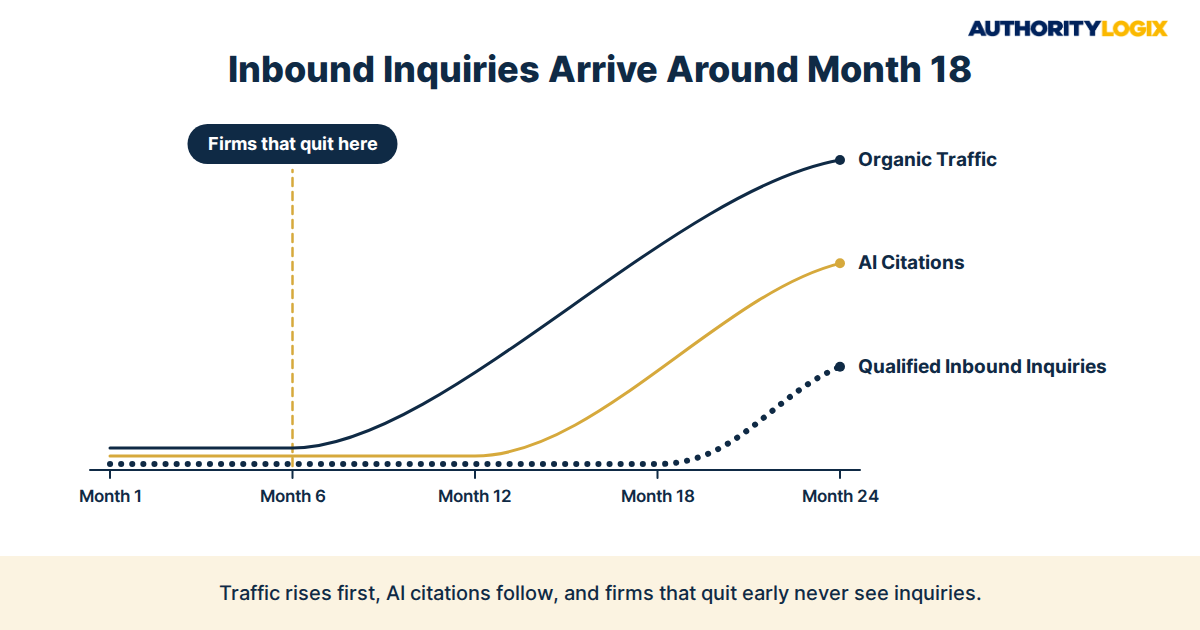
Authority infrastructure for a financial advisory firm produces measurable organic traffic impact in the 6–12 month range, AI citation presence in the 12–18 month range, and compounding qualified inbound inquiries in the 18–24 month range. The firms that quit at month 6 with 10 articles published have built nothing yet.
The firms that reach month 24 with 50 scenario-specific, credential-attributed articles published are operating with an inbound channel that compounds without proportional increases in effort or cost. The lead magnet system that captures research-phase prospects during that 6–12 month build period ensures that the authority infrastructure is generating pipeline activity even before organic rankings are fully established — converting early visitors through lead magnets while the ranking compounding begins.
Ready to break through your firm’s referral ceiling with authority infrastructure that compounds?
A Case Study in Financial Advisory Firm Referral Ceiling Growth
The advisory firms breaking through the referral ceiling in 2026 are not the largest or the best-resourced. They are the ones that started building authority infrastructure 12–24 months ago when most competitors were still debating whether content marketing was worth the effort. In 2025, organic marketing narrowly edged out referrals as a source of new client growth for the first time in the survey’s history, according to Nitrogen’s 2025 Annual Growth Study. That shift did not happen because referrals declined.
It happened because the firms that built content-driven authority infrastructure added a compounding growth channel that produced results the referral channel could not match. The organic leads framework makes the financial case. Organic leads close at a much higher rate than purchased leads. A ratio that reflects the trust differential between a prospect who arrived pre-educated by the firm’s own content and one who arrived cold from a purchased list.
The authority infrastructure build is not complicated — but it requires the right architecture and the discipline to maintain it over 18–24 months before the compounding begins. BKDSCR.com demonstrates what this looks like at production scale in an adjacent financial services niche: 18 pillar pages, 48 scenario-specific cluster articles, 7 interactive investor tools, all organized into topic clusters, all bidirectionally linked, all producing organic rankings and AI citation eligibility in a competitive CFPB-supervised market. The pillar strategy that organizes the content architecture for financial advisory firms works the same way — scenario-specific pillar pages, cluster articles for each client planning question, lead capture at every article, distribution amplifying every published piece.
When you’re ready to build, work with us is the starting point. From there, we scope the specific systems your firm needs first.