


Key Takeaways
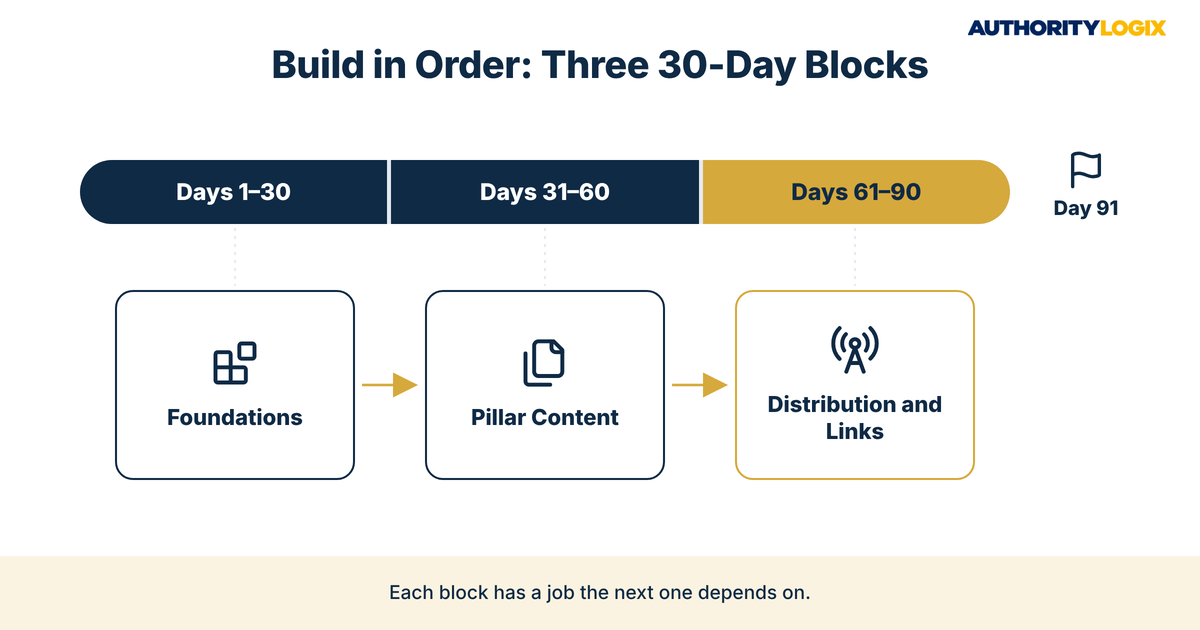
- A real estate authority 90 day plan puts the build in order: foundations first, then content that can rank, then distribution and links.
- HubSpot’s 2026 State of Marketing found that 40.6% of marketers cite updating SEO for search changes as a top trend, and 35.4% plan their largest investment increases in website, blog and SEO.
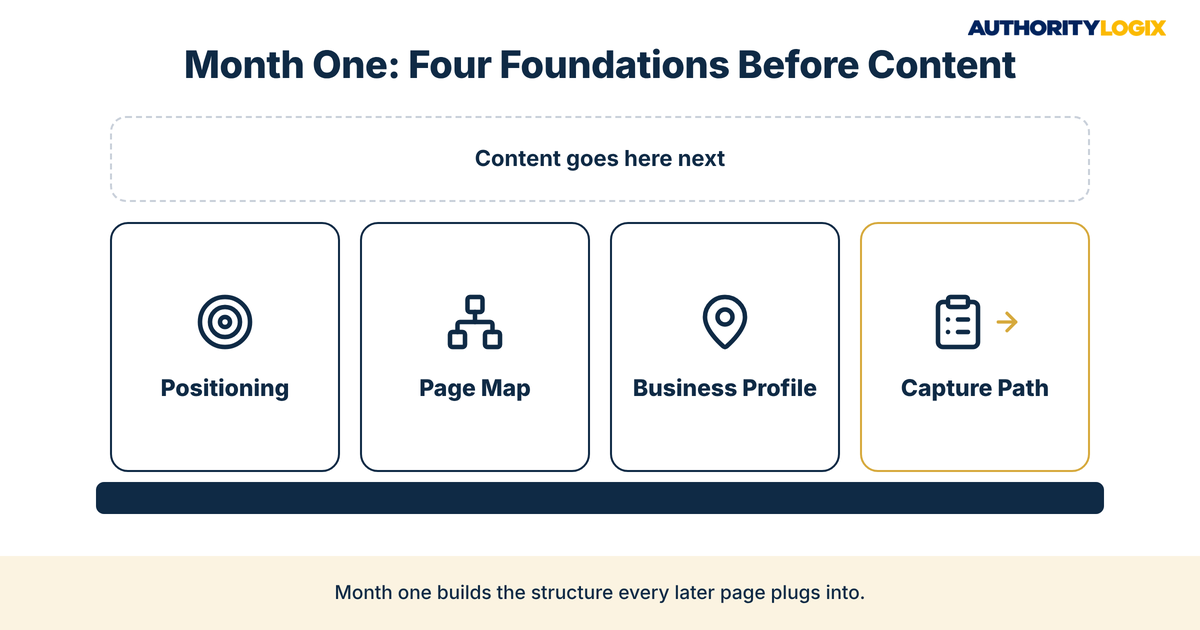
- Days 1 to 30 belong to positioning, site architecture, the Google Business Profile and a capture path — not content volume.
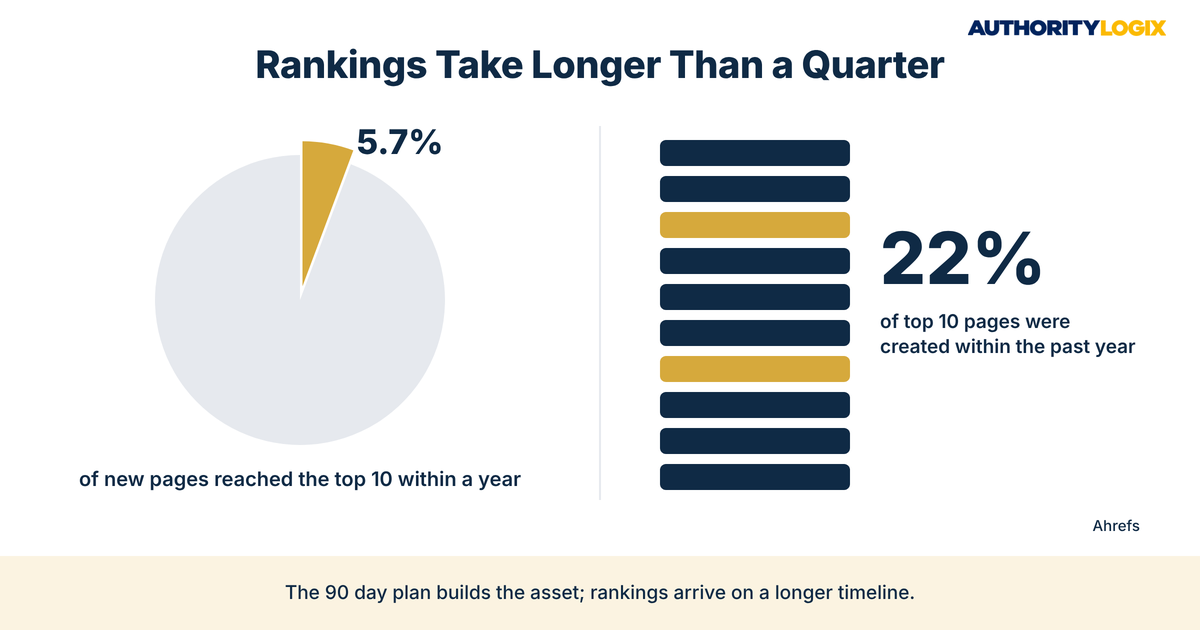
- An Ahrefs study of 2 million pages found only 5.7% reached Google’s top 10 for at least one keyword within a year, so the real estate authority 90 day plan builds assets rather than promising instant rankings.
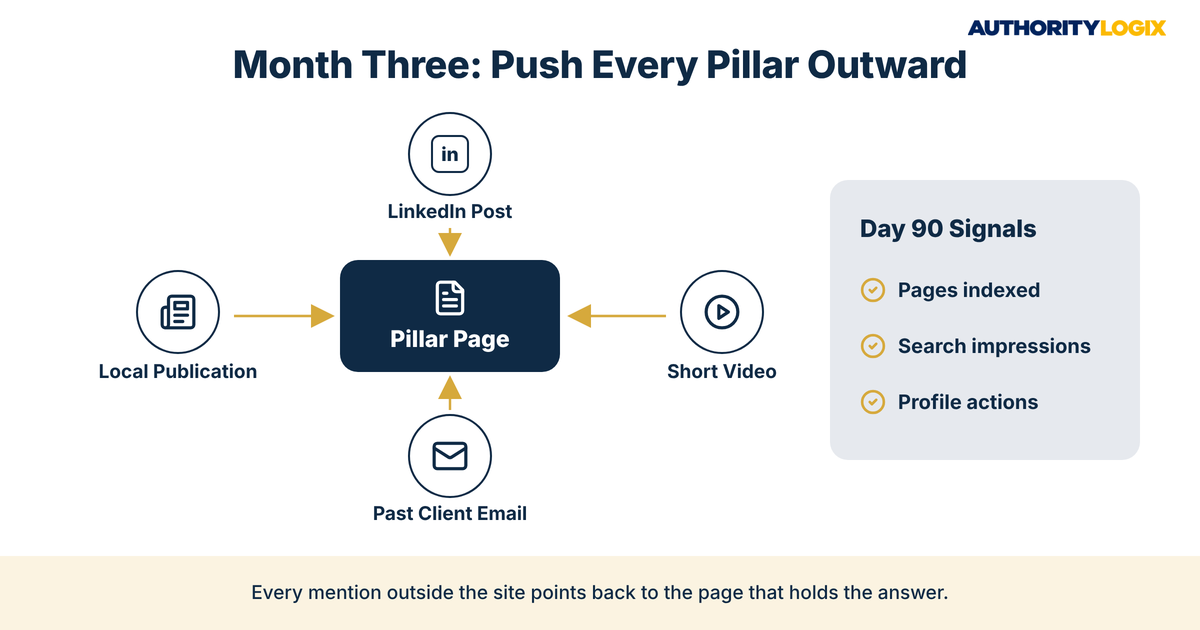
- Days 61 to 90 add distribution and internal links, and the first measurable signals are leading indicators such as indexed pages, impressions and profile actions.
- The real estate authority 90 day plan is the first quarter of a longer real estate authority growth timeline, not a finish line.
Table of Contents
A real estate authority 90 day plan answers the question most brokers and team leaders never get a straight answer to: what do you build first? You have closed deals for years, you know which blocks trade fast and which listings sit, and past clients would vouch for you — yet a seller searching your market finds the portals and two competitors with half your experience. The local SEO playbook covers how firms get found before Zillow and Redfin do, and this article covers the order of operations that makes getting found possible.
That gap is the credible but invisible problem. It is not a talent problem or an effort problem. It is a sequencing problem, and a real estate authority 90 day plan fixes it by deciding what gets built in which month, so nothing is published before the structure exists to hold it.
Why a Real Estate Authority 90 Day Plan Beats a Year of Random Posting
Random posting feels productive. A listing photo on Monday, a market update on Thursday, a blog post when someone has a free afternoon. Twelve months later the firm has a pile of content and no rankings, because nothing was connected to anything else and nothing was built to answer a specific search.
Across the real estate industry, the firms that rank are rarely the ones that publish the most. They are the ones whose pages, profiles and posts point to each other, answer the questions buyers, sellers and investors actually type, and send every visitor toward a next step. A real estate authority 90 day plan is how you build that connection on purpose instead of hoping it appears.
Marketers have noticed the shift. HubSpot’s State of Marketing survey of more than 1,500 marketers found that 40.6% of them cite updating SEO for search changes as a top trend, and 35.4% plan their largest investment increases in website, blog and SEO. Budgets are moving back toward owned infrastructure, which means your real estate authority 90 day plan is competing against firms that are also getting more deliberate.
The difference between random posting and a plan is that a plan treats publishing as a system. Firms that run on documented content systems know who writes what, where it lives on the site and which page it supports before a single word is drafted. The real estate authority 90 day plan below splits the first quarter into three 30-day blocks, and each block has a job the next one depends on.
The Real Estate Authority Guide lays out the full market authority framework that this real estate authority 90 day plan puts into motion — positioning, proof, content and distribution working as one system.
Days 1 to 30: The Broker Authority Building Roadmap Starts With Foundations
The first month of any broker authority building roadmap produces almost nothing a casual visitor would notice. That is the point. Days 1 to 30 of the real estate authority 90 day plan are about the structure every later page will plug into, and skipping them is why so many agent websites look busy and rank for nothing.
What the Real Estate Authority 90 Day Plan Builds in Month One
Month one has four deliverables. Each one is a decision before it is a page, and they are listed in the order they should be finished:
- Positioning — the markets, property types and client needs (buying, selling, investing) the firm wants to be known for, described by property and market, never by who lives there
- Site architecture — a page map showing which pillar page each future article will support
- Google Business Profile — categories, service areas, services and photos completed and verified
- A capture path — one clear next step on every page, such as a market report request, a valuation form or a consultation booking
The capture path matters more than most agents expect. Visibility without a way to convert it is just traffic, and the lead generation system approach treats every page as a step in an inbound pipeline rather than a brochure. Building that path in month one means the first visitor who arrives in month three has somewhere to go.
Positioning decides what gets written later. A brokerage that works with small multifamily owners needs different pages than a team focused on first-time sellers, and firms with an investor client base need investor content that speaks in cap rates, rent rolls and exit timing. Decide this in month one and every article in months two and three has a clear reader.
| Block | What Gets Built | Done When |
|---|---|---|
| Days 1 to 30 | Positioning, page map, Google Business Profile, capture path | Every planned page has a home and every page has a next step |
| Days 31 to 60 | Pillar pages and the first supporting articles | Each priority topic has one substantial page written from the agent’s expertise |
| Days 61 to 90 | Distribution, internal links, first outside mentions | Every pillar is linked, repurposed and pointed back to from outside the site |
| Day 91 onward | Depth under each pillar of the real estate authority 90 day plan | The publishing rhythm runs without the founder writing every word |
Days 31 to 60: Agent Authority First 90 Days Content That Earns Rankings
Month two is where most firms want to start, and it only works because month one happened. The agent authority first 90 days pattern that actually produces rankings is narrow and deep: a small number of substantial pages on the topics the firm wants to own, rather than dozens of thin posts on everything.
Month two is anchored by the pillar page. Firms that build pillar pages first — a comprehensive page on selling a multifamily building in a specific borough, for example — give every later article a home to link back to, and they give Google a clear signal of what the site is about. Supporting articles then answer the narrower questions around each pillar.
This is also where expectations need resetting. An Ahrefs study that followed 2 million pages found that only 5.7% ranked in Google’s top 10 for at least one keyword within a year, and a separate Ahrefs keyword sample found only 22% of current top 10 pages were created within the past year. Content built in month two of a real estate authority 90 day plan is an asset that matures, not a switch that flips.
Content earns rankings faster when it is organized. Grouping pillar pages and their supporting articles into an educational hub — a buyer section, a seller section, an investor section — turns a blog into a library that both readers and search engines can navigate. That structure is what separates a real estate authority 90 day plan from a content sprint.
Not sure which foundations your firm is missing before it starts a real estate authority 90 day plan? The RE Authority Gap Assessment shows where your profile, pages and content are weakest and what to build first.
Days 61 to 90: Distribution, Links and the First Measurable Signals
By day 61 the firm has a positioned site, a working profile, a capture path and a first set of pillar pages. Month three of the real estate authority 90 day plan gets that work in front of people and starts the outside signals that tell Google the site deserves attention.
Distribution is not reposting a link to every social channel. Real authority distribution means turning each pillar page into LinkedIn posts, short videos, emails to past clients and pitches to local publications, each one pointing back to the page that holds the full answer. Every mention outside the site becomes a reason for a reader, and for Google, to come back to it.
Linking the Real Estate Authority 90 Day Plan Into One System
Internal links are the part of month three nobody sees and everybody needs. Each new article should link to its pillar, each pillar to its neighbors, and each page to the capture path, which is the hub-and-spoke model the content system blueprint lays out in detail. A site linked this way passes authority from its strongest pages to its newest ones.
Month three is also when the lead generation mechanics get their first real test. Does the valuation form work on a phone, does a market report request reach a person the same day, does the consultation booking land on a real calendar? Small leaks at this stage cost the inquiries the first two months earned.
The Signals Worth Measuring on Day 90
The numbers worth watching at the end of the quarter are leading indicators, not closed deals. Track these from Google Search Console and the Business Profile dashboard:
- Pages indexed, compared with pages published
- Search impressions for market and property-type terms
- Business Profile calls, direction requests and website clicks
- Capture-path submissions, even if there are only a handful
- Branded searches for the firm or agent name
None of those numbers will look impressive yet. What matters is direction, because a real estate authority 90 day plan is judged by whether the curve has started to bend, not by where it sits on day 90.
Reading the Real Estate Authority Growth Timeline After the Real Estate Authority 90 Day Plan
Day 91 is not a finish line. The real estate authority growth timeline runs in quarters, and the first one mostly proves that the foundation holds. Firms that read it correctly keep building, while firms that expected a full pipeline by day 90 tend to stop right before the work starts paying off.
The Ahrefs findings above explain why. Most pages currently ranking in Google’s top 10 are more than a year old, so the quarter after the real estate authority 90 day plan is about adding depth under the pillars rather than starting over. The AuthorityLogix real estate resource library is organized the same way, with cornerstone guides at the top and supporting articles beneath them.
Keeping that depth growing takes a rhythm. A content calendar on its own is just a list of dates, and what turns it into publishing infrastructure is that each date is tied to a pillar, a keyword and a distribution plan.
BKDSCR.com, the AuthorityLogix proof-of-concept in the NYC outer-borough DSCR investment niche, followed a long timeline rather than a single sprint. It was built in under 18 months with zero paid ads, and the platform now carries 18 pillar pages, 7 interactive investor tools and 48 SEO-optimized blog posts. It ranks for competitive DSCR and NYC real estate terms because the pieces were built in order and connected.
What Firms Get Wrong in Their First 90 Days
Most failed first quarters are not lazy ones. They are busy quarters spent on the wrong things in the wrong order. These are the questions brokers and team leaders ask most often, along with the mistakes behind them.
Should we start with content or with the website?
Start with the structure the content will live in. Publishing articles on a site with no page map, no profile and no capture path produces orphaned pages that rank poorly and convert nobody. In a real estate authority 90 day plan, the website work in days 1 to 30 is what makes days 31 to 60 pay off.
Can we compress the real estate authority 90 day plan into 30 days?
You can produce the deliverables faster, but you cannot make Google crawl, evaluate and trust them faster. Compressing the build usually means skipping positioning and internal linking, the two steps that decide whether the content ever ranks.
Is social media enough for agent authority in the first 90 days?
Social posts mostly reach people who already know you, which is why referral-heavy agents find them comfortable. Search reaches people who have never heard of you, and the growth playbook explains why firms that build owned pages first get more out of social later. Use social to distribute the pages, not to replace them.
Who should run a real estate authority 90 day plan inside a brokerage?
The broker or lead agent should own the expertise, and someone else should own the system. A producing agent will not maintain a page map, a publishing rhythm and a link structure while running listings, which is exactly the split behind what we do for real estate firms. Your knowledge stays in the firm while the infrastructure gets built around it.
What should we expect to see on day 90?
Expect evidence from a real estate authority 90 day plan, not revenue: indexed pages, first impressions, some profile actions and possibly a first inbound inquiry. Anyone who guarantees rankings or a lead count by day 90 is promising something no one controls.
Ready to turn your market expertise into a real estate authority 90 day plan that is built in the right order and keeps working after day 90? Let’s map out what your firm should build first.
The Honest Expectation for Day 91 and Beyond
A real estate authority 90 day plan will not replace your referral business by the end of the quarter, and it should never be sold that way. What it does is turn years of earned credibility into a structure the market can find, and the sequence in how we work is built around exactly that: foundations, then content, then distribution.
The order is the part most firms get wrong, and it is the part AuthorityLogix proved with its own time and money first. That is the plain answer to why AuthorityLogix: the system was built in a live, competitive real estate market before it was ever offered to a client.
Authority compounds. The honest answer is that most brokers, agents and investment firms already have the expertise their market is searching for. What is missing is the infrastructure that makes the market see it, and the first 90 days decide whether that infrastructure is built on a foundation or on guesswork.