


Key Takeaways
- Mortgage resource library SEO turns a lender’s everyday expertise into a permanent, organized set of pages that keeps ranking and producing borrower inquiries long after each page goes live.
- Ahrefs reports that 72.9% of pages ranking in Google’s top 10 are more than three years old — search rewards pages built to last, not posts written to fill a week.
- HubSpot found that 76% of its monthly blog views and 92% of its monthly blog leads came from older posts, the compounding effect a library is designed to capture.
- A lender educational resource library works when it is organized by borrower question, with cornerstone guides at the top and focused articles beneath them.
- Mortgage content hub lead generation depends on capture points inside the library — worksheets, checklists, and next-step offers — not a contact form in the footer.
- A financial services knowledge library is maintained, not finished: scheduled reviews, updated figures, and compliance checks keep every page accurate and rankable.
Table of Contents
Why Mortgage Resource Library SEO Produces Leads for Years
Mortgage resource library SEO is the practice of building a permanent, organized collection of educational pages that answers the questions borrowers search before they ever call a lender. Most mortgage companies already have the knowledge to build one. Their loan officers answer the same 40 questions every week, and almost none of those answers live anywhere a borrower can find them.
That is the credible but invisible problem in its most expensive form. The expertise exists, but it lives in phone calls and inboxes instead of on indexed pages. A library fixes that by giving every answer a permanent address, and the structure holding it together starts with pillar pages that cover each core topic in depth and route readers to narrower articles beneath them.
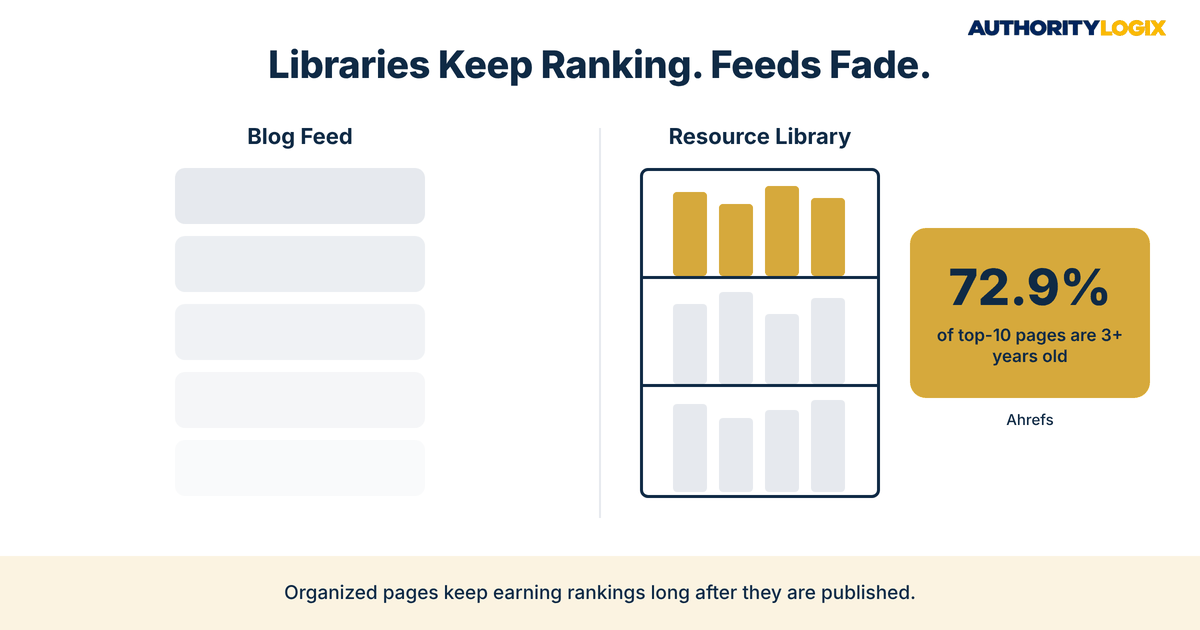
The reason a library outperforms a stream of one-off posts comes down to how search engines treat age. According to Ahrefs, 72.9% of pages ranking in Google’s top 10 are more than three years old, and only 1.74% of newly published pages reach the top 10 for any keyword within their first year. Rankings are slow to earn and durable once earned. That is why mortgage resource library SEO is planned around permanence rather than publishing frequency.
A separate Ahrefs study found that 96.55% of all pages get zero search traffic from Google. Most of those pages were never organized into anything — they were written to fill a slot, published once, and left disconnected from the rest of the site. The framework for avoiding that outcome, from keyword mapping to site architecture, is laid out in the SEO playbook, and a library is where those principles become a working asset.
There is a borrower-behavior reason too. Ellie Mae’s Connecting with Borrowers Online study found that 92% of borrowers went online before reaching out to a lender, and 48% researched online specifically to find a lender they could trust. Each page a borrower reads before calling is a small proof of competence, and mortgage resource library SEO puts those proofs in front of borrowers at the exact moment they are deciding who to trust. To see how a library fits the wider set of visibility systems, the financial services services hub shows how each piece connects.
The Financial Services Content System lays out the compliance-aware publishing blueprint behind mortgage resource library SEO, from topic architecture to review workflows.
Lender Educational Resource Library Architecture That Search Engines Reward
A lender educational resource library is not a blog with a new label. A blog is organized by date, so the newest post sits on top and everything older sinks out of sight. A library is organized by topic, so a borrower researching DSCR qualification finds every relevant page in one place regardless of when it was written. That shift from chronology to structure is the core of mortgage resource library SEO.
The Three Layers of Mortgage Resource Library SEO Architecture
The architecture that holds up over time has three layers. Each one has a specific job, and each one hands the reader to the next.
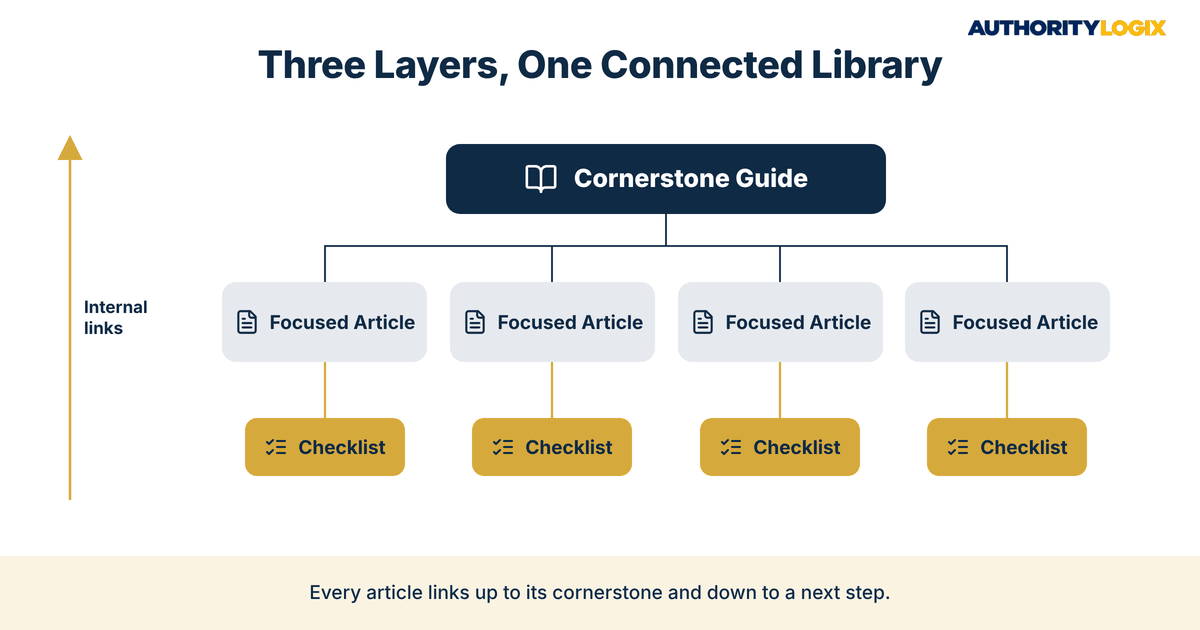
- Cornerstone guides — one comprehensive page per core borrower topic, such as purchase financing, investment property loans, refinancing, or self-employed qualification.
- Focused articles — single-question pages that target specific long-tail searches and link back up to their cornerstone.
- Conversion assets — worksheets, document checklists, and pre-qualification guides that give a reader a reason to share contact details.
In mortgage resource library SEO, internal links are what turn those layers into one structure instead of three piles. Every focused article links to its cornerstone, every cornerstone links down to its articles, and every page points to a relevant tool. That pattern tells search engines which pages carry the most authority on a topic, and it is the mechanism behind long-term rankings for mortgage companies that publish less often than their competitors but publish with more structure.
Organizing a Lender Educational Resource Library by Borrower Question
Most mortgage websites are organized around the lender’s product menu, but borrowers do not search that way. They search “how much do I need down on a duplex” or “can I qualify with 1099 income,” and the library should be organized around those questions first and products second. An educational hub built this way mirrors the borrower’s research path, so each answer leads naturally to the next question the borrower is about to ask.
The practical starting point is the question log your loan officers already carry in their heads. Pull 60 to 100 recurring questions, group them into five or six topic clusters, and assign each cluster a cornerstone. That list becomes the build plan for the first 12 months, and it keeps mortgage resource library SEO anchored to what borrowers actually ask rather than to keyword tools alone.
Mortgage Content Hub Lead Generation: Capture Inside the Library
Mortgage resource library SEO without capture is a reading room, not a pipeline. Mortgage content hub lead generation works when every page in the library offers a next step that fits where the reader is in the research process. A borrower reading about DSCR basics is not ready for an application, but that same borrower may well want a rental income worksheet.
HubSpot’s State of Marketing research, summarized in its marketing statistics roundup, ranks website, blog, and SEO as the number one ROI-generating channel for marketers. It also finds that small businesses are 23% more likely than average to see ROI from blog posts. Those returns depend on conversion paths, not page views, and a library that ranks but never asks for anything produces readers instead of conversations.
The same HubSpot data shows nearly 70% of marketers say leads now reach them later in the buying process, after more research done on their own. For lenders, that means the library is handling the early sales conversation before the borrower ever calls. Mortgage resource library SEO gets those borrowers to the page, and the capture point on that page decides whether the visit becomes a lead.
| Library Layer | Borrower Stage | Capture Point That Fits |
|---|---|---|
| Focused article | Early research, one question at a time | Topic checklist or glossary download |
| Cornerstone guide | Comparing loan options | Program comparison guide with email follow-up |
| Conversion asset | Testing whether a deal or purchase works | Worksheet or calculator with saved results |
| Document checklist page | Preparing to apply | Consultation request with a named loan officer |
The publishing rhythm matters as much as the capture points. A content calendar tied to topic clusters keeps each new page filling a gap in the library instead of scattering across unrelated subjects. Planning by cluster also means every new article launches with a cornerstone to link to and an offer already built.
None of this works when each piece is built in isolation. Cornerstone pages, capture points, and email follow-up need to share one structure, so a download on a refinance article triggers refinance-specific follow-up rather than a generic newsletter. Connecting those pieces is the job well-built content systems handle, and it is what separates a library that generates leads from one that only generates page views.
Not sure how your mortgage resource library SEO compares to the lenders outranking you in your market?
Building a Financial Services Knowledge Library That Stays Current
A financial services knowledge library ages whether anyone watches it or not. Loan limits change, program guidelines shift, and rate environments move, and search engines notice when a page stops matching what searchers expect. The fix is a maintenance schedule built into the library from day one rather than a cleanup project every few years.
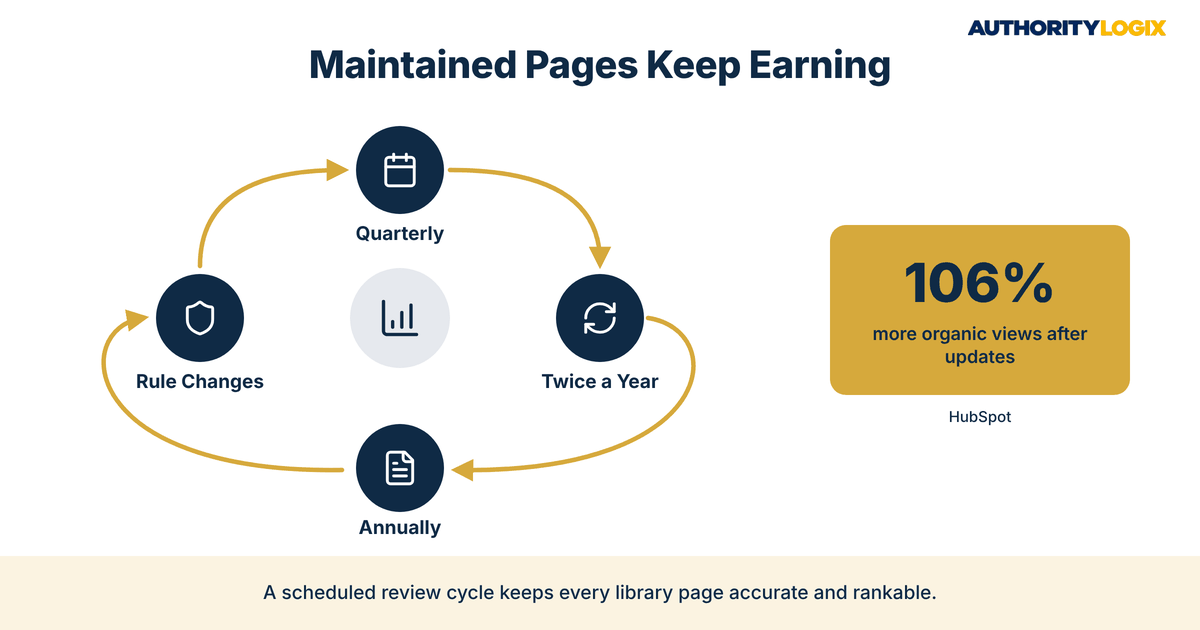
HubSpot’s own experience shows what maintenance is worth. In its historical optimization analysis, HubSpot found that 76% of monthly blog views and 92% of monthly blog leads came from older posts, and that updating and republishing older posts raised their monthly organic search views by an average of 106%. For lenders, that is the strongest argument for mortgage resource library SEO: the work done in year one keeps paying in year three, as long as someone keeps it current.
A Review Cycle for a Financial Services Knowledge Library
| Review Cycle | What Gets Checked | Why It Matters |
|---|---|---|
| Quarterly | Mortgage resource library SEO rankings, traffic, and leads by cluster | Shows which pages need an update first |
| Twice a year | Statistics, examples, and internal links | Keeps figures current and links unbroken |
| Annually | Full cornerstone rewrite review | Protects the pages that carry the most authority |
| After any program or rule change | Every page that mentions the change | Prevents outdated claims and compliance exposure |
In mortgage resource library SEO, accuracy is a trust signal, not housekeeping. A borrower who finds an outdated figure on a lender’s site draws a conclusion about the lender, not just the page. That is why the authority guide treats expert review and visible update dates as core credibility signals for any firm asking borrowers to trust it with a major financial decision.
Compliance belongs in the same cycle. Every page that discusses loan programs, qualification, or costs should pass through the lender’s compliance review before it goes live and again after any material update, and it should stay educational rather than promising rates or approvals. Writing that holds up under that review is a specialized skill, which is why finance content for regulated firms is drafted differently from general business writing.
Distributing Mortgage Resource Library SEO Content Beyond the Website
A library that lives only on your website leaves mortgage resource library SEO depending entirely on search engines to find its readers. Distribution shortens that wait. Each cornerstone guide can be broken into LinkedIn posts, email sequences for past clients, short summaries for referral partners, and syndicated versions that point back to the original page.
HubSpot’s data adds urgency: nearly 30% of marketers reported decreased search traffic as consumers turn to AI tools. Search remains the foundation of mortgage resource library SEO, but a library also needs to be shared and referenced in places beyond Google results. A distribution plan connected to the firm’s lead system makes sure each reader who arrives from a partner email or a LinkedIn post lands on a page with a clear capture point.
Realtor and CPA partners are an underused channel. A lender who sends a referral partner a clean, accurate explainer on self-employed qualification gives that partner something worth forwarding to their own clients. Over time those forwards become backlinks, branded searches, and introductions, which is the practical side of authority distribution for mortgage companies that already have a referral base to build from.
What Mortgage Companies Get Wrong About Resource Libraries
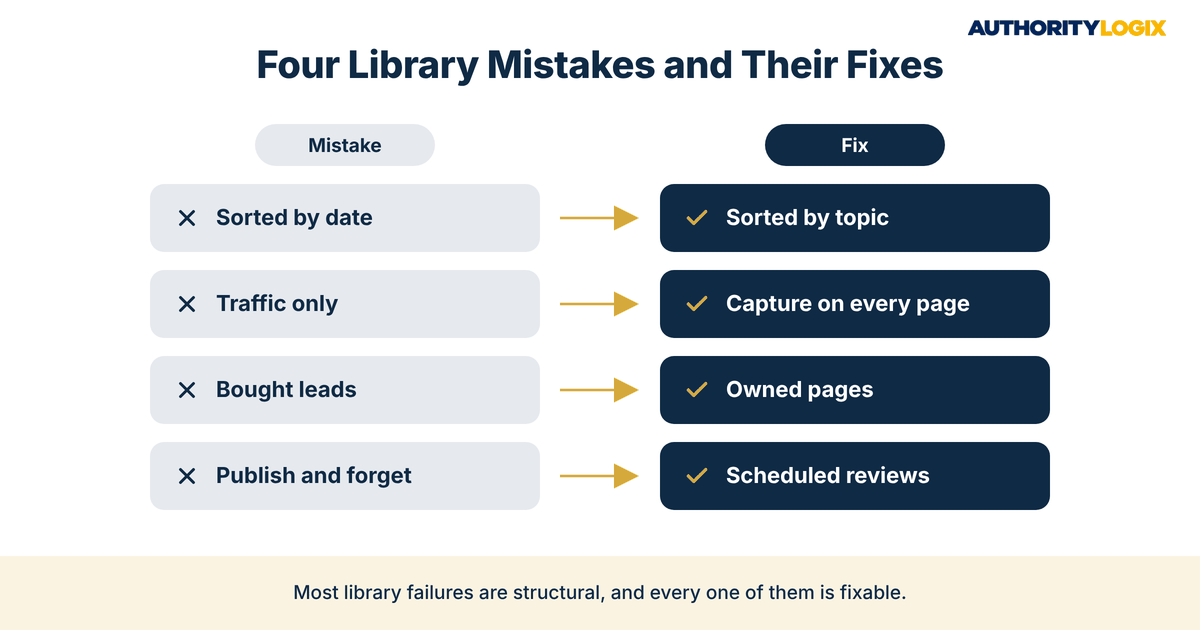
Most failed attempts at mortgage resource library SEO do not fail because the lender lacked expertise. They fail because of a handful of structural mistakes that repeat across markets, and each one is fixable once it is named.
Publishing by date instead of by topic
A library organized like a news feed buries its best answers within months. Group pages by borrower question and link them to a cornerstone, and older pages keep working instead of disappearing.
Treating the library as a traffic project
Mortgage resource library SEO rankings matter only when readers have somewhere to go next. A library without capture points produces readers, not borrowers, so each cluster needs its own offer tied into the firm’s lead generation infrastructure.
Can we buy leads instead of building a library?
Purchased leads stop the moment the spending stops, and the same lead is often sold to several lenders. Mortgage resource library SEO builds something owned, and pages published this year can still be producing inquiries years from now.
How long before mortgage resource library SEO produces leads?
Expect months, not weeks. Rankings for focused, long-tail questions usually arrive first, with competitive cornerstone topics following later, so the first year is a build phase measured by steady growth rather than an overnight spike.
Where should a lender start if nothing is built yet?
Start mortgage resource library SEO with the question log and one cornerstone topic, not a full site rebuild. Mapping that first cluster is part of what we do with mortgage companies, and it usually reveals that half the library already exists in the loan officers’ heads.
Who should write the library?
The lender’s experts should supply the substance, while a production system handles structure, drafting, and compliance formatting. That division of labor is how we build libraries that sound like the firm without consuming the firm’s time.
Ready to turn your mortgage resources into a library that ranks? We’ll organize, expand, and connect it so borrowers find it first.
Mortgage Resource Library SEO Is an Asset, Not a Campaign
Campaigns end when the budget does. Mortgage resource library SEO keeps working because every page holds a permanent address, a permanent answer, and a permanent path to the next step. You’re building an asset, not running a campaign, and the growth playbook for financial firms shows how that asset fits a longer plan for market position and referral independence.
The mortgage resource library SEO model is not theoretical. BKDSCR.com was built from scratch in the NYC outer-borough DSCR niche with 18 pillar pages, 7 interactive investor tools, and 48 SEO-optimized blog posts, with zero paid ads and in under 18 months. That build is the clearest example of why it works when structure comes before volume.
The honest answer is that most mortgage companies already have the expertise a strong library needs. What is missing is the infrastructure that turns those answers into pages the market can find, and the maintenance that keeps them ranking. If you want that infrastructure built for your firm, the next step is to work with us on a plan for your first topic cluster.