


Key Takeaways
- Mortgage content infrastructure long-term ranking is not about getting lucky with a viral article — it is about exploiting a structural advantage that compounds over time and becomes more difficult for competitors to close the longer they wait. Financial services SEO delivers 1,031% ROI over three years, according to First Page Sage 2026 proprietary campaign data — fourth-highest across all industries measured.
- The 18-month window is both a promise and a threat. A mortgage company that starts building content infrastructure today will see meaningful organic traffic by month 9–12, primary revenue channel contribution by month 18, and compounding results through month 36 and beyond. A mortgage company that waits until month 18 to start is 18 months behind a competitor who started today — and that gap is structural, not catchable with a burst of content production.
- Compounding posts — about 1 in 10 — grow to 2.5 times their launch-month traffic six months after publication, according to HubSpot’s analysis of nearly 20,000 blog posts. The performance gap between mortgage companies with structured content infrastructure and those without it is not linear — it accelerates as the compounding infrastructure grows.
- The trigger lead ban effective March 2026 (Homebuyers Privacy Protection Act) forced mortgage companies to confront their lead source dependency at exactly the moment when owned content infrastructure had become the most viable alternative. Companies that had already built their content infrastructure were unaffected. Companies that hadn’t were exposed — and are now building on a 12–18 month lag to competitors who had already built.
- Organic search SEO delivers leads at a substantially lower cost than paid lead acquisition. SEO leads close at a much higher rate than outbound leads. For a mortgage company running volume-based purchased lead models, the math on switching to or supplementing with organic inbound content infrastructure is not a marketing debate — it is a margin improvement decision.
- The compounding nature of mortgage content infrastructure means that the decision to build is time-sensitive in a way that most marketing decisions are not. A billboard purchased today and a billboard purchased in 18 months produce the same result on day 1 of each campaign. Content infrastructure purchased today produces 18 more months of compounding authority than the same infrastructure purchased in 18 months — and that gap never closes.
Table of Contents

Mortgage content infrastructure long-term ranking is the compounding asset that most mortgage companies understand intellectually but fail to build. Not because they don’t believe in it, but because the payoff timeline is long enough that short-term priorities consistently win the resource allocation argument. A paid lead vendor delivers leads this week. A content infrastructure build delivers compounding organic authority in 9–12 months and primary revenue contribution at 18 months. For a loan officer team focused on this quarter’s closings, the 18-month timeline feels too distant to justify the investment.
For the mortgage company that is thinking about where its pipeline will come from in 2028, it is the only investment that produces a compounding asset rather than a recurring expense. The SEO playbook for financial services firms covers the strategic framework; this article is the business case. The data on what mortgage content infrastructure actually produces over 18 and 36 months. And why the mortgage companies building it today will be structurally advantaged over those that are still waiting.
Financial services SEO delivers 1,031% ROI over three years, according to First Page Sage 2026 proprietary campaign data — the fourth-highest SEO ROI of any industry measured, behind real estate at 1,389%. According to First Page Sage research, thought leadership SEO — the specific type of content infrastructure that mortgage companies build through scenario-specific pillar pages and cluster articles — delivers a 748% ROI with a 9-month breakeven.
At 18 months, SEO becomes the primary organic revenue channel for companies that have maintained consistent publishing. Over a multi-year horizon, the same budget spent on SEO can deliver far more traffic than the equivalent spent on paid search. The mortgage company that decides today that this investment is not worth making is making a decision that compounds against it for the next three years.
The authority guide covers why published expertise is the primary trust signal for mortgage companies competing for borrower and broker attention. This article covers the compounding mechanics — what happens month by month when a mortgage company builds content infrastructure, what the gap looks like at 18 and 36 months between a company that builds and one that waits, and why the structural authority gap between the two never closes.
The complete framework for building mortgage content infrastructure — architecture, publishing cadence, and 18-month compounding projections — is in the Financial Services Growth Playbook.
Why the 18-Month Window Is Both a Promise and a Threat
The 18-month compounding window in mortgage content infrastructure is often framed as a promise. “build now and in 18 months you’ll have a primary organic revenue channel.” That is accurate. But it is equally and more urgently a threat. Every month a mortgage company waits to start is a month during which a competitor who has already started extends the structural authority gap. The FS industry hub covers the competitive dynamics of financial services digital authority. And in the mortgage market specifically, the structural advantage of early infrastructure builders is visible in Google search results for competitive borrower-facing queries.
The DSCR lender who published a comprehensive DSCR pillar page and eight cluster articles 18 months ago now ranks in the top positions for multiple DSCR-related queries. A DSCR lender starting that content build today will reach those same ranking positions in 18 months. 18 months from now, in a market where the early builder will already be extending into their second tier of cluster topics.
The trigger lead ban effective March 4, 2026 made this window visible in the most concrete possible way. Mortgage companies whose primary new-client acquisition source was purchased trigger leads had that source significantly restricted overnight. Companies that had already built owned content infrastructure — pillar pages ranking on Google, lead magnets capturing borrower contacts, automated nurture sequences converting those contacts to booked calls. Had an alternative already operational when the trigger lead source was disrupted.
Companies that hadn’t needed to build fast, starting from zero in a market where their competitors had 12–18 months of compounding authority already working for them. The credibility gap that the trigger lead ban exposed is the same gap that content infrastructure builds close. But closing a gap that is already 18 months wide requires 18 months of building before the starting position is even reached, let alone surpassed.
What Compounding Actually Means for Mortgage Content Infrastructure
The word “compounding” in the context of mortgage content infrastructure has a specific, measurable meaning that is distinct from the vague promise of “growing over time.” HubSpot’s analysis of nearly 20,000 blog posts found that compounding posts — about 1 in 10 — grow to 2.5 times their launch-month traffic six months after publication. That means a cluster article that earns 500 organic visits in month 1 earns approximately 1,250 visits in month 7 — from the same article, without additional investment. The search statistics on mortgage borrower behavior confirm that the compounding mechanism for financial content specifically is topical authority accumulation.
Each new cluster article published under a pillar page increases the topical authority of the entire cluster, which lifts the ranking positions of all articles in the cluster — not just the new one. A mortgage company that publishes its 10th DSCR scenario article does not just add one article’s worth of traffic. It also increases the ranking authority of the previous 9 articles simultaneously.
The content systems that support mortgage content infrastructure for compounding performance are organized around this topical authority accumulation principle. Every new article must be part of a topic cluster with a pillar page, and must link back to that pillar page, to receive the compounding benefit. A mortgage company that publishes 50 unconnected blog posts accumulates 50 standalone pages — no compounding topical authority, no cluster lift, no ranking improvement for adjacent articles.
A mortgage company that publishes 5 pillar pages each with 8–10 cluster articles accumulates compounding authority across 45–55 pages, each reinforcing the others. The performance gap between these two approaches is not visible in month 3. It is visible and significant by month 12, dominant by month 18, and insurmountable by month 36.
The Build: What Mortgage Content Infrastructure Requires in the First 18 Months
Phases 1 and 2 of Mortgage Content Infrastructure Long-Term Ranking
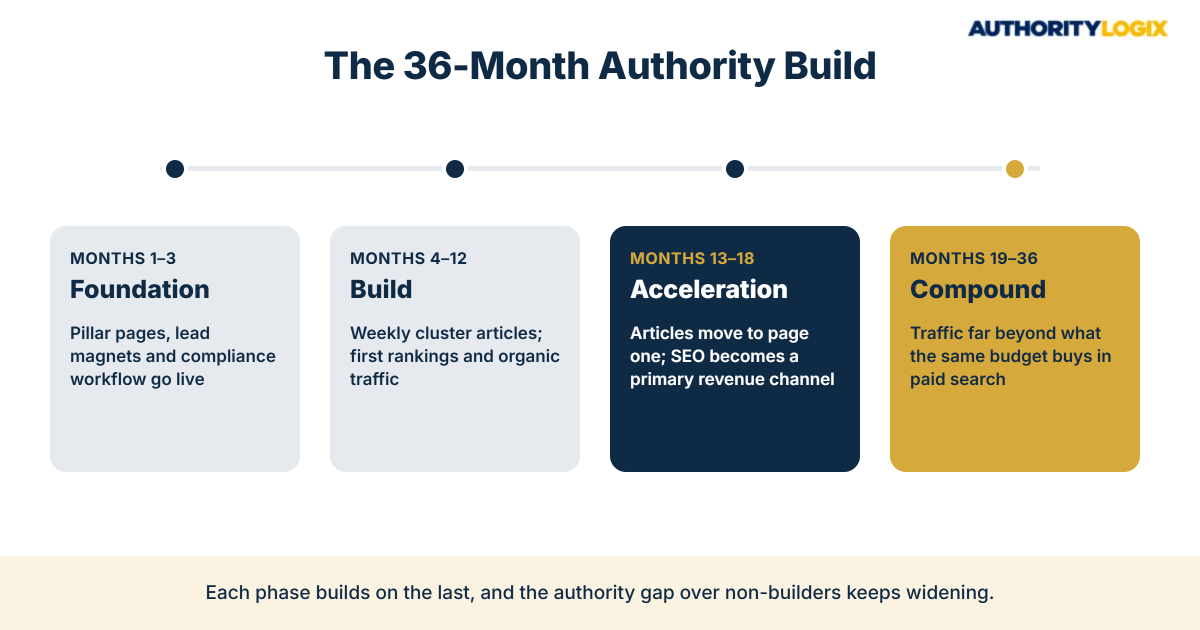
Mortgage content infrastructure in the first 18 months has three phases. Phase 1 (months 1–3): foundation. The first two pillar pages are published, each with their first two cluster articles. The lead magnets for each topic cluster are built and deployed on the cluster articles. The compliance review workflow is established. The content calendar is set. The E-E-A-T guide covers the trust signals — named authorship with NMLS credentials, cited data, external source attribution — that must be embedded in the pillar pages from the start, because these signals are what Google’s YMYL evaluation requires to begin accumulating trust for financial content.
Phase 2 (months 4–12): build and accumulate. One to two new cluster articles per week, working down the search volume order within each topic cluster. Each article links back to its pillar page. The pillar page links to each cluster article as it is published.
Distribution begins from month 1: every new article is promoted through a LinkedIn post and the existing email subscriber list. The educational hub architecture that organizes the cluster articles at the site level ensures that as new cluster articles are published, the topical depth signal Google evaluates keeps growing across the entire cluster — not just on the new page. By month 12, a mortgage company that has maintained this cadence has published 5 pillar pages and 40–50 cluster articles, all internally linked, all with lead capture embedded, and all with compliance review documented.
Phase 3 of Mortgage Content Infrastructure Long-Term Ranking
Phase 3 (months 13–18): acceleration. The topical authority accumulated in phase 2 begins lifting all cluster articles in each established cluster. Rankings that were on page 2–3 in month 9 move to page 1 by month 15. Organic traffic is compounding, lead capture is converting visitors to contacts, and the nurture sequences are booking first calls with captured contacts. By month 18, the content infrastructure is operating as a primary revenue channel alongside the referral and paid lead channels — not replacing them, but supplementing them with a source of qualified inbound that grows without proportional increases in cost.
| Phase | Months | Key Activities | Expected Output |
|---|---|---|---|
| Phase 1 — Foundation | 1–3 | 2 pillar pages, first cluster articles, lead magnets, compliance workflow, content calendar | Infrastructure live; first indexing; no significant traffic yet |
| Phase 2 — Build | 4–12 | 1–2 cluster articles/week, distribution via LinkedIn and email, lead capture operational | 40–50 published articles; first rankings; organic traffic begins; lead capture converting |
| Phase 3 — Acceleration | 13–18 | Topical authority lift across all clusters; page 2–3 articles move to page 1; nurture converting | Primary revenue channel status; approaching the 748% ROI First Page Sage reports for thought leadership SEO |
| Phase 4 — Compound | 19–36 | New clusters launched on established authority; AI citations increasing; structural gap widens | Traffic well beyond what the same budget buys in paid search; a widening authority gap over non-builders |

The Architecture That Makes the 18-Month Compound Work
The compounding performance of mortgage content infrastructure depends entirely on the architecture — specifically, the pillar page and topic cluster model described in the pillar strategy resource. A mortgage company that publishes 50 standalone blog posts without pillar pages and cluster architecture accumulates 50 isolated articles — no compounding topical authority, no cluster lift effect, no structural ranking advantage over a competitor who publishes 20 well-organized cluster articles. The architecture is what converts individual articles from standalone pages into components of a compounding authority network where each new article lifts the ranking of all adjacent articles.
The lead capture layer embedded in every cluster article is what converts the compounding traffic into compounding pipeline. Without lead capture, the content infrastructure produces compounding readership — which does not translate into revenue. With lead capture, every new reader who finds the cluster article through organic search becomes a potential contact in the nurture sequence, which converts to booked calls, which convert to applications.
The lead generation architecture that connects these layers. Content infrastructure → organic traffic → lead capture → nurture sequence → booked call — is the pipeline that the 18-month build is constructing. The pipeline does not flow at full capacity in month 3. It flows at increasing capacity in months 12–18 and at primary revenue channel capacity by month 18–24.
Not sure where your mortgage company’s current content infrastructure stands? The FS Authority Gap Assessment identifies the gaps and maps the 18-month build sequence.
Distribution: Accelerating the Compounding Curve
Organic search ranking is the long-term compounding engine, but distribution is what accelerates traffic during the 6–12 month window before organic rankings mature. A mortgage company that publishes a new cluster article and does nothing else with it must wait for Google’s crawler to index it, evaluate it, and slowly increase its ranking position over months. A mortgage company that publishes the same article and immediately distributes a LinkedIn post linking to it, sends an email to its subscriber list.
And submits it for syndication through platforms that reach the target audience is accelerating the initial traffic curve. And that initial traffic produces early signals that help Google rank the article faster. The lead funnel architecture that benefits from this accelerated traffic begins filling faster when distribution is part of the content workflow from month 1.
The authority distribution layer for mortgage companies covers the specific channels — LinkedIn for broker and investor audiences, email for existing borrower and referral networks, syndication for reach beyond organic search — and the workflow that makes distribution a consistent part of the content production cycle rather than an afterthought that happens sporadically. Distribution without content infrastructure produces temporary visibility. Content infrastructure without distribution produces slow organic build. Together, they produce the accelerated 18-month compounding curve that makes the investment case for mortgage content infrastructure compelling in the first place.
What Most Companies Get Wrong About Mortgage Content Infrastructure Long-Term Ranking
They measure content against the wrong timeline
A mortgage company that evaluates its content infrastructure investment at month 3 and sees minimal organic traffic has measured a long-term compounding asset against a timeline designed for short-term paid channels. At month 3, the infrastructure is indexed but not yet authoritative. At month 12, it is authoritative and ranking. At month 18, it is delivering primary revenue channel contribution. Measuring at month 3 and concluding the investment is not working is equivalent to measuring the return on a 30-year fixed mortgage in month 3 and concluding the asset is underperforming.
The AI search dimension adds further compounding. The same content infrastructure that is building Google organic authority is simultaneously building AI citation eligibility. A second compounding benefit that begins producing results on a similar 12–18 month timeline.
They treat compliance as a reason not to publish rather than a framework for publishing
The compliance environment for mortgage content is real, but it is not a prohibition on publishing — it is a framework for publishing correctly. The compliance system that makes mortgage content infrastructure publishable within CFPB and NMLS requirements is a workflow, not a wall. Mortgage companies that use compliance uncertainty as a reason to delay the content build are delaying the start of their 18-month compounding window by exactly the length of their delay — with no reduction in the work required to reach primary revenue channel status.
They publish without a calendar and lose the compounding benefit of consistency
Google’s topical authority accumulation for financial content rewards consistent publishing cadence. A mortgage company that publishes 5 articles in January, nothing in February, 2 in March, and 8 in May is not building topical authority — it is publishing sporadic data points. The content calendar that organizes mortgage content infrastructure publishing into a consistent weekly cadence is the operational mechanism that makes the 18-month compounding curve achievable. Without the calendar enforcing consistency, the investment in pillar pages and cluster architecture produces diminished returns because the topical authority signal Google evaluates includes publishing consistency, not just publishing volume.

Ready to start building the content infrastructure that puts you 18 months ahead of competitors?
The Companies Winning at Mortgage Content Infrastructure Long-Term Ranking Right Now
The mortgage companies at month 18 of their content infrastructure build right now. The ones operating with primary revenue channel organic inbound, ranking in the top positions for competitive borrower queries. And appearing in AI citations when prospects search for their expertise — started building in 2024 and early 2025. They are not the largest mortgage companies in the market. They are the ones that made the decision earlier than their competitors and maintained the publishing discipline for 18 months. The financial services SEO 1,031% three-year ROI that First Page Sage’s campaign data documents is not evenly distributed across all financial services firms.
It flows to the ones with the infrastructure. The organic leads framework makes the margin case. Organic inbound leads close at a much higher rate than purchased leads, and the cost per organic lead through content infrastructure is substantially lower than paid acquisition. The firms operating at month 18 are closing better-qualified leads at lower cost — from a channel that is compounding without additional per-lead spend.
BKDSCR.com demonstrates this infrastructure at production scale in the NYC outer-borough DSCR investor niche. The 18 pillar pages, 48 SEO-optimized blog posts, and 7 interactive investor tools on the site are the product of exactly the 18-month build described in this article. Consistent weekly publishing, topic cluster architecture, lead capture at every article, distribution amplifying every piece. The result is a site that ranks for competitive DSCR head terms and dozens of long-tail scenario queries, that generates inbound borrower and broker engagement without paid advertising. And that provides AuthorityLogix the proof-of-work demonstration that the 18-month compounding model works in a live CFPB-supervised mortgage market. The same build that produced that result is available to every mortgage company in this market.
The referral ceiling article covers the parallel constraint for advisory firms. The same structural argument applies: the compounding advantage builds only from the day construction starts, and compounds against you from the day the decision is delayed.
When you’re ready to build, work with us is the starting point. From there, we map the content infrastructure your specific market actually needs.