


Key Takeaways
- A financial services client advisory board is a small, structured group of your best clients who meet on a set schedule to tell you what your market needs, what confuses them, and who else they know.
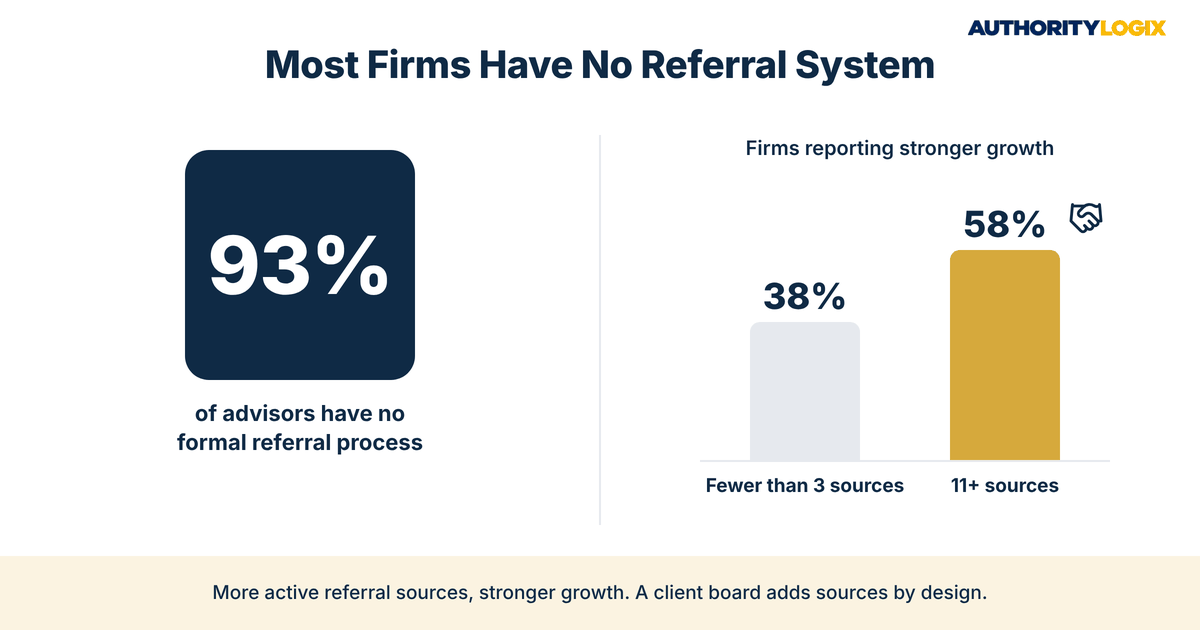
- AssetMark’s 2026 Growth Assessment found 93% of advisors have no formal referral process — a financial services client advisory board gives that process a permanent home.
- Schwab’s 2026 RIA Benchmarking Study found firms with a documented referral plan for existing clients attracted 1.6x more new client assets than firms without one.
- A mortgage client advisory group applies the same principle for lenders, bringing together past borrowers, real estate agents, and repeat investors who explain why they chose you.
- Every session of a financial services client advisory board produces raw material — questions, objections, and client language — that becomes content, offers, and search visibility.
- The board is not a focus group or a sales event. It is infrastructure that turns private client trust into visible market authority.
Table of Contents
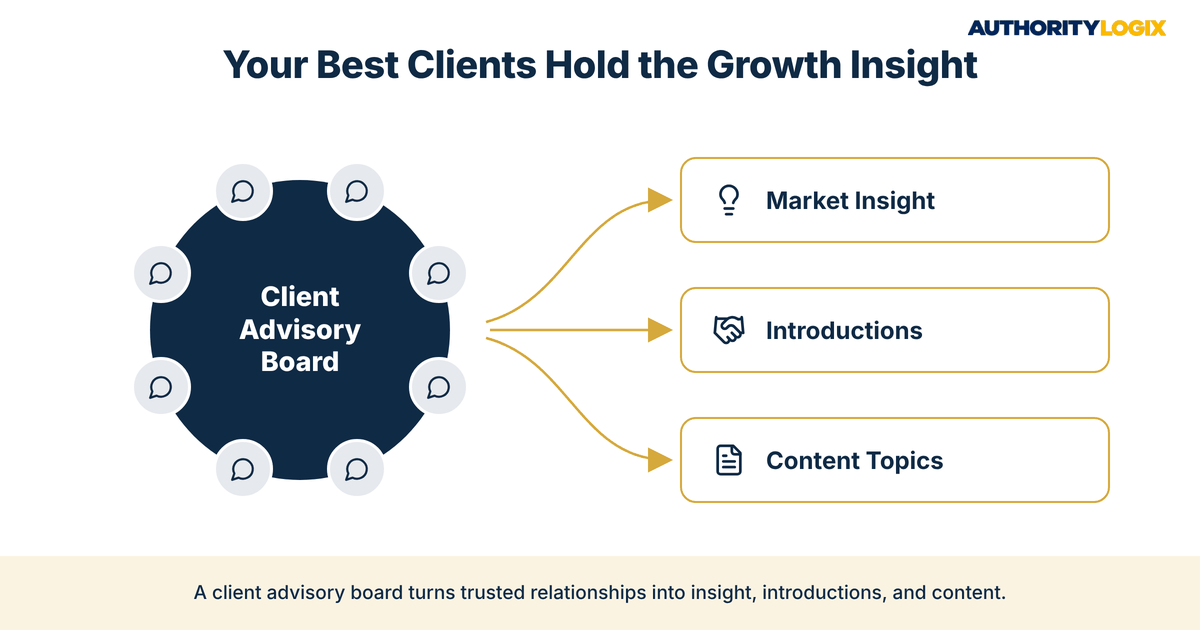
A financial services client advisory board solves a problem most firm owners feel but rarely name: the clients who trust you most know exactly why they chose you, and that knowledge never leaves the room. Without a financial services client advisory board, that insight stays locked inside individual conversations. When growth depends on whoever happens to mention your name, you are living under a referral ceiling that extra effort alone will not lift.
Industry data shows how wide that gap has become. The Ensemble Practice’s 2026 True Ensemble Growth and Profitability study found organic growth from new client relationships was 3.7% in 2025, near the lowest level in its decade of benchmarking. Paithos Research’s RIA Signals Report found median assets grew 14.5% in 2025 while median client counts rose only 2.1%.
What a Financial Services Client Advisory Board Does for Growth
A financial services client advisory board is a standing group of clients who meet two to four times a year to give structured feedback on your service, your communication, and your market. It is not a client appreciation dinner. Members represent the clients you want more of, and they are asked why they stay, what nearly made them leave, and what they tell friends about you.
A financial services client advisory board produces three outputs. First, it tells you what your market needs, in your clients’ words. Second, it creates clients who feel invested in your success and make introductions. Third, it supplies a steady stream of real questions to answer publicly, which is how lasting trust signals are built — a subject the authority guide covers in depth.
Why a Financial Services Client Advisory Board Beats Another Survey
Satisfaction surveys collect scores. A financial services client advisory board collects reasons. A score of nine tells you a client is happy; a conversation tells you the client almost chose a competitor because your website never explained how you handle self-employed borrowers. That insight points to a specific gap you can fix.
The Ficomm Partners and Absolute Engagement 2026 survey of 1,000 advised investors found nearly 74% said it was very important that an advisor understood their specific needs. A financial services client advisory board is the most direct way to learn what those needs sound like before a prospect ever calls. Firms that want to see how that insight connects to every other visibility system can start with the financial services hub, which maps each system a firm needs.
The Financial Services Growth Playbook shows how lenders, advisors, and firms turn client relationships and market insight into authority that keeps building year after year.
Advisor Client Board Referral Strategy: Turning Members Into Introductions
An advisor client board referral strategy works because it changes who feels responsible for your growth. Clients who see their opinion acted on start to think of the firm as partly theirs, and that ownership produces introductions without a direct ask.
The data on formal referral systems is blunt. AssetMark’s 2026 Growth Assessment of 240 advisors, as reported by InvestmentNews, found 93% of advisors have no formal referral process, and nearly 90% do not formally review marketing outcomes. The same research found 58% of firms with 11 or more active referral sources reported stronger growth, compared with 38% of firms with fewer than three.
| Finding | Statistic | Source |
|---|---|---|
| Advisors with no formal referral process | 93% | AssetMark 2026 Growth Assessment |
| Firms reporting stronger growth, 11+ referral sources vs. fewer than three | 58% vs. 38% | AssetMark 2026 Growth Assessment |
| Top-performing firms with a documented client referral plan | 52% | Schwab 2026 RIA Benchmarking Study |
| New client assets, firms with an existing-client referral plan vs. without | 1.6x more | Schwab 2026 RIA Benchmarking Study |
| Advisors who gained clients through unsolicited referrals | 76% | InspereX 2025 Advisor Pulse Outlook |
| Organic growth from new client relationships, 2025 | 3.7% | The Ensemble Practice 2026 |
These numbers describe a profession that depends on referrals but rarely builds anything to produce them. InspereX’s 2025 Advisor Pulse Outlook found 76% of advisors gained new clients through unsolicited referrals, while only 38% gained clients through referrals they solicited from existing clients. A financial services client advisory board closes that gap by giving the firm a structured, repeatable reason to stay in conversation with the clients most inclined to introduce others. It also supports long-term positioning, because members who shape your service tend to describe you as the firm that listens.
How a Financial Services Client Advisory Board Expands Referral Sources
The AssetMark finding about referral source count matters here. Each member of a financial services client advisory board brings a network — partners, attorneys, accountants, and adult children. InspereX found 57% of advisors have no relationship with their clients’ adult children, a referral source most firms never reach. Inviting members to bring a guest to one annual session widens the referral base without a single cold request.
Those topics should not stay in a meeting notebook. Each question a member raises becomes a candidate for a guide, a calculator explanation, or a resource page inside your educational hub, where prospects referred by members can find answers before they ever book a call.
Mortgage Client Advisory Group Formats That Work
A mortgage client advisory group runs on the same logic, adjusted for how lending relationships work. Borrowers work closely with a lender around a closing and then often disappear for years. ICE’s Mortgage Monitor found refinance retention reached 28% in the third quarter of 2025, a three-and-a-half-year high — which still means most borrowers who refinanced did so with someone else. Non-bank servicers retained 35% of those borrowers versus 13% for banks, a gap that shows how much an ongoing relationship matters.
For mortgage companies and DSCR lenders, the strongest groups mix three types of members: past borrowers who closed in the last two years, real estate agents who send purchase business, and repeat investors who finance multiple properties. Agents see where deals stall, investors see where communication falls short, and first-time borrowers see which steps confused them.
The format matters less than consistency. Pick one your members can attend and hold it on schedule for a full year.
- Quarterly roundtable: a 90-minute session with six to ten members and one focused question set.
- Annual in-person session: a longer meeting with a guest invitation, built around next year’s service priorities.
- Virtual panel: short video calls for members spread across a region or state.
- Asynchronous feedback group: a private email thread where members answer one question each month.
- Partner sub-group: a separate group for agents or referral partners whose needs differ from borrowers.
Members should know how their input will be used, and seeing it used publicly is part of the appeal. When a member’s question becomes a post, a short video, or a published answer, the firm’s LinkedIn authority grows from real client concerns instead of generic market commentary. Ask permission before referencing any member, and never share client-specific details.
Compliance shapes every format choice. Lenders under CFPB and NMLS oversight, and advisors under FINRA or SEC rules, should treat a financial services client advisory board as service feedback, not product marketing, and route public content through normal review. Firms that already run documented content systems have an advantage here, because review, approval, and publishing steps are already defined.
Not sure whether your firm is turning client trust into visible authority? The FS Authority Gap Assessment shows where your visibility infrastructure is strong, where it is thin, and what to build first.
Financial Firm Client Community Growth and Content Insights
Financial firm client community growth is the second-order effect of a working board. When members see their feedback change the firm, they talk about it, and the board becomes the core of a wider client community. The Ficomm Partners and Absolute Engagement survey found 15% of investors received a referral and still used at least one other method to evaluate an advisor before reaching out — so many introductions a member makes still end with a search.
That search is where community insight pays off a second time. Members ask the same questions prospects type into Google and AI tools. The same survey found 59% of investors under 45 found their advisor without any referral, so the answers you publish must be strong enough to win prospects on their own, a process the SEO playbook lays out step by step.
What Board Members Reveal That Keyword Tools Cannot
Keyword tools show what people search. Board members show why. A borrower in a mortgage client advisory group might say she nearly chose another lender whose site explained bank-statement loans in plain English. Those reasons are the brief for your next piece of finance content, written in your clients’ language rather than industry shorthand.
This is how a financial services client advisory board shapes visibility without anyone on the board writing a word. The firm supplies the expertise, members supply the questions, and the published answers reach prospects who will never attend a meeting.

Turning Financial Services Client Advisory Board Insights Into Content and Offers
A financial services client advisory board only produces growth when its insight leaves the meeting room. The simplest system is a three-step loop: capture every question and objection word for word, sort them by how often they appear, and assign each recurring theme to a specific asset with a publish date. The loop runs after every session, so the board and the publishing schedule move together.
| Board Input | Content Asset | Growth Purpose |
|---|---|---|
| Repeated “how does this work” questions | Educational guide or FAQ page | Answers prospects before they call |
| Objections members nearly acted on | Myth-versus-reality or comparison article | Removes the doubt that stalls decisions |
| Language members use to describe you | Website headlines and service page copy | Makes the firm sound like its clients |
| Suggestions for new services or tools | Calculator, checklist, or offer page | Gives new prospects a reason to start a conversation |
| Questions from members’ guests | LinkedIn posts and short video answers | Reaches the networks members belong to |
That table is a working version of the content system AuthorityLogix uses: every input has a destination, and every asset has a reason to exist. Run quarterly, a financial services client advisory board replaces monthly topic guessing with a pipeline fed by clients who already trust you.
Publishing is half the job. Board-sourced content should reach the outlets prospects check through structured authority distribution, so the answers carry third-party credibility. BKDSCR.com shows what this looks like in practice: 18 pillar pages, 7 interactive investor tools, and 48 blog posts built around real investor questions, ranking for competitive DSCR and NYC real estate keywords with zero paid ads.
What Firms Get Wrong About a Financial Services Client Advisory Board
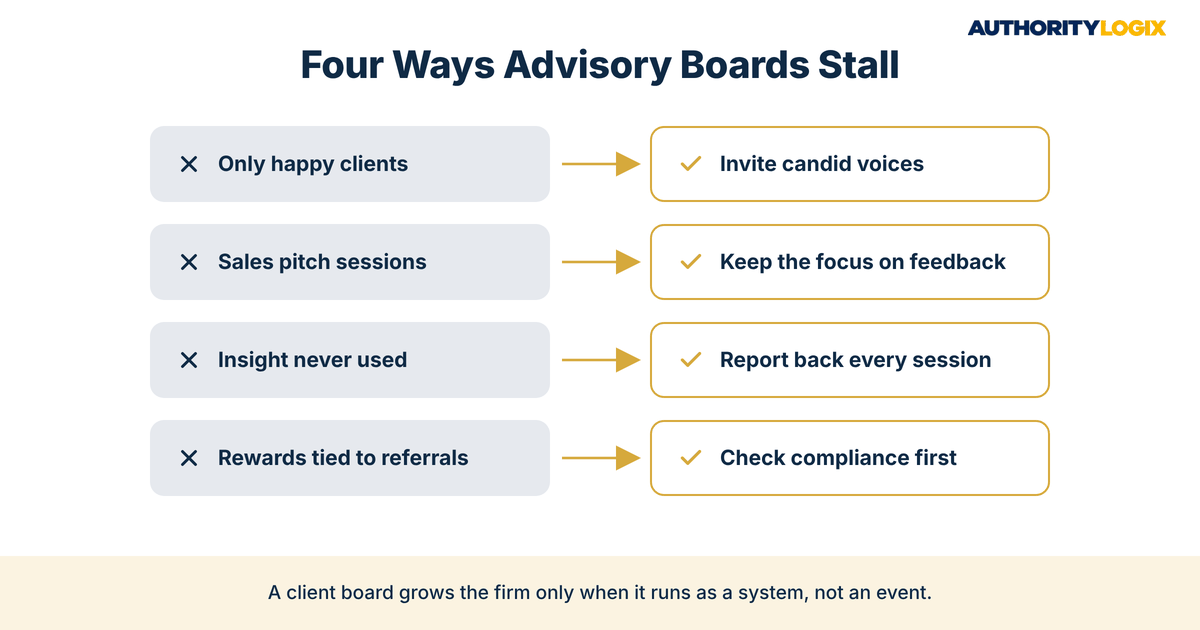
A financial services client advisory board usually fails for predictable reasons, and none involve the clients. The firm treats the board as an event rather than a system.
Mistake: Inviting only the happiest clients
A financial services client advisory board stacked with enthusiasts tells you what you already believe. Include one or two members who had a difficult experience and stayed anyway, because they know exactly where your process breaks.
Mistake: Turning sessions into sales pitches
The moment a meeting turns into a product presentation, members stop giving honest feedback. Keep the agenda on their experience, and let introductions happen naturally afterward.
Mistake: Collecting insight and never acting on it
Members notice when nothing changes. Close every financial services client advisory board session by reporting what the firm did with the last round of feedback, and connect each insight to your lead generation infrastructure so a member’s question becomes a page, an offer, or a follow-up sequence that brings in new prospects.
Question: How many members should a financial services client advisory board have?
Eight to twelve members is a workable range for most firms — small enough for every voice to be heard and large enough to show patterns. Identifying which client segments a firm wants more of is part of what we do at the start of every engagement, and that same map tells you who belongs on the board.
Question: Should board members be compensated?
Common ways to thank members include a meal, a small honorarium, or a charitable donation in their name, but check with your compliance team before offering anything of value connected to referrals. Keeping any thank-you tied to feedback rather than introductions protects both the member and the firm, and it reflects how we build client-facing systems, with compliance review placed first.
Thinking about a client advisory board? We’ll help you structure it and turn the feedback into content that wins new clients.
Your Best Clients Already Know What Your Market Needs
The honest assessment is that a financial services client advisory board will not fix a firm with weak service, and it will not replace the infrastructure that turns insight into visibility. What it does is give you the most reliable input a firm can have: the reasons real clients chose you, in their own words. Pair that input with a lead system that captures prospects who arrive through referrals and search, and the board stops being a nice gesture and becomes part of how the firm grows.
Your referral network is a ceiling, not a foundation. The board does not remove referrals from the picture; it turns them into a structured source that feeds content, distribution, and search visibility at the same time. If you want to see the proof behind that approach before deciding anything, why it works walks through the build behind it.
Most financial professionals already have clients who would gladly help them grow; they have never been asked in a structured way. Firms that build a financial services client advisory board and publish what they learn will be easier to find and trust a year from now. When you are ready to build that infrastructure, work with us is the place to start.