


Key Takeaways
- Financial services long-term positioning is not a marketing campaign — it is the accumulated result of published expertise, consistent distribution, and systematically documented credibility that builds over years, not quarters. High-ROI B2B marketers are more likely to use thought leadership across all funnel stages rather than limit it to acquisition, according to the TopRank Marketing and Ascend2 State of B2B Thought Leadership in 2026 report.
- 97% of B2B marketers say thought leadership is critical to full-funnel success, according to the same 2026 research. Yet only 43% extend it beyond acquisition to engage and retain customers post-sale. The positioning gap — between firms that publish expertise as a comprehensive strategy and those that treat it as a lead generation tactic — is visible in renewal rates, referral rates, and competitive win rates for firms competing for the same client segment.
- 32% of professionals now discover thought leadership through GenAI tools, according to TopRank Marketing and Ascend2’s 2026 research. Financial services firms that have built structured, attributed, scenario-specific content libraries are the ones appearing in AI-generated answers when prospects search for expertise on specific financial planning scenarios or mortgage programs. The AI citation is not a random event — it is the result of a content infrastructure that meets the topical depth and authorship attribution standards that AI platforms apply when selecting sources.
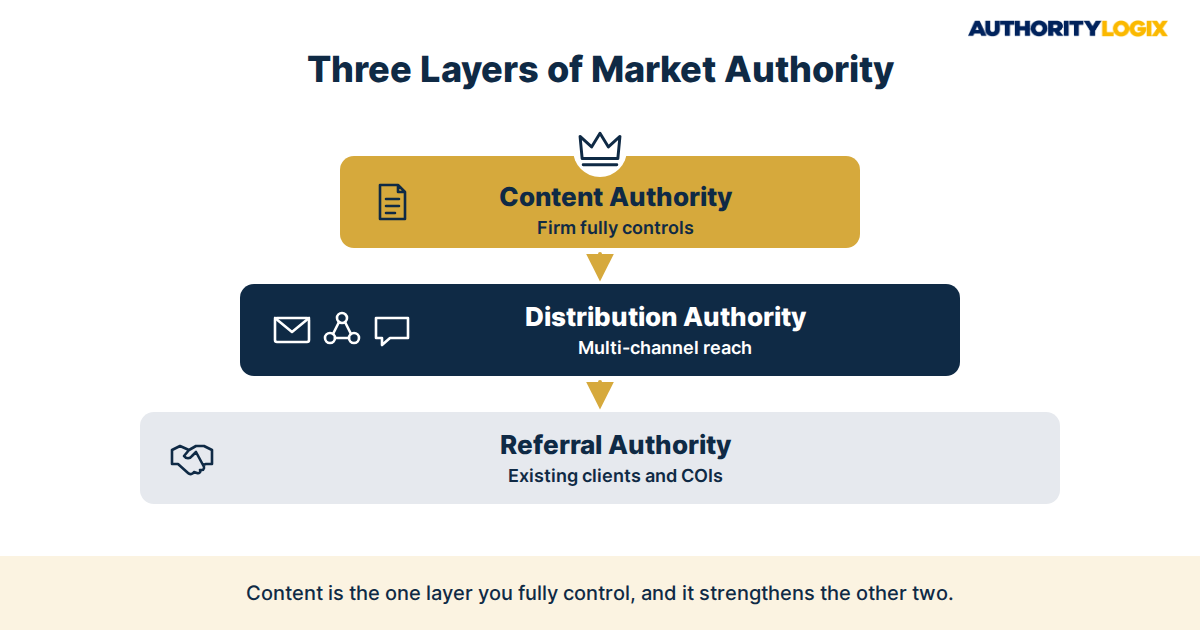
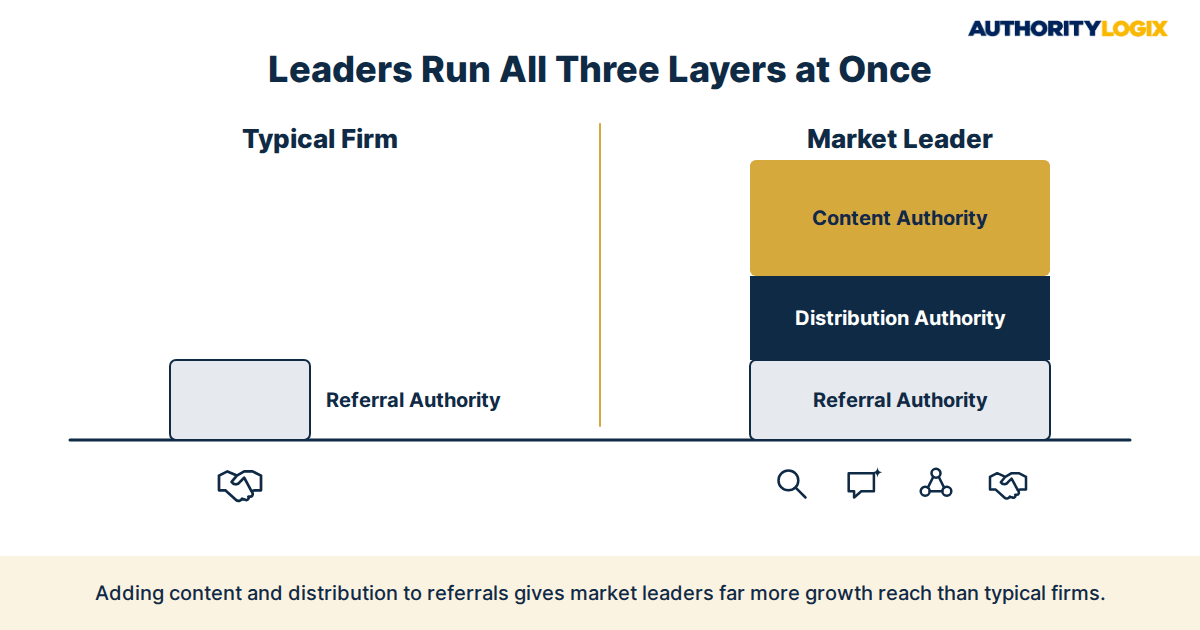
- Long-term positioning in financial services is built through three compounding layers: content authority (what the firm has published), distribution authority (who sees it and how consistently), and referral authority (what the firm’s existing clients and COIs say about its expertise). Most financial services firms have the third layer but have built no infrastructure for the first two — which means their positioning is entirely dependent on what their existing clients say, to people those clients happen to know.
- The firms that will dominate financial services market share in 2028 and 2029 are the ones building content and distribution infrastructure in 2026 — not because market leadership requires years of effort, but because the compounding advantage of an early build cannot be shortcut by a competitor who starts 18 or 24 months later.
- Positioning is not about being the biggest — it is about being the most credible source on the specific topics that matter to the clients a firm is trying to attract. A DSCR lender that becomes the definitive resource on DSCR loan qualification for NYC outer-borough investors does not need to compete with national lenders on brand awareness — it dominates the specific search and AI-discovery pathway that reaches its target borrower.
Table of Contents
Financial services long-term positioning is the specific strategic outcome that separates the financial firms whose names surface automatically when a prospect is evaluating a decision. Without the firm having made any contact with that prospect yet — from the firms that are never considered until someone is specifically referred. The difference between these two categories of firm is not brand budget. It is not the number of years in operation. It is not the depth of the existing client relationships. It is the presence or absence of a published body of expertise that exists in the world.
Online, cited in AI platforms, distributed through LinkedIn, visible in search results — that the prospect encounters before they have spoken to anyone at the firm. The SEO playbook for financial services firms covers the mechanics of building that presence; this article covers the strategic framework. What positioning actually means for financial services firms, what the three layers of compounding positioning authority are. And why the firms building those layers now are structurally separating from those that are not.
The data on what long-term positioning through thought leadership produces for financial services and B2B professional service firms is now well-documented. Top-performing B2B firms that use thought leadership across all funnel stages — not just for acquisition, but for client engagement and retention. High-ROI marketers are more likely to use thought leadership across every funnel stage, according to the TopRank Marketing and Ascend2 State of B2B Thought Leadership in 2026 report.
And 32% of professionals now discover thought leadership through GenAI tools, according to the same TopRank Marketing and Ascend2 research. The firms that have built structured, attributed, scenario-specific content libraries are appearing in AI-generated answers. The firms that haven’t are invisible — not just in search. But in the new AI-mediated discovery layer that is becoming a primary channel for how financial services prospects find and evaluate expertise.
The authority guide covers the foundational trust signals that long-term positioning requires. This article covers the strategic framework that financial services market leaders use to build that positioning over time — and why it is a compounding asset, not a marketing campaign, that separates the firms at the top of the market from the rest.
The complete long-term positioning framework — authority infrastructure, distribution strategy, and compounding growth system — is in the Financial Services Growth Playbook.
What Positioning Actually Is — and What Most Financial Services Firms Mistake It For
Most financial services firms confuse positioning with branding. A new logo, a refined tagline, a redesigned website, and a LinkedIn banner that describes the firm as “experts in wealth management” or “specialists in DSCR lending” are branding assets. They tell the market what the firm claims about itself. Positioning is what the market believes about the firm based on the expertise it has demonstrated, publicly, over time. The FS industry hub covers the economic cost of digital invisibility.
The deeper cost of branding without positioning is that the firm’s self-description competes with zero demonstrated evidence, while a competitor who has published 30 scenario-specific articles on the same topic has demonstrated evidence that the market can evaluate independently. No prospect chooses between two taglines. They choose between two demonstrations of expertise — and the firm that has published the demonstration wins.
The distinction between branding and positioning is the distinction between what a firm says it is and what the market believes it is — based on what the market has seen the firm do, publicly. The credibility gap between financial services firms with published expertise and those with only self-descriptions is the gap that long-term positioning closes — not by asserting expertise, but by demonstrating it in public, on a consistent basis, over time. Positioning is built through publication, attribution, distribution, and consistency. It cannot be purchased. It can only be earned.

The Three Layers of Financial Services Long-Term Positioning
Financial services long-term positioning is built through three compounding layers. Each layer amplifies the ones beneath it. The bottom layer — referral authority — is already present in most established financial services firms: existing clients refer the firm to people they know, and that referral carries implicit credibility. Most firms build no additional layers. As the search statistics on financial clients suggest, the referral authority layer reaches only people within the social and professional networks of existing clients. Layers two and three — distribution authority and content authority — are what extend the firm’s positioning to prospects who are not in those networks.
Layer 1 of Financial Services Long-Term Positioning: Content Authority
Content authority is the body of published, attributed, scenario-specific expertise that the firm has produced. Pillar pages, cluster articles, interactive tools, and research-based guides all exist publicly, accessible to any prospect who searches for the topic. It is the only layer of positioning that the firm fully controls and builds from scratch. The content systems that build this layer for financial services firms organize it by client scenario rather than by service category.
Because the positioning value of content authority is specific. The firm that has written the most comprehensive, most credentialed, most scenario-accurate content on DSCR loan qualification for LLC-titled short-term rentals is the positioned expert on that topic. Not because they claim to be, but because the evidence is public.
Layer 2 — Distribution Authority: Amplifying the Foundation
Distribution authority is the consistent, systematic reach of the firm’s published expertise to its target audience. Through LinkedIn posts linking to cluster articles, email broadcasts to the subscriber list, syndication placing articles on platforms the target audience already reads. And AI citation eligibility built through the topical depth and authorship attribution of the content library. The E-E-A-T guide covers the specific trust signals that make financial services content AI-citation-eligible.
Named authorship, credential attribution, cited external sources, scenario specificity — which are the same signals that produce distribution authority through AI. A firm with 40 published articles and consistent distribution is reaching its target audience through three channels simultaneously: Google organic search, LinkedIn network, and AI discovery. That three-channel reach is what separates positioned firms from invisible ones.
Layer 3 — Referral Authority: Amplified by the Foundation
Referral authority — the implicit credibility that comes from being referred by a trusted source. Is amplified when the prospect who receives the referral can immediately verify the firm’s expertise through a published body of work. A prospect who receives a referral to a firm with no published content must evaluate the firm based solely on the referral and whatever the firm presents in a first meeting. A prospect who receives a referral to a firm with 30 published scenario articles on the specific planning problem they face can evaluate the firm’s expertise before the first meeting — and arrives at that meeting already convinced.
The educational hub architecture that organizes the content layer by client scenario is what makes this referral amplification work. When the referring client says “they know a lot about DSCR for LLC-titled properties,” the prospect can immediately find the evidence. And that evidence is what converts the referral from a warm introduction to a pre-sold first meeting.
How Financial Services Market Leaders Build Content Authority
The content authority layer for financial services market leaders is built through the pillar page and topic cluster architecture. The same architecture described in the pillar strategy resource and demonstrated at production scale by BKDSCR.com. A financial services firm that is building for long-term market leadership defines its 3–5 topic clusters based on the client scenarios it serves best, publishes a comprehensive pillar page for each cluster.
And publishes 6–10 scenario-specific cluster articles beneath each pillar on a consistent publishing cadence. At month 18–24, this content library represents a published positioning statement that cannot be replicated quickly. 50–80 articles, all internally linked, all credentialed, all E-E-A-T compliant, all appearing in Google organic results and AI discovery pathways for queries relevant to the firm’s target client.
The market leader positioning advantage of content authority is not primarily about traffic volume. It is about who finds the firm and what they believe when they find it. A prospect who finds a financial advisory firm’s pillar article on sequence-of-returns risk management for business owners — and reads it thoroughly, downloads the scenario guide, and receives five follow-up emails — has formed a detailed impression of that firm’s expertise before any human-to-human contact. That impression is the positioning. The authority distribution layer that amplifies this content — LinkedIn, email, AI — is what extends that impression-forming encounter to the full addressable audience, not just the organic search users who happen to search the right query.
| Positioning Layer | What It Builds | Firm Control | Timeline |
|---|---|---|---|
| Content Authority | Published body of scenario-specific expertise; Google rankings; AI citation eligibility | High — the firm builds and owns the asset | Visible impact: 9–12 months. Primary revenue: 18 months. Dominant: 24–36 months. |
| Distribution Authority | Consistent multi-channel reach to target audience; LinkedIn following; email subscriber base; AI discovery | Medium-high — requires content to distribute; audience builds with consistency | LinkedIn authority: 12–18 months consistent posting. Email list: ongoing build. AI citations: 12–18 months. |
| Referral Authority | Implicit credibility from referred clients; amplified when backed by published content authority | Low without content layer; medium-high when content layer validates and amplifies referrals | Already present in established firms; amplification begins immediately when content layer is added |

Not sure where your financial services firm’s current positioning stands? The FS Authority Gap Assessment identifies the gaps and maps the authority build sequence.
The AI Discovery Layer That Is Reshaping Financial Services Positioning
The AI discovery dimension of long-term positioning is the newest and fastest-growing layer of the positioning stack. 32% of professionals now discover thought leadership through GenAI tools. A number that was near zero three years ago and is growing rapidly. When a high-net-worth prospect asks an AI platform “which financial advisors specialize in retirement income planning for business owners in the Northeast” or “what DSCR lenders publish educational content specifically for NYC real estate investors”.
The AI’s answer is drawn from the content it has indexed, cited, and attributed to specific firms. The AI search article covers the specific technical requirements for AI citation eligibility in financial services content. Named authorship, credential attribution, topical depth, scenario specificity — all of which are the same requirements that build the content authority layer of the positioning stack.
The AI discovery layer creates a new form of positioning leverage: a financial services firm that has been cited by AI platforms as an authoritative source on its target topics benefits from the AI’s existing trust infrastructure — the prospect who receives an AI citation of the firm’s content arrives with a pre-existing credibility signal that no cold introduction can replicate. The lead generation infrastructure that captures and converts this AI-discovered traffic — lead magnets, nurture sequences, calendar booking — converts the AI citation into a pipeline that compounds with every additional article the firm publishes and every additional AI platform that indexes its content library.
What Most Firms Get Wrong About Financial Services Long-Term Positioning
They treat positioning as a one-time project
A positioning workshop, a brand refresh, or a messaging audit produces a document that describes what the firm wants to be known for. Long-term positioning is not a document — it is an accumulated body of public evidence that the firm actually is what it claims. The positioning document says “DSCR lending specialists for NYC investors.” The positioning stack says “here are 40 articles, a DSCR calculator, an investor guide.
And 18 pillar pages that demonstrate DSCR lending expertise for NYC investors.” Prospects evaluate the evidence, not the document. The organic leads framework makes the business case. Organic leads generated through demonstrated expertise close at a far higher rate than purchased leads. Because the demonstrated expertise has pre-sold the prospect on the firm’s credibility before first contact.
They build the wrong audience
A financial services firm publishing general personal finance content, broad market updates, and industry news aggregation builds an audience of general readers — not the specific, high-intent prospects long-term positioning is designed to attract. Positioning authority is scenario-specific: the DSCR lender that becomes the definitive resource on DSCR loan qualification for LLC-titled short-term rental properties in secondary markets has positioned itself for the exact borrower searching that exact query — not the general audience reading about real estate investing. The authority marketing framework for DSCR lenders demonstrates this: scenario specificity is what produces both the organic ranking and the AI citation, because both Google and AI platforms reward content that answers the specific question the prospect is asking.
They stop before the compounding begins
The 97% of B2B marketers who say thought leadership is critical to full-funnel success are aware of its potential. The 43% who actually extend it beyond acquisition are the ones who have built and maintained it long enough to see the compounding effect. The content infrastructure article covers the specific timeline: meaningful organic traffic in months 9–12, primary revenue channel in month 18, dominant positioning advantage by month 24.
The financial services firms that stop at month 6 with 10 articles published have not built positioning — they have produced a first draft. The firms that reach month 24 with 60 published articles have built the structural advantage that no burst of later content production can quickly close.
Ready to build the long-term positioning that puts your firm’s name in front of prospects before they’re referred?
The Financial Services Long-Term Positioning Leaders Separating From the Market Right Now
The financial services firms building structural market separation right now are not the firms with the most assets under management or the most loan volume. They are the firms that started building their content authority layer 12–24 months ago and have maintained the publishing discipline to reach the compounding phase. The referral ceiling article covers the structural constraint this creates for advisory firms — the growth rate of a referral-only firm is determined by the referral rate of its existing clients, a rate the firm cannot control. Both the referral ceiling and the compliance concern dissolve when the structural growth data is applied to the specific firm’s situation.
The compliance guide covers the regulatory framework that makes the content layer publishable within FINRA and CFPB requirements. The most common objection — “compliance won’t let us publish” — dissolves once the educational content standard is applied correctly.
BKDSCR.com is AuthorityLogix’s proof-of-concept demonstration of what the three-layer positioning stack looks like at production scale in a live lending market. 18 pillar pages organized into 6 topic clusters, each with associated scenario cluster articles, all bidirectionally linked, all E-E-A-T compliant, all appearing in Google organic results and AI discovery pathways for relevant queries. The content authority layer is live. The distribution authority layer — LinkedIn posts, email broadcasts, syndication — amplifies it consistently.
The referral authority layer — borrowers and brokers who refer based on the expertise they have seen demonstrated online — is amplified by the first two layers. That is the full three-layer positioning stack operating simultaneously, producing compounding market authority that the firms without any layer of content authority cannot match on the specific topics the platform covers. When you’re ready to build your positioning stack, work with us is the starting point.