

Key Takeaways
- A financial services competitive authority analysis measures what the market can actually see about you and your closest competitors, from search positions to reviews, before you spend a dollar on a build.
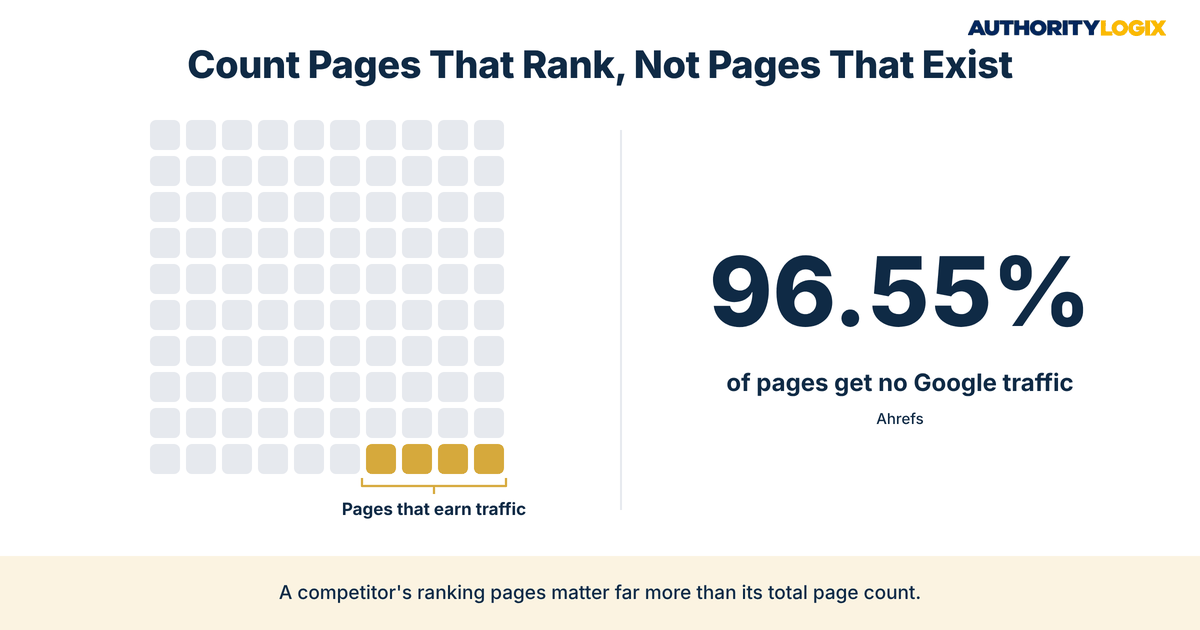
- Ahrefs found that 96.55% of pages in its index get zero traffic from Google, so counting a competitor’s ranking pages tells you far more than counting its total pages.
- Backlinko’s click-through research shows the top three organic results take 54.4% of all clicks, which makes those three positions the first benchmark in any financial services competitive authority analysis.
- Wealthtender’s 2025 study found 96% of high-income households would still research an advisor online after a referral, so buyers compare you to competitors whether you track them or not.
- Lender authority benchmarking works best against one clear market leader, scored on the same six dimensions every quarter.
- A financial services competitive authority analysis only earns its keep when it ends in a sequenced build plan with an owner and a review date.
Table of Contents
Why a Financial Services Competitive Authority Analysis Comes First
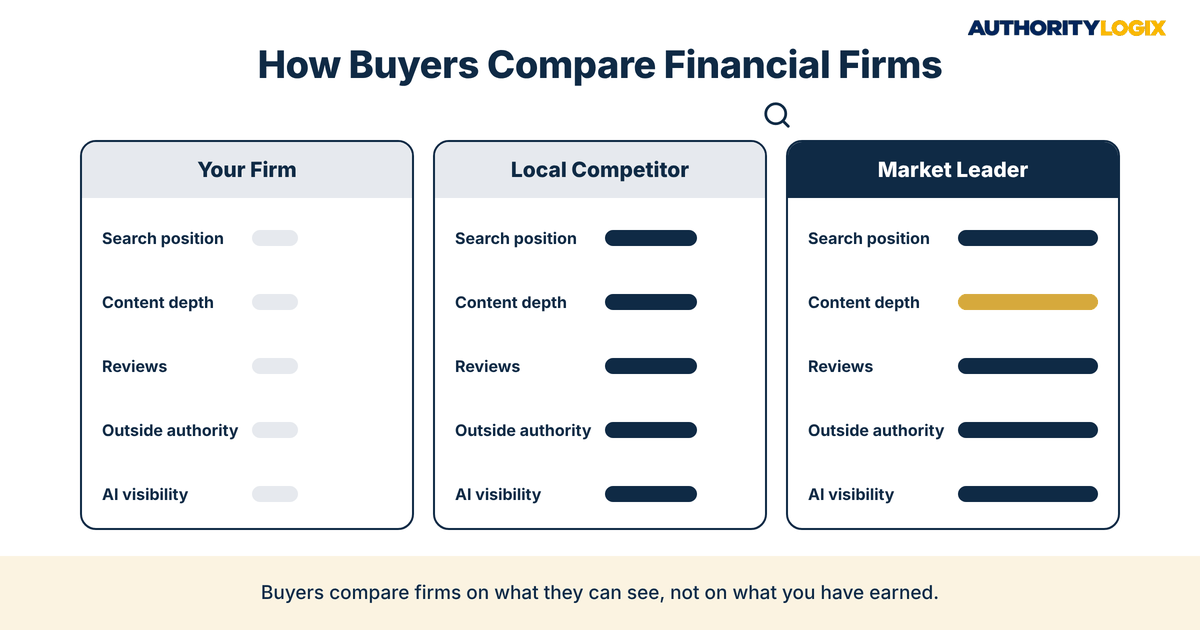
A financial services competitive authority analysis answers a question most firm owners never ask directly: when a borrower or client compares you to the three firms down the street, what do they actually find? You have the years and the closed loans. The market sees none of it unless it is published somewhere a buyer can check. That gap between earned credibility and visible credibility is what we call credible but invisible, and guessing rarely closes it.
Most firms skip this step and jump to tactics: a new website, a blog push, or ads. Without a benchmark, nobody knows whether those tactics close the gap or add volume in a lane the leader already owns. A financial services competitive authority analysis shows where a durable competitive moat can be built and where competing head-on would waste a year of effort.
A financial services competitive authority analysis also changes what you measure. Rankings matter, but so do reviews, citations, bylines, and the depth of educational content behind each page, which is the trust layer covered in our authority guide for financial firms. Google treats lending and financial planning as Your Money or Your Life topics, so visible proof of expertise carries more weight here than in most industries.
What a Financial Services Competitive Authority Analysis Measures
- Search position: who holds the top three results for your core searches
- Content depth: ranking educational pages per topic
- Review strength: review count, rating, recency, and reply rate
- Outside authority: linking domains, media mentions, bylines, and directory citations
- AI visibility: whether the firm is cited in AI-generated answers for core questions
- Conversion paths: tools and guides that turn visits into inquiries
For mortgage companies, DSCR lenders, and advisory firms, the competitors that matter are rarely national brands. They are the two or three local and niche players who show up every time your ideal client searches. Mapping them is where every engagement on our services hub begins, because the right plan depends on who you are actually up against.
A financial services competitive authority analysis is the diagnostic step inside a larger growth plan. The Financial Services Growth Playbook shows how lenders, advisors, and firms turn that diagnosis into authority that keeps building.
Mortgage Company Competitor Content Audit: What to Collect
A mortgage company competitor content audit is the first stage of a financial services competitive authority analysis, and it starts with a short list. Pick the three to five firms that appear most often when you search the loan programs you want to be known for. Search from a private browser window in your target market, and record who appears in the map pack, the top organic results, and any AI-generated answer at the top of the page.
That last item is no longer optional. Semrush research tracking more than 10 million keywords found AI Overviews appeared on 6.49% of queries in January 2025 and on 24.61% by July, before settling near 15.69% in November. A competitor cited in that answer box is seen by your buyer before any organic result is.
| What to Collect | Where to Find It | What It Tells You |
|---|---|---|
| Top-three positions for 10 to 20 core searches | Private browser searches from your market | Who owns the clicks buyers actually make |
| Ranking educational pages by topic | Competitor navigation, sitemap, and an SEO tool | How deep their topical coverage really runs |
| Review count, rating, and newest review date | Google Business Profile and industry directories | How current their trust signals look |
| Linking domains and media mentions | An SEO tool such as Semrush or Ahrefs | How much outside authority backs their pages |
| Citations in AI answers | AI Overviews and AI assistants, asked your core questions | Who the machines already trust |
| Lead capture tools | Calculators, guides, and forms on their site | How they turn a visit into an inquiry |
Count pages that rank, not pages that exist. Ahrefs found that 96.55% of the pages in its index receive no traffic from Google at all, so a competitor with 400 blog posts may have only a few dozen doing real work. Our search statistics breakdown shows why the borrower journey rewards the few pages that hold top positions for research-stage questions.
Then look at how those ranking pages connect. A competitor whose rate pages, program guides, and FAQs link to one another has built something closer to an educational hub than a blog. That structure is harder to copy than any single page, and it is often the real reason a smaller lender outranks a bigger one. Note it in your mortgage company competitor content audit even when the page count looks modest.
Advisor Competitive Analysis Marketing Beyond Rankings
Advisor competitive analysis marketing has to look past the search results page, because advisory clients rarely hire from a single click. Wealthtender’s 2025 study of households earning more than $100,000 found 96% would still research an advisor online even after a strong recommendation, 72% would visit the advisor’s website, and 97% plan to interview multiple advisors. Your prospects are already running their own comparison, and a financial services competitive authority analysis makes it visible to you.
What they compare is trust. The same Wealthtender research found 83% want to check an advisor’s reputation through online reviews and awards, while only 36.4% value testimonials on the advisor’s own website. Score each competitor on third-party proof: independent reviews, credentials on author pages, published bylines, and the E-E-A-T signals Google looks for on financial content.
Review recency deserves its own column. BrightLocal’s 2026 Local Consumer Review Survey found 74% of consumers look for reviews written within the last three months, and 80% are more likely to use a business that replies to all of its reviews. A competitor with 200 stale reviews can look weaker than a firm with 60 recent, answered ones. Registered advisors should note how competitors handle disclosures too, and route any review program through compliance.
Finally, look at publishing rhythm. Does the competitor publish one market commentary a quarter, or a steady series of planning guides tied to client questions? Firms that run on documented content systems tend to publish in connected series, and those series collect rankings and reviews together. Firms that publish on impulse leave gaps of months between posts, and those gaps are your openings.
Not sure where your firm stands against the competitors your buyers compare you to? The FS Authority Gap Assessment scores your visibility, trust signals, and content depth so you know what to build first.
Lender Authority Benchmarking Against the Market Leader
Lender authority benchmarking works when you pick one firm to measure against: the competitor that wins most often in the searches you care about. Averaging five competitors produces a blurry target. Benchmarking against the leader produces a specific gap you can close, one dimension at a time.
Position comes first in a financial services competitive authority analysis because clicks concentrate at the top. Backlinko’s analysis of organic click-through rates found the first result earns a 27.6% click-through rate, the top three results take 54.4% of all clicks, and only 0.63% of searchers click anything on page two. If the leader holds positions one through three for your core terms, every month you sit on page two is a month of inquiries you never see.
The Financial Services Competitive Authority Analysis Scorecard
| Dimension | What to Measure | Why It Matters | Review Cycle |
|---|---|---|---|
| Search position | Top-three rankings across 20 core searches | Top three results take 54.4% of clicks (Backlinko) | Monthly |
| Content depth | Ranking educational pages per topic | 96.55% of pages earn no Google traffic (Ahrefs) | Quarterly |
| Review strength | Count, rating, recency, and reply rate | 74% want reviews from the last three months (BrightLocal) | Monthly |
| Outside authority | Linking domains, media mentions, and bylines | Third-party proof outweighs self-published claims | Quarterly |
| AI visibility | Citations in AI answers for core questions | AI Overviews reached 24.61% of queries in July 2025 (Semrush) | Quarterly |
| Conversion paths | Tools, guides, and assessments per key page | Visits only matter when they become inquiries | Quarterly |
Score each dimension from one to five for your firm and for the leader, then rank the gaps by size and by how fast they can close. Review gaps close in weeks; content depth gaps take quarters. The search side of that sequence is mapped in detail in our SEO playbook for lenders and advisors, including which pages to build first.
Watch for the gap that sits underneath the others. In most financial services competitive authority analysis work, the leader’s edge traces back to a body of plain-language finance content written for the buyer’s actual questions, such as DSCR coverage ratios, bank statement qualification, or retirement income planning. Rankings, links, and AI citations tend to follow that content. Chasing them without it rarely holds.

Turning a Financial Services Competitive Authority Analysis Into a Build Plan
A financial services competitive authority analysis that ends in a slide deck changes nothing. The output should be a build plan: the three to five gaps you will close first, the order you will close them in, who owns each one, and the date you will re-score the market. Sequence matters more than speed.
Start with the content gaps that block everything else. If the leader owns twelve ranking guides on DSCR lending and you own two, no amount of link building fixes that imbalance. A content system maps each missing topic to a page, each page to a search, and each search to a stage in the buyer’s decision. You publish against the gap list rather than against a calendar.
BKDSCR.com, the AuthorityLogix proof-of-concept in the NYC outer-borough DSCR niche, was built against exactly this kind of gap list. It carries 18 pillar pages, 7 interactive investor tools, and 48 SEO-optimized blog posts, built in under 18 months with zero paid ads. Each piece answers a question local investors were searching that competing lenders had left thin.
Distribution comes next. Once the pages exist, they need outside signals such as syndicated articles, earned mentions, and consistent directory listings, so search engines and AI tools treat them as credible. That outward layer is what authority distribution covers, and it is where firms with strong content but weak visibility usually find their fastest gains.
How Often to Repeat a Financial Services Competitive Authority Analysis
Re-run the full financial services competitive authority analysis every quarter, and repeat the review and ranking checks monthly. A competitor that launched a resource library six months ago can climb into the top three of a niche market. Quarterly re-scoring shows whether the gaps you targeted are actually closing.
Financial Services Competitive Authority Analysis Mistakes That Lead to the Wrong Plan
Most failed plans trace back to a flawed financial services competitive authority analysis, not poor execution. The firm measured the wrong competitor, counted the wrong metric, or trusted a one-time snapshot. The mistakes and questions below come up before almost every commitment to lead generation infrastructure.
Mistake: Benchmarking against national brands
A regional DSCR lender comparing itself to a national online lender or a wirehouse will always lose the comparison and learn nothing useful. National brands win on budget, not local relevance. Benchmark against the firms that actually appear in your market’s searches, because those are the firms your buyers are choosing between.
Mistake: Copying the leader instead of finding the gap
The goal is not to rebuild the leader’s website with your logo on it. The goal is to find the topics, questions, and trust signals the leader has left thin, then own them outright. That gap-first approach is what we do at the start of every engagement, because imitation only ever earns second place.
Question: How many competitors should a financial services competitive authority analysis include?
Three to five is the working range. Fewer than three tells you little, and more than five buries the signal. One should be the clear market leader.
Question: Can I run a financial services competitive authority analysis myself?
Yes, at a basic level. A private browser, a spreadsheet, and a trial of an SEO tool will cover search positions, page counts, and reviews. What most firm owners lack is the time to repeat it every quarter and the pattern recognition to turn findings into a sequenced plan, which is why how we build starts with a scored analysis rather than a content order.
Question: Does a financial services competitive authority analysis replace a compliance review?
No. It is a marketing and visibility exercise only. Any content, review program, or claim it leads to still needs to clear your normal compliance process, whether that sits with your licensed leadership, your broker-dealer, or your chief compliance officer.

Want to know exactly where competitors out-rank your firm? We’ll run the analysis and turn the gaps into your build order.
Financial Services Competitive Authority Analysis: Know the Gap Before You Build
Every firm owner can name their top competitors. Few can say exactly why those competitors win the searches, the reviews, and the AI answers that shape a buyer’s shortlist. A financial services competitive authority analysis turns that hunch into a measured gap, and the gap becomes the brief for your content, your distribution, and eventually your lead system.
This is not guesswork. The six dimensions of a financial services competitive authority analysis are the same ones behind the BKDSCR.com build, and they explain why it works without paid ads. Authority compounds when it is built against a known gap rather than a hunch.
The honest assessment is that most lenders and advisors are not losing to better firms. They are losing to firms that measured the market first and built against what they found. If you want that measurement done properly and turned into a build plan, the conversation starts at work with us. If you would rather run it yourself, start with the scorecard above and re-score every quarter.