


Key Takeaways
- Financial services competitive moat authority is not a marketing tactic — it is a structural business asset that protects market position the way a patent, a network effect, or a switching cost protects a technology company. Companies with strong competitive moats tend to command higher market value, according to business strategy analyses.
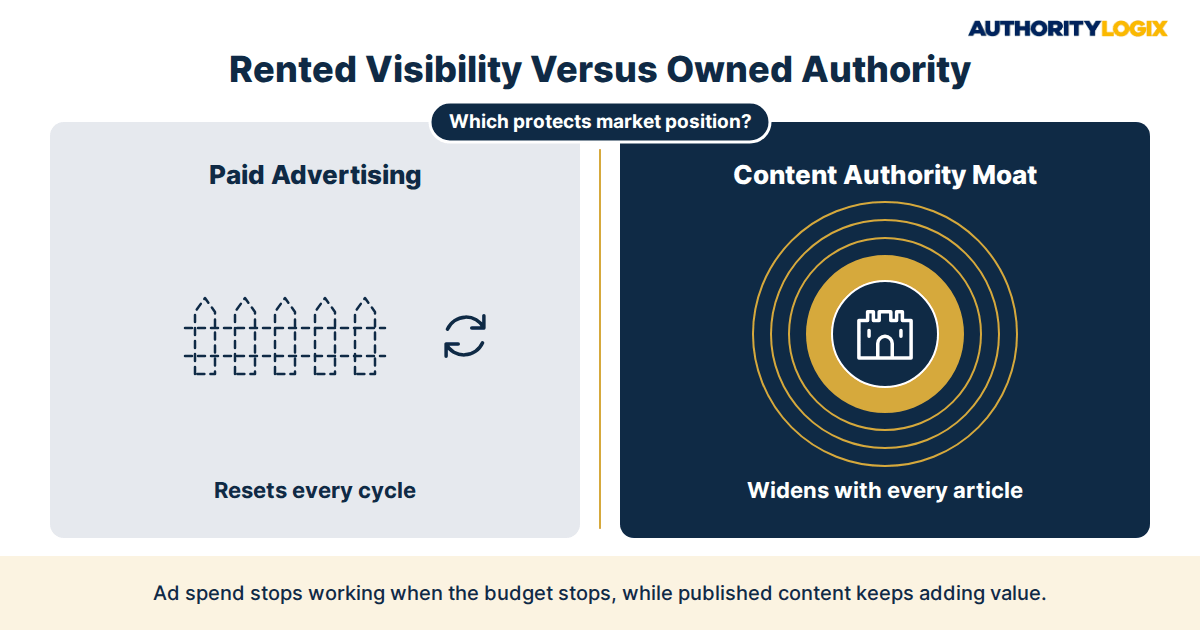
- A paid advertising campaign is not a moat. It produces leads while the budget is active and produces nothing the day the budget stops. A content authority moat — a comprehensive, topically deep, credential-attributed body of published expertise — continues producing organic traffic, leads, and market visibility whether or not the firm spends another dollar on marketing that month.
- Cluster maturity creates a meaningful ranking advantage over competitors. A six-month head start in building content authority does not create a six-month lead — it creates a structural gap that widens every week the competitor has not started, because the accumulated topical authority compounds while the non-builder’s position stays flat.
- The defensibility of a financial services content moat comes from what is genuinely difficult to replicate: named authorship with verified credentials, years of consistent scenario-specific publishing, the accumulated internal linking structure of a mature topic cluster, and the trust signals that Google and AI platforms have already validated. A competitor cannot purchase this. They can only build it — from scratch, starting today, while the moat owner’s advantage continues to widen.
- AI platforms are compressing many traditional competitive advantages — features, pricing, even certain types of technical differentiation can now be replicated faster than ever. But AI has not compressed accumulated content authority. If anything, the AI discovery layer makes an established content moat more valuable, because AI platforms preferentially cite sources with demonstrated topical depth and verified authorship — signals that cannot be manufactured overnight.
- The financial services firms building durable competitive moats in 2026 are not spending more on advertising — they are redirecting a portion of that spend into content infrastructure that compounds instead of resetting to zero every budget cycle. The moat is not built by outspending competitors. It is built by out-lasting them.
Table of Contents
Financial services competitive moat authority is the specific type of durable, defensible market position that protects a firm from competitive erosion the way a genuine business moat protects a company in any industry. Not through pricing power or proprietary technology, but through an accumulated body of demonstrated expertise that is structurally difficult for a competitor to replicate quickly. Most financial services firms have no moat. They have a marketing budget. The distinction matters enormously: a marketing budget produces results proportional to spend, for as long as spend continues, and produces nothing the moment spend stops.
A moat produces protection that exists independent of ongoing spend — it is an asset the firm owns, not a rental the firm pays for continuously. The SEO playbook for financial services firms covers the mechanics of building organic search presence. This article covers the strategic framework — what makes a financial services content asset genuinely defensible. And why the firms building that defensibility now are constructing a competitive advantage that will be increasingly difficult for competitors to close.
The business case for moat-building over pure ad spend is well established in strategy research. Companies with strong competitive moats tend to command higher market value than those without. And in content-specific terms, cluster maturity creates a meaningful ranking advantage. Meaning a mature topic cluster does not just rank slightly better than a newer competitor’s content, it ranks nearly three times more effectively for the same competitive queries.
The compounding nature of this advantage is what separates a moat from a marketing tactic. A six-month head start does not create a six-month lead that a competitor can close with a sprint. It creates a structural gap that widens every week the competitor has not started, because the moat owner’s authority keeps compounding while the non-builder’s position remains flat.
The authority guide covers the foundational trust signals that any durable financial services positioning requires. This article covers the strategic moat framework — what specifically makes a content asset defensible in financial services, why AI has compressed some competitive advantages but strengthened others, and how the firms building genuine moats today are positioning themselves for market leadership that competitors cannot quickly close.
The complete framework for building a durable competitive moat — content architecture, compounding mechanics, and long-term defense strategy — is in the Financial Services Growth Playbook.
Why Ad Spend Is Not a Moat — and Why Financial Firms Keep Treating It Like One
The confusion between marketing spend and competitive moats is one of the most expensive strategic errors financial services firms make. Paid search, paid social, purchased leads, and sponsorships are all forms of rented visibility. The firm pays for access to an audience for as long as the payment continues, and the access ends the moment the payment stops. None of it accumulates. None of it compounds. A firm that has spent $2 million on paid lead generation over five years has the same competitive position on day one of year six as it did on day one of year one.
The spend produced leads during the period it was active, but it produced no durable asset that persists after the spend ends. The FS industry hub covers the economic dynamics of financial services digital competition. The firms treating marketing spend as a competitive strategy are competing on a treadmill that resets every budget cycle, while their competitors who are building content authority are climbing a ladder that never resets.
The reason financial firms default to ad spend over moat-building is straightforward: ad spend produces immediate, measurable results. A campaign launched this week produces leads next week. A content authority moat produces meaningful results in 9–12 months and compounding results in 18–24 months. For a firm under quarterly pressure to show pipeline growth, the ad spend timeline is more comfortable — even though it produces no lasting competitive advantage.
The credibility gap between financial services firms with genuine moats and those relying entirely on rented visibility becomes visible precisely when ad spend becomes constrained. During budget cuts, during a difficult fundraising environment, during a leadership transition that pauses marketing spend. The firm with a content moat continues generating organic traffic and leads through that disruption. The firm without one goes dark.

What Makes a Financial Services Content Asset a Genuine Moat
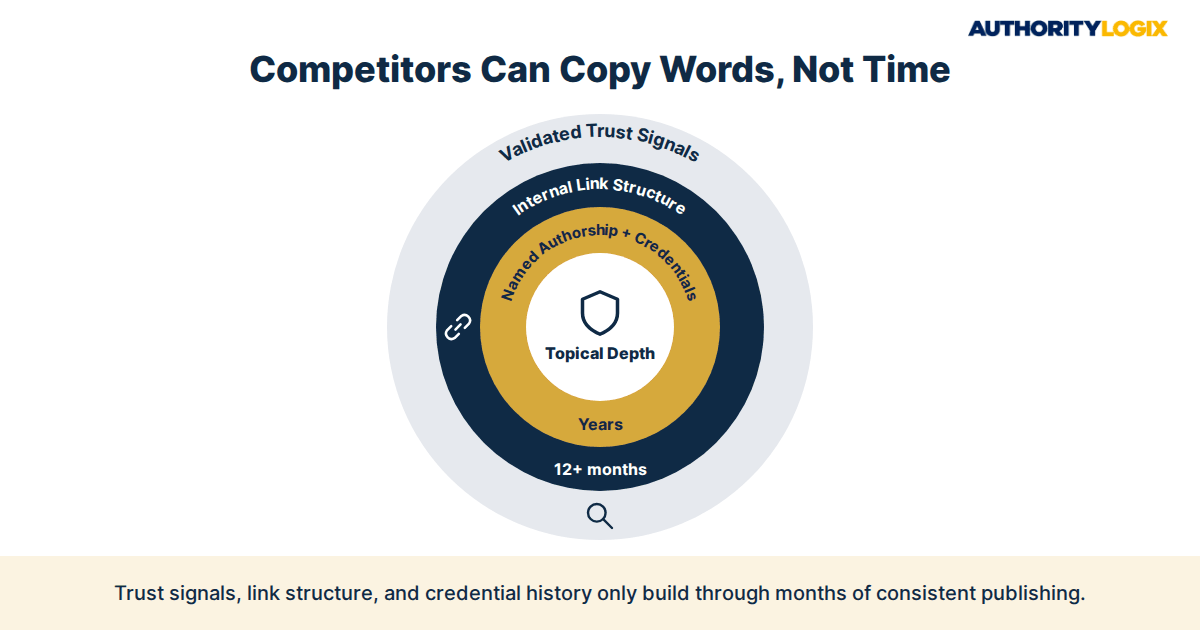
Not all content is a moat. A single well-written article is a content asset, but it is not defensible — a competitor with sufficient resources could produce a comparable article within weeks. A genuine content moat in financial services has four characteristics that make it structurally difficult to replicate quickly. Topical depth (comprehensive coverage of a specific scenario cluster, not a single article), named authorship with verified credentials (NMLS ID, CFP or CFA designation, years of documented experience), accumulated internal linking structure (a mature topic cluster with dozens of bidirectionally linked articles).
And validated trust signals (existing Google rankings, existing AI citations, existing backlink profile). The search statistics on financial services search behavior confirm why depth matters more than volume. Google’s YMYL evaluation rewards comprehensive topical coverage from credentialed sources, not isolated articles regardless of how well-written any individual piece is.
The content systems that build genuine moats for financial services firms are organized around this defensibility principle from the start: every pillar page and cluster article is built to accumulate into a comprehensive scenario coverage, not to stand alone as an isolated marketing asset. A DSCR lender that has published 8 comprehensive articles on DSCR qualification scenarios, all linked to a 4,000-word pillar page, all carrying named authorship and NMLS credentials, has built a moat that a competitor cannot replicate in a month — even with unlimited budget.
That defensibility comes partly from time: Google and AI platforms have already validated the existing content through months of crawling, indexing, and citation, and that validation history cannot be purchased or rushed. No amount of budget shortens that clock.
Building the Moat: The Architecture That Compounds Defensibility
The Architecture Behind Financial Services Competitive Moat Authority
The architecture that produces a genuine financial services content moat is the same pillar page and topic cluster model described in the pillar strategy resource — but applied with moat-building as the explicit objective, not just SEO performance. A firm building a moat selects its topic clusters based on where it has genuine, defensible expertise — a DSCR lender’s moat is built around DSCR lending scenarios, not general real estate investment advice; a financial advisory firm’s moat is built around the specific planning scenarios its advisors have years of documented experience handling, not generic personal finance content that any competitor could produce.
Organizing Content for Financial Services Competitive Moat Authority
The educational hub architecture that organizes the moat-building content ensures that every new article deepens the existing moat rather than starting a new, unconnected one. Cluster maturity creates a meaningful ranking advantage — which means a firm that has been consistently building one deep topic cluster for 18 months has a structural advantage over a competitor who starts fresh, even if that competitor publishes at a faster initial rate. The moat is not built by publishing volume alone. It is built by publishing volume within a coherent, accumulating structure — where article 40 makes articles 1 through 39 rank better, not just itself.
| Moat Component | Why It’s Defensible | Time to Replicate |
|---|---|---|
| Topical Depth | Comprehensive scenario coverage requires sustained publishing over months, not a burst of content | 12–18 months minimum, even with unlimited budget |
| Named Authorship + Credentials | Verified expertise takes years to accumulate; cannot be manufactured | Years — credentials and track record cannot be purchased |
| Internal Link Structure | A mature, bidirectionally linked cluster of 40+ articles cannot be built overnight | 12+ months of consistent weekly publishing |
| Validated Trust Signals | Google and AI platforms have already crawled, indexed, and cited the content over time | Cannot be rushed — validation accrues only through elapsed time and consistent quality |
Why Competitors Genuinely Cannot Copy a Mature Moat Quickly
The defensibility of a financial services content moat rests on the fact that a competitor cannot purchase elapsed time. A competitor with unlimited budget could theoretically hire writers to produce 50 articles matching the topical scope of an established moat within a month — but those 50 articles would launch with zero Google crawl history, zero AI citation history, zero accumulated backlink profile, and zero validated trust signals.
The E-E-A-T guide covers why Google’s trust evaluation for financial content specifically rewards demonstrated, time-validated expertise over recently published volume. The same 50 articles published by an established moat owner over 12 months of consistent output, with named authorship building a documented track record, will substantially outrank the same volume published in a single month by a new entrant, even if the writing quality is comparable.
The authority distribution layer compounds this defensibility further: a firm with an established LinkedIn following, an existing email subscriber base, and syndication relationships already in place can distribute new moat content to an audience instantly. A new entrant has to build that distribution infrastructure from zero while simultaneously trying to catch up on content depth — a competitive disadvantage on two fronts simultaneously. The moat is not just the content itself. It is the content plus the distribution infrastructure plus the validated trust signals plus the credentialed authorship — a combination that takes years to assemble and cannot be shortcut by spending more money in a shorter period.
Not sure how defensible your financial services firm’s current market position actually is? The FS Authority Gap Assessment evaluates your moat and identifies the gaps.
The AI Discovery Layer: A Moat That AI Has Strengthened, Not Weakened
AI has genuinely weakened many traditional business moats — features that once took months to build can now be replicated in days, and code-based differentiation is increasingly commoditized across industries. But AI has not weakened content authority moats in financial services. If anything, it has strengthened them, because AI platforms preferentially cite sources with demonstrated topical depth, verified authorship, and established trust signals — exactly the characteristics that take the longest for a competitor to manufacture. The AI search article covers the specific technical requirements for AI citation eligibility: named authorship, credential attribution, cited external sources, scenario specificity — a checklist that a competitor cannot satisfy overnight regardless of how much content they can generate quickly.
The lead generation infrastructure that converts moat traffic into pipeline is what makes the moat commercially valuable, not just defensively valuable. A moat that generates traffic but converts none of it into leads is protecting market visibility without protecting market share. The lead capture layer embedded throughout the moat’s content — scenario-matched lead magnets, nurture sequences, calendar booking — is what converts the defensive advantage of the moat into the offensive advantage of a growing client base that competitors cannot quickly poach through comparable content, because they have no comparable content to offer as an alternative.
What Most Firms Get Wrong About Financial Services Competitive Moat Authority
They confuse content volume with content moat
A financial services firm that publishes 100 loosely related blog posts across a dozen unconnected topics has produced content volume, not a content moat. The moat requires topical concentration — deep coverage of a defined set of scenarios that a specific target audience actually searches for — not broad, shallow coverage of everything the firm might conceivably discuss. The organic leads framework makes the performance case: organic leads generated through concentrated, deep topical authority close at a far higher rate than purchased leads — precisely because the concentration produces the kind of demonstrated, specific expertise that converts skeptical prospects into confident ones.
They think a moat can be built in a marketing sprint
A moat, by definition, cannot be built quickly — if it could be built quickly, it would not be defensible, because a competitor could build the same thing just as quickly. The authority marketing framework for DSCR lenders is built around this principle explicitly: the value of the moat comes precisely from the fact that it takes 12–24 months to build, which is exactly why a firm that starts today has a structural advantage over every competitor that starts later — the advantage is not in the content itself, but in the elapsed time the content represents.
They abandon the moat-building effort when a paid campaign produces faster short-term results
A financial services firm that launches both a paid lead generation campaign and a content moat build simultaneously will see the paid campaign produce leads within weeks, while the moat produces nothing visible for months. The natural organizational impulse is to redirect budget toward the channel showing immediate results — which means the moat-building effort gets starved of resources before it has a chance to compound. The content infrastructure article covers the specific timeline required for the moat to begin producing visible results — 9–12 months for meaningful traffic, 18 months for primary revenue channel status.
Firms that maintain the moat-building investment through this period are the ones that end up with a durable competitive asset. Firms that redirect the budget to paid channels at month 4 never reach the point where the moat begins paying dividends.

Ready to build an authority moat that protects your market position without ad spend?
Building Financial Services Competitive Moat Authority: Where to Start
Building a genuine competitive moat in financial services starts with topical concentration, not topical breadth. A firm should identify the 2–3 scenario clusters where it has the deepest, most defensible genuine expertise — not the broadest appeal, but the deepest credibility — and commit to building comprehensive, credentialed, consistently published coverage of those specific clusters over 18–24 months. The long-term positioning article covers the three-layer authority stack that a moat is built from; the moat itself is the accumulated result of that stack maintained consistently over a period long enough that the accumulated trust signals become structurally difficult for a competitor to replicate.
The referral ceiling article covers the parallel structural constraint that content moats solve for advisory firms specifically — a referral-only growth model has no moat at all, because it depends entirely on the behavior of existing clients rather than any asset the firm has built and owns. BKDSCR.com is AuthorityLogix’s demonstration of what a mature financial services content moat looks like in production: 18 pillar pages, 48 scenario-specific cluster articles, all bidirectionally linked, all carrying named authorship and NMLS credentials, all validated by months of Google crawl history and AI citation activity.
That is a moat a new competitor entering the NYC outer-borough DSCR lending market today could not replicate for 18–24 months, even with substantial budget, because the elapsed time and accumulated trust signals cannot be purchased. No amount of spending shortens that clock.
When you’re ready to start building your firm’s moat, work with us is the starting point. From there, we identify which piece of the moat to build first.