


Key Takeaways
- A financial services website SEO audit shows what Google actually crawls, indexes, and trusts on your site — a view your clients never see.
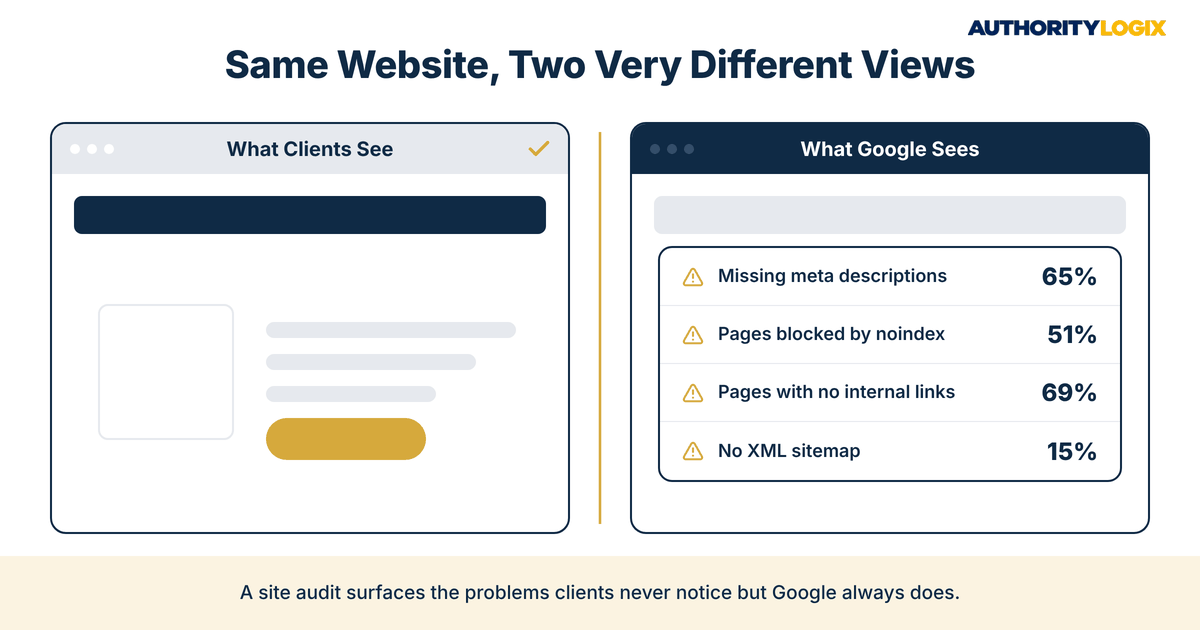
- SE Ranking’s 2025 analysis of 418,125 site audits found missing meta descriptions on 65.38% of sites and noindex-blocked pages on 50.58%.
- Only 48% of mobile websites pass Core Web Vitals, according to HTTP Archive’s 2025 Web Almanac.
- Mortgage website technical SEO problems — orphaned program pages, stale sitemaps, leftover noindex tags — can pull revenue pages out of search without anyone noticing.
- A financial advisor site audit has to check trust and authorship signals, not just technical errors, because Google holds financial pages to a higher standard.
- A financial services website SEO audit only pays off when the findings are sequenced: indexing first, ranking second, conversion third.
Table of Contents
A financial services website SEO audit is the fastest way to learn why a firm with 20 years of earned credibility still cannot be found on Google. You know your clients and your market better than anyone competing for them — but Google does not grade experience the way a referral partner does. It grades what it can crawl, render, and verify against the E-E-A-T standard it applies to financial pages, and most lender and advisor sites give it very little to work with.
Credible but invisible is the pattern, and a financial services website SEO audit is where it becomes measurable. This article covers what a financial services website SEO audit examines, how a lender website Google crawl actually behaves, what belongs on a financial advisor site audit checklist, and how to turn findings into a fix plan instead of a spreadsheet nobody opens.
What a Financial Services Website SEO Audit Actually Reveals
Most firm owners judge their website the way a client does: it loads, the logo looks right, the phone number works. A financial services website SEO audit judges it the way Google does, page by page, and the two views rarely match. SE Ranking’s 2025 analysis of 418,125 website audits found missing meta descriptions on 65.38% of sites, duplicate title tags on 53.69%, and missing H1 headings on 54.67%. None of those problems are visible to a prospect scrolling your homepage. All of them shape whether that prospect ever finds it.
Those findings carry more weight in financial services than in most industries, because Google treats mortgage, lending, and investment pages as Your Money or Your Life content and holds them to a higher trust bar. Technical errors read as neglect, and neglect undercuts the credibility signals covered in the authority guide. A firm can carry decades of closed loans and satisfied clients and still look, to a crawler, like a site nobody maintains.
What a Financial Services Website SEO Audit Measures That Analytics Miss
Analytics tells you who arrived. A financial services website SEO audit tells you who never could. Ahrefs’ study of 1,002,165 domains found that 80.4% had images missing alt attributes, 72.3% had slow pages, and 66.2% had pages with only one followed internal link pointing to them. Each of those is a quiet signal that a page is less important, less accessible, or less finished than a competitor’s version of the same answer.
A financial services website SEO audit is diagnostic, not cosmetic. It maps every page Google knows about, every page it ignores, and every page it has indexed but does not trust — the same three-part view we apply across the services hub before any build begins. Firms that skip this step usually spend money publishing new content onto a site that cannot carry it.
The Financial Services SEO Playbook shows how lenders and advisors turn audit findings into search visibility that compounds month over month.
Mortgage Website Technical SEO: The Crawl and Index Layer
Mortgage website technical SEO starts with one question: can Google reach, render, and store every page you want ranked? Most lenders assume the answer is yes. A financial services website SEO audit usually answers no for a meaningful share of the site, and the causes are rarely dramatic — a staging noindex tag left on after launch, a loan program page orphaned during a redesign, a sitemap still listing URLs that redirect.
SE Ranking’s data shows how common these failures are. Half of audited sites — 50.58% — had pages blocked by a noindex directive, 35.73% had pages returning 4XX errors, and 14.78% had no XML sitemap at all. For a lender, any one of those can remove a DSCR program page or a state licensing page from search without anyone on the team noticing.
Why Mortgage Website Technical SEO Breaks Down on Lender Sites
Lender websites tend to grow by accretion. A new loan product gets a page, a new branch gets a page, a compliance update adds a disclosure page, and none of it is planned against a coherent site structure that tells Google which pages matter most. The result is a flat, sprawling site where the pages that should rank compete with pages that should never have been indexed.
Fixing the crawl layer is not a one-time cleanup. Every new page, rate update, or market report either reinforces the architecture or erodes it, which is why audit findings feed directly into the content systems that govern how new pages get published, linked, and retired. Without that governance, the same errors return within a year, and the next financial services website SEO audit finds them all over again.

How a Lender Website Google Crawl Works and What It Skips
A lender website Google crawl is not a full read of your site. Googlebot follows links, respects robots directives, and allocates attention based on how important each page appears to be. Pages buried four clicks deep with a single internal link pointing at them get crawled less often, refreshed less often, and trusted less.
Google’s own Search Console Help center documents the tools that show this process from Google’s side, including the Sitemaps report and the option to ask Google to recrawl specific URLs. It is the first place any financial services website SEO audit should start, because Search Console reports what Google actually did rather than what a third-party tool predicts.
The stakes are higher than most firm owners realize. Ellie Mae’s Connecting with Borrowers Online study found that 92% of borrowers researched online before contacting a lender, a pattern we break down in our mortgage search statistics resource. If the pages answering those research questions get skipped in the crawl, the borrower finds a competitor’s answer instead.
What Googlebot Deprioritizes on Lender and Advisor Sites
Three patterns get deprioritized most often. Thin location pages that repeat the same 150 words with a city name swapped in. Rate and product pages that sit behind scripts Google has to render before it can read them. Blog posts published with no internal links pointing to them at all. Ahrefs’ search traffic study found that 96.55% of the pages in its index get zero traffic from Google — publishing a page and getting it found are two different achievements.
The fix is architectural. When educational pages are grouped by topic, linked to each other, and connected to the loan program or service pages they support, Google reads them as a body of expertise rather than scattered posts. That is the job of an educational hub, and it is the structure a financial services website SEO audit usually recommends once the crawl errors are cleared.
The Financial Advisor Site Audit Checklist: Seven Layers Google Reads
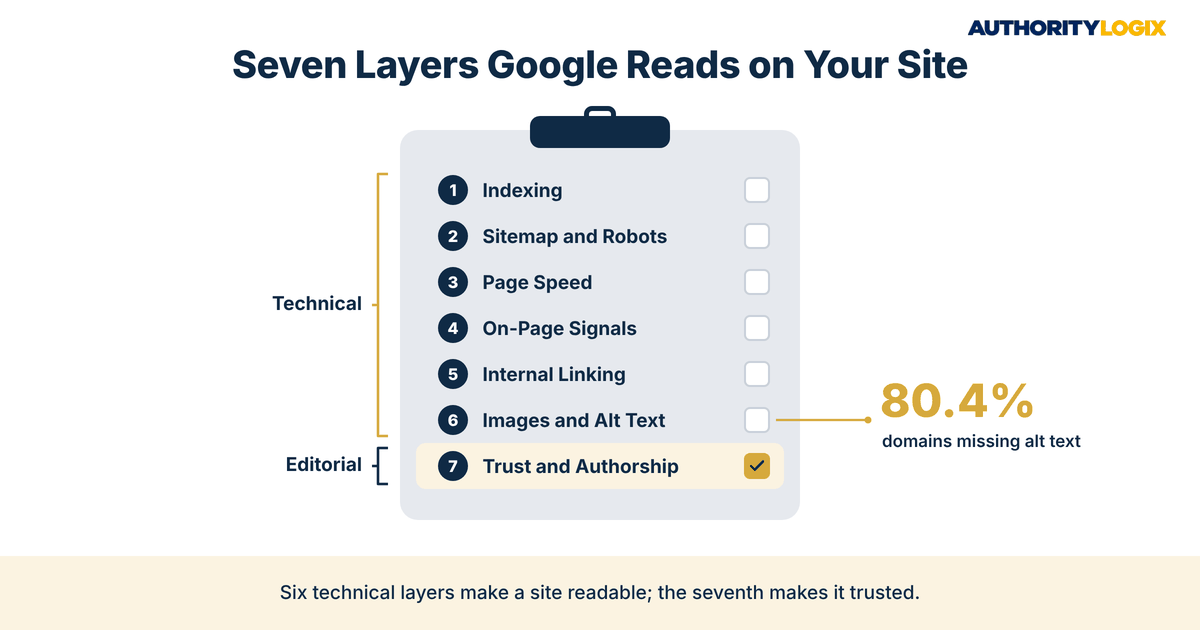
A financial advisor site audit and a mortgage site audit check the same seven layers, even when the content on top differs. Advisors tend to fail on trust and authorship signals; lenders tend to fail on crawl health and program-page depth. The checklist below is the order we work through a financial services website SEO audit, from the layers Google needs first to the layers that build authority over time.
| Audit Layer | What to Check | Common Finding |
|---|---|---|
| 1. Indexing | Pages indexed vs. pages you want ranked; stray noindex tags; 4XX errors | Noindex-blocked pages on 50.58% of audited sites (SE Ranking, 2025) |
| 2. Sitemap and robots | XML sitemap present, clean, and submitted in Search Console | No XML sitemap on 14.78% of sites (SE Ranking, 2025) |
| 3. Page speed | Core Web Vitals on mobile, especially Largest Contentful Paint | Only 48% of mobile sites pass Core Web Vitals (HTTP Archive Web Almanac, 2025) |
| 4. On-page signals | Unique titles, meta descriptions, one H1 per page | Missing meta descriptions on 65.38% of sites (SE Ranking, 2025) |
| 5. Internal linking | Every revenue page linked from related content | Pages with no inbound internal links on 69.32% of sites (SE Ranking, 2025) |
| 6. Images and accessibility | Descriptive alt text on every meaningful image | Missing alt attributes on 80.4% of domains (Ahrefs) |
| 7. Trust and authorship | Named authors, credentials, licensing and disclosure pages | The layer most financial services website SEO audit reports skip entirely |
Notice that the first six layers are technical and the seventh is editorial. That is deliberate, because a clean site with no expertise behind it ranks no better than an expert site Google cannot crawl. The seventh layer is where the audit connects to the content system — the publishing architecture that decides which questions your firm answers and in what order.
For advisors in particular, the trust layer carries regulatory weight. Pages need clear authorship, accurate credentials, and compliance-reviewed language, which is why findings on this layer usually turn into a finance content plan rather than a technical ticket. The goal is never to give advice on the page; it is to show Google and the reader that a qualified professional stands behind every word.
Not sure where your firm stands on these seven layers? The FS Authority Gap Assessment shows where your visibility infrastructure is weakest and what to build first.
Turning Financial Services Website SEO Audit Findings Into a Prioritized Fix Plan
A financial services website SEO audit that produces a 400-row spreadsheet and no sequence is a report, not a plan. The useful output of a financial services website SEO audit is a short, ranked list: what blocks indexing, what blocks ranking, and what blocks conversion — in that order. Rewriting meta descriptions on pages Google cannot index wastes the first month of the work.
How to Sequence Financial Services Website SEO Audit Fixes
Start with indexing errors, broken pages, and redirect chains, because they decide whether anything else matters. Then move to speed and on-page signals on the pages closest to revenue — loan programs, advisor service pages, and contact paths. HTTP Archive’s 2025 Web Almanac found that only 62% of mobile sites reach a good Largest Contentful Paint score, so speed work on a few revenue pages often pays back faster than any new content project.
The final tier is conversion. Once the right pages are indexed and ranking, each one needs a clear next step that captures the prospect instead of sending them back to the search results. That handoff — from ranked page to captured inquiry — is the core of a first-party lead system, and a financial services website SEO audit is the moment to confirm every ranking page actually feeds it.
Firms that run this sequence well treat the financial services website SEO audit as the front end of a pipeline rather than a technical chore. Visibility without capture produces traffic reports; capture without visibility produces empty forms. Our lead generation builds start from audit findings for exactly that reason, because the pages Google already favors are the cheapest place to begin collecting inbound inquiries.
Financial Services Website SEO Audit Mistakes That Leave Rankings on the Table
Most firms that commission a financial services website SEO audit get real value from it. Many lose part of that value through a handful of predictable mistakes. These are the ones we see most often, along with the question firm owners ask us most.
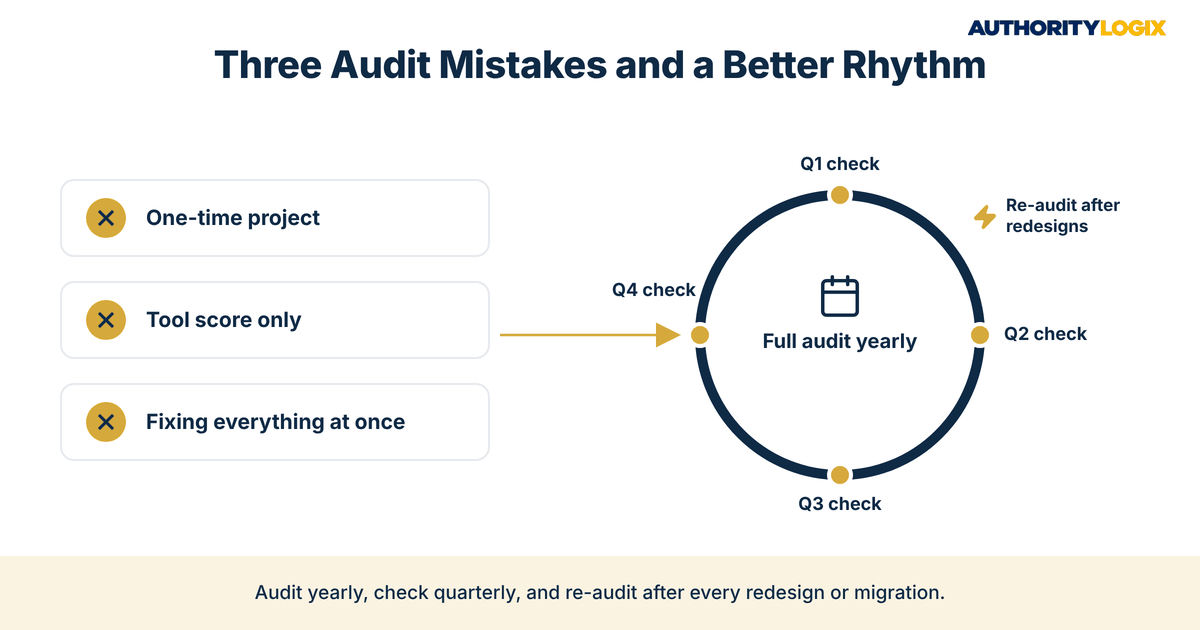
Mistake: Treating the audit as a one-time project
Sites drift. New pages get published, plugins update, and links break, so a site that audited clean in January can carry dozens of new errors by summer. A quarterly check paired with ongoing authority distribution keeps both the technical base and the external trust signals moving in the same direction.
Mistake: Relying on an automated tool score
Automated crawlers flag issues by volume, not by business impact, so a missing alt tag on a decorative icon can weigh the same as a noindex tag on your top loan program page. Interpreting findings against your actual revenue pages is part of what we do in every engagement. A tool score of 92 out of 100 can still hide the one error costing you the most.
Question: How often should a lender or advisor run a financial services website SEO audit?
A full audit once a year, with lighter quarterly checks in Search Console, is a sensible rhythm for most lenders and advisory firms. Run one immediately after any redesign, domain change, or platform migration, because those are the moments sites lose indexed pages in bulk.
Mistake: Fixing everything at once
A firm that tries to clear every warning in one sprint usually stalls halfway and fixes nothing that matters. Sequencing matters more than speed, which is why the order behind how we build runs foundation first, content architecture second, and distribution third. Each layer depends on the one beneath it.
Want the hidden gaps on your site found and fixed in the right order? We’ll audit what Google sees and build the corrections into a working plan.
What Google Sees That Your Prospects Never Do
Your prospects see a homepage, a headshot, and a phone number. Google sees crawl paths, index status, load times, authorship signals, and how every page connects to every other page. When those two views disagree, Google’s view decides who gets found, and the long-range planning in the growth playbook starts by closing that gap.
BKDSCR.com is the proof we point to. It was built from scratch in the NYC outer-borough DSCR niche with 18 pillar pages and 7 interactive investor tools, and it ranks for competitive DSCR terms with zero paid ads. The financial services website SEO audit discipline behind that build is a large part of why it works, because every page was planned against what Google needs to see before a word was written.
If you want a second set of eyes on your own site, work with us is where that conversation starts. Either way, run a financial services website SEO audit before you publish another page, because new content placed on a broken foundation adds volume without adding authority.
The honest answer is that most lenders and advisors are not losing to firms with more expertise. They are losing to firms whose websites make that expertise readable to Google. Authority compounds, but only on a foundation Google can actually read.