

Key Takeaways
- Mortgage landing page conversion is the gap between the traffic a lender already earns and the applications that traffic actually produces.
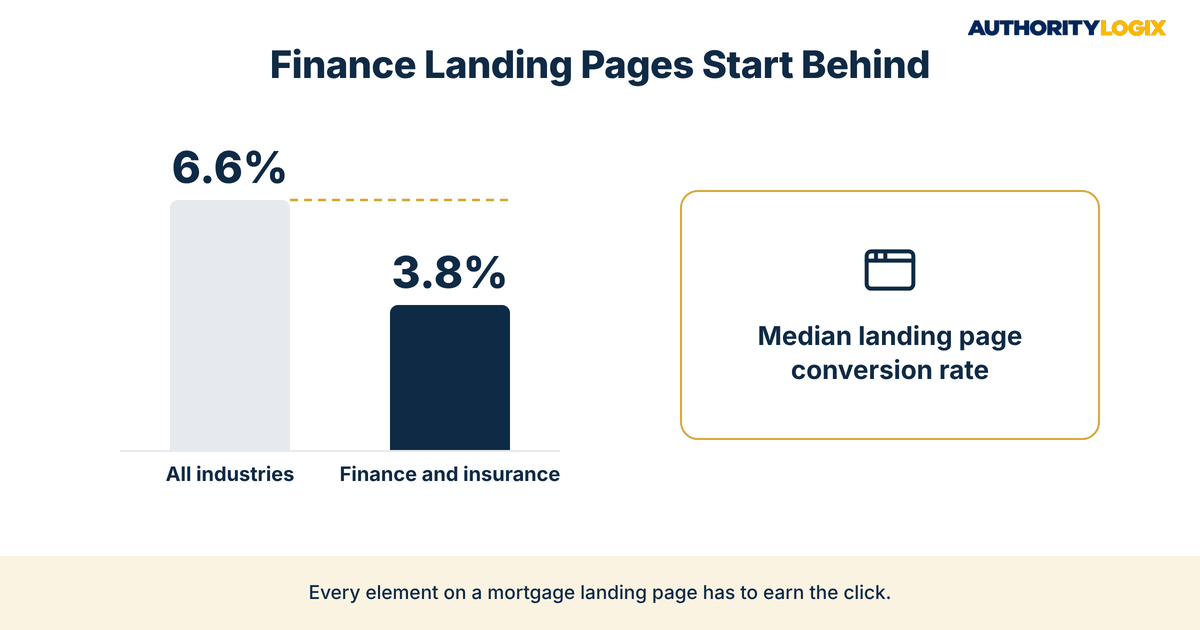
- Unbounce’s benchmark data puts the median finance and insurance landing page at 3.8%, against a 6.6% median across all industries, so financial pages start behind.
- Pages written at a 5th to 7th grade reading level converted at 11.1% in Unbounce’s analysis, more than double the 5.3% for professional-level copy.
- Loan officer landing page optimization comes down to a short list of elements: one offer, one action, visible credentials, and a form that asks only what the first call needs.
- A lender landing page strategy matches each page to its traffic source, because search, referral, and email visitors arrive with different questions.
- Measure mortgage landing page conversion against funded loans, not form fills, or the numbers will reward the wrong pages.
Table of Contents
Mortgage landing page conversion is where most lenders quietly lose the business they already paid to attract. You rank for a loan program, a referral partner texts a borrower your link, or a rate alert lands in an inbox — and the visitor arrives, reads for a few seconds, and leaves without applying. The traffic was never the whole problem. The page waiting for that borrower was never built to turn a visit into a conversation, and it is the last step of the lead funnel most lenders never finish building.
The lenders who struggle here are rarely short on expertise. They have closed thousands of loans and know their programs cold. What the borrower sees in those first seconds is a generic page, a rate disclaimer, and a long form. That is a mortgage landing page conversion problem, and it is an infrastructure problem — not a copywriting one.
Why Mortgage Landing Page Conversion Decides Your Cost Per Application
Every lender pays for traffic in some form — ad spend, SEO work, referral relationships, or the hours behind an email list. Conversion rate decides what each of those dollars actually buys. Unbounce analyzed more than 41,000 landing pages and 57 million conversions for its conversion benchmark report and found a 6.6% median conversion rate across all industries. Its finance and insurance benchmarks put that industry’s median at 3.8%, the low end of the range.
Paid search shows the same pattern. WordStream by LocaliQ’s 2025 Google Ads benchmarks found finance and insurance converting at 2.55%, the lowest of any industry it analyzed, while the average cost per lead across all industries rose to $70.11. Expensive clicks plus weak mortgage landing page conversion multiply the cost of every application.
| Benchmark | Figure | Source | What It Means for Mortgage Landing Page Conversion |
|---|---|---|---|
| Median landing page conversion, all industries | 6.6% | Unbounce | The baseline a well-built page can be measured against |
| Median landing page conversion, finance and insurance | 3.8% | Unbounce | Financial pages start behind and need every trust signal working |
| Google Ads conversion rate, finance and insurance | 2.55% | WordStream by LocaliQ, 2025 | Paid clicks are the least forgiving traffic a page will receive |
| Average Google Ads cost per lead, all industries | $70.11 | WordStream by LocaliQ, 2025 | Every point of mortgage landing page conversion lowers that cost |
The math is simple to run on your own numbers. If a page converts at 3% and you lift it to 6%, the same budget produces twice the applications without one additional click. Trust is the variable that moves that number in financial services, which is why the credibility signals laid out in the authority guide belong on the landing page itself, not just on your About page.
The CFPB’s research on mortgage shopping adds a second reason to care. Three out of four borrowers applied with only one lender or broker, and almost half seriously considered only one before applying. If your page is the one they land on, the application is yours to lose. The pattern holds for every lender type on the financial services hub, from DSCR specialists to retail mortgage teams.
The Financial Services Lead Generation System shows how landing pages fit into a first-party pipeline that does not depend on bought leads.
Loan Officer Landing Page Optimization: The Elements That Matter
Loan officer landing page optimization is less about design trends and more about removing every reason a borrower has to hesitate. The pages that convert share a short list of elements, and most underperforming pages are missing at least three of them. Unbounce’s finance benchmarks found that pages under 200 words tended to convert best in the industry, while finance pages use 11.8% more words than the cross-industry baseline.
The Five Elements Behind Mortgage Landing Page Conversion
- One specific headline naming the program and the borrower — “DSCR loans for Brooklyn two-family investors.”
- A single call to action repeated once lower on the page.
- Visible credentials near the form: NMLS ID, licensed states, years in business, and review count.
- A short form asking only what the first call requires.
- An educational reason to act, such as a document checklist.
That last element catches the borrower who is not ready to apply. Someone three months from a purchase will not fill out an application, but they will download a checklist. Well-built lead magnets give that borrower a reason to stay in your pipeline, which is a quieter form of mortgage landing page conversion.
Readability matters as much as length for mortgage landing page conversion. In Unbounce’s analysis, pages written at a 5th to 7th grade reading level converted at 11.1%, compared with 5.3% for professional-level copy. Financial services is the one exception the report flagged, where more complex language can actually help conversions. For lenders, keep the headline and form plain and let the depth live on an educational hub the page links to, where careful borrowers can keep reading.

Mortgage Website Lead Conversion Starts With One Clear Offer
Mortgage website lead conversion breaks down most often on pages that try to do everything at once. A homepage offering purchase loans, refinances, DSCR programs, a calculator, and a blog feed is a directory, not a landing page. The borrower has to do the sorting, and most will not.
The fix is architectural. Each loan program, each market, and each borrower type gets its own page with one offer and one action, and the navigation makes it easy to reach the right page from search or from a partner’s link. That is the logic behind the site structure lenders need before any single landing page can perform, because no amount of mortgage landing page conversion work saves a page buried three clicks deep.
One clear offer also changes what you can measure. When a page has a single purpose, its mortgage landing page conversion rate tells you something real. When a page has six purposes, a low number could mean the offer is wrong, the audience is wrong, or the borrower simply could not find the button.
A dedicated page for every program and market sounds like a large project, and done by hand it is. The lenders who make it sustainable treat landing pages as part of their content systems, with templates, approved compliance language, and a publishing process that turns a new program into a live page in days rather than months.
Not sure where your mortgage landing page conversion is losing borrowers? The FS Authority Gap Assessment shows where your visibility and conversion infrastructure is weak and what to build first.
Lender Landing Page Strategy for Search, Referral and Email Traffic
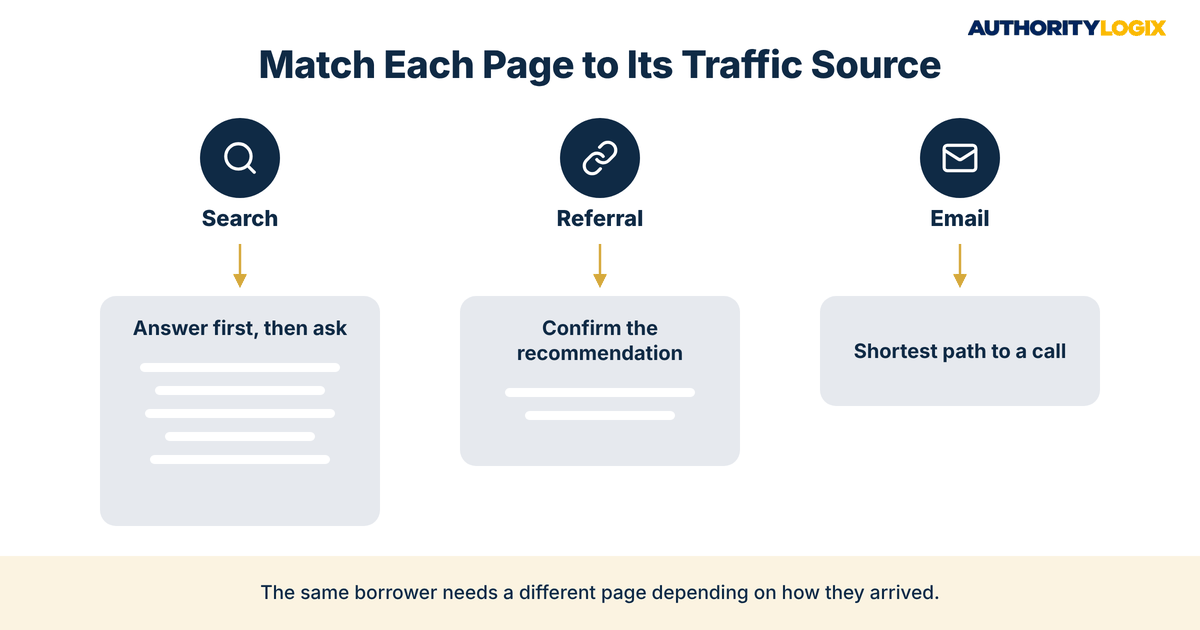
A lender landing page strategy starts with a simple question: where did this visitor come from, and what do they already believe? A search visitor is comparing options. A borrower clicking an agent’s text already has a recommendation and wants confirmation. A past client opening a rate-alert email already trusts you.
How Each Traffic Source Changes Mortgage Landing Page Conversion
| Traffic Source | What the Borrower Wants | What the Page Must Do |
|---|---|---|
| Organic search | An answer to the question they typed | Answer first, then offer the next step |
| Paid search | The exact offer named in the ad | Repeat the ad’s promise in the headline and keep the form short |
| Referral partner | Confirmation that the recommendation was sound | Show the loan officer, credentials, and reviews up front |
| Email to past clients | The quickest route to a conversation | Match the email’s headline and offer a direct calendar link |
Search visitors need the page to answer their query before it asks for anything. If the page ranks for “DSCR loan requirements,” the first screen should show the requirements, with the call to action placed right after the answer. The full approach to earning those rankings sits in the SEO playbook, but mortgage landing page conversion is where that ranking finally turns into a borrower conversation.
Referral visitors are a different job. A referred borrower arrives with one lender in mind — yours — and the page should confirm that choice rather than restart the sale. Your name, photo, NMLS ID, and reviews will do more for mortgage landing page conversion than any rate table.
Email visitors already know you, so their page can be the shortest of the three. A matching headline, a brief form, and a calendar link usually outperform a full program page here. What keeps every page credible is the finance content behind them — borrower explanations written once, reviewed for compliance, and reused everywhere.
Testing Mortgage Landing Page Conversion Against Funded Loans
Most lenders who track landing pages at all track form submissions, which rewards the wrong pages. A page that collects 40 unqualified submissions looks better on a dashboard than a page that collects 12 borrowers who actually close, and the second page is the one paying your bills.
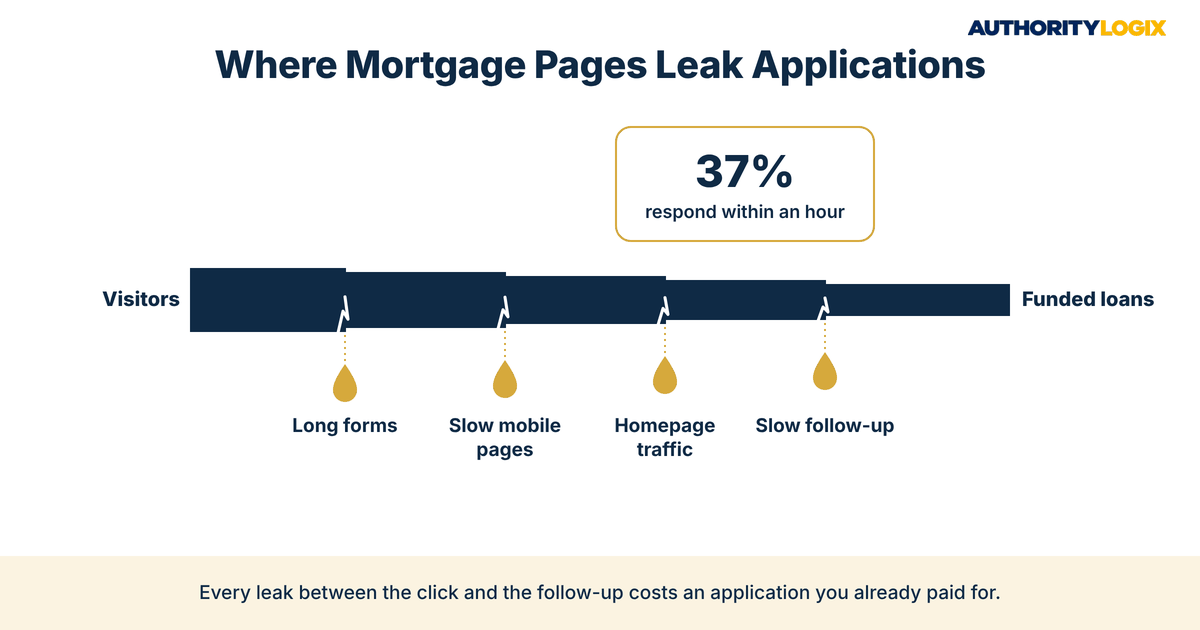
Speed belongs in the measurement too. Harvard Business Review’s study of 2,241 U.S. companies found that only 37% responded to a web lead within an hour, and the average response time among companies that responded within 30 days was 42 hours. Firms that made contact within an hour were nearly seven times as likely to qualify the lead as those that waited even one hour longer. A page with strong mortgage landing page conversion that hands its leads to a slow follow-up process will still lose the borrower.
Mortgage Landing Page Conversion Metrics Beyond the Form Fill
- Form submission rate by page and by traffic source
- Time from submission to first live contact
- Application rate from submitted leads
- Funded loans per 100 visitors to each page
- Cost per funded loan by traffic source
Testing mortgage landing page conversion works best when changes are isolated. Change the headline on one page, hold everything else steady, and read the result before touching the form. The pages themselves should come out of a documented content system, so a winning headline or form layout can roll out to every program page instead of living on one.
Traffic volume shapes how fast you learn what lifts mortgage landing page conversion. A page with 200 visitors a month takes a long time to show a winner, while a page fed by syndication and search produces readable results sooner. That is one reason authority distribution and landing page testing belong in the same plan — one supplies the visitors, and the other tells you what those visitors respond to.
Mortgage Landing Page Conversion Mistakes That Leak Applications
Most weak pages trace back to a handful of repeat mistakes. These are the questions lenders ask most often.
Mistake: Is a longer form better because it pre-qualifies borrowers?
Usually not. Unbounce’s finance benchmarks show 63.4% of the industry’s landing pages rely on forms, which makes the form the biggest lever on mortgage landing page conversion. Collect what the first call needs and gather the rest later.
Mistake: Why does our mobile page convert worse than desktop?
Unbounce found that 83% of the visits it analyzed happened on mobile devices, while desktop still converted 8% better. Google’s mobile research found that 53% of mobile visitors leave a page that takes longer than three seconds to load. A page with heavy rate widgets and a ten-field form hurts mortgage landing page conversion for the borrower who is actually there.
Mistake: Should every ad and campaign point to the homepage?
No. Sending paid or partner traffic to a homepage forces the borrower to find their own path. Dedicated pages, one per campaign or program, are the backbone of any lead generation infrastructure that holds up when the budget grows.
Mistake: Should compliance details stay in the footer?
They work harder near the form. An NMLS ID, an Equal Housing Opportunity statement, and licensed states are trust signals as much as disclosures.
Mistake: How do we know which page to fix first?
Start with the pages that receive the most traffic and post mortgage landing page conversion below your own average. Those pages carry the largest gap between what you have paid for and what you are getting, which is why finding that leak is what we do first in every engagement, before anything new gets built.
Mistake: Can we fix this one page at a time?
You can, but the gains stay small unless the system behind the pages changes. Templates, approved language, tracking, and follow-up have to work together, and that sequence is the core of how we build conversion infrastructure for lenders. Volume without infrastructure is just noise.
Ready for landing pages that turn borrower clicks into applications? We’ll rebuild the pages around one clear next step for each loan program.
Traffic You Already Paid For Deserves a Page That Converts
Every lender in a competitive market is paying for attention in some form. The firms that pull ahead stop treating each new campaign as the fix and start treating mortgage landing page conversion as part of the longer plan laid out in the growth playbook. Infrastructure compounds. Ads stop.
BKDSCR.com is the clearest example we can point to. It was built from scratch with 18 pillar pages, 7 interactive investor tools, and 48 SEO-optimized blog posts, and it generates inbound leads organically with zero paid ads. That live build in a competitive DSCR market is the plainest evidence of why it works.
The honest assessment is this: most lenders do not have a traffic problem as large as they think. They have a mortgage landing page conversion problem. The borrowers are already arriving — from search, from partners, from your own email list — and the expertise to close them is already in the building. What is missing is a page built to make that expertise visible in the first few seconds, and if you want that built for your firm, work with us is where the conversation starts.