


Key Takeaways
- Real estate blogging lead generation turns the market knowledge your firm already has into searchable answers that bring buyers, sellers, and investors to you.
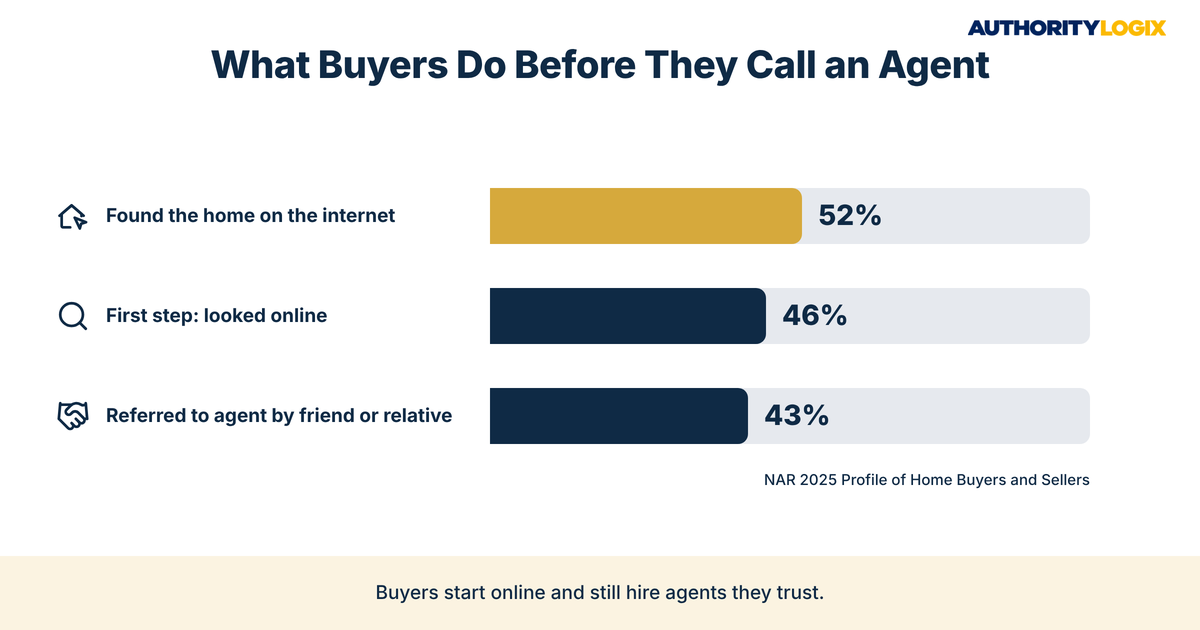
- NAR’s 2025 Profile of Home Buyers and Sellers found that 46% of buyers started by looking online for properties for sale, and 52% found the home they purchased on the internet.
- HubSpot’s 2026 State of Marketing data reports that website, blog, and SEO remain the number one ROI-generating channel according to marketers.
- Broker content marketing leads arrive already familiar with your thinking, which makes the first conversation easier than a shared portal inquiry.
- Agent blog ROI lead generation is measurable with three numbers: search impressions, attributed inquiries, and closed business traced to a first blog visit.
- Real estate blogging lead generation compounds only with a steady cadence, connected internal links, and distribution, not bursts of posts followed by silence.
Table of Contents

Real estate blogging lead generation is the quiet difference between the firm a buyer calls and the firm a buyer never hears about. You may have closed hundreds of transactions and know every street in your farm area, yet still be absent when a seller types a pricing question into Google. Across the real estate industry the pattern repeats: firms that are credible but invisible, with expertise nobody searching can see.
Most real estate blogs stall after a dozen posts because blogging is treated as a chore for slow weeks. Real estate blogging lead generation works only when publishing runs on content systems that turn market knowledge into searchable answers on a fixed schedule.
Does Real Estate Blogging Lead Generation Still Work in the AI Search Era?
The fair question in 2026 is whether a blog still matters when AI tools answer questions directly. HubSpot’s 2026 State of Marketing report found that nearly 30% of marketers saw search traffic decline as consumers turned to AI tools. Any honest case for real estate blogging lead generation has to account for that shift.
The same report shows why the channel has not disappeared. Blog posts were used by 38% of marketers in 2025, the third most popular content format. AI answers are assembled from published pages, so the firm with the clearest local answer is the one most likely to be cited or clicked, which keeps real estate blogging lead generation relevant.
Why Real Estate Blogging Lead Generation Starts With Client Questions
Buyers and sellers do not search for your firm name. They search for what a duplex rents for, how long a sale takes in this market, or what a tax reassessment means for a landlord. Real estate blogging lead generation begins by mapping those questions, then answering each with more local detail than any portal can.
That mapping belongs in a content calendar built around the buying and selling seasons in your market. A spring listing post published in March misses the seller who started researching in January. Timing is part of the answer.
The Real Estate Lead Generation System shows where real estate blogging lead generation fits inside a full inbound pipeline, from the first search to the first call.
What Broker Content Marketing Leads Look Like Compared to Portal Leads
A portal lead has seen a listing photo and a price, and the same inquiry may be routed to several agents at once. Broker content marketing leads arrive after reading your take on their exact question. The first conversation starts with familiarity instead of a pitch, which is the real advantage of real estate blogging lead generation.
HubSpot’s 2026 data reports that nearly 70% of marketers say leads come to them later in the buying process. For a brokerage, the research phase happens before anyone fills out a form, and the blog is where that research either finds you or finds a competitor. A blog that answers the questions buyers ask during that phase is doing sales work while you are showing properties.
That is why real estate blogging lead generation is judged by conversation quality, not raw inquiry volume. In the content system model every post is one part of a connected library: market updates feed area pages, and area pages feed seller guides.
The capture path matters as much as the post. A reader who finishes an article on rental cash flow should find a market report request or valuation form, not a generic contact page. Purpose-built lead generation infrastructure turns that reader into a named prospect.
The practical differences show up in the very first call. Here is what a blog-sourced prospect usually brings with them:
- They already know how you think about pricing, timing, and their part of the market
- They have self-selected into the property type or service you write about
- They often arrive with specific questions drawn from your own posts
- They are contacting you because of your expertise, not because a portal assigned them to you

How to Measure Agent Blog ROI Lead Generation Without Guesswork
Most agents who quit blogging cannot tell whether it is working. Agent blog ROI lead generation becomes measurable once you stop asking whether the blog gets traffic and start asking which posts produce conversations. HubSpot’s 2026 report found that small businesses are 23% more likely than average to see ROI from blog posts, and most brokerages and investment firms fit that description.
The Three Numbers That Show Whether Real Estate Blogging Lead Generation Is Working
Real estate blogging lead generation can be tracked with three numbers from Google Search Console, Google Analytics, and your CRM. None of them require an agency dashboard:
- Search impressions for the question each post targets
- Form fills and calls attributed to blog landing pages, tagged by source
- Closed transactions that trace back to a first visit on a blog post
The third number takes longest to appear, and it matters most. A seller who reads three of your posts and then calls is a real estate blogging lead generation result, even if the CRM only records a phone call. Ask every new client how they found you.
Measurement also shows which topics carry weight. Trust signals such as named authors, local proof, and specific market data, all covered in the authority guide, separate posts that convert from posts that merely rank. Rewrite posts that earn impressions but never start a conversation.
Before writing anything new, look at what you already have. Years of useful material often sit in newsletters and listing presentations, and a well-organized resource library shows how that material can be structured so each piece answers one question and links to the next.
Not sure whether your blog is producing leads or just pages? The RE Authority Gap Assessment shows where your publishing, search visibility, and lead capture fall short.
Real Estate Publishing Leads Statistics: What the Data Does and Doesn’t Prove
Real estate publishing leads statistics get quoted loosely, so precision matters. NAR’s 2025 Profile of Home Buyers and Sellers reports that all buyers use the internet in their search, that 46% of buyers said their first step was looking online for properties for sale, and that 52% found the home they purchased on the internet.
The same NAR report shows that relationships still decide who gets hired. Forty-three percent of buyers were referred to their agent by a friend, neighbor, or relative, and 66% of recent sellers used an agent who was referred to them or whom they had worked with before. Blogging does not replace referrals; it gives referred prospects something to read when they look you up.
On the marketing side, HubSpot’s 2026 State of Marketing data, published on its marketing statistics page, reports that website, blog, and SEO remain the number one ROI-generating channel according to marketers. That finding covers all industries, so treat it as direction rather than a forecast for your firm.
| Finding | Source | What It Means for Real Estate Blogging Lead Generation |
|---|---|---|
| 46% of buyers’ first step was looking online for properties for sale | NAR 2025 Profile of Home Buyers and Sellers | Your answers have to be published before the first call |
| 52% of buyers found the home they purchased on the internet | NAR 2025 Profile of Home Buyers and Sellers | Your posts compete for the research around listings |
| 43% of buyers were referred to their agent by a friend, neighbor, or relative | NAR 2025 Profile of Home Buyers and Sellers | Referred prospects still look you up online |
| Website, blog, and SEO rank as the number one ROI-generating channel | HubSpot 2026 State of Marketing | The channel behind real estate blogging lead generation rates highly across industries |
Here is what the data does not prove. No source cited here shows that a blog guarantees a specific number of leads, and claims of a fixed lead multiple usually trace back to cross-industry software data. Honest real estate blogging lead generation planning follows the direction of the evidence, not a promised multiplier.
What the evidence does support is depth. A connected educational hub of buyer guides, seller guides, and market explainers gives Google and AI tools a clear picture of what the firm knows. One isolated post rarely does that.
Investment firms have a particular opening because investor questions are specific and underserved. Posts on cap rates, rent-to-price ratios, and financing in a defined market attract investors ready to act, and dedicated investor content development keeps that material accurate.
Local search ties the effort together. Posts that name the towns and property types you work in support the map pack and organic rankings described in the local SEO playbook, so one post serves a search question and a local visibility goal at once.
The Publishing Cadence That Makes Real Estate Blogging Lead Generation Compound
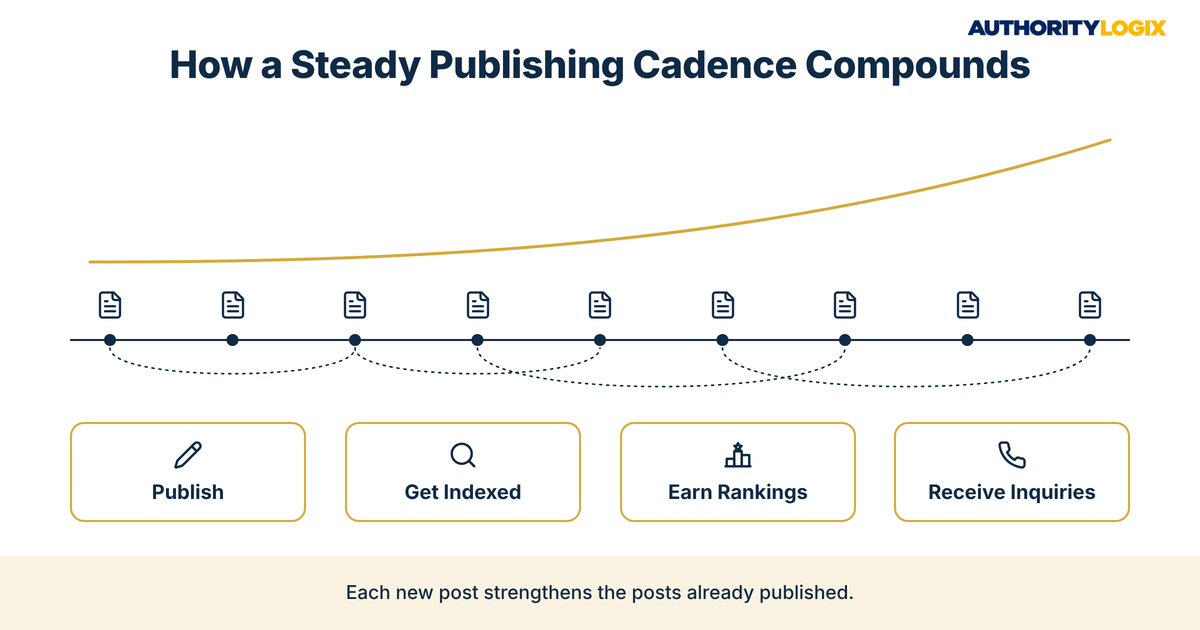
Cadence matters more than any single post. Search engines and readers both reward a site that keeps adding useful answers on a steady rhythm. Real estate blogging lead generation compounds because each new post strengthens the ones already published through internal links and growing topical depth. A burst of twenty posts followed by six months of silence does the opposite.
Pages take months to settle into stable positions, which is why long-term ranking depends on infrastructure that keeps publishing through slow seasons and busy ones. A post written this quarter often does its best work a year from now.
A Realistic Publishing Plan for a Busy Brokerage
Most firms cannot publish daily, and they do not need to. A sustainable real estate blogging lead generation plan usually looks like this:
- One in-depth post each week, built around a question clients actually ask
- One monthly market update that interprets local sales and rent data
- A quarterly refresh of top posts so figures and links stay current
- A standing interview slot where an agent records answers that become future posts
Distribution finishes the job. Each post should become LinkedIn updates, email newsletters, and syndicated versions that reach people who are not searching yet, which is the work of authority distribution. Volume without infrastructure is just noise.
BKDSCR.com shows the cadence model in practice. Built as the AuthorityLogix proof-of-concept in the NYC outer-borough DSCR niche, it carries 48 SEO-optimized blog posts, 18 pillar pages, and 7 interactive investor tools, built in under 18 months with zero paid ads. Each post links into the pillar pages and tools, so every new article strengthens the rest.
Where Firms Go Wrong With Blogging and Why Most Quit Too Early
Most firms that give up on blogging were not short on effort. They worked from assumptions that do not hold in real estate search and quit before the compounding started. These are the questions firm owners ask most often.
Should agents write the posts themselves?
Agents should supply the expertise, not the finished posts. A busy agent will not draft, edit, and publish every week, and a blog that depends on free time stops in the first busy month. That split, where the agent talks and someone else builds, is the starting point for how we build every publishing system.
How long before a blog produces leads?
Expect months, not weeks. New posts need time to be indexed and earn rankings, and early inquiries often come from older posts. Anyone who guarantees a lead count or ranking position for real estate blogging lead generation is promising something no one controls.
Is it better to write about listings or about the market?
Listing posts expire the day the property sells. Market posts, buyer and seller guides, and investor explainers keep answering questions for years, which is why they carry most real estate blogging lead generation results.
Can a firm buy blog posts in bulk and get the same result?
Bulk posts from writers who do not know your market read as generic, and readers can tell. Outsourcing works only when the process captures your local knowledge first. Pairing that expertise with a production system is what we do for brokers, agents, and investment firms.
What if the blog has been dormant for years?
A dormant blog is a head start, not a write-off. Refreshing the strongest older posts with current data is usually faster than starting over, because the pages and their links already exist. Restart real estate blogging lead generation with a review of what still earns impressions, then rebuild the publishing rhythm around it.
Ready to turn your market knowledge into a blog that brings in buyer, seller, and investor conversations every month? Let’s build the publishing system your firm has been missing.
An Honest Look at What Consistent Publishing Can Deliver
Consistent publishing will not replace your referral network, and it will not produce leads in the first month. It makes your expertise findable by people researching before they ask a friend for a name. Real estate blogging lead generation is slow to start and hard for competitors to copy once it runs.
Over time, a connected blog becomes a business asset rather than a marketing expense. The growth playbook describes how visibility built this way keeps producing after the build phase ends, because each post keeps answering questions long after it was published.
The proof is not theoretical. BKDSCR.com was built in a live outer-borough market with AuthorityLogix’s own time and money, and that build is the core of why AuthorityLogix can describe this process with specifics instead of promises. The same architecture applies to any brokerage, team, or investment firm with real expertise in a real market.
The honest answer is that most real estate firms already have the expertise their market is searching for. What is missing is the publishing infrastructure that makes the market see it, and real estate blogging lead generation is that infrastructure, built one useful answer at a time.