

Key Takeaways
- A real estate firm authority comparison measures what the market can see about a firm — dedicated pages, content depth, reviews and earned links — not how many listings it carries.
- NAR’s 2025 Profile of Home Buyers and Sellers found 88% of buyers used an agent or broker and 91% of sellers used an agent, so the contest is over which firm gets chosen, not whether one is.
- Content Marketing Institute’s 2026 B2B research found 96% of B2B marketers say their organization creates thought leadership content, but only 4% rate their program leading and 7% advanced — producing content and holding authority are different things.
- Why similar brokers rank differently usually traces back to signals Whitespark’s 2026 ranking factors report puts at the top: the primary Business Profile category and a dedicated page for each service.
- A real estate firm authority comparison you can run in an afternoon scores five signals against three local competitors and shows exactly where your gap sits.
- The real estate visibility difference widens every year because published assets keep working while firms without them start again from zero.
Table of Contents

What a Real Estate Firm Authority Comparison Reveals That Listings Never Do
A real estate firm authority comparison starts with an uncomfortable observation: two brokerages can carry nearly identical inventory in the same market and still look nothing alike online. One shows up when a seller searches for an agent in their area, and the other appears only when someone already knows its name. The difference rarely sits in the listings themselves, which is why the local SEO playbook treats search visibility as its own discipline rather than a side effect of inventory.
If you have been in this business for fifteen years, you already know how this feels. You have closed more deals than the firm that keeps appearing above you, and your past clients would vouch for you. Yet the market sees the other firm first. That is the credible but invisible problem, and it is structural rather than personal.
Listings are close to a commodity. Most firms in a given market pull from the same MLS feed, so two firm websites often show the same houses twice. A real estate firm authority comparison looks past that shared inventory at the assets only one firm owns: its explanations, its market commentary, its reviews and the links other sites have given it.
The stakes are not about whether consumers hire a firm. NAR’s 2025 Profile of Home Buyers and Sellers found that 88% of buyers purchased through an agent or broker and that 91% of sellers used an agent, equal to the highest share on record. Across the real estate industry, the real contest is which firm a buyer or seller finds and trusts first, often before the first phone call.
The firms that win that early choice are not necessarily better agents. They have built content systems that turn what they know into pages, answers and commentary the market can actually find. A real estate firm authority comparison makes that hidden infrastructure visible, which is the first step toward building your own.
The Real Estate Authority Guide lays out the full framework behind a real estate firm authority comparison — how market authority is built, measured and protected over time.
Why Similar Brokers Rank Differently for the Same Neighborhood Searches
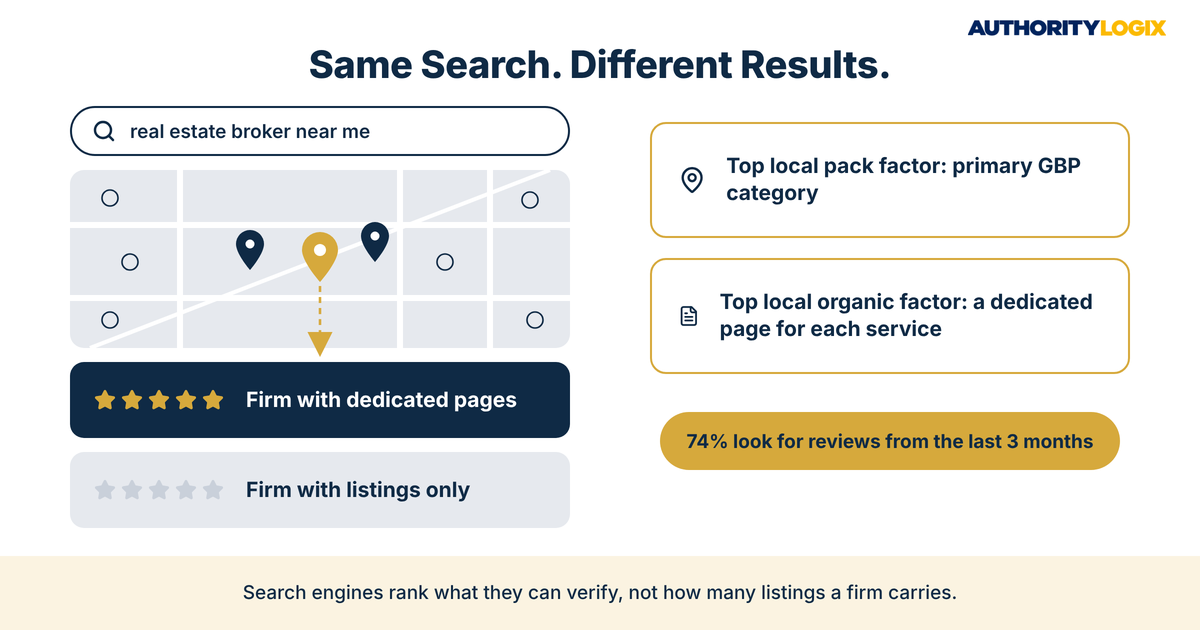
Why similar brokers rank differently is mostly a question of what Google can verify about each one. Whitespark’s 2026 Local Search Ranking Factors report lists the primary Google Business Profile category as the top factor for the local pack, and a dedicated page for each service as the top factor for local organic results. Neither factor has anything to do with how many listings a firm carries.
Picture two brokerages on the same avenue. Both have a Business Profile, an IDX search page and roughly the same listings. Only one also has a page for each area it serves, a page for each service it offers and a steady record of recent reviews. In a real estate firm authority comparison, that second firm wins nearly every signal before inventory ever enters the picture.
What Search Engines Can Verify About Each Firm
Reviews are the next layer of proof. BrightLocal’s 2026 Local Consumer Review Survey of 1,002 US adult consumers found that 74% look for reviews written in the last three months, and 80% say they are likely to use a business that responds to all of its reviews. In a real estate firm authority comparison, a steady flow of recent, answered reviews is a signal a dormant profile cannot fake.
Those signals turn into pipeline. A firm that ranks for the searches its prospects run feeds every stage of its lead generation system, while a firm that does not is left waiting on referrals. The visibility gap and the lead gap are the same gap.
The pattern is sharper with investors. A buyer looking at a two-family rental or a small mixed-use building searches for analysis — cap rates, rent rolls, financing options — before searching for a firm. Brokerages that publish genuine investor content meet that buyer during research, and in a real estate firm authority comparison those research pages become an asset the competition simply does not have.
The Agent Authority Gap Explanation: Content Depth, Links and Consistency
The agent authority gap explanation comes down to three variables that work together: how deep a firm’s content goes, how many credible sites link to it and how consistently it publishes. A firm can be strong on one and still lose, because each variable feeds the other two. Depth earns links, links lift rankings, and consistency keeps both from decaying.
Content Depth Versus Content Volume
Depth is not the same as volume, and some of the clearest evidence comes from outside real estate. Content Marketing Institute’s 2026 B2B research found that 96% of B2B marketers say their organization creates thought leadership content, yet only 4% rate their program leading and 7% advanced. Nearly everyone produces, and very few build authority. A real estate firm authority comparison shows the same split locally.
Links are the second variable. Ahrefs’ 2023 search traffic study found that 96.55% of all pages in its index get zero traffic from Google, and it reported a clear correlation between the number of websites linking to a page and that page’s traffic. Pages that explain something well earn links, which is how a firm builds a competitive moat no competitor can copy through the same IDX feed.
Consistency is the third variable and the one most firms break. A brokerage that publishes eight market updates in January and nothing until June leaves a record that looks abandoned to search engines and prospects alike. In a real estate firm authority comparison, the leading firm is rarely smarter. It simply kept publishing through the months when everyone else stopped.
Depth, links and consistency come together most clearly in an educational hub — a connected library of guides that answers the questions buyers, sellers and investors ask in the order they ask them. In a real estate firm authority comparison, a firm with that kind of library holds signals that a firm with scattered, disconnected posts cannot match.
Not sure how your firm would score in a real estate firm authority comparison against your top local competitors? The RE Authority Gap Assessment shows where your content, links and reviews fall short and what to build first.
How to Run a Real Estate Firm Authority Comparison Against Your Market
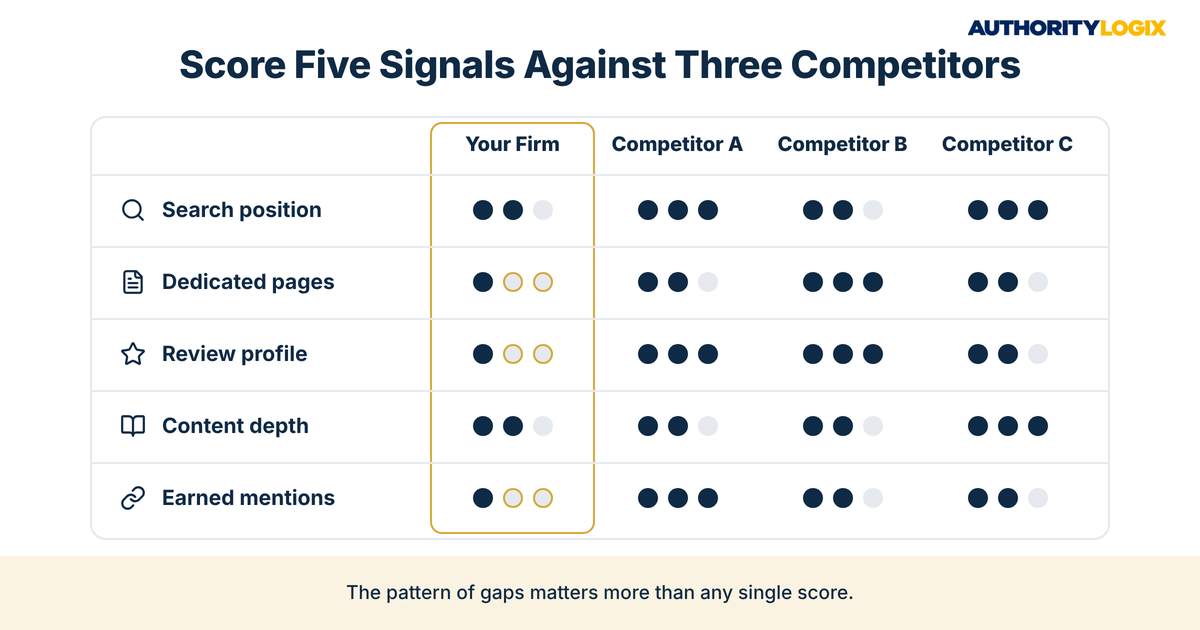
A useful real estate firm authority comparison takes an afternoon, not a consultant. Pick the three firms that most often appear above you for the searches that matter — your service areas, your property types and your services — and score each one, plus your own firm, on the same five signals. Use a private browser window so your own search history does not skew what you see.
Five Signals to Score in a Real Estate Firm Authority Comparison
| Signal | What to Check | What Strong Looks Like |
|---|---|---|
| Search position | Where each firm appears for five to ten core local searches | Map pack presence and page-one organic results for those searches |
| Dedicated pages | Area, property-type and service pages on each site | One page per market and service, each with original content |
| Review profile | Count, recency and owner responses on Google | Reviews from the last three months, with every review answered |
| Content depth | Guides, market reports and investor analysis | Explanations a buyer, seller or investor would save and share |
| Earned mentions | Links and citations from local media, associations and partners | Steady mentions from sites the market already trusts |
Score each signal from one to three and total the results. The point is not precision but pattern. Most firms find that their gap sits in two or three signals rather than all five, and some discover that a strong review profile is being wasted because the site has no lead generation path to catch the prospects those reviews send.
The second common pattern is a content gap disguised as a ranking gap. A firm that loses on search position in a real estate firm authority comparison often loses because it has nothing on its site worth ranking. Fixing that is a publishing problem, and the content system lays out the infrastructure that keeps those pages coming without depending on an agent’s spare evenings.
The third pattern is the mention gap. A firm may publish solid material that nobody outside its own website ever sees, so the links and citations never arrive. Getting finished work in front of local media, associations and partner sites is the job of authority distribution, and in a real estate firm authority comparison it is the step that turns good pages into earned mentions.
Closing the Real Estate Visibility Difference One Asset at a Time
The real estate visibility difference closes the same way it opened: one asset at a time. Firms that try to fix everything at once usually publish a burst of content, run out of time and go quiet again, which leaves them where they started. The firms that close the gap pick the weakest signal from their real estate firm authority comparison and build against that signal first.
Start with the signal that blocks the others. If your real estate firm authority comparison shows no dedicated area or service pages, reviews and links have nowhere useful to point, so pages come first. The AuthorityLogix resource library is organized the same way, with each guide building on the one before it, so you can follow the sequence.
Build on property you own. A profile on a national portal or a social platform can lose its reach overnight with a policy change, and the audience you built there never belonged to you. An owned presence — your site, your guides, your review record — is the part of the real estate visibility difference that keeps working no matter what the platforms decide.
This is the model behind BKDSCR.com, the AuthorityLogix proof-of-concept in the NYC outer-borough DSCR investment niche. It was built in under 18 months with 18 pillar pages, 7 interactive investor tools and 48 SEO-optimized blog posts, with zero paid ads. None of those assets looked impressive on day one. Together they became exactly the signals a real estate firm authority comparison measures.

What Firms Get Wrong When They Compare Themselves to Competitors
Most firms that run a real estate firm authority comparison do it once, glance at the results and draw the wrong conclusion. The mistakes below are the ones that come up most often, framed as the questions owners actually ask.
Is the firm with more listings always the authority?
No. Listings measure inventory, not visibility, and two firms with the same inventory can sit at opposite ends of a real estate firm authority comparison. Inventory helps a firm close deals once it is found, while authority decides whether it is found in the first place.
Should we copy whatever the top-ranking firm publishes?
Copying a competitor’s topics usually produces a weaker version of pages that already rank. The stronger move is to find the questions your market asks that nobody has answered well, which is the approach the growth playbook takes to long-term positioning. Matching a competitor puts you level at best, while filling the gaps they left is what moves you past them.
Can paid portal leads close the gap instead?
Portal leads can fill a calendar, but they never show up in a real estate firm authority comparison because the authority belongs to the portal. When the spending stops, the leads stop and nothing on your own site has grown. That is renting visibility, not building it.
Do we need an agent writing every week?
Not necessarily. Agents should supply the expertise while someone else turns it into finished pages and gets them distributed. That division of labor is what we do for real estate firms that are credible in their market but missing from its search results, and it means agents keep selling while the system keeps publishing.
How often should we rerun the comparison?
Quarterly is enough for most firms. Search positions shift slowly, and a real estate firm authority comparison run every three months shows whether the assets you added are moving the signals you targeted.
Ready to build the dedicated pages, review flow and earned mentions that move your firm from matching competitors on listings to leading them on authority?
The Honest Reason Authority Gaps Widen Every Year
Authority gaps widen because published assets keep working and unpublished expertise does not. A neighborhood guide written two years ago can still bring in sellers, while the knowledge in an agent’s head reaches only the people already in the room. Each year the firm with the library adds to it, and the firm without one starts again from zero.
That is why the gap rarely closes by accident. It closes when a firm decides to build in a deliberate order — pages, then reviews, then deeper content, then distribution — which is the sequence behind how we build authority for real estate firms. Every real estate firm authority comparison you run after that should show the distance getting smaller.
We know the sequence works because we ran it with our own time and money before offering it to anyone else, and that is the short answer to why AuthorityLogix exists. The longer answer is BKDSCR.com, built in a live, competitive market with no paid ads behind it.
The honest answer is that most firms losing a real estate firm authority comparison already have the expertise their competitors are publishing. What they are missing is the infrastructure that makes the market see it. The listings were never the difference, and they will not be the fix.