


Key Takeaways
- Real estate firm media coverage authority is the credibility a firm earns when journalists, trade publications, and local outlets choose to quote it — something no ad budget can purchase.
- Nielsen’s 2015 Global Trust in Advertising survey found 66% of consumers trusted editorial content such as newspaper articles, compared with 47% for ads in search results and 42% for online banner ads.
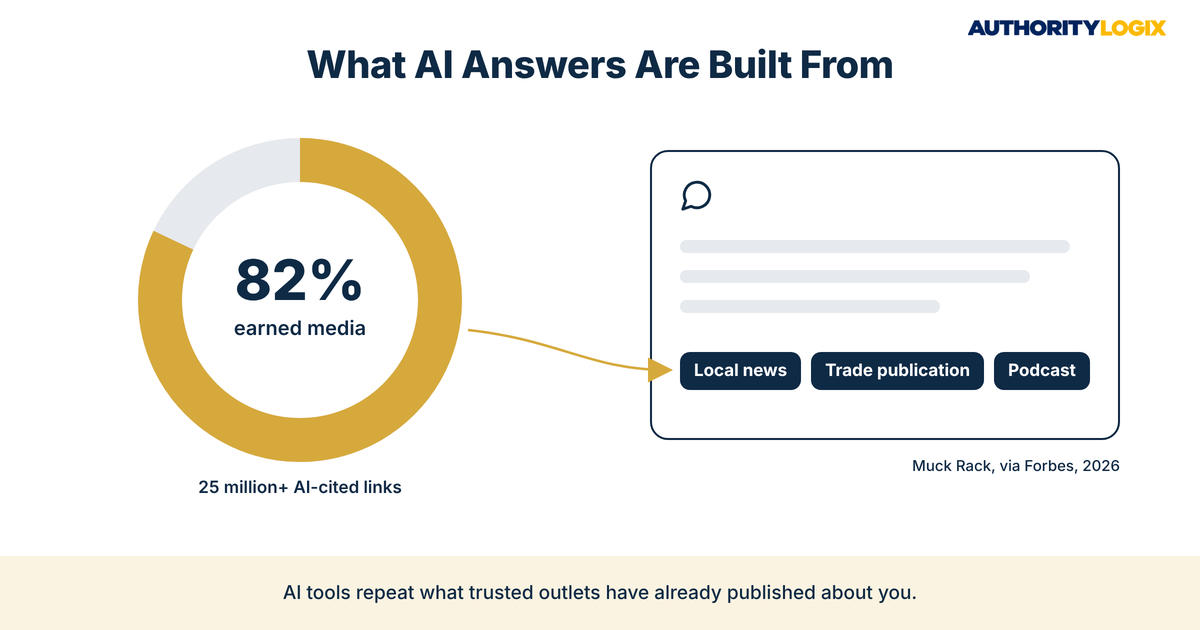
- A Muck Rack analysis of more than 25 million links cited by AI models found earned media made up roughly 82% of cited sources, as reported in Forbes in September 2026.
- Muck Rack’s 2025 State of Journalism report found 84% of journalists say at least some of their stories are inspired by PR pitches, while 86% disregard pitches that are not relevant to their beat.
- Real estate firm media coverage authority grows only when each mention is captured on your own site, connected to your content, and distributed to the people you want to reach.
- The work is a system build: something worth reporting, a repeatable pitch process, and owned infrastructure that carries each mention into search and AI.
Table of Contents
Real estate firm media coverage authority is the one form of credibility you cannot buy, and that is exactly why buyers, sellers, and investors trust it. You may have closed hundreds of deals and know every block in your market, yet stay invisible to anyone who was not referred to you, while a competitor with half your experience gets quoted in the local business journal every quarter. That gap is rarely about expertise. It is about whether your firm has the foundation covered in the local SEO playbook — the pages and signals that let journalists and prospects find you.
This is the credible but invisible problem in its plainest form. Paid ads can rent attention for a week, but they cannot make a reporter call you for comment on rising inventory or a zoning change. Real estate firm media coverage authority is built differently, and the rest of this article explains how to build it on purpose.
Why Real Estate Firm Media Coverage Authority Outlasts Every Paid Ad Budget
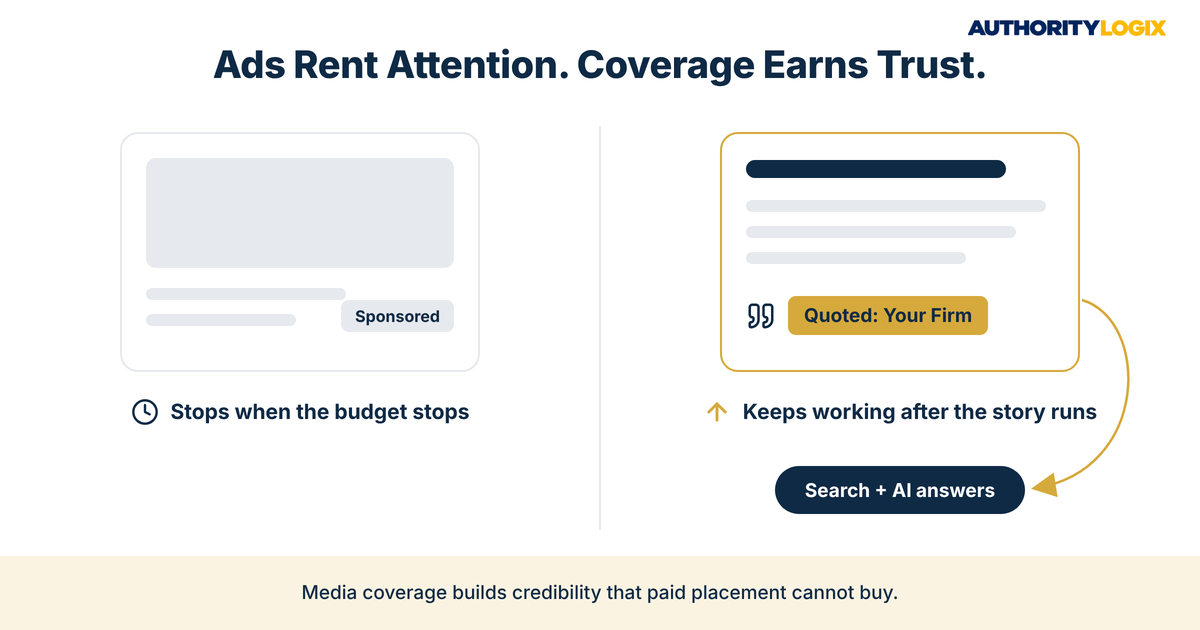
An ad tells the market what you say about yourself. A news story, a trade column, or a podcast interview tells the market what someone else decided you were worth quoting. That difference is the foundation of real estate firm media coverage authority, and it is why one well-placed story can shape a broker’s reputation more than months of sponsored posts. Look at how most real estate marketing budgets are spent and nearly all of it is paid placement that disappears the day the invoice stops.
When the budget ends, a portal ad or sponsored post drops out of view and takes its visibility with it. A quoted comment in a regional business publication stays indexed, keeps appearing when someone searches your name, and can be referenced on your own site for years. Infrastructure compounds. Ads stop.
The catch is that earned coverage rarely sustains itself. Most firms that land a story treat it as a one-time win, share it once, and move on. Real estate firm media coverage authority lasts only when each mention connects to content systems that capture it, publish around it, and point every new visitor toward deeper material on your site.
The Real Estate Authority Guide shows where real estate firm media coverage authority fits inside the full set of credibility signals that make a firm the obvious choice in its market.
What Broker Press Coverage Credibility Looks Like to a Buyer or Investor
Buyers and sellers still choose people, not platforms. NAR’s 2025 Profile of Home Buyers and Sellers found that 88% of buyers purchased their homes through a real estate agent or broker, and 91% of sellers sold with an agent’s help. For most prospects the question is not whether to hire a professional but which one, and broker press coverage credibility is one of the fastest ways a stranger can answer that question in your favor.
Third-party coverage also carries more weight than paid placement. Nielsen’s 2015 Global Trust in Advertising survey of more than 30,000 consumers in 60 countries found that 66% trusted editorial content such as newspaper articles. Ads in search engine results earned the trust of 47%, ads on social networks 46%, and online banner ads 42%. The same survey put branded websites at 70%, a reminder that coverage works best when it points to a site with real substance.
| Format | Share Who Trust It (Nielsen 2015) | Why It Matters for Real Estate Firm Media Coverage Authority |
|---|---|---|
| Branded websites | 70% | Your own site is where every story should send readers |
| Editorial content such as newspaper articles | 66% | A quoted market comment borrows the outlet’s credibility |
| Ads in search engine results | 47% | Rented visibility that resets when the budget ends |
| Ads on social networks | 46% | Reach without third-party validation |
| Online banner ads | 42% | The least trusted format in this comparison |
What Real Estate Firm Media Coverage Authority Signals Before the First Call
When a prospect searches your name before a listing appointment, they are looking for proof that other people take you seriously. A quote in a local news story about rent trends, a byline in a trade publication, or a podcast episode on small multifamily financing tells them that someone with editorial standards vetted you. That kind of real estate firm media coverage authority works before you pick up the phone, and it feeds your lead generation system by sending prospects to you already half convinced.
Investors read coverage differently from homebuyers. They want evidence that you understand cap rates, rent rolls, and local supply. Broker press coverage credibility with investors depends on having substantive investor content on your site to back up what the article said, because the first click after reading a story is usually your website.

How an Agent Earned Media Strategy Starts With Something Worth Reporting
Journalists are not short on pitches. Muck Rack’s 2025 State of Journalism report, based on 1,515 qualified journalist respondents, found that most journalists still receive more than five pitches per day, and only 3% say those pitches always align with their coverage. The same survey found that 86% will disregard pitches that are not relevant to their beat.
The opening is real, though. Muck Rack found that 84% of journalists say at least some of their stories are inspired by PR pitches. An agent earned media strategy wins that opening by bringing a reporter something they cannot easily get elsewhere: local data, a clear point of view, and a source who can explain what the numbers mean for people in the market.
Story Angles That Build Real Estate Firm Media Coverage Authority
The strongest angles come from work you already do. Every closed deal and investor call produces observations a local reporter would find useful. Real estate firm media coverage authority starts with turning those observations into material a journalist can use:
- A quarterly market report built from your own deal activity
- Plain-language commentary on rate changes, inventory shifts, or new local regulations
- Investor analysis of rent trends and small multifamily pricing
- Quotable answers to the questions clients ask most
- A named spokesperson who responds quickly and stays on topic
None of this works if the material lives in a slide deck. Data and commentary need a permanent home on your site where a reporter can verify and link to them, which is why any backlink strategy for agents starts with publishing assets worth citing rather than asking for links.
Over time, that material becomes an educational hub journalists can return to every time your market makes news. Firms that publish this way spend less time chasing reporters, because reporters start finding them through search. That is the quiet advantage of real estate firm media coverage authority built on owned content.
Not sure where your firm stands on real estate firm media coverage authority? The RE Authority Gap Assessment shows which credibility signals the market can see today and which ones are missing.
Turning Real Estate Firm PR Authority Into Search and AI Visibility
Coverage is no longer judged only by how many people read the story. It is also judged by what search engines and AI tools learn from it. A Muck Rack analysis of more than 25 million links cited by AI models found that earned media — unpaid, unmanaged third-party coverage — accounted for roughly 82% of cited sources, as reported in Forbes in September 2026.
That changes the math for real estate firm PR authority. When someone asks an AI assistant which brokers understand investment property in a given market, the answer is assembled from what other sources have already published, and the Forbes piece argues that generative models gravitate toward brands with dense, current, well-sourced media footprints. A firm with no coverage gives those systems nothing to draw from.
Coverage alone still leaves gaps. Each mention should send readers somewhere specific, and the lead generation infrastructure on your site — a report download or consultation request — is what turns a reader who arrived from a news story into a conversation. Real estate firm media coverage authority without a capture path just builds someone else’s audience.
The same applies to the pages coverage points to. A reporter who quotes your market analysis will often link to the original, so that original has to sit inside a connected content system rather than on an orphaned page. When it does, every link from an outlet strengthens the pages around it, and real estate firm media coverage authority starts showing up in ordinary search results as well as AI answers.
Then the coverage has to travel. A quote in a local business journal reaches that publication’s readers once, but authority distribution puts the same insight in front of your qualified audience on LinkedIn, in your email list, and across syndication channels.
How to Build Real Estate Firm Media Coverage Authority That Compounds
The firms that build real estate firm media coverage authority over years do not rely on lucky breaks. They run a simple, repeatable system in which every story feeds the next one, and every mention is captured, published, and distributed.
| Stage | What You Build | What It Produces |
|---|---|---|
| Source material | Quarterly market data from your own deals | Something a reporter cannot get elsewhere |
| Pitch process | A short list of reporters who cover housing | Fewer, better pitches that fit each beat |
| Owned home | A press page and supporting articles on your own site | A place for every mention to point |
| Distribution | LinkedIn, email, and syndication of each story | Repeat exposure to your qualified audience |
| Measurement | Branded searches, inquiries, and referring links | Proof of which coverage drives conversations |
The Publishing Cadence Behind Real Estate Firm Media Coverage Authority
A steady cadence matters more than any single placement. A firm that publishes one market report each quarter, pitches it to a handful of relevant reporters, and logs every resulting mention on its site builds a record that grows each year. The AuthorityLogix resource library follows the same principle, with each new article strengthening the ones already published.
This is also where the comparison with paid placement becomes concrete. Ad spend buys a fixed window of visibility, while content infrastructure keeps producing value after the work is done. Real estate firm media coverage authority sits on the infrastructure side of that line, as long as you capture what you earn.
BKDSCR.com, the AuthorityLogix proof-of-concept in the NYC outer-borough DSCR investment niche, shows what that owned foundation looks like: 18 pillar pages, 7 interactive investor tools, and 48 SEO-optimized blog posts, built in under 18 months with zero paid ads. That library gives a reporter something to cite and a reader somewhere to go next.

What Real Estate Firms Get Wrong About Press Coverage
Most firms that struggle with press are not short on expertise. They are working from assumptions that made sense when a framed newspaper clipping was the whole payoff. Here are the questions firm owners ask most often.
Is a paid press release the same as earned media?
No. A distributed press release is paid placement, and reporters and readers treat it that way. Real estate firm media coverage authority comes from an editor choosing to quote you, which is why one relevant local story usually does more than a stack of wire releases.
Do we need a PR agency to get coverage?
Not necessarily. Many firms land their first stories by offering reliable local data to two or three reporters who already cover housing, and an agency only helps if it is working from real material. The growth playbook treats coverage as one piece of a wider visibility system, so it gets built in order with everything else.
Who should own media relations inside a brokerage?
Your principals should own the expertise and someone else should own the system, because a busy broker will not track reporters, publish market data, and distribute every mention each month. Keeping the knowledge in-house while the publishing and distribution run outside is what we do for real estate firms that are credible in their market but missing from its coverage.
Can anyone guarantee coverage?
No one can, and anyone who promises placements is describing paid media. What you can control is having something worth reporting, pitching it to the right people, and making sure every mention you earn keeps working for your real estate firm media coverage authority.
Ready to turn your market data and expertise into press coverage that keeps building credibility long after the story runs? Let’s build the system that captures and distributes every mention you earn.
The Honest Truth About Earned Media for Brokers and Agents
Earned media is slower than paid placement and less predictable. Some quarters will produce nothing. But the firms that commit to it build something their ad-dependent competitors never will: a public record of being the people others quote. That record is real estate firm media coverage authority, and it keeps paying out after the work is done.
The sequence in how we build puts the owned foundation first — the pages, data, and distribution that make coverage worth having — and pitching second. That order matters because a story pointing to a thin website wastes the attention it creates.
We can explain our approach with specifics because BKDSCR.com was built in a live, competitive market with AuthorityLogix’s own time and money. The same thinking applies to any broker, agent team, or investment firm with real expertise and a market that has not yet seen it.
The honest answer is that most real estate firms already have the expertise reporters want to quote. What is missing is the infrastructure that makes the market see it, and real estate firm media coverage authority is what that infrastructure produces when it is built in the right order.