


Key Takeaways
- Real estate long-tail keywords are specific, multi-word searches such as a neighborhood, a price range or a property type, and they signal a buyer or seller who is close to acting.
- According to the National Association of Realtors 2025 Home Buyers and Sellers Generational Trends report, 43% of buyers started their search by looking online for properties, and 51% found the home they bought on the internet.
- Ahrefs reports that keywords with fewer than 10 searches per month make up almost 93% of its U.S. keyword database, so most real search demand lives in the long tail.
- Real estate keyword research works best when it starts from the questions clients ask in person, then checks Google suggestions and the “People also ask” box.
- High-intent real estate keywords split into buyer, seller and investor searches, and each group needs its own page with its own next step.
- One page per search intent, connected by internal links to a pillar page, turns scattered long-tail rankings into a steady inbound pipeline.
Table of Contents
Why Real Estate Long-Tail Keywords Win Higher-Intent Clients
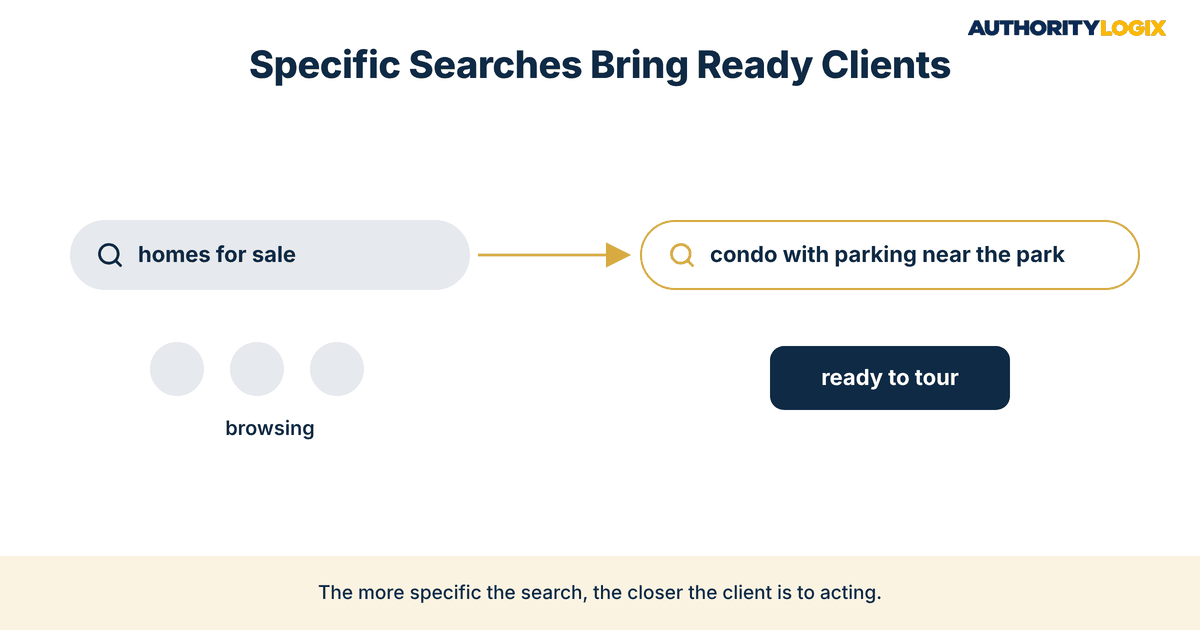
Real estate long-tail keywords are the specific searches people type when they already know what they want: a neighborhood, a price range, a property type, a school district or a question about a sale. A search for “homes for sale” could come from anyone. A search for a two-family house near a named park under a set price comes from someone who has done their homework. Your broader keyword strategy sets the market you serve, and real estate long-tail keywords are where that market turns into conversations.
The search starts earlier than most agents assume. According to the National Association of Realtors 2025 Home Buyers and Sellers Generational Trends report, 43% of buyers said their first step was looking online for properties for sale, and 51% found the home they purchased on the internet. The same report found that 88% of buyers purchased with the help of an agent. The online search and the agent are not competitors; the search is how buyers decide which agent to call.
That is why real estate long-tail keywords matter more than broad terms for most firms. The national portals own the short searches, and a local brokerage will rarely outrank them for a city name plus “homes for sale.” The specific searches are different, because portals answer them with listings while a local firm can answer them with knowledge, and that answer is what good real estate marketing is built on.
Short-Tail vs Long-Tail Keywords in Real Estate
A short-tail keyword is one or two words with large volume and vague intent, such as “real estate” or a city name plus “homes.” A long-tail keyword adds the details that reveal intent: location, budget, property type, timing or a problem to solve. Short-tail terms bring browsers. Real estate long-tail keywords bring people who are comparing options, which is exactly when a credible local answer earns the call.
Long-tail does not mean low value. Each phrase draws fewer searches, but there are far more of them, and together they add up to most of the demand in a local market. A firm that ranks for dozens of specific phrases often receives more qualified inquiries than a firm chasing one broad term it will never win.
The Real Estate Local SEO Playbook shows how to get found before the big portals do, and where real estate long-tail keywords fit into a local search plan.
How Specific Property Search Keywords Work
Specific property search keywords follow a pattern. Most combine three building blocks: a place, a property and a qualifier. The place can be a city, a neighborhood, a school zone or a street. The property can be a condo, a two-family, a townhouse or a multifamily building. The qualifier is the detail that narrows the search, such as a price ceiling, a feature, a timeline or a financing type.
Once you see the pattern, real estate long-tail keywords stop looking random. Each combination is a page or a section waiting to be written, and the combinations multiply quickly in any real market. Organizing them into a repeatable publishing plan is the job of dedicated content systems, so pages get built in a steady order instead of whenever someone has a free afternoon.
Question searches are the other half of real estate long-tail keywords. Buyers ask how closing costs work, what a co-op board looks for, or how long a sale takes in a given neighborhood. Sellers ask what their home is worth, whether to renovate before listing, and when to list. Each question is a search a real person typed, and each one is a chance to answer it better than a portal can.
The Ahrefs research behind its long-tail keywords guide shows how lopsided search demand is: keywords with fewer than 10 searches per month account for almost 93% of its U.S. keyword database. For a real estate firm, that means most of the searches that matter to your market will never show up as big numbers in a keyword tool. They show up as conversations, and the firms that publish answers to them collect the inquiries.
This is also where real estate long-tail keywords protect a small firm. A broad term can be bought or outranked by a portal with a large budget, but a precise answer to a neighborhood question is hard to copy without local knowledge. Building that library of answers is what we build for firms that want search visibility they own instead of rent.

Real Estate Keyword Research: Finding the Phrases Buyers and Sellers Type
Real estate keyword research starts in your own inbox, not in a software tool. The questions buyers and sellers ask in showings, listing appointments and follow-up emails are the most reliable list of long-tail phrases you will ever get, because they come from the people you want to reach. Write them down in the words clients used, not in industry language, because those words are your real estate long-tail keywords.
Next, test those phrases where search behavior is visible. Type each one into Google and note the suggestions that appear as you type, the questions in the “People also ask” box, and the related searches at the bottom of the results page. Each of those is a phrase other people searched, and many will be more specific than your starting list.
Then sort what you find by intent. A phrase that names a price and a neighborhood belongs on a buyer page. A phrase about home value or timing belongs on a seller page. A phrase about rental income or cap rates belongs on an investor page. Sorting first keeps your real estate content focused, because each page answers one kind of question for one kind of client.
Five Proven Sources of Real Estate Long-Tail Keywords
- Client questions: the exact words buyers and sellers use in emails, calls and showings.
- Google suggestions: the phrases that appear as you type a neighborhood or property type into the search box.
- People also ask: the question box on the results page, which shows related questions searchers ask.
- Related searches: the list at the bottom of the results page for each phrase you test.
- Your own site search and analytics: the queries that already bring visitors, including ones you never targeted.
Local knowledge is what turns that list of real estate long-tail keywords into an advantage. An agent who knows which blocks flood, which buildings have strict boards, or which streets sit in a sought-after school zone can answer questions a keyword tool will never surface. That kind of industry experience is the raw material of long-tail content, and it is the one ingredient national portals cannot buy.
Not sure which real estate long-tail keywords your market is already searching, and whether your site answers them? The assessment shows where your firm stands against local competitors.
High-Intent Real Estate Keywords: Buyer, Seller and Investor Searches
High-intent real estate keywords are the phrases that show a person is close to a decision. They usually name something concrete, such as a price, a timeline, a building, a financing type or an action like “sell” or “tour.” Treating all real estate long-tail keywords as equal wastes effort, because a curious browser and a seller who needs to move in ninety days type very different searches.
| Client type | Example long-tail search | What the page should offer |
|---|---|---|
| Buyer | Two-family homes near a named park under a set price | Neighborhood context, current inventory and a tour request |
| Buyer | What a co-op board asks for in a specific neighborhood | A plain-language guide and a consultation offer |
| Seller | What is my home worth in a named neighborhood | Recent sales context and a valuation request |
| Seller | Best time to list a condo in a named city | Local timing patterns and a listing consultation |
| Investor | Rental income for a two-family in a named neighborhood | Rent context, deal math and a call with an investment specialist |
Location is what makes most of these phrases local, and local pages are where small firms win. Dedicated neighborhood pages give each area its own home on your site, so specific searches about that area have a precise page to land on instead of a general listings feed.
Each page also needs a next step that matches the search. A buyer searching a specific building wants a tour, a seller searching home values wants a valuation, and an investor searching rental income wants the numbers. Matching the offer to the intent is the core of inbound lead generation, and it is where real estate long-tail keywords stop being traffic and start being appointments.
Investor searches deserve special care. Phrases about rental income, cap rates, financing and multifamily buildings come from people who compare numbers before they call anyone. A page that shows the math clearly earns their trust faster than a page that only lists properties, which is why investor-focused real estate long-tail keywords reward depth over volume.

Building Pages Around Real Estate Long-Tail Keywords
Finding real estate long-tail keywords is the easy part. Building pages that rank for them takes structure. The most common mistake is writing one blog post per phrase with no connection between them, which leaves dozens of thin pages competing with each other and no clear signal to Google about what the firm actually knows.
The fix is a hub-and-spoke structure. A broad page covers the main topic, such as buying in a specific neighborhood, and links out to focused pages that each answer one specific search. A well-built pillar page ties the cluster together, so every new long-tail page strengthens the others instead of diluting them.
One Page per Search Intent
Each page should target one intent, not one exact phrase. Several long-tail variations often share the same need, such as different wordings of the same question about closing costs. Those belong on one strong page that answers the question completely, with the variations used naturally in headings and paragraphs, rather than on five nearly identical pages.
Over time, those pages form a library that answers the questions your market asks most. An organized educational hub makes the library easy to browse for clients and easy to crawl for search engines, and it gives every new page a place to live from the day it is published.
The publishing rhythm matters as much as the structure. A firm that adds two well-researched pages on real estate long-tail keywords a month for a year ends up with a library of more than twenty specific answers, each one a new way to be found. The content system lays out how to plan that rhythm so it survives busy listing seasons.
What Agents Get Wrong About Real Estate Long-Tail Keywords
Most problems with real estate long-tail keywords come from treating them like broad keywords with extra words. The goal is not to stuff a long phrase into a page. The goal is to answer the specific question behind it better than anyone else in the market, which is the same principle behind the trust signals in the authority guide.
Mistake: chasing search volume instead of intent
A phrase with ten searches a month from serious sellers is worth more than a phrase with a thousand searches from casual browsers. Judge each phrase by who types it and what they want next, not by the number a keyword tool shows.
Mistake: publishing pages nobody ever sees
A good page still needs to be found. Sharing each new answer through email, social profiles and partner channels speeds up discovery, which is the role of authority distribution in a long-tail plan.
FAQ: What long-tail keywords should real estate agents target?
Start with the searches that combine your strongest neighborhoods with the property types you sell most, then add the questions clients ask you every week. Those phrases match the business you already do, so the inquiries they bring are the ones you are best placed to win. The resource library has more guides on choosing which pages to build first.
FAQ: How many long-tail keywords should one page target?
One primary intent per page, with a handful of close variations used naturally. If two phrases need different answers or different next steps, they need different pages.
FAQ: How long do real estate long-tail keywords take to rank?
Specific, low-competition phrases often move faster than broad terms, but timing depends on the site, the market and the quality of the page. Consistent publishing and internal linking matter more than any single page, which is how we work with every client.

Ready to turn the questions your clients already ask into pages that bring buyers and sellers to you?
The Bottom Line: Specific Searches Build Specific Pipelines
Real estate long-tail keywords reward the firms that know their market best. The searches are small one at a time, but together they cover most of what buyers, sellers and investors actually type, and each one is a chance to show local knowledge a portal cannot match. A firm that answers those questions consistently builds visibility that keeps working long after each page is published.
The approach is proven in practice. You can see it applied in our work, including BKDSCR.com, built with 18 pillar pages and 7 interactive investor tools that answer the specific questions DSCR investors search. The same structure works for any real estate firm willing to write down what clients ask and answer it in public.
Start small and stay consistent. Pick one neighborhood, list the ten questions clients ask about it most, check each one in Google, and publish one complete answer at a time. Within a year, real estate long-tail keywords can become the most reliable source of inquiries your firm has.