


Key Takeaways
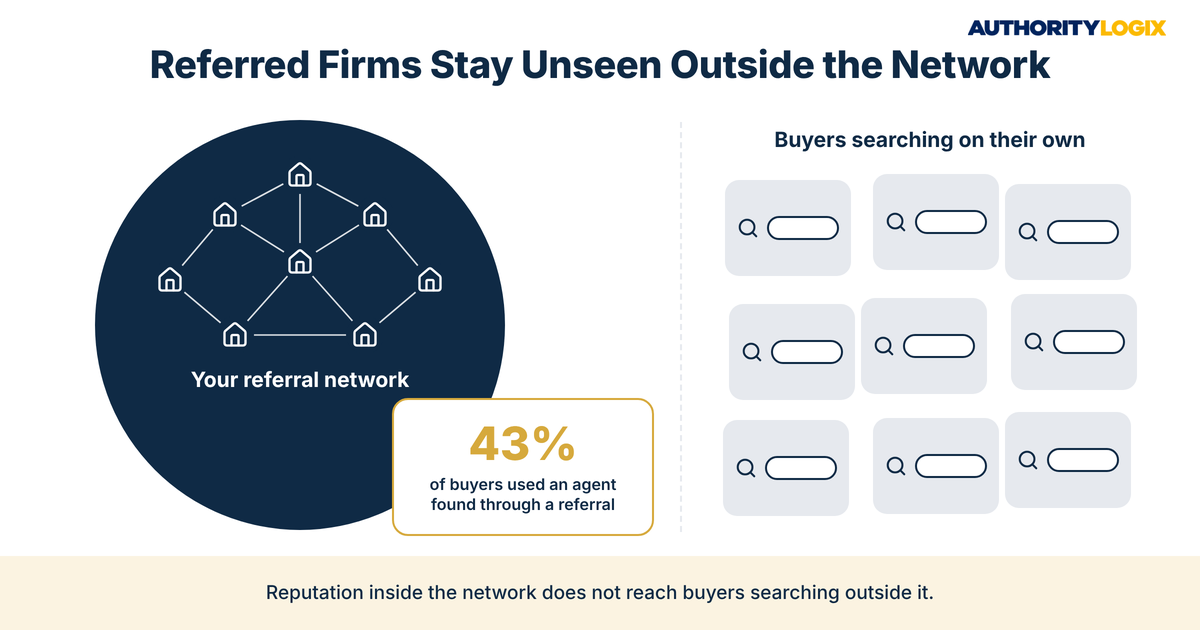
- The real estate referral dependence visibility gap is the distance between the reputation a firm has earned inside its network and what a qualified buyer who was never referred can actually find.
- NAR’s 2025 Profile of Home Buyers and Sellers found that 43% of buyers used an agent they found through a referral — proof that referrals matter, and a reminder that they are only one path buyers take.
- The same NAR report found that 66% of sellers found their agent through a referral or used an agent they had worked with before, so relationship business is real — and it stops at the edge of your network.
- Closing the real estate referral dependence visibility gap does not mean abandoning referrals; it means adding owned content, search visibility and distribution that let strangers verify you.
- BKDSCR.com shows the model at work: 18 pillar pages, 7 interactive investor tools and 48 blog posts, built with zero paid ads.
Table of Contents
What the Real Estate Referral Dependence Visibility Gap Actually Costs a Firm
The real estate referral dependence visibility gap is what happens when a firm’s reputation lives entirely inside the people who already know it. You may have closed hundreds of transactions, kept repeat clients for a decade and built a referral network most agents would envy — and still be missing when a qualified buyer who has never heard your name starts searching. The local SEO playbook explains how local search decides who that buyer sees first, and for a referral-built firm the answer is usually someone else.
That is the credible but invisible problem in its plainest form. Inside your network, you are the obvious choice. Outside it, you are a name with a thin website, a quiet Google Business Profile and no published proof of what you know. The real estate referral dependence visibility gap is not a talent problem or an effort problem — it is a structural one, and it costs the firm every month it stays open.
Referrals are still the strongest channel most firms have, and the data backs that up. According to NAR’s 2025 Profile of Home Buyers and Sellers, 43% of buyers used an agent that they found through a referral, and 18% chose to purchase through an agent they had worked with in the past. They also describe a channel with a hard edge: a referral can only come from someone who already knows you.
Every buyer outside that circle is the cost of the real estate referral dependence visibility gap. Across the real estate industry, referral-built firms tend to measure success by deals closed, not by the deals they never had a chance at — and the second number is the one that limits growth. A buyer relocating into your market, an investor comparing three firms, a seller whose friends all used someone else: none of them can refer themselves to you.
What closes the real estate referral dependence visibility gap is not more effort from the people already doing the deals. It is a set of content systems that turn what your team already knows into pages, guides and market answers a stranger can find and verify. Those systems keep working when the referral calendar is slow, which is exactly when a referral-only firm feels the real estate referral dependence visibility gap the most.
The Real Estate Authority Guide shows how to turn the reputation your referrals already prove into market authority that qualified buyers outside your network can see.
Why the Broker Referral Ceiling Authority Problem Shows Up After Year Five
Most referral-built firms do not feel the ceiling early. In the first years the network grows almost as fast as the firm does — every closed deal adds a past client, and every past client knows a few more people. For a lot of brokers, that math changes somewhere around year five. The network keeps producing, but it stops growing at the pace the firm needs, and the broker referral ceiling authority problem shows up on the calendar first.
Your referral network is a ceiling, not a foundation. It can support a good business, but it cannot be extended on demand, and it does not respond when you decide to grow into a new neighborhood, a new price point or a new client type. A purpose-built lead generation system works differently, because it is designed to reach people who have no connection to you yet.
How the Real Estate Referral Dependence Visibility Gap Widens Over Time
The real estate referral dependence visibility gap widens quietly. While referrals stay steady, newer competitors publish market updates, collect reviews and build pages that answer the questions buyers are typing. Each year those firms add searchable proof, and each year the referral-only firm adds none. The experience gap may favor you, but the visibility gap favors them.
The effect is sharpest with investors, who rarely pick a firm on a friend’s word alone. They compare rent assumptions, property types and local knowledge before making contact, and firms that publish investor content give them something to compare. A broker with twenty years of investment sales and nothing published loses that comparison by default, which is the broker referral ceiling authority problem in a single transaction.
None of this means referrals stopped working. It means the firm outgrew a single channel, and the real estate referral dependence visibility gap is the price of never building a second one.

Where Qualified Buyers Look When No One Refers Them to You
When no one refers a qualified buyer to you, the search starts on a screen. NAR’s 2025 Profile of Home Buyers and Sellers reports that the home search process most often began online, and that recent buyers ranked real estate agents as their most useful information source (85%).
That sequence is where the real estate referral dependence visibility gap does its damage. Buyers start online and still want an agent, so the real question is which agent they find while they search. A firm stuck at the referral ceiling is absent from that moment, even when it is the most experienced option in the market.
| Where a Non-Referred Buyer Looks | What They Need to Find | What a Referral-Only Firm Usually Shows |
|---|---|---|
| Local search and the map pack | A verified profile, recent reviews and clear service areas | A profile claimed years ago with few recent reviews |
| Neighborhood and market pages | Specific answers about the areas, price points and property types they are weighing | A homepage and a listings feed |
| Educational guides | Plain explanations of the buying, selling or investing process | Nothing published beyond listings |
| A search on your firm’s name | Proof that matches what they heard or read about you | A thin website that undercuts the reputation |
| AI answer tools | Clear, structured content those tools can draw from | No published content to reference — the real estate referral dependence visibility gap at its widest |
Qualified buyers also spend real time in research mode. NAR’s 2025 Profile puts the median search duration at 10 weeks — ten weeks of questions that someone is going to answer. Firms that build an educational hub become that someone, and the real estate referral dependence visibility gap starts to close before the buyer ever picks up the phone.
Sellers follow a similar pattern with a different emphasis. The same NAR report found that 66% of sellers found their agent through a referral or used an agent they had worked with in the past, and 35% of sellers emphasized the importance of the agent’s reputation. Reputation matters, but reputation that cannot be verified online does little for the seller who was never introduced to you.
Not sure how wide the real estate referral dependence visibility gap is at your firm? The RE Authority Gap Assessment shows what a non-referred buyer can and cannot find about you, and what to build first.
How Agent Beyond Referrals Visibility Gets Built Without Abandoning Your Network
Agent beyond referrals visibility does not replace the network. It extends the network’s reputation to people the network will never reach. Firms that do this well treat referrals as the base of the business and owned content as the layer that lets the base grow — the referral still arrives, but now the referred client can also verify what they were told.
That last point is easy to miss. A referred client often searches your name before calling, so the real estate referral dependence visibility gap affects them too. When that search shows a thin site and an empty profile, the referral loses some of its strength, and solid lead generation infrastructure keeps those warm introductions from going cold.
The Four Layers of Agent Beyond Referrals Visibility
| Layer | What It Does | What It Replaces |
|---|---|---|
| Searchable market pages | Answer the neighborhood, price point and property-type questions qualified buyers type | Waiting for someone to mention your name |
| Educational guides | Teach the process and show your judgment before the first call | The same explanation repeated to every new client |
| Review and profile signals | Give strangers recent, specific proof of your work | Word of mouth that only travels inside the network |
| Authority distribution | Places your expertise on platforms and publications buyers already read | A reputation limited to past clients and the real estate referral dependence visibility gap that comes with it |
Those layers only work when they are fed on a schedule rather than in bursts. The approach in the content system treats each market page, guide and update as part of one connected library, so every new piece strengthens the ones already published.
The final layer is reach. Publishing on your own site makes you findable, while authority distribution places that same expertise where qualified buyers and investors already spend time — syndicated articles, industry publications and LinkedIn. That is how agent beyond referrals visibility stops depending on whether a stranger happens to search the exact right phrase.
Your network does not need to change for any of this to work. Past clients still refer, and the real estate referral dependence visibility gap shrinks because strangers finally have a way in.

Closing the Real Estate Referral Dependence Visibility Gap With Owned Content
Owned content is the part of the system you control completely. Ads stop when the budget stops, and portal listings belong to the portal. Pages, guides and market reports published on your own domain keep answering questions for as long as they stay accurate, which is why owned content is the most durable way to close the real estate referral dependence visibility gap.
What Owned Content Has to Prove to a Stranger
A referred client arrives with trust borrowed from the person who sent them. A stranger arrives with none, so owned content has to do the work the referral used to do. It has to show local knowledge that only someone working the market would have, explain the process plainly and make the next step obvious.
Firms that want to see how this looks in practice can browse the AuthorityLogix resource library, where each guide is built around a specific question real estate firms ask. The structure matters as much as the writing: each piece answers one question well and points to the next logical one.
The payoff shows up in lead quality. Prospects who find you through your own content have already read your thinking, and the difference between organic leads and purchased lists comes down to that head start.
BKDSCR.com, the AuthorityLogix proof-of-concept in the NYC outer-borough DSCR investment niche, was built on this model: 18 pillar pages, 7 interactive investor tools and 48 SEO-optimized blog posts, with zero paid ads, in under 18 months. It was built for the same reason a referral-built firm needs owned content — to be found by investors who had never been introduced.
The real estate referral dependence visibility gap closes one published answer at a time. That is slower than buying ads and faster than waiting for the network to grow, and every accurate page keeps adding reach long after it goes live.

What Firms Get Wrong About the Real Estate Firm Referral Limit
Most firms that hit the real estate firm referral limit are not doing anything wrong with their clients. They are working from assumptions that made sense when referrals could carry the whole business, and the growth playbook covers why those assumptions break as a firm grows. These are the mistakes that keep the real estate referral dependence visibility gap open.
If referrals are working, why build anything else?
Because working and growing are different things. Referrals reward past service, but they cannot be turned up when you want more business, and the real estate referral dependence visibility gap means every buyer outside your network goes to someone else by default.
Can the agents handle content in their spare time?
Rarely, and not for long. Agents should own the expertise while someone else owns the system, because a busy agent will not update pages, request reviews and publish guides every week. That split — your knowledge, an outside build — is what we do for firms that are trusted in their market but missing from its search results.
How long does it take to close the real estate referral dependence visibility gap?
It depends on the market, the competition and how much the firm has already built. Profile and review improvements can show up sooner, while market pages and guides need time to earn rankings. No one can honestly guarantee a ranking position or a lead count.
Does the real estate firm referral limit apply to large teams too?
Yes, and often more sharply. A large team multiplies the number of agents who need deals, but each agent’s network has its own edge, so the real estate referral dependence visibility gap grows with headcount unless the firm builds shared, searchable proof.
Ready to build the owned content and visibility system that closes your real estate referral dependence visibility gap?
The Honest Math on Referrals Versus Being Findable
Referrals will probably remain a large part of your business, and they should. But the honest math on the real estate referral dependence visibility gap is simple: referrals stop at the edge of your network, and findability does not. The sequence in how we build puts the faster visibility signals first, then adds the market pages and guides that take longer to mature.
We hold that view because we have built it ourselves. BKDSCR.com was built in a live outer-borough market with AuthorityLogix’s own time and money, which is why AuthorityLogix talks about this work with specifics instead of promises.
The honest answer is that most referral-built firms already have the expertise qualified buyers are searching for. What is missing is the infrastructure that lets those buyers see it, and the real estate referral dependence visibility gap stays open until someone builds it.