


Key Takeaways
- Real estate website internal linking decides which of your pages Google treats as important, because Google says it uses links as a relevance signal and to find new pages to crawl.
- Google’s Search Central documentation says every page you care about should have a link from at least one other page on your site.
- Semrush advises aiming for at least two or three internal links pointing to every new piece of content, and flags pages more than three clicks from the homepage.
- A pillar-and-cluster structure lets one investment firm or brokerage site rank for many related searches instead of a single page competing for everything.
- Good anchor text is descriptive, reasonably concise, and relevant, per Google — and Semrush suggests keeping it to five words or fewer.
- Real estate website internal linking is infrastructure, not a one-time cleanup: every new page joins the system the day it is published.
Table of Contents

Why Real Estate Website Internal Linking Decides Which Pages Rank
Real estate website internal linking is the quiet system that decides whether Google sees your firm as one strong page or as a connected library of expertise. Most investment firms and brokerages already have the material — market reports, acquisition criteria, deal summaries, investor FAQs — but those pages sit side by side with no paths between them. The firm is credible but invisible, and the cause is structural rather than a shortage of content.
Google is direct about why this matters. Its Search Central documentation states that Google uses links as a signal when determining the relevancy of pages and to find new pages to crawl. How pages connect is a core part of how the AuthorityLogix real estate industry hub approaches visibility for investment firms, brokers, and teams, because a page nothing links to sends no signal at all.
For a firm with dozens of published pages, real estate website internal linking determines which pages get discovered, which look important, and which quietly carry no weight. Publishing more without connecting it does not solve the problem — it only multiplies the number of disconnected pages. That is why the publishing model in the content system treats every new article as a node that must link into an existing pillar before it goes live.
This is also where most website projects stop short. They deliver pages and articles, but not the architecture that ties articles to service pages, calculators, and conversion paths. Building that architecture is part of what we do for real estate firms, because rankings across multiple pages come from structure, not from any single post.
The Real Estate Local SEO Playbook shows where real estate website internal linking fits inside the full local search system — site structure, market pages, profiles, and reviews working together.
Investment Firm SEO Site Architecture: Hubs, Clusters, and Click Depth
Investment firm SEO site architecture is the floor plan that real estate website internal linking is drawn on. The simplest version that works has three layers: a homepage, a small set of pillar pages that each own one broad topic, and supporting articles that each answer one narrower question. Links run down from each pillar to its cluster, back up from each article to its pillar, and sideways between articles that genuinely relate.
For an investment firm, the pillars usually map to what the firm actually does — acquisitions, investor relations, specific markets, specific property types. The sequence in how we build starts there, with the architecture mapped before a single article is written. Retrofitting real estate website internal linking onto a backlog of unplanned posts takes far longer than planning it once.
How Real Estate Website Internal Linking Handles Click Depth
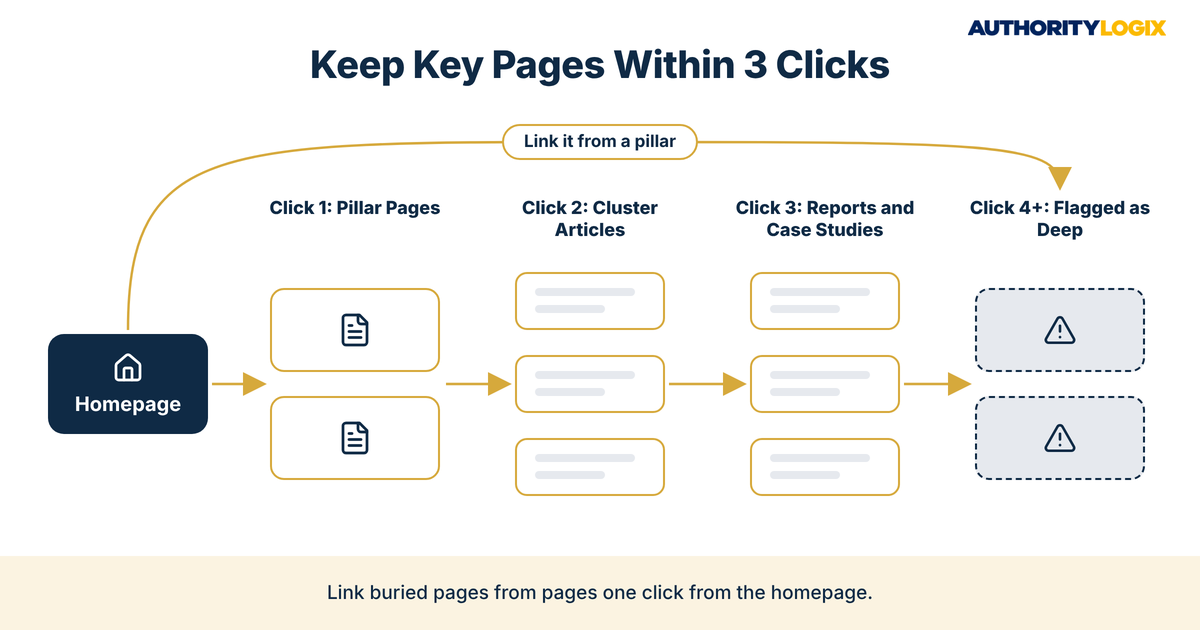
Click depth is the number of clicks it takes to reach a page starting from the homepage. Semrush’s internal linking guide recommends aiming for “at least two or three internal links” pointing to every new piece of content, and its Site Audit tool flags pages with a crawl depth of more than three clicks from the homepage. The guide, by Alex Lindley and published September 10, 2026, notes that deep pages may signal to crawlers that a page has little importance.
In real estate website internal linking, the pages most often buried are the ones investors value most — a deal case study four menus deep, a market report linked only from an old newsletter. Semrush’s suggested fix is to link directly to deep pages, ideally from pages only one click from the homepage — on most firm sites, that means a pillar or a primary service page.
The same logic applies to the pages that convert. Your investor content — acquisition criteria, a track record summary, an explainer on how your fund structures distributions — should sit no more than a couple of clicks from wherever an investor first lands. If an investor has to hunt for it, most will not.
Broker Content Pillar Cluster Links That Pass Relevance
Broker content pillar cluster links are the specific connections between a pillar page and the articles that support it, and they are where relevance is passed or lost. A brokerage with a pillar on 1031 exchanges and a handful of supporting articles has a real cluster only if those pages link to each other with anchors that describe the destination. Without the links, Google sees separate pages competing for overlapping searches.
The rule is reciprocal. Every supporting article links up to its pillar, the pillar links down to every supporting article, and articles link sideways only when a reader finishing one would naturally want the other. This is the model laid out in the pillar page strategy, and it is why real estate website internal linking is planned per cluster, not per page.
What One Brokerage Cluster Looks Like
Here is a simple cluster an investment brokerage could build around a single pillar. Broker content pillar cluster links run between every piece, so each page strengthens the others:
- Pillar: a complete guide to buying small multifamily property in your market
- Supporting: how to read a rent roll before making an offer
- Supporting: what lenders review on a two-to-four-unit purchase
- Supporting: estimating repairs and capital expenses on older buildings
- Supporting: when a 1031 exchange makes sense for a multifamily seller
A cluster also needs a steady supply of new pages. One that stops growing stops showing that the topic is actively covered, while competitors who keep publishing keep adding pages to their own. Ongoing content systems solve this by assigning each new article to a specific pillar, so real estate website internal linking expands every time something is published rather than waiting for an annual cleanup.
Not sure where your firm stands on real estate website internal linking? The RE Authority Gap Assessment shows where your pages are disconnected, buried, or missing, and what to connect first.
Real Estate Pillar Page Internal Links: How Many and Where
Real estate pillar page internal links carry more weight than links anywhere else on the site, because the pillar is the page you most want to rank and the page that passes relevance to everything beneath it. Google’s documentation offers no target number. It states that “there’s no magical ideal number of links a given page should contain,” and adds that if you think it’s too much, then it probably is.
That leaves the count to judgment, guided by structure. The pillar links to every article in its cluster, each article links back to the pillar early in the body, and each new article receives links from at least two or three existing pages, in line with the Semrush guidance above. Firms that publish large educational archives face one more layer, covered in the guide to resource library SEO for investment firms.
| Link Location | What It Does | Rule of Thumb |
|---|---|---|
| Pillar to cluster articles | Passes relevance down to each supporting topic | Link every supporting article once |
| Cluster article to pillar | Confirms the topic hierarchy | One contextual link, early in the body |
| Article to related article | Keeps readers inside the topic | Only when the next read is genuinely related |
| Service page to pillar | Connects commercial pages to educational depth | One link inside the explanation |
| Homepage or hub to pillar | Keeps pillars one click from the homepage | Every pillar reachable from the main menu or a hub |
| Existing pages to a new article | Gets new content discovered | At least two or three internal links (Semrush) |
In real estate website internal linking, placement matters as much as count. A link inside a sentence that explains why the destination matters tells Google and the reader what the next page covers, while a block of links at the bottom of a page says far less. An educational hub works for this reason: its pages link in context, inside the explanation, where the reader is already deciding what to read next.
Pillars should also connect to each other where topics overlap, such as a market pillar linking to a property-type pillar. Those cross-links are what make real estate website internal linking read as one body of work rather than several isolated sections. The authority guide explains how that connected depth turns into market credibility no single page can build alone.

Anchor Text, Orphan Pages, and Fixing Broken Paths
Anchor text is the clickable wording of a link, and it is the main clue Google gets about the destination. Google’s documentation says good anchor text is “descriptive, reasonably concise, and relevant to the page that it’s on,” and suggests checking whether it is specific enough to make sense by itself. Semrush suggests limiting anchors to five words or fewer. For real estate website internal linking, that means “rent roll analysis” instead of “this article.”
When several articles point to the same pillar, vary the wording naturally — “small multifamily guide,” “buying two-to-four units,” “multifamily acquisition basics” — rather than repeating one exact phrase on every page. Each variation still describes the same destination, and together they tell Google the pillar covers the full topic.
Finding Orphan Pages in Real Estate Website Internal Linking
An orphan page is a published page that no other page on your site links to. Google’s guidance that every page you care about should have a link from at least one other page is the simplest test there is, and Semrush puts it plainly: orphaned pages have no internal links, so they’re harder to find. Archives are where orphans collect, including a public resource library of market updates, where older pieces are the easiest to lose.
Broken internal links are the other leak. Semrush describes them as links that direct users and crawlers to pages that don’t exist, which tends to happen after a firm renames a market page or rebuilds its site. Fixes hold up better when authority distribution sends outside attention to pages that are already well connected, rather than to pages buried deep in the site. A quarterly audit of real estate website internal linking should cover these steps:
- Crawl the site and list every page with zero or one internal link pointing to it
- Link each orphan from its pillar and from one related article
- Replace broken links with the current URL instead of relying on redirects
- Remove nofollow from internal links — Semrush notes it tells Google not to pass authority to the linked page
- Recheck anything more than three clicks from the homepage
- Rewrite vague anchors so each one makes sense by itself

Real Estate Website Internal Linking Mistakes and Common Questions
Most firms that struggle with real estate website internal linking are not short on effort. They are working from habits formed when a website was a brochure, and the questions below are the ones investment firm principals, brokers, and team leaders ask most often.
Can a plugin handle real estate website internal linking automatically?
Automated tools can suggest links, but they match words, not intent. A plugin that links every mention of a neighborhood name to the same page creates repetition without hierarchy. Use tools to surface opportunities and judgment to place the links.
Should every page link to the homepage and contact page?
Your navigation already does that. Body links are more valuable when they point to the next logical page a reader needs — the pillar, a related article, or the service page that solves the problem just described.
How do internal links connect to inbound leads?
Every educational page should leave the reader one step closer to a conversation. Linking articles to the right lead generation path, a calculator, or a consultation page turns a reader who found you through search into an inquiry instead of a single-page visit.
Is a cluster finished once it is built?
No. Each new article should link into an existing cluster on the day it goes live, and its pillar should be updated to link back. A full lead generation system depends on that structure staying current, because a pillar that stops linking to new pages stops moving readers toward the pages that convert.
What is the most common mistake?
Treating real estate website internal linking as a one-time project. Firms run an audit, fix a batch of links, then publish the next round of articles without connecting them, and the site drifts back into disconnected pages.
Ready to turn your published pages into a real estate website internal linking system that ranks more than one page at a time? Let’s map your pillars, clusters, and links.
What Internal Links Will and Won’t Do on Their Own
Real estate website internal linking is not a substitute for useful pages. It passes relevance and guides crawlers, but it cannot make a thin market page worth ranking or create demand that is not there. Real estate website internal linking amplifies what you have already built, which is why it matters most to firms with real expertise already on the page.
BKDSCR.com, the AuthorityLogix proof-of-concept in the NYC outer-borough DSCR investment niche, was built around pillar pages and the content that supports them: 18 pillar pages, 7 interactive investor tools, and 48 SEO-optimized blog posts. It ranks for competitive DSCR and NYC real estate keywords with zero paid ads, and it was built in under 18 months.
Over time, that kind of structure becomes an asset rather than an expense. The growth playbook describes how visibility built this way keeps working after the build phase ends, and every new page that joins a cluster strengthens the pages already there. Authority compounds.
The honest answer is that most real estate investment firms and brokerages already have the expertise their market is searching for. What is missing is the connective structure that lets Google and investors see it as one body of work, and that structure is the reason why AuthorityLogix builds connected systems instead of one-off posts. Build the links in the right order, and the pages you already have start working together.