Key Takeaways
- Local SEO for mortgage companies is the highest-intent acquisition channel available to independent lenders — borrowers searching “mortgage broker near me” are ready to act, not browse.
- The Google Map Pack captures a large share of local search clicks, and the top position in that pack receives the largest share — often more than the first organic result when both appear on the same page.
- GBP signals now account for 32% of local pack ranking weight, making Google Business Profile optimization the single highest-leverage local SEO activity for any mortgage company.
- NAP consistency across directories, NMLS Consumer Access, and data aggregators is a compliance requirement and a ranking requirement — inconsistent data fragments citation authority and suppresses map visibility.
- Review velocity matters more than review volume — a mortgage company with 15 reviews from the past 30 days outranks a competitor with 200 reviews from 3 years ago.
- Businesses in the Local Pack receive 126% more traffic than businesses appearing only further down in Local Finder results — local SEO is not a branding exercise, it is a pipeline infrastructure decision.

Why Local SEO for Mortgage Companies Produces Higher-Intent Leads Than Any Other Channel
Local SEO for mortgage companies is the channel most independent lenders have underbuilt and most national aggregators cannot replicate. The borrower who types “DSCR lender near me” or “mortgage broker Queens” into Google is not browsing. They are at the bottom of their research funnel, ready to make contact. That intent level is what separates local search traffic from every other digital acquisition channel.
A paid ad can intercept a borrower at any stage of the journey. Local SEO captures them specifically at the moment they have decided to act. The
authority guide makes clear that credibility infrastructure and search infrastructure are inseparable. The same signals that rank a mortgage company in the Map Pack are the signals that convert a borrower who finds them there.
The numbers behind local mortgage search confirm why this channel deserves priority attention. According to
BrightLocal research, 49% of consumers trust online reviews as much as personal recommendations, and 97% read reviews for local businesses. For mortgage companies, that 24-hour window is the application conversation. The borrower who found the lender through local search, read the reviews, and clicked through to the website is not a cold lead — they are a self-qualified prospect who has already made a trust decision before picking up the phone.
Position in the Map Pack determines how much of that traffic a mortgage company captures. Pin 1 in the Local Pack receives the largest share of local search clicks. Pin 2 receives a smaller share. Pin 3 receives less still. Businesses that appear in the Local Pack receive 126% more traffic than businesses that appear only further down in Google’s Local Finder results, according to SOCi. The Map Pack is not a bonus feature of local SEO — it is the primary objective. Local search dominance also reinforces
AI search visibility — lenders with strong local authority are more likely to be cited by AI systems answering local financial queries.
The Financial Services SEO Playbook covers the complete search infrastructure for mortgage companies, DSCR lenders, and financial advisors — from technical foundation through content architecture and local authority.
SEO Playbook →
The Local SEO Mortgage Company Ranking Framework: Relevance, Distance, Prominence
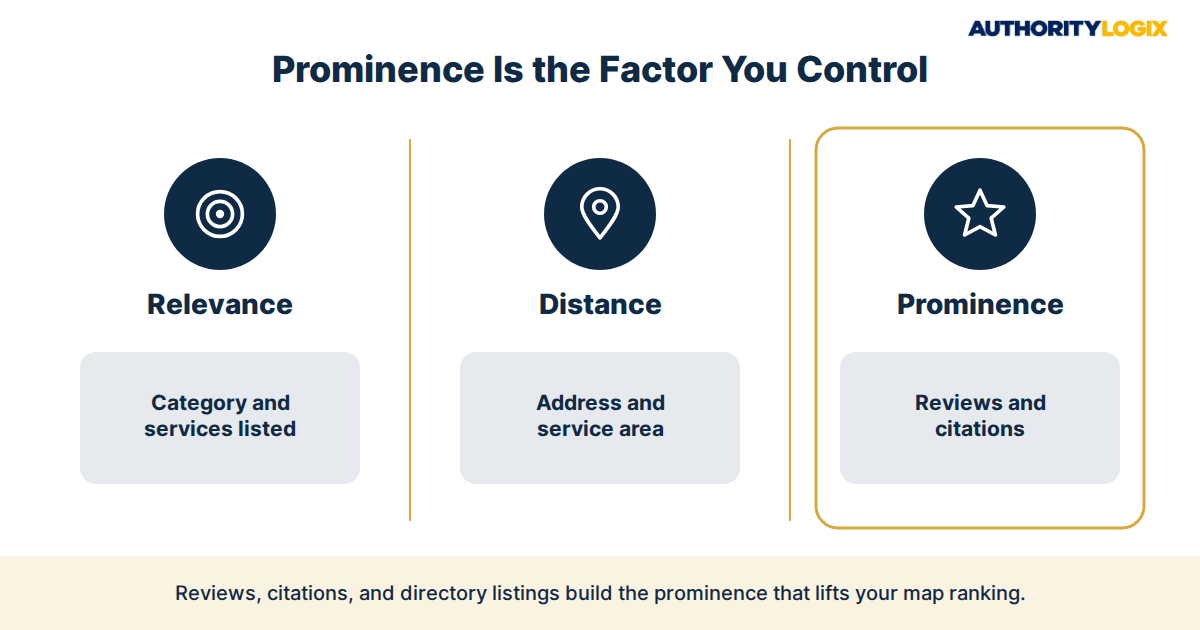
Google states its local ranking model in direct terms: the Map Pack is determined by three factors — relevance, distance, and prominence. Understanding what each means in practice for a mortgage company is the foundation of every optimization decision. Most lenders focus on one factor while neglecting the other two, which is why their local SEO for mortgage company efforts produce partial results. The broader
search statistics on borrower behavior show why Map Pack visibility is not optional — the majority of borrower journeys begin in a search engine before any lender interaction.
| Ranking Factor |
What Google Evaluates |
Mortgage Company Application |
| Relevance |
Does the business match what the searcher needs? |
GBP primary category, business description, services listed, content on the linked website |
| Distance |
How close is the business to the searcher or the searched location? |
Accurate address data, service area configuration, location-specific landing pages |
| Prominence |
How well-known and trusted is the business across the web? |
Review count and velocity, citation footprint, backlink profile, NMLS Consumer Access listing |
Prominence is the factor most within a mortgage company’s active control — and the one most lenders neglect. Google measures prominence by aggregating signals from across the web: how many authoritative sources mention the business, how consistently the name and address appear, how many reviews exist and how recent they are, whether the business appears in regulatory directories like NMLS Consumer Access, and how the website performs technically. The
content systems infrastructure that supports a mortgage company’s website directly feeds the prominence signals Google uses to rank that company locally.
Google Business Profile Optimization: The Highest-Leverage Local SEO Activity
For local SEO for mortgage companies, Google Business Profile optimization is the single activity that produces the fastest and most measurable impact on Map Pack position. GBP signals now account for 32% of local pack ranking weight, according to Whitespark’s 2026 Local Search Ranking Factors survey — the largest single factor in the model. A mortgage company with a fully optimized GBP profile receives significantly more clicks than one with an incomplete profile. The
lead generation infrastructure that converts Map Pack traffic into applications depends entirely on the GBP profile being the conversion bridge between search and contact.
The GBP Optimization Checklist for Mortgage Companies
Most mortgage companies claim their GBP profile and stop. A claimed-but-unoptimized profile is not the same as a competitive one. The optimization gap between a basic listing and a fully built GBP profile is the gap between being invisible in the local pack and appearing in the top three. The checklist covers six components:
1. Primary Category Selection. The primary GBP category is the single most influential relevance signal in the profile. “Mortgage Lender” is the correct primary category for most independent lenders. “Mortgage Broker” is correct for brokerage operations. Selecting a generic category like “Financial Services” or “Bank” suppresses local relevance for the specific queries mortgage borrowers run.
2. Business Description with NMLS ID. The GBP description is the only field where free-form text can carry keyword signals. A mortgage company’s description should clearly state the loan products offered, the geographic markets served, years in business, and NMLS ID. The NMLS ID in the description is both a compliance signal and an E-E-A-T trust signal that Google’s quality systems evaluate for YMYL financial content.
3. Services and Products Listed. GBP allows mortgage companies to list specific loan products as services. DSCR loans, FHA loans, VA loans, jumbo loans, and refinance products should each appear as a separate service with a description. Each service listing is an additional relevance signal for product-specific local queries.
4. Photos: Quantity and Quality. GBP profiles with more photos receive more engagement than profiles with few images. For mortgage companies, photos should include the office location, the team, and branded imagery that reinforces market authority. Photo recency matters — profiles with recently added photos signal an actively managed presence.
5. Q&A Section Management. The GBP Q&A section is publicly editable, meaning anyone can submit a question — and anyone can submit an answer. Mortgage companies that do not proactively seed and manage their Q&A section risk having incorrect or misleading content appear in their profile. Pre-populating the Q&A with accurate answers to the most common borrower questions is both a compliance control and a conversion optimization.
6. Weekly Posts. GBP posts signal active profile management to Google’s local ranking algorithm. Weekly posts — market updates, loan product explanations, local market data — maintain posting velocity and create additional keyword signals within the profile. The
financial services hub covers how GBP posting connects to the broader content distribution system.
Review Velocity: The Local SEO Signal Most Mortgage Companies Mismanage
Review velocity — the rate at which new reviews arrive — is a more powerful local ranking signal than total review count for mortgage companies competing in local search. Google’s local ranking algorithm weights recency heavily: a lender with 15 reviews published in the past 30 days ranks above a competitor with 200 reviews, most of which are 2 to 3 years old. The 2026 BrightLocal data confirms that 74% of consumers look for reviews from the past three months. A static review profile, even a strong one, loses Map Pack position to a competitor with active review velocity. Review signals feed directly into
E-E-A-T Trustworthiness scoring — the credibility layer Google weighs heavily for financial content.
For mortgage companies specifically, compliant review collection requires attention to what the reviews say. CFPB UDAAP standards prohibit marketing communications that create misleading impressions about financial outcomes. Reviews that describe specific interest rates received, guaranteed savings, or investment outcome claims create regulatory exposure. Compliant review collection focuses the request on the service experience: communication clarity, process responsiveness, how questions were answered, how the closing process was managed. The
lead generation system documents how a systematic post-close review request sequence produces review velocity without requiring the loan officer’s time for each individual follow-up.
| Review Signal |
Ranking Impact |
Compliance Consideration |
| Quantity (50+ reviews) |
More likely to appear in the Local Pack than firms with few reviews |
No compliance restriction on soliciting reviews; state rules vary on directing to specific platforms |
| Velocity (new reviews monthly) |
Recency-weighted; recent reviews outrank large but stale counts |
Request the review for service experience, not financial outcomes |
| Rating (4.5 star sweet spot) |
4.5 stars produces higher CTR than 5.0; perfect scores trigger skepticism |
Never incentivize reviews — FTC endorsement rules apply |
| Response rate (respond to all) |
Businesses responding to 25%+ of reviews earn 35% more revenue |
Responses are marketing communications — apply the same UDAAP standard |
Not sure whether your Map Pack position reflects your actual market authority? The FS Authority Gap Assessment identifies the specific gaps in your local SEO infrastructure.
FS Authority Gap Assessment →
NAP Consistency: The Citation Infrastructure That Supports Every Other Local SEO Signal
NAP consistency — the uniform presentation of a mortgage company’s Name, Address, and Phone number across every directory, data aggregator, and regulatory listing. Is the foundational layer of local SEO for mortgage companies that most lenders have not fully built. Google uses NAP data from across the web to confirm a business’s identity, location, and legitimacy. When a mortgage company’s address appears as “Suite 200” on its website, “Ste. 200” on Yelp.
And with an old phone number on Google Maps, Google may treat these as signals from separate entities rather than cumulative authority signals from one business. The result is fragmented citation authority and suppressed Map Pack ranking. NAP consistency also directly reinforces the GBP listing itself — the
GBP setup guide covers the exact fields and compliance requirements lenders must get right before citation building begins.
For mortgage companies, NAP consistency carries a compliance dimension that other industries do not face. NMLS Consumer Access — the regulatory directory maintained by the Nationwide Multistate Licensing System — is one of the most authoritative external validation sources Google uses for financial services entities. A mortgage company whose address on NMLS Consumer Access differs from its GBP listing has not just an SEO problem but a regulatory signal problem: Google’s quality raters evaluate whether financial firms’ information matches regulatory filings. The
finance content service treats NAP consistency as a compliance-first requirement, not a marketing afterthought.
The Local SEO Mortgage Company NAP Audit Process
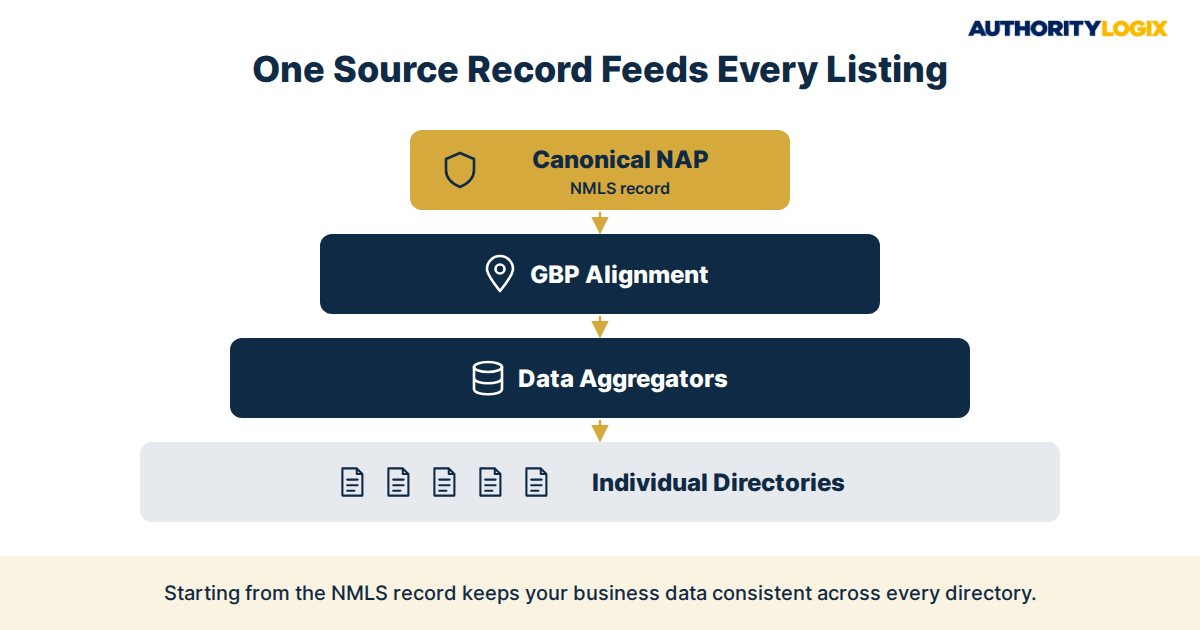
The NAP audit for a mortgage company covers four layers. First, the canonical NAP — the exact format that will appear everywhere — is established from the NMLS Consumer Access record, since that is the regulatory source Google treats as authoritative for licensed mortgage entities. Second, the GBP profile is aligned to the canonical NAP exactly. Third, each major data aggregator (Neustar Localeze, Data Axle, Foursquare, Factual) is updated, since these aggregators feed dozens of secondary directories automatically. Fourth, individual high-value directories — Yelp, Better Business Bureau, Zillow, Bankrate, LendingTree — are audited and corrected manually. The
content system documents how NAP audit and maintenance integrates with the ongoing local SEO workflow.
Location Pages: The Content Infrastructure That Extends Local SEO Beyond the GBP
The Google Business Profile establishes a mortgage company’s local presence for its primary office location. Location-specific landing pages extend that presence to every geographic market the company serves — including markets where the company has no physical office but actively originates loans. A DSCR lender serving Brooklyn, Queens, and the Bronx needs not just a Brooklyn GBP listing but dedicated location pages for each borough that answer the specific search queries borrowers in those areas run. The
educational hub architecture is the content infrastructure that produces location pages at the depth and specificity Google’s local relevance signals reward.
A mortgage company location page that ranks in local search is not a 150-word address page with a phone number. It is a resource that answers the specific questions a borrower in that market is searching: what loan products are available, what the local market conditions are, what the qualification requirements are for properties in that geography, and which loan officer handles that market. Each of these content elements is a relevance signal that ties the page to the geographic queries the lender wants to rank for.
Local SEO for Mortgage Companies: What Most Strategies Get Wrong
The data on local mortgage search behavior is widely understood. The conclusions most lenders draw from it — and the actions they take — are frequently wrong.
Claiming the GBP and treating it as complete.
A claimed GBP profile is the minimum, not the optimization. Most mortgage companies claim their listing, add a phone number, and move on. The 32% of local pack ranking weight carried by GBP signals is earned through active optimization — correct primary category, complete services list, populated Q&A, weekly posts, and a systematic review request process. A claimed-but-idle profile competes at a permanent disadvantage against any lender who has built the GBP as an active asset.
Ignoring NAP consistency until rankings drop.
NAP inconsistencies accumulate silently. A mortgage company that moved offices two years ago and updated its website but not its directory listings is carrying citation fragmentation it may not know about. Google does not send a notification when citation authority is fragmenting — rankings simply stop improving, and competitors with cleaner citation footprints overtake positions that should belong to the more established firm. The
growth playbook treats NAP consistency as a quarterly maintenance task, not a one-time setup.
Treating reviews as a passive outcome instead of an active system.
Review velocity is a ranking signal, which means the absence of a systematic review request process is a ranking suppressor. Mortgage companies that receive reviews only when clients choose spontaneously to leave them — a minority of closed borrowers without a follow-up system — will always lag competitors who have built a post-close review request sequence into their workflow. The
authority distribution system covers how review collection integrates into the client communication sequence without creating compliance exposure.
Competing on generic geographic terms instead of product-specific local queries.
A mortgage company that optimizes only for “mortgage broker [city]” is competing against every other lender in that geography for the same head term. A mortgage company that has built content and GBP signals around “DSCR lender [city],” “non-QM mortgage [neighborhood],” and “investment property loan [borough]” is competing in a segment where its specific product expertise gives it a structural content advantage. Local SEO for mortgage companies produces the highest returns when geographic specificity and product specificity are combined.

Ready to dominate the map pack in your market with a local SEO system built for lenders?
Work With Us →
Building a Local SEO System That Produces Pipeline, Not Just Rankings
Local SEO for mortgage companies is not a set of tactics performed once. It is a system maintained consistently — because Map Pack positions are not locked in perpetuity. A competitor who begins actively managing their GBP, building review velocity, and cleaning their citation footprint can displace a lender who earned a strong position and stopped maintaining it. The infrastructure that produces Map Pack rankings is the same infrastructure that holds them. If your firm is ready to build that infrastructure, work with us is the starting point.
The system has four components that run in parallel. GBP management — weekly posts, review response within 24 hours, Q&A monitoring, photo updates — maintains the active-profile signals Google’s algorithm tracks. Review velocity management — a systematic post-close email request, a direct link to the GBP review page, a response protocol for every review — maintains the recency-weighted review signals. NAP maintenance — quarterly audits of major directories, immediate correction when new inconsistencies appear — prevents citation fragmentation from accumulating. Location content — regular updates to location pages reflecting current market conditions — maintains the content freshness signals that support geographic relevance. This is
what we do as a baseline component of every local SEO engagement.
The connection between local SEO rankings and funded loan volume is direct, measurable, and faster than most lenders expect. A mortgage company that moves from outside the Map Pack to position 2 or 3 in its primary market typically sees inbound call volume increase within 60 to 90 days of achieving that position — because the borrowers who were previously finding a competitor are now finding them. See
how we build for the sequencing and timeline AuthorityLogix follows to move mortgage companies from local invisibility to Map Pack position.
| Local SEO Component |
Maintenance Cadence |
Impact Timeline |
| GBP profile completeness |
One-time setup + quarterly review |
Ranking lift within 30–60 days of full optimization |
| GBP weekly posts |
Weekly |
Active-management signal; ongoing ranking maintenance |
| Review velocity |
Systematic post-close (every funded loan) |
Recency signal; visible in rankings within 30 days of new reviews |
| Review response |
Within 24 hours of every review |
Ranking signal + conversion signal for prospects reading reviews |
| NAP audit and correction |
Quarterly |
Citation fragmentation repair; ranking improvement over 60–90 days |
| Location page content updates |
Monthly or per market event |
Content freshness signal; sustained geographic relevance |
The Market Position Local SEO Builds That Paid Ads Cannot
The honest answer about local SEO for mortgage companies is that it requires patience most lenders do not budget for and produces a market position most lenders do not realize they are forfeiting while they wait. A mortgage company that reaches Map Pack position 1 in its primary market for its core product searches owns the highest-intent traffic in that market at effectively zero marginal cost per lead — because the infrastructure that produces the ranking was built once and maintained systematically, not purchased for every lead. The broader
credibility gap between established lenders and newer competitors is often widest in local search — where newer firms built Map Pack infrastructure first.
Most lenders in any given local market have not fully built this infrastructure. The GBP profile is incomplete. The citation footprint is inconsistent. The review velocity is sporadic. The location pages are thin. Every one of these gaps is an opportunity for a mortgage company that builds the system correctly — because the competitor who builds it first owns the Map Pack position, and displacing that position requires the same 12 to 18 months of systematic infrastructure work to catch up. Learn more about
why it works through the AuthorityLogix proof-of-concept before deciding whether to build.


