


Key Takeaways
- The physical therapy patient journey has four distinct stages — search, evaluate, convert, and prepare — and most PT practices have significant drop-off at stages two and three, where educational content systems and response speed determine whether a prospective patient books or moves on.
- 82% of patients research providers online before booking, and the average patient visits 5.4 websites during that research — making the practice website the most critical patient acquisition asset most PT practices underinvest in.
- Many healthcare consumers expect a same-day response to inquiries. Practices that respond within the hour consistently convert more inquiries into booked evaluations than those that respond the next business day.
- Patients spend real time researching providers online before contacting them — enough time to read a condition page, scan a clinician bio, and read several reviews. Practices with strong content at each of those touchpoints convert that research time into bookings.
- 41% of consumers always read reviews when looking for a business, per BrightLocal’s 2026 survey. A practice with high review volume and recent activity is systematically more likely to be selected than one with fewer or older reviews — regardless of clinical quality.
- Pre-visit education — condition pages, FAQ content, and “what to expect” guides — reduces patient anxiety, improves episode completion rates, and produces more detailed, positive reviews from patients who arrived informed and prepared.
Table of Contents
The physical therapy patient journey does not begin at the first appointment — it begins at the first search. By the time a patient calls a PT practice, they have already formed opinions about clinical expertise, reviewed the practice’s patient history, and compared it against at least two or three alternatives. The practices that understand this journey and invest in the infrastructure at each stage convert a higher percentage of potential patients into booked evaluations, at every stage of the process.
The acquisition playbook covers the five systems that generate patient volume. This article maps the patient’s own experience across each stage of the journey — what they search for, what they evaluate, what makes them book, and what determines whether they arrive prepared and complete their full episode of care.
82% of patients research providers online before booking, per Searchlab’s 2026 healthcare marketing analysis — and the average patient visits 5.4 websites during that research. Most PT practices are not present at enough of those touchpoints to win the comparison. The lead generation systems system builds the touchpoint infrastructure that captures patients at each stage of their journey, not just at the booking moment. For a deeper treatment of this topic, see the acquisition playbook.
Stage 1: Search — How the Physical Therapy Patient Journey Begins
The patient journey begins with a search query, not a physician recommendation. 46% of Americans turn to search engines like Google to find a new doctor, per Harmony Healthcare IT’s 2024 poll — and for musculoskeletal conditions where patients are aware of their options, that percentage is likely higher. The search query tells a great deal about the patient’s intent: “physical therapy near me” is a proximity search from someone ready to book. “Physical therapy for rotator cuff” is a research search from someone still learning. Both deserve a response — but different content answers each. Practices tracking this metric can also review the educational hub for additional benchmarks.
The local visibility guide covers how the Google Map Pack captures proximity searchers. For condition-specific research searches, the asset is the condition page — a page that appears when a patient is searching “physical therapy for [their condition]” before they have identified a practice. A practice that appears at the research stage has a head start on every competitor the patient discovers later. The local search service manages the full local visibility infrastructure that places the practice in front of patients at the awareness stage.
What Search Queries Reveal About the Physical Therapy Patient Journey
Search queries fall into three intent categories, each requiring different content to convert. Informational queries — “what is physical therapy for sciatica,” “how long does PT take for knee replacement” — represent patients who are still learning. They need educational answers, not booking pages. Commercial queries — “physical therapist for back pain reviews” — represent patients comparing options. They need review evidence and credentialed clinician content. Transactional queries — “book PT evaluation near me” — represent patients ready to act. They need a clear booking path with minimal friction. The content systems provides additional context on this topic.
Most PT practice websites are built only for transactional intent — a homepage with services and a phone number — and are absent from the informational and commercial stages where most patients first encounter a practice. The content playbook maps the page types that capture all three intent categories and guide patients through the journey from initial research to booking. How the five channels that bring patients into the journey are built is covered in the patient acquisition pipeline guide.
AI Search and the Patient Journey
47% of patients have used AI tools to research healthcare providers, per rater8’s 2026 Patient Choice Report — and 89% of healthcare-related searches trigger a Google AI Overview, per BrightEdge. AI search is reshaping the earliest stage of the patient journey by answering condition questions directly in the search results, before the patient visits any practice website. For the related AuthorityLogix implementation framework, see lead generation.
Practices whose condition pages are structured to earn AI citation appear in these AI answers — and those that are not structured for citation are invisible at the most upstream point of patient research. Direct-access patients — those who initiate without a referral — are covered in the direct-access patient generation guide. Direct-access patients — those who initiate without a referral — are covered in the direct-access patient generation guide.

The Physical Therapy Patient Acquisition Playbook covers how each step of the patient journey connects, from first search to scheduled evaluation.
Stage 2: Evaluate — How Patients Choose Between PT Practices
The evaluation stage is where the majority of the patient journey’s competitive differentiation happens. Patients who find two or three PT practices in a proximity search or through condition-specific research spend real time comparing those options — reading reviews, scanning clinician bios, evaluating condition page depth, and checking practical details like hours and insurance. The practice that is most credible, most transparent, and most responsive to the specific questions driving that evaluation wins the booking.
41% of consumers always read reviews when looking for a business, per BrightLocal’s 2026 Local Consumer Review Survey. Many compare multiple providers. And 41% of healthcare consumers say they would stop going to a provider over a poor digital experience, per Cedar’s 2019 consumer experience study — meaning a slow-loading website, a thin services page, or a missing clinician bio can eliminate a practice from consideration before any human interaction occurs. The PT industry hub tracks the evaluation factors that most influence provider selection in local PT markets.
What Patients Look at During Evaluation
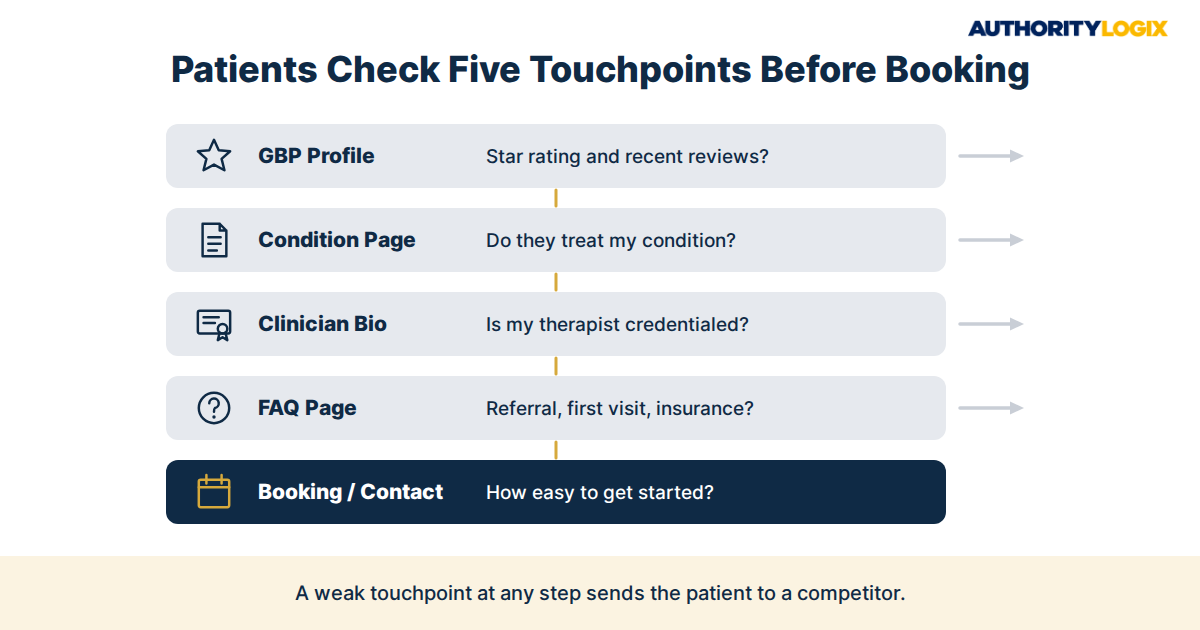
Patients evaluating PT practices examine five touchpoints in order of engagement: the Google Business Profile (star rating, review volume, recency, photos), the condition page relevant to their situation (is this practice experienced with my condition?), the clinician bio for the therapist they would see (what are their credentials and specialty training?), the patient FAQ page (can I come without a referral, what does a first visit involve, does my insurance cover this?), and the booking or contact page (how easy is it to start the process?). For a deeper treatment of this topic, see the local visibility guide.
Each of these five touchpoints is a potential drop-off point. A GBP with low review count loses patients to a competitor with higher volume at step one. A missing or thin condition page loses patients who need confirmation that the practice treats their specific problem at step two. A generic “Our Team” page with no credentials loses patients who want clinician expertise at step three. The education guide covers how to build the clinical content that satisfies each of these evaluation touchpoints.
The Review Evaluation Standard in 2026
Patient evaluation of reviews has become more sophisticated. Prospective patients are not just reading star ratings — they are reading the content of individual reviews for condition-specific language, clinician name mentions, and references to how the practice handled their specific situation. A practice whose reviews consistently mention “rotator cuff,” “sports injury,” and “post-surgical recovery” signals condition-specific expertise to patients searching for those exact conditions — in a way that a generic 5-star review does not.
Review recency is also a primary evaluation factor. BrightLocal’s 2026 data found that 32% of consumers want reviews from the last two weeks. A practice with 80 reviews but the most recent posted four months ago is at a disadvantage against a competitor with 30 reviews and consistent weekly activity. Recency signals that the practice is active, accepting patients, and generating satisfied ones — all of which reduce evaluation risk for prospective patients.
Not sure where patients are dropping off in your practice’s patient journey?
Stage 3: Convert — Turning Patient Interest Into a Booked Evaluation
The conversion stage is where patient intent meets practice infrastructure. A patient who has completed the evaluation stage and selected a practice is ready to act — but the speed and ease of the conversion experience determines whether they book now or delay until the momentum passes. Many healthcare consumers expect a same-day response to inquiries. Practices that meet that expectation convert a measurably higher share of inquiries into scheduled evaluations. For a deeper treatment of this topic, see the patient acquisition pipeline.
Conversion Friction: What Stops Patients From Booking
The most common conversion friction points in PT practice websites are: no online scheduling option (requiring a phone call as the only path to booking), contact forms that ask for excessive information before confirming availability, phone numbers buried in the footer rather than visible above the fold on condition pages, and slow inquiry response — either automated confirmation delays or callback windows measured in days rather than hours. Fixing even one of these usually recovers more bookings than any amount of added traffic.
Each friction point represents a percentage of motivated patients who do not complete the booking because the path to scheduling is harder than their willingness to overcome it. A patient who was ready to book but could not find the phone number on a mobile condition page may not try again — particularly if a competitor’s GBP click-to-call button is one tap away. The lead generation system audits conversion friction across every patient-facing touchpoint and removes the barriers that cause motivated patients to abandon before booking.
Response Speed as a Conversion Factor
Response speed is the single most impactful conversion variable in the physical therapy patient journey — and the one most PT practices have not systematized. A patient who submitted a contact form at 7pm on Tuesday and received a response the following Thursday afternoon has had two days to find, evaluate, and book with a competitor. The inquiry was not lost to a better practice — it was lost to a faster one.
The conversion infrastructure that minimizes response-time drop-off includes: an automated email confirmation sent within minutes of any form submission acknowledging receipt and setting a specific callback expectation, online scheduling as an alternative to phone-based booking, and a defined same-business-day callback protocol for all inquiries received before 4pm. These are not technology investments — they are operational protocols that require only implementation. The authority gap assessment benchmarks inquiry response speed against local competitors as part of its full acquisition analysis. For a deeper treatment of this topic, see the direct-access patient generation.

Stage 4: Prepare — Pre-Visit Education and Episode Completion
The physical therapy patient journey does not end when a patient books an evaluation — it continues through the pre-visit period where expectations are formed and anxiety is either resolved or amplified. A patient who books and then spends the days before their first appointment uncertain about what to bring, what the evaluation will involve, or whether their insurance will cover the visit is at elevated risk of cancellation or no-show. Pre-visit education is the infrastructure that reduces that risk.
Only about 30% of outpatient PT patients attend all of the visits their insurer approves, per a Strive Labs claims analysis reported by WebPT. A significant portion of that attrition begins before the first visit — patients who cancel or no-show because uncertainty made delay feel safer than commitment. The education guide covers the specific pre-visit content that addresses patient anxiety and sets the expectations that drive episode completion.
What Pre-Visit Education Should Cover
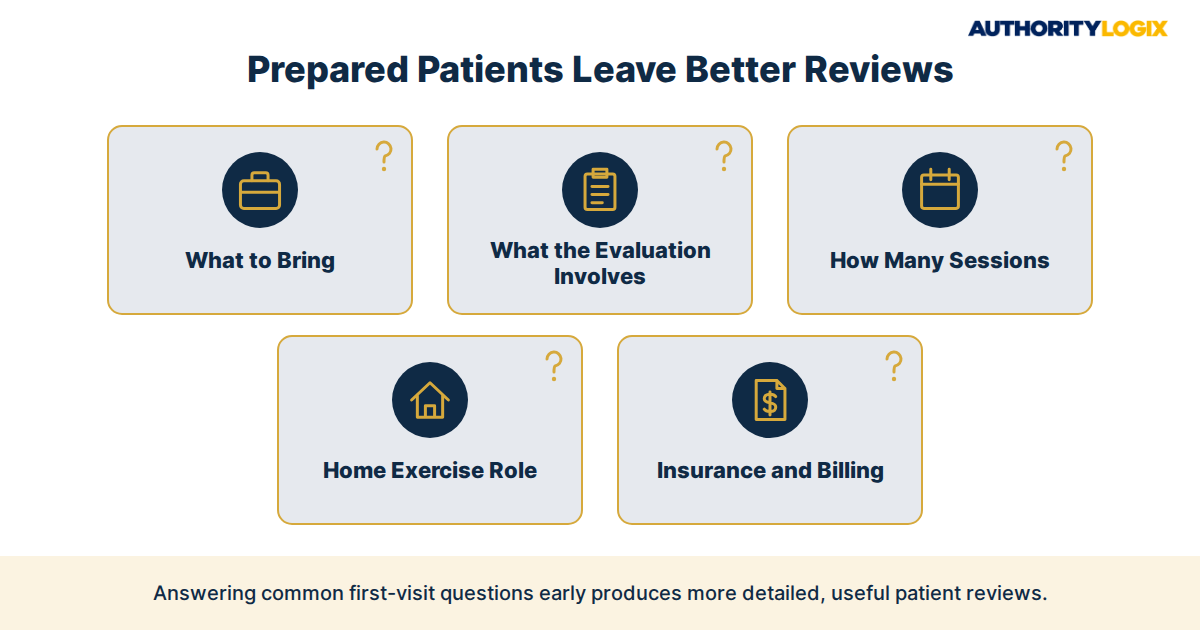
Effective pre-visit patient education addresses five specific questions that newly booked patients consistently have: What should I bring to my first PT appointment? What will the initial evaluation involve? How many sessions will I typically need? What role does home exercise play in my recovery? How does physical therapy billing and insurance work? Each of these questions, answered clearly and accessibly, reduces a specific source of pre-visit anxiety that otherwise contributes to cancellation and no-show rates.
Pre-visit education content can be delivered through the practice website’s FAQ page, through an automated email sequence triggered by the booking confirmation, or through a dedicated “What to Expect” page linked directly from the booking confirmation email. Practices that deliver pre-visit education systematically produce patients who arrive prepared, ask better questions, adhere to home exercise programs, and complete their full episode of care — all of which affect both clinical outcomes and practice revenue. For a deeper treatment of this topic, see the education guide.
Pre-Visit Education as a Review Driver
Patients who arrive at their first visit informed and prepared leave reviews that are more specific, more detailed, and more useful to other prospective patients than reviews from patients who arrived uncertain. A review that says “I was nervous about my first PT appointment but the practice sent me a great overview of what to expect — the evaluation was exactly what they described” is a direct conversion asset for the next prospective patient reading it. The acquisition playbook connects pre-visit education to the review generation system that feeds the patient journey at its very first stage.
FAQ: The Physical Therapy Patient Journey
At which stage do most PT practices lose patients?
Most independent PT practices lose the highest percentage of potential patients at Stage 2 — evaluation — because they have not built the content touchpoints that answer the questions prospective patients ask during provider comparison. A practice that ranks in the Google Map Pack but has a thin website, no condition pages, and minimal clinician bio content loses patients who find it but cannot confirm it is the right choice. The authority gap assessment identifies exactly which evaluation touchpoints are missing and benchmarks them against local competitors.
How many reviews does a PT practice need to pass the evaluation stage?
47% of consumers will not use a business with fewer than 20 reviews, per BrightLocal’s 2026 survey. But volume alone is not sufficient — recency matters independently. A practice with 20 reviews and consistent weekly activity passes evaluation more reliably than one with 60 reviews and a four-month gap in activity. In competitive urban markets, the practices ranking in the local pack typically have 80 to 150 or more reviews. The local visibility guide covers the review generation system that produces consistent new volume and recency.
What is the most effective pre-visit communication a PT practice can send?
An automated booking confirmation email that includes three specific elements: a plain-English overview of what the first evaluation involves, a link to the practice’s “What to Expect” FAQ page, and the practical logistics — what to bring, where to park, how to contact the practice if anything changes. This email takes under an hour to set up in any basic email platform and reduces no-shows, cancellations, and first-appointment anxiety simultaneously. It also signals to the patient that the practice is organized and patient-centered before the first visit even occurs.
How does the patient journey differ for physician-referred versus direct-access patients?
Physician-referred patients typically arrive at Stage 3 — conversion — having already been told where to go. But they still evaluate the practice online before confirming or calling. A referred patient who searches the practice name and finds thin content or low reviews may call to confirm and then ask to be referred elsewhere. Direct-access patients enter at Stage 1 with no pre-existing direction — they must be found, evaluated, and converted entirely through owned channels. The content playbook maps the content strategy that serves both journey types simultaneously. For the full specialty framework, visit the PT resources hub.
Optimizing Every Stage of the Physical Therapy Patient Journey
The physical therapy patient journey is a four-stage process with a specific drop-off risk at each stage. Practices that invest in the search infrastructure, evaluation content, conversion systems, and pre-visit education that eliminate drop-off at each stage convert a systematically higher percentage of prospective patients into booked, completed episodes of care. The investment is not large — it is consistent and staged, beginning with the highest-impact actions and building the compounding infrastructure over time.
The Insight Articles in the Patient Acquisition library go deeper on every stage of the patient journey — from local search and condition page strategy to review generation, conversion infrastructure, and pre-visit education content. The PT resources hub organizes the full library so practice owners can navigate directly to the specific journey stage they are optimizing today. The referral dependence offers additional context on this area. The PT industry hub demonstrates how the five-system framework — content, local search, patient education, lead generation, and authority distribution — supports every stage of the patient journey.
Ready to rebuild every stage of the patient journey, from first search to scheduled evaluation?