


Key Takeaways
- Direct access physical therapy patients — those who self-refer without a physician order — represent the fastest-growing patient acquisition segment available to independent PT practices in 2026.
- As of July 2025, all 50 states, DC, and the US Virgin Islands allow some form of direct access. But APTA identifies patient awareness as the primary barrier — most patients do not know they can self-refer.
- Self-referred PT episodes cost about 13% less than physician-referred episodes, per a Health Services Research study by Pendergast and colleagues — a cost advantage that resonates with patients and employers when communicated clearly.
- The practices that capture direct-access patients do three things: they communicate direct access prominently on their website and GBP, they publish condition-specific content that captures search queries before patients see a physician, and they convert profile visitors into booked evaluations through fast response systems.
- Condition and location-specific searches — “physical therapy for back pain near me,” “PT for knee injury without referral” — are how direct-access patients find practices. Practices that do not appear for these searches are invisible to the segment.
- Direct access marketing does not conflict with referral dependence development — it runs in parallel. The same content that builds direct-access visibility also signals clinical expertise to referring physicians who research practices before sending patients.
Table of Contents
Direct access physical therapy patients — those who contact a PT practice directly without a physician referral — are now a scalable patient acquisition channel in every US jurisdiction. As of July 2025, all 50 states, DC, and the US Virgin Islands allow some form of direct access to physical therapy services. The legal infrastructure exists. The patient demand exists. What most practices are missing is the marketing infrastructure that makes them findable, credible, and bookable to patients who are actively self-referring.
The acquisition playbook positions direct-access marketing as one of five owned patient acquisition channels. This article covers the specific tactics that generate direct-access patients — what they search for, how they evaluate practices, what makes them book, and how to build the visibility infrastructure that captures their demand continuously.
APTA’s State of Direct Access report lists consumer awareness among the barriers advocates still need to address — even in states with unrestricted access. Patients who do not know they can self-refer do not self-refer, regardless of how convenient or cost-effective direct access would be for them.
The practice that communicates this clearly captures patients who would otherwise wait for a physician appointment they do not need. For a deeper treatment of this topic, see the acquisition playbook.
Understanding Direct Access Physical Therapy Patients
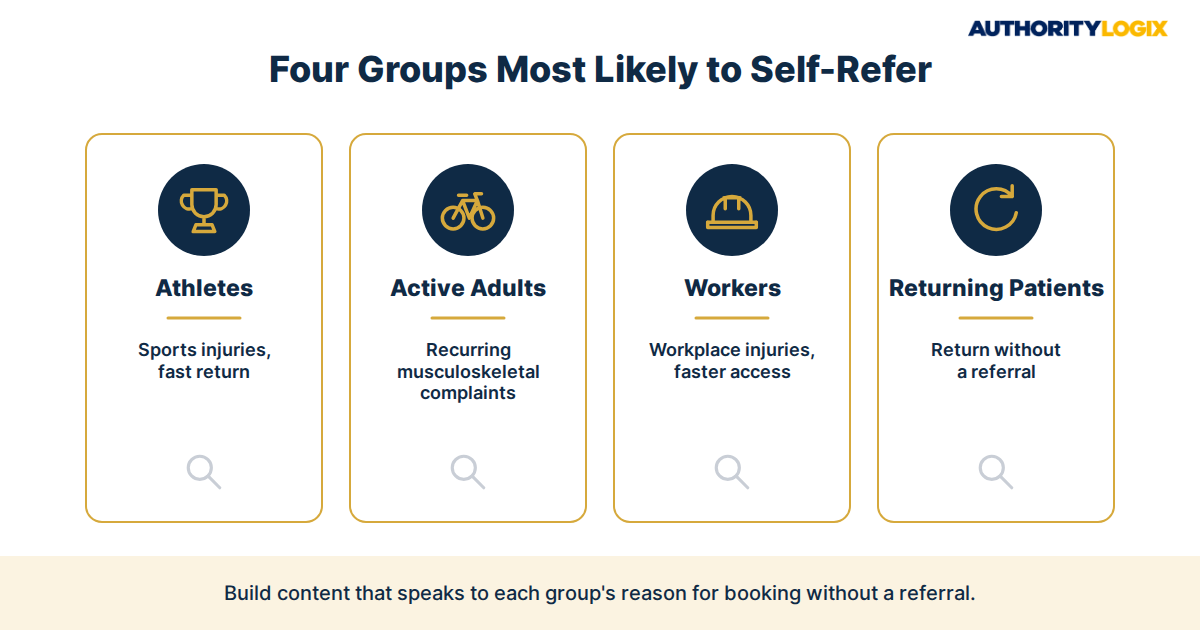
Direct-access patients are not a uniform group. They include athletes who know their sports injuries benefit from PT, active adults managing recurring musculoskeletal complaints, workers who sustained workplace injuries and want faster access than their employer’s managed care process allows, and patients who experienced PT previously and understand that they can return without a referral. What unites them is a willingness to initiate care independently — and a reliance on search to find the right practice.
The conditions with the highest direct-access search volume are lower back pain, shoulder injuries, knee pain, sports rehabilitation, pelvic health, and neck pain. These are the conditions where patients most actively research providers before booking — and where a practice with strong condition-specific content captures demand that referral-dependent competitors never see. The PT industry hub tracks the condition categories driving the highest direct-access search volume by market.
What Direct Access Physical Therapy Patients Need Before They Book
A direct-access patient who finds a PT practice through a condition search needs three things before they book: confirmation that the practice treats their specific condition, evidence that the clinicians are qualified to treat it, and proof that others have had positive experiences. These are the signals provided by condition-specific content, credentialed clinician bio pages, and a strong review profile — not by a generic services page and a phone number.
A Health Services Research study by Pendergast and colleagues found self-referred PT episodes cost about 13% less than physician-referred episodes — a meaningful cost advantage for patients with high deductibles or limited insurance coverage. Practices that communicate this advantage explicitly — in their FAQ pages, in their homepage direct-access statement, in their GBP posts — convert a higher percentage of the cost-conscious direct-access patients who are comparing their options. The education guide covers how patient-facing content communicates these advantages credibly.
The Difference Between Provisional and Unrestricted States
21 states allow fully unrestricted direct access — patients can initiate and complete a full PT episode without any physician involvement, per APTA’s 2025 State of Direct Access report. The remaining 29 states and DC have provisional access, meaning some limitations apply: visit caps, time limits, or referral requirements for specific procedures. Practices in provisional states need to communicate what direct access actually allows in their state — and what insurance coverage applies — to convert informed patients who might otherwise assume they need a referral for everything. For a deeper treatment of this topic, see the education guide.
In both unrestricted and provisional states, Medicare Part B has required a physician plan of care since 2005 — a limitation that affects Medicare patients but not most commercially insured direct-access patients. A clear FAQ answer addressing Medicare patients separately from commercial insurance patients prevents the confusion that causes some Medicare patients to delay PT care they could access more easily than they realize.
The Physical Therapy Patient Acquisition Playbook covers the full system for reaching direct access patients and turning their searches into scheduled evaluations.
Where Direct-Access Patients Search — and How to Be Found
Direct-access patients do not start their search on insurance directories or physician referral networks. They start on Google — typically with a condition and location query. “Physical therapy for rotator cuff near me,” “PT for lower back pain without referral [city],” “physical therapist pelvic floor [neighborhood].” The practices that appear in the Google Map Pack and in the top organic results for these searches consistently capture direct-access demand that competitors without local search infrastructure never reach.
The local visibility guide covers the full local search system. For direct-access patient generation specifically, the three most critical local search elements are: a GBP optimized for the practice’s primary condition specialties, a review profile with recent, condition-specific reviews that match what direct-access patients search for, and location-specific condition pages that combine geographic and clinical keywords.
GBP Optimization for Direct-Access Searches
A GBP optimized for direct-access patient generation goes beyond basic category and contact information. The Services section should list specific conditions and treatments using the patient language that appears in direct-access searches — not clinical terminology. “Lower back pain relief” rather than “lumbar rehabilitation.” “Sports injury recovery” rather than “musculoskeletal rehabilitation.” The business description should include a direct access statement — “No referral required” or “Patients can book directly” — that Google can surface in response to “PT without referral” searches.
Google Posts are a low-cost, high-impact direct-access marketing channel that the local search system manages as part of a consistent GBP activity cadence. A weekly GBP post that addresses one condition — “Managing knee pain after a running injury? Our sports rehabilitation team offers direct-access evaluations — no physician referral required” — builds condition-specific relevance signals while communicating direct access availability to prospective patients browsing the profile. Condition-specific posts outperform generic “we’re open” posts in both engagement and local search relevance contribution. For a deeper treatment of this topic, see the local visibility guide.
Condition Pages That Capture Pre-Referral Searches
Condition pages are the highest-value direct-access patient acquisition assets a PT website can have. A patient searching “physical therapy for shoulder impingement” at 9pm — before they have seen a physician — is at the exact moment of provider research. A practice with a comprehensive, credentialed shoulder impingement page that appears in that search captures a patient who might otherwise wait weeks for a physician appointment before being referred to PT.
Each condition page should address direct access explicitly — confirming that the patient can book directly without a referral, and explaining what the first evaluation involves. This removes the primary uncertainty that prevents self-referral even in patients who are ready to book. The content playbook covers the full keyword strategy and page structure for condition pages that rank and convert direct-access patients simultaneously.

Not sure where your practice stands on direct-access visibility?
Direct Access Physical Therapy Patients: The Marketing Tactics That Generate Self-Referrals
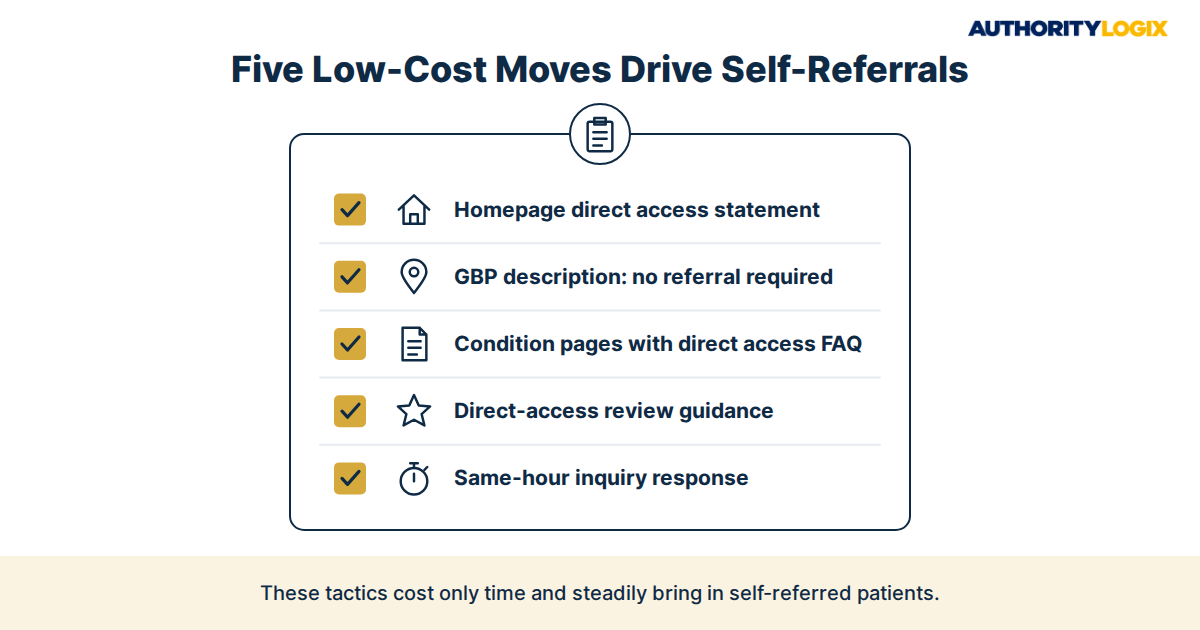
Direct-access patient generation is not a single tactic — it is a coordinated set of visibility and communication actions that together make a practice findable, credible, and bookable to patients who are ready to initiate care without a physician order. The practices generating the most consistent direct-access volume do five things well: they communicate access clearly, they rank for condition searches, they have strong review profiles, they educate before asking patients to book, and they respond to inquiries fast.
Communicate Direct Access Prominently and Specifically
The single highest-ROI direct-access marketing action most PT practices have not taken is adding a clear direct access statement to their homepage above the fold. “No physician referral needed — call to schedule your evaluation directly” communicates the access advantage to every visitor who lands on the homepage — whether they arrived from a search, a GBP click, or a word-of-mouth recommendation. A statement that is not visible is a statement that does not convert. For a deeper treatment of this topic, see the patient acquisition pipeline.
Direct access statements also belong in the GBP business description, in every relevant condition page’s opening section, in FAQ page answers, and in the practice’s email signature and social media bios. The goal is to eliminate the assumption that a referral is required at every point where a prospective patient might be making that assumption. The lead generation system includes the specific placement framework for direct access messaging across all patient-facing touchpoints.
Build Reviews That Reference Direct Access
Review content that explicitly mentions direct access — “I booked directly without a referral and was seen within three days” — builds social proof for the self-referral process itself. Prospective direct-access patients reading reviews are not just evaluating clinical quality. They are also evaluating whether the practice is set up to handle direct-access patients efficiently. Reviews that confirm a smooth, referral-free booking experience remove a specific hesitation that generic reviews do not address.
BrightLocal’s 2026 survey found that 41% of consumers always read reviews when looking for a local business. Training front desk staff to guide departing direct-access patients toward specific, experience-referenced review language — without scripting or incentivizing — produces condition-specific and process-specific reviews that reinforce both local search rankings and direct-access patient confidence. A practice where 30% of its Google reviews mention direct access or self-referral has built a social proof asset that is directly relevant to the segment it is targeting.
Respond to Direct-Access Inquiries Within the Hour
Direct-access patients are self-motivated and time-sensitive. A patient who decided to book PT without waiting for a physician appointment is not going to wait 48 hours for a callback. Healthcare patients increasingly expect a fast response to their inquiries. A practice that generates direct-access inquiries through strong local search visibility but responds slowly loses those patients to competitors with faster systems.
The conversion infrastructure for direct-access patients includes: online scheduling or a click-to-call button prominent on every condition page, an automated email response to form submissions within minutes, and a defined same-business-day callback protocol for any inquiry received during office hours. Fast response is not a luxury for direct-access patient generation — it is a competitive requirement. The authority gap assessment audits inquiry response speed alongside visibility metrics as part of its full acquisition analysis. For a deeper treatment of this topic, see the patient journey guide.
FAQ: Direct-Access Physical Therapy Patient Generation
Do direct-access patients have insurance coverage for PT?
Most commercial insurance plans do not require a physician referral for physical therapy coverage — patients can initiate a PT claim directly. The exceptions are some HMO plans that require primary care gatekeeper approval for specialist services, and Medicare Part B which requires a physician plan of care. A FAQ page answer that addresses insurance coverage explicitly — separating commercial insurance from Medicare — prevents the referral assumption from blocking self-referral among patients with perfectly valid direct-access coverage. The education guide covers how to write insurance FAQ content that is accurate, clear, and conversion-optimized.
Should a practice market direct access differently in provisional versus unrestricted states?
Yes. In unrestricted states, direct access messaging can be unqualified: “No referral needed for any PT service.” In provisional states, messaging should be condition-specific and visit-aware: “Most patients can start PT directly — call to confirm your coverage.” A blanket “no referral needed” statement in a provisional state risks creating patient frustration when they discover limitations that apply to their specific situation. State-specific accuracy protects patient trust and prevents the churn that comes from overpromising the access process.
Does direct-access marketing require a bigger marketing budget?
No. The highest-impact direct-access marketing actions — homepage statement, GBP description update, FAQ page answers, direct-access messaging in condition pages — cost only the time to implement. They do not require paid advertising or additional media spend. The incremental investment is in content production for condition pages, which is a long-term organic asset, not a recurring expense. The acquisition playbook maps the full 90-day implementation sequence for zero-media-spend direct-access marketing.
How quickly do direct-access marketing changes produce results?
Homepage and GBP updates produce results within 30 to 60 days as Google re-crawls and updates profile relevance signals. Condition page organic rankings develop over 3 to 6 months for mid-competition long-tail queries. The fastest direct-access result is usually from GBP Post messaging — a direct-access-focused post published weekly consistently generates profile views and clicks from patients actively searching for self-referral options in the practice’s local area. Practices that actively communicate direct access availability give patients a clear reason to self-refer.

Building a Practice That Direct-Access Patients Can Find, Trust, and Book
Direct access physical therapy patients are not a niche segment — they are the fastest-growing self-initiated patient acquisition channel available to every PT practice in the country. The practices generating consistent direct-access patient volume have done one thing differently: they made their practice findable, understandable, and bookable to patients who are ready to initiate care without a physician order. The full five-channel patient acquisition pipeline shows how direct-access sits alongside other owned channels. The patient journey guide covers related acquisition dynamics. For the full specialty framework, visit the PT resources hub.
The Insight Articles in the Patient Acquisition library go deeper on every element of direct-access patient generation — from condition page strategy and GBP optimization to conversion infrastructure and direct-access messaging for specific patient populations. The PT resources hub organizes the full library so practice owners can move directly to the specific direct-access challenge they are solving today.
The opportunity is immediate. Every day a practice operates without clear direct-access messaging, optimized condition pages, and a fast inquiry response system is a day those patients are booking with a competitor who has built what this practice has not yet built. The implementation sequence is straightforward, the results are measurable, and the content systems behind it covers this in further detail.
The compounding value of an owned direct-access patient pipeline grows with every week of consistent execution. The growth blueprint covers this in further detail. The PT industry hub demonstrates how the five-system framework — content, local search, patient education, lead generation, and authority distribution — turns direct-access visibility into booked evaluations.
Ready to build the direct-access patient pipeline that brings people straight to your door?