

Key Takeaways
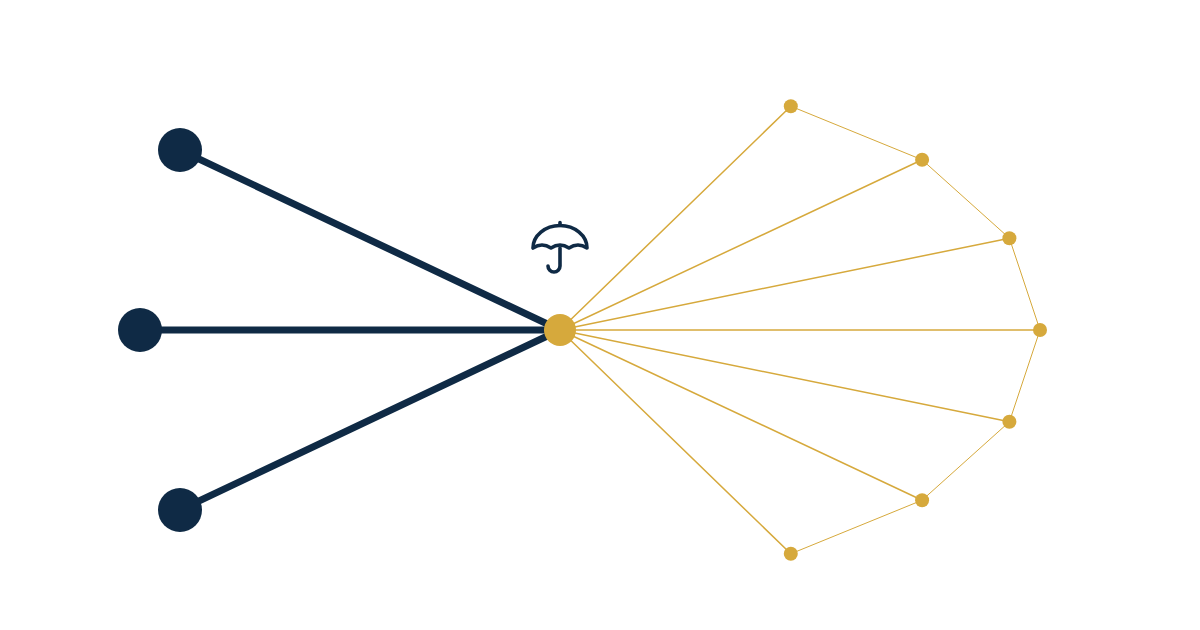
- To reduce physician referral dependence in physical therapy is not to abandon referral relationships — it is to build owned acquisition channels that make any single referral disruption manageable rather than catastrophic.
- Private equity-backed chains are actively building affiliated referral networks that redirect independent practice referrals to their own locations. Practices that rely on physician referrals for 70% or more of new patients are the most exposed to this structural shift.
- As of July 2025, all 50 states allow direct access to physical therapy — making patient-initiated acquisition legally available and strategically urgent for every independent PT practice.
- The three owned channels that produce the most consistent direct-access patient volume for independent practices are: local search optimization, condition-specific patient education content systems, and systematized past-patient reactivation.
- Referral concentration risk is measured by the percentage of new patients from any single source. A healthy practice typically has no single source representing an outsized share of monthly new patient volume.
- The same content and visibility infrastructure that generates direct-access patients also strengthens physician referral relationships — referrers who find strong clinical authority content and positive reviews send more patients, more consistently.
Table of Contents
The decision to reduce physician referral dependence physical therapy practices face is not a rejection of referral relationships — it is a recognition that a practice whose patient volume depends on channels it does not control is structurally vulnerable. Physician retirements, hospital employment contracts, PE-backed clinic affiliations, and insurance panel changes all shift referral patterns without warning. The practices that weather these disruptions are the ones that built owned acquisition channels before they needed them. The full five-channel model is mapped in the patient acquisition pipeline guide.
The acquisition playbook maps the complete five-channel acquisition pipeline. This article focuses specifically on the referral dependence problem — how to measure it, what the structural risks look like in 2026, and the three owned channels that generate direct-access patient volume most reliably for independent PT practices.
The competitive context matters. With the 50 largest companies holding only 29% of revenue, PT remains one of the most fragmented healthcare sectors in the country — and one of the most actively consolidated by private equity, per ResearchAndMarkets’ 2022 U.S. physical therapy clinics report. PE-backed chains do not just open new locations — they build the affiliated referral networks that redirect independent practice referrals to their own clinics. That structural pressure is accelerating. For a deeper treatment of this topic, see the acquisition playbook.
Why Physician Referral Dependence Is a Growing Risk in 2026
The referral landscape for independent PT practices has changed structurally over the past five years. Growing hospital employment of primary care physicians means that many physicians who once referred freely to independent practices are now embedded in health systems with their own affiliated PT services. A physician who joins a hospital system in January may stop referring to an independent clinic by March — not because the clinical quality changed, but because the system’s policies redirected referrals internally.
HOPTS (Hospital-Owned Physical Therapy Services) and POPTS (Physician-Owned Physical Therapy Services) have grown significantly in markets where PE consolidation is advanced. An independent practice that built its patient volume on relationships with three orthopedic surgeons who joined a POPTS arrangement has lost those referrals to a competitor that is also a financial partner of those same physicians. This is not a clinical quality problem — it is a structural realignment that independent practices cannot prevent by treating patients better.
The PT industry hub tracks how these market dynamics are affecting independent practice patient volume across regions. The local search service builds the local visibility infrastructure that captures direct-access patient demand independent of referral channels. The local search service builds the local visibility infrastructure that captures direct-access patient demand independent of referral channels. The education guide provides additional context on this topic.
Measuring Progress to Reduce Physician Referral Dependence Physical Therapy Metrics
The shift has accelerated measurably in 2025 and 2026. CMS Physician Fee Schedule cuts of 3.4% for 2024 and 2.83% for 2025 have squeezed independent PT margins, making it harder to invest in the marketing and visibility infrastructure that would reduce referral dependence — even as the competitive pressure to do so grows. Practices that are already investing in owned channels from a position of relative stability are building the competitive moat before they need it. For the related AuthorityLogix implementation framework, see local search service.
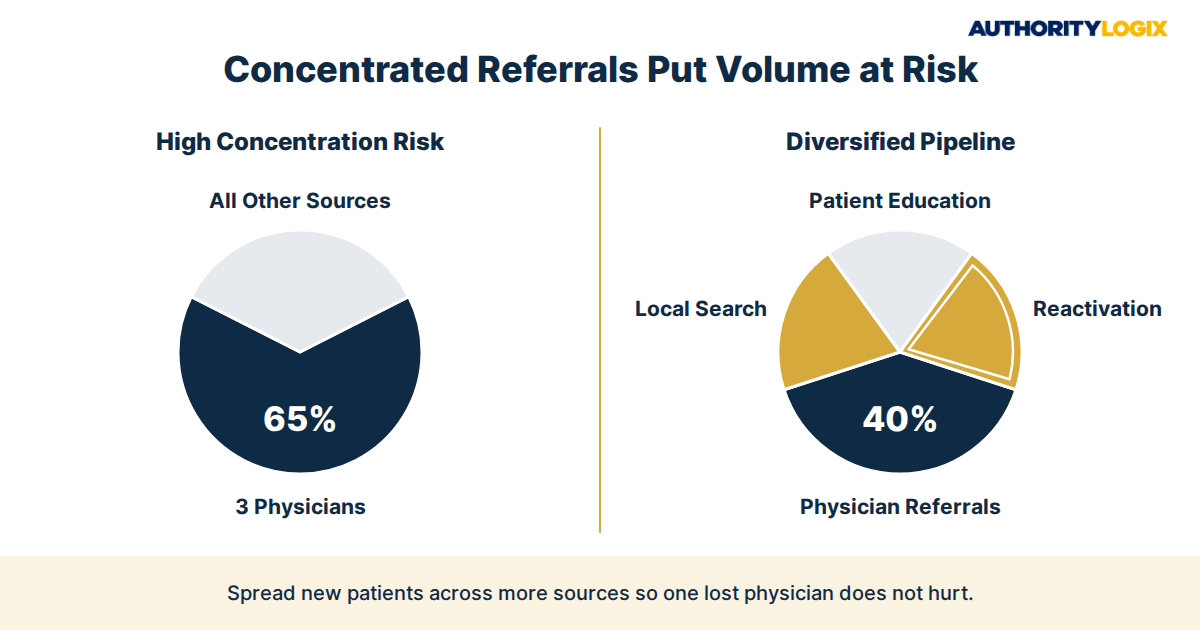
Referral concentration risk is the percentage of new patients coming from any single source. A practice where three referring physicians account for 65% of new evaluations has significant concentration risk. A practice where no single source represents more than 15% of new patient volume has built resilience into its acquisition mix. The calculation is simple: divide new patients from each source by total new patients for the month, and look at the top three sources. If any single source exceeds 20%, the practice has meaningful concentration risk.
Practices that have never run this calculation are often surprised by the result. A referral relationship that feels strong and reciprocal can represent 30 to 40% of monthly new patient volume — a number that looks different when quantified as “the loss of this one relationship would reduce monthly evaluations by 12 to 15.” The PT Authority Gap Assessment includes referral concentration analysis as a standard component of its acquisition system audit.
The Physical Therapy Patient Acquisition Playbook covers how practices build a patient pipeline that grows beyond physician referrals.
The Three Owned Channels That Reduce Physician Referral Dependence Physical Therapy Practices Rely On
Reducing physician referral dependence does not happen by stopping referral development — it happens by growing other channels until referrals represent a healthy percentage of a larger total. The three channels that produce the most consistent direct-access patient volume for independent PT practices are local search optimization, condition-specific patient education content, and past-patient reactivation. Each operates independently, generates patients the practice controls, and compounds over time.
Owned Channel 1: Local Search Optimization
Local search is the highest-intent direct-access patient acquisition channel available to a PT practice. A patient searching “physical therapy for knee pain near me” is actively looking for a provider and ready to book — no physician intermediary required. Organic search drives a large share of new patient website sessions for health and wellness practices. A practice with a fully optimized GBP, consistent NAP data, and a review generation process producing two to four new reviews per week is systematically capturing this demand. To diagnose this issue in your own practice, use the authority gap assessment.
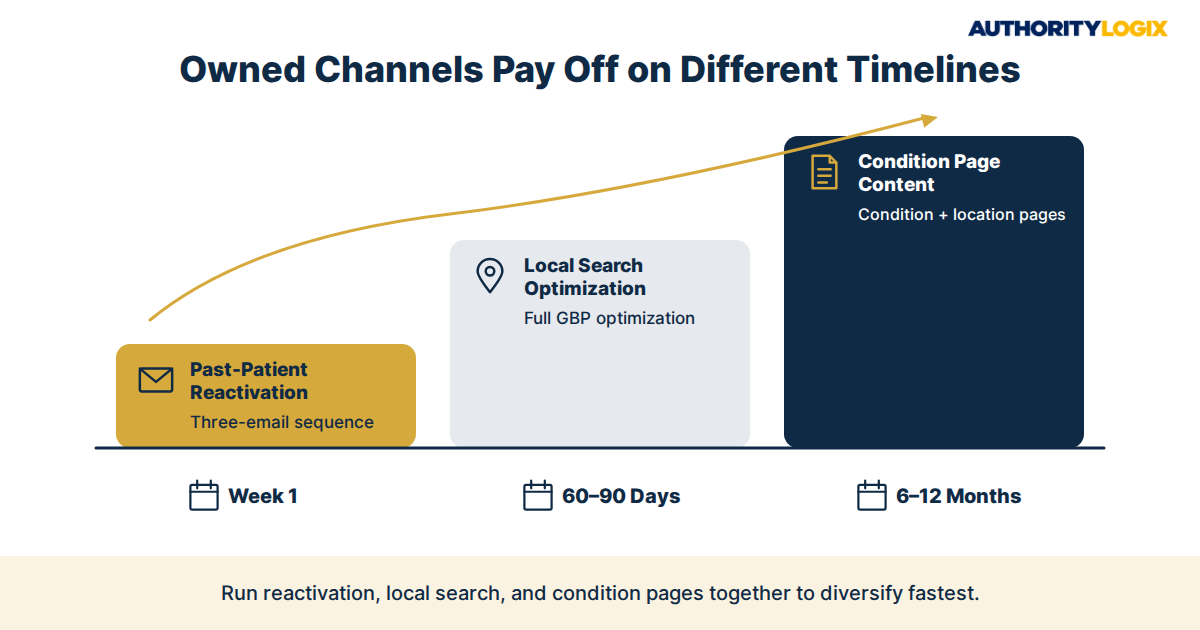
The local visibility guide covers the complete local search system. For referral diversification specifically, the GBP investment is the most immediate — a fully optimized profile produces measurable increases in profile actions within 60 to 90 days of completion, and those actions represent direct-access patients who found the practice without any physician involvement.
Owned Channel 2: Condition-Specific Patient Education Content
Condition pages capture patients at the research stage of the patient journey — before they have identified a practice, before they have seen a physician, and before any referral relationship becomes relevant. A patient searching “physical therapy for rotator cuff without referral” who finds a well-optimized condition page from a local PT practice is at the exact moment where the practice can own the relationship from the very beginning. As of July 2025, all 50 states allow direct access, per APTA — making this early-stage content capture legally and practically available everywhere.
The compounding value of condition pages is what makes them the most strategically important referral diversification investment. A page published today and optimized for a specific condition and location continues generating patient inquiries for years — at zero incremental cost per visitor. The education guide covers the E-E-A-T content standards that make condition pages rank in healthcare search and convert the visitors they attract. How patients move from condition research to booked evaluation is covered in the patient journey guide.
Owned Channel 3: Past-Patient Reactivation
Past-patient reactivation is the fastest owned channel to activate for immediate patient volume. Former patients who completed an episode of care in the past 12 to 36 months represent a pre-qualified patient database — people who already trust the practice, know the location, and understand the value of PT. A three-email reactivation sequence sent to this database consistently generates booked evaluations within the first week, from people who require no marketing spend to acquire and no referral to initiate. For a deeper treatment of this topic, see the local visibility guide.
Reactivation campaigns also serve a secondary function in referral diversification. A reactivated patient who returns for a new complaint, completes care, and leaves a review generates a new review, a new patient acquisition data point from an owned channel, and a word-of-mouth referral source — all without any physician involvement. Each reactivation campaign strengthens the owned channel flywheel at near-zero incremental cost. The lead generation system provides the reactivation sequence framework and the email platform recommendations that work with PT practice management systems. The cost of patient acquisition across each channel is covered in the patient acquisition cost guide.
Not sure how concentrated your practice’s patient acquisition is?
Protecting Physician Referral Relationships While Building Owned Channels
Reducing physician referral dependence and strengthening physician referral relationships are not opposing strategies. The same content and visibility infrastructure that generates direct-access patients also makes a practice more referrable. A practice with deep condition-specific educational content, credentialed clinician bio pages, and a strong review profile gives referring physicians the confidence to send patients consistently — because the online evidence confirms what the physician already knows about clinical quality.
Referring physicians increasingly research the practices they send patients to. A physician who is considering referring a post-surgical knee patient to a PT practice will find that practice online — and the content, reviews, and visible credentials they find either confirm or undermine the referral decision. The education guide covers how clinical credibility content serves both direct-access patient acquisition and physician referrer confidence simultaneously. For a deeper treatment of this topic, see the patient journey.
The Referral Relationship Maintenance Strategy
Maintaining physician referral relationships while building owned channels requires two ongoing activities. First, active communication with referring physicians — quarterly check-ins, shared outcome data, condition-specific case collaboration — that keeps the relationship visible and demonstrates clinical quality in concrete terms. Second, the visibility and content infrastructure that makes the practice findable and credible when a physician searches for it or when a patient the physician referred looks it up before calling. The content strategy that builds authority across all channels is covered in the content playbook.
Content infrastructure also makes a practice more resilient when a referral relationship is disrupted. A practice that loses a key referring physician but already ranks in the local map pack for its primary condition searches, has a library of condition pages generating organic inquiries, and has a reactivation list producing quarterly booked evaluations does not experience the same revenue drop as one that had no owned channels at all. The diversification investment pays its return most visibly at the moment of disruption — which means the time to make it is before that moment arrives.
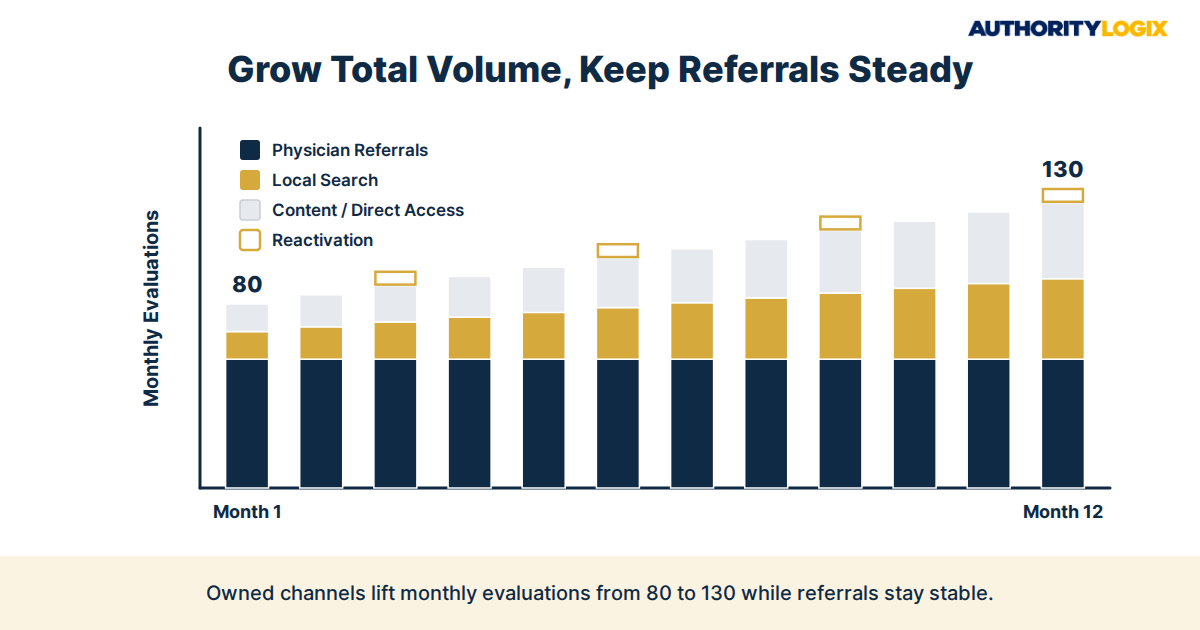
The goal of referral relationship maintenance is not to increase concentration — it is to maintain existing relationships while diversification reduces their share of total volume. A practice that grows from 80 evaluations per month (70% physician-referred) to 130 evaluations per month (43% physician-referred) has preserved its referral volume while growing its owned channels sufficiently that referrals now represent a resilient rather than existential share of the patient mix. The acquisition playbook maps the 12-month diversification timeline that achieves this shift.
FAQ: How to Reduce Physician Referral Dependence Physical Therapy Practices Ask About
How long does it take to meaningfully reduce referral concentration?
The reactivation channel produces results in the first week. Local search improvements appear in profile actions within 60 to 90 days. Condition page organic traffic develops over 6 to 12 months. A practice that activates all three channels simultaneously can bring referral concentration down meaningfully within 12 months — not because referral volume decreases, but because owned channels are generating additional patient volume alongside it. The local visibility guide covers the local search investments that produce results fastest. For a deeper treatment of this topic, see the patient acquisition cost.
Will building direct-access channels damage my physician referral relationships?
No — and the evidence is the opposite. Referring physicians who research a practice and find strong clinical content, positive reviews, and visible credentials refer more patients, more consistently. Physicians do not want to send patients to practices that appear thin or underdeveloped online. The content infrastructure that generates direct-access patients demonstrates exactly the clinical depth and credibility that physician referrers are looking for. The lead generation system builds both direct-access and referral-supporting infrastructure simultaneously.
What referral concentration percentage should a PT practice target?
No single source should represent more than 15 to 20% of monthly new patient volume for a practice with healthy acquisition resilience. Physician referrals as a category — not a single physician — can represent 40 to 50% of total volume without creating undue concentration risk, as long as that volume is distributed across multiple independent referrers. The risk is concentration within the referral category, not the category itself. The authority gap assessment produces the referral concentration analysis that makes this calculation clear for any practice.
Is direct-access marketing legal and ethical in all states?
Yes. APTA confirmed in July 2025 that all 50 states, DC, and the US Virgin Islands allow some form of direct access to physical therapy services. Marketing direct access — communicating that patients can book PT without a physician referral — is legal, ethical, and aligned with APTA’s own advocacy position. Practices in provisional access states should be specific about what direct access allows in their state, but the marketing of direct access availability is appropriate and encouraged across all jurisdictions.

Building a Practice That Grows Without Waiting for Referrals
Reducing physician referral dependence in physical therapy is not a one-time project — it is an ongoing investment in owned acquisition channels that compounds over time and makes the practice progressively more resilient to the structural shifts reshaping the PT referral landscape. The practices that make this investment before they experience a referral disruption are the ones that continue growing through it. For the full specialty framework, visit the PT resources hub.
The practices that grow most consistently in 2026 are those treating patient acquisition as an operational system rather than a reactive response to referral disruptions. Building owned channels is the operational investment that makes the practice competitive on its own terms — regardless of what any individual referring physician, hospital system, or PE-backed competitor does with their referral patterns.
The Insight Articles in the Patient Acquisition library go deeper on every channel — from local search and direct-access marketing to reactivation campaigns and condition page strategy. The PT resources hub organizes the full library so practice owners can navigate directly to the specific diversification challenge they are solving today. The PT industry hub demonstrates how the five-system framework — content, local search, patient education, lead generation, and authority distribution — replaces referral dependence with owned acquisition channels.
Ready to cut your dependence on physician referrals with a patient pipeline you control?