


Key Takeaways
- Local SEO for physical therapists covers the on-page and organic search signals that determine whether a PT practice ranks for condition-specific and location-specific patient searches — the complement to GBP optimization for capturing the full spectrum of local patient demand.
- On-page signals account for 15% of local pack ranking weight per Whitespark’s 2026 Local Search Ranking Factors study — and rise to 24% for AI search visibility, making them the top-weighted factor for practices targeting AI Overview citations.
- A large share of all Google searches carry local intent. For physical therapy, that means millions of weekly condition + location searches — “physical therapy for knee pain [city],” “PT near me for back pain” — that represent direct-access patients actively looking for a provider.
- The highest-converting PT local keyword pattern is condition + location + intent: “physical therapy for rotator cuff injury in [city]” converts at a dramatically higher rate than broad terms like “physical therapy” because the patient has already identified the problem and is in provider-selection mode.
- Linking the GBP profile directly to a city-specific location page matters, since Whitespark’s 2026 survey ranks GBP landing page signals among the top local pack factors — one of the most commonly overlooked on-page local SEO actions for PT practices with a single location.
- LocalBusiness schema markup — the structured data that tells Google the practice’s NAP, hours, service area, and specialties — is still missing from many US medical practice websites, making it a technical SEO advantage available to practices that deploy it.
Table of Contents
Local SEO for physical therapists is the organic search component of local visibility — the system that determines whether a PT practice’s website pages rank when patients search for condition-specific care in a specific geographic area. While GBP optimization controls map pack visibility, local SEO controls what happens in the organic results beneath the map pack — and in the growing share of patient searches where AI Overviews surface before any organic listings appear at all.
The local visibility guide covers the full four-signal local visibility system. This article focuses on the on-page and organic SEO dimension — keyword strategy, location page structure, on-page optimization signals, and schema markup — the elements that give a PT practice’s website the local relevance signals Google needs to rank it for high-intent patient searches.
A large share of Google searches carry local intent, and the Whitespark 2026 Local Search Ranking Factors study maps the signals that determine who ranks for them. For physical therapy, local intent searches are the highest-value patient acquisition opportunity — they represent patients who have a specific problem, are in their geographic market, and are actively looking for a provider. The local search system builds the full organic and GBP visibility infrastructure that captures this demand across all search surfaces. The full four-signal local visibility system that local SEO sits within is covered in the local visibility strategy guide.
For a deeper treatment of this topic, see the local visibility guide. It walks through how organic and GBP signals reinforce each other in practice.
Local SEO for Physical Therapists: How Local Intent Searches Work
Local intent searches for physical therapy fall into three patterns, each requiring different content to capture. Proximity searches — “physical therapy near me,” “PT clinic near me” — are dominated by the map pack. The on-page and organic SEO opportunity is primarily in the other two patterns: condition + location searches (“physical therapy for back pain in [city]”) and condition + question searches (“how long does PT take for knee replacement [city]”). Both of these patterns surface organic results alongside or instead of the map pack — and both respond to content that matches the query’s specific intent. The content playbook provides additional context on this topic.
Understanding which search pattern a patient is using when they arrive at a page determines which content keeps them engaged and moves them toward booking. A patient in proximity search mode needs a GBP profile and a fast click-to-call. A patient in condition research mode needs a condition page with clinical depth and a direct access statement. Matching the page content to the search pattern is what separates high-converting local SEO from high-traffic content that does not produce evaluations.
The PT industry hub tracks the condition search categories that generate the highest direct-access patient inquiry volume for independent PT practices by market type. The consistent finding: lower back pain, knee pain, shoulder injuries, sports rehabilitation, and pelvic health generate the highest organic search volume for direct-access condition queries — and are the highest-priority condition page targets for most independent PT practices. For the related AuthorityLogix implementation framework, see local search.
Local SEO for Physical Therapists: Why Condition + Location Keywords Convert Best
Condition + location keywords — “physical therapy for rotator cuff injury in [city],” “PT for knee pain [neighborhood]” — convert at dramatically higher rates than broad head terms because the patient has already completed the first stage of their decision process. They know they have a rotator cuff injury. They know they want PT. They are searching for a specific provider in their area. This is not research intent — it is selection intent. A practice whose condition + location page appears for this query has captured a patient who is minutes from booking, not weeks from deciding. The map pack guide provides additional context on this topic.
The competitive reality makes these keywords more achievable than broad terms. “Physical therapy” as a standalone keyword is contested by large health system domains and national PT chain websites with decade-long domain authority. “Physical therapy for shoulder impingement in [city neighborhood]” is a long-tail local query where an independent practice with a single well-optimized condition page can realistically rank in the top five within 3 to 6 months. The content playbook maps the keyword research methodology that identifies the highest-value condition + location targets for a specific practice’s market.

The Physical Therapy Local Visibility Guide covers the full local search framework behind rankings for high-intent patient searches.
Location Pages: The Confirmed Local Ranking Signal Most PT Websites Are Missing
Linking the GBP profile directly to a city-specific location page matters because Whitespark’s 2026 survey ranks GBP landing page signals, such as keywords in the page title tag, among the top local pack factors — the page the GBP links to matters for local ranking, not just the GBP itself. Most PT practice websites link their GBP to the homepage.
A practice that links its GBP to a dedicated location page — a page that includes the city name, the practice’s local NAP, neighborhood-specific references, and condition-specific content — generates a stronger local relevance signal than one linking to a generic homepage. The full GBP optimization protocol — including Services, description, and posts — is covered in the GBP optimization guide. The full GBP optimization protocol — including Services, description, and posts — is covered in the GBP optimization guide. For a deeper treatment of this topic, see the local visibility strategy.
What a PT Location Page Must Include
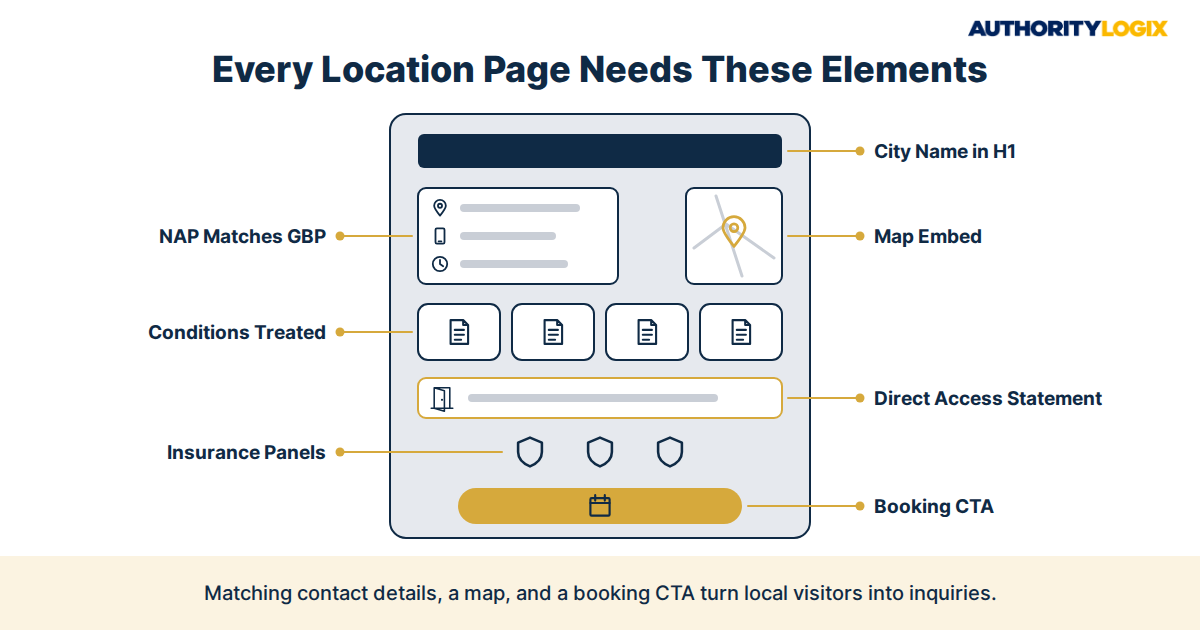
An effective PT location page is not a directory listing — it is a locally optimized landing page that combines geographic specificity with clinical credibility. It must include: the city name in the H1 and title tag, the full practice NAP matching the GBP exactly, a Google Maps embed, and the primary conditions treated with location-specific language.
The page should also include the direct access statement, accepted insurance panels, and a prominent booking CTA. The PT Authority Gap Assessment → assessment evaluates the GBP-linked page against these standards and benchmarks it against local competitor location pages.
For multi-location PT practices, a separate location page for each clinic — each with unique local content, the specific clinic’s NAP, and neighborhood-specific condition references — is the foundation of a local SEO strategy that avoids location cannibalisation. Each location page should target the specific neighborhood and surrounding area the clinic serves, not the same city-level terms as every other location. The local search system includes the location page architecture framework for both single and multi-location PT practices. For a deeper treatment of this topic, see the GBP optimization guide.
Not sure how your website’s local SEO stacks up against competitors?
On-Page Local SEO Signals: The 15% Ranking Weight PT Websites Underinvest In
On-page signals — NAP on the website, local keywords in title tags and headings, domain authority, page speed, and mobile performance — account for 15% of local pack ranking weight per Whitespark’s 2026 data. For AI search visibility specifically, on-page signals rise to 24% — the top-weighted factor category, above GBP signals. This means that practices building for both traditional local search and AI citation eligibility need strong on-page optimization as the foundation, not an afterthought.
Keyword Placement in Title Tags and H1s
Every condition page and location page on the PT practice website needs the primary keyword in the title tag (in the first half, under 60 characters) and in the H1 heading. For a condition + location page: “Physical Therapy for Lower Back Pain — Brooklyn, NY” as the title tag, and “Physical Therapy for Lower Back Pain in Brooklyn” as the H1.
The primary keyword should also appear in the first sentence of the page, in at least one H2 subheading, and in the image ALT text. This consistent keyword placement sends an unambiguous relevance signal that Google uses to match the page against the target query. To diagnose this issue in your own practice, use the authority gap assessment.
NAP on the website should match the GBP exactly — same business name format, same address format including suite numbers and abbreviations, same phone number format. The website’s contact page and footer should both include the full NAP. Inconsistency between the website NAP and the GBP NAP creates a citation signal conflict that suppresses local ranking independently of any other optimization. The acquisition playbook covers how on-page NAP consistency integrates with the broader citation management system.
LocalBusiness Schema Markup
LocalBusiness schema markup — JSON-LD structured data that tells Google the practice’s NAP, service area, hours, specialties, and accepted insurance — is still missing from many US medical practice websites. The practices that deploy it correctly gain a technical signal advantage that most local competitors have not captured.
Businesses with large review counts are far more likely to appear in the Local Pack than those with only a handful — and schema markup is among the on-page signals that reinforce Google’s confidence in the listing’s accuracy. The practices that deploy it correctly gain a technical signal advantage that most local competitors have not captured. Schema markup does not directly increase rankings — it gives Google a structured, machine-readable confirmation of the information it is already trying to parse from the page, improving confidence in the listing’s accuracy. For a deeper treatment of this topic, see the acquisition playbook.
For a PT practice, the relevant schema types are LocalBusiness (with subtypes MedicalClinic and Physician), combined with Service schema for each condition treated and MedicalSpecialty for specialty certifications. This structured data stack gives Google the clearest possible signal about what the practice is, where it is, what it treats, and who treats it. The education guide covers how schema markup integrates with E-E-A-T signals for healthcare content — with the clinician bio page as the primary schema anchor.

FAQ: Local SEO for Physical Therapists
How many condition pages does a PT website need for effective local SEO?
The minimum effective foundation is one condition page for each of the top three conditions the practice treats most frequently — three to five pages to start. Each page targets a specific condition + location keyword combination, covers the condition from the patient’s perspective, and attributes the content to a named clinician. This foundation generates the first measurable organic traffic from condition-specific local searches within 3 to 6 months. The authority gap assessment identifies which condition pages exist in local competitors’ sites and which gaps in the practice’s coverage represent the highest-traffic opportunities.
Does the website URL that the GBP links to affect local ranking?
Yes — and significantly. Whitespark’s 2026 survey ranks signals on the GBP landing page, such as keywords in its title tag, among the top local pack factors. The page the GBP links to should be the practice’s most locally optimized page — the location page that includes the city NAP, neighborhood references, and condition-specific content. Linking to a generic homepage is the default setting; changing it to the location page is a targeted local ranking improvement that most PT practices have not made. The local search system includes the location page build and GBP link update as part of the initial local SEO foundation setup.
How long does it take for on-page local SEO changes to affect rankings?
Technical changes — schema markup deployment, NAP correction, title tag updates — typically produce ranking signals within 30 to 60 days as Google recrawls the updated pages. New condition pages begin generating organic impressions within 30 to 90 days and develop meaningful click volume over 3 to 6 months for mid-competition long-tail condition + location queries. Location page improvements that affect the GBP-linked URL produce local pack ranking movement over 60 to 90 days. The content playbook covers Google Search Console monitoring for tracking which queries produce impressions before ranking positions develop. For the full specialty framework, visit the PT resources hub.
Should a PT practice focus on local SEO or GBP optimization first?
GBP first — it accounts for 32% of local pack ranking weight versus 15% for on-page signals, and GBP optimization produces measurable results within 30 to 60 days while organic condition page rankings develop over 3 to 6 months. Complete GBP optimization, NAP correction, and review generation before investing heavily in condition page production.
Once the GBP foundation is active, begin condition page production in parallel — the two systems reinforce each other as organic traffic from condition pages increases the behavioral signals that support GBP ranking. Practices that run GBP and organic content at the same time generally reach competitive local visibility faster than those that sequence one before the other.

Building the Organic Local Visibility That Compounds Alongside GBP
Local SEO for physical therapists is not a separate system from GBP optimization — it is the organic layer that works alongside GBP to capture the full spectrum of local patient demand. A practice that completes GBP optimization and then builds out condition pages, a location page, and schema markup has covered all the controllable local ranking signals with the highest ranking weights. For the related AuthorityLogix implementation framework, see lead generation systems.
The compounding returns come from each new condition page adding a new search entry point, each new review strengthening the review signal, and each organic traffic session reinforcing the behavioral signals that support the overall local ranking position. None of these gains disappear the way paid traffic does the moment a campaign budget runs out.
The Insight Articles in the Local Search and Visibility library go deeper on every dimension — from GBP optimization and review generation to NAP citation management, schema markup implementation, and AI search visibility. The PT resources hub organizes the full library so practice owners can navigate directly to the specific local visibility challenge they are solving today. The lead generation systems service manages the full local SEO and GBP visibility program for PT practices. Practices building long-term visibility can reference the growth blueprint for a comprehensive growth framework. The PT industry hub demonstrates how the five-system framework — content, local search, patient education, lead generation, and authority distribution — connects local SEO to the rest of the practice’s growth system.
Ready to rank for the high-intent local searches that turn into new patients?